Paras Steel Industries logoPARAS STEEL
INDUSTRIES

Knowledge centre

Precast mould guides, ideas and manufacturing insights.

Practical articles to help you choose, operate and maintain precast concrete moulds and machinery.

Precast U Drain Manufacturing Process: A Step-by-Step Guide

Precast Mould Guide

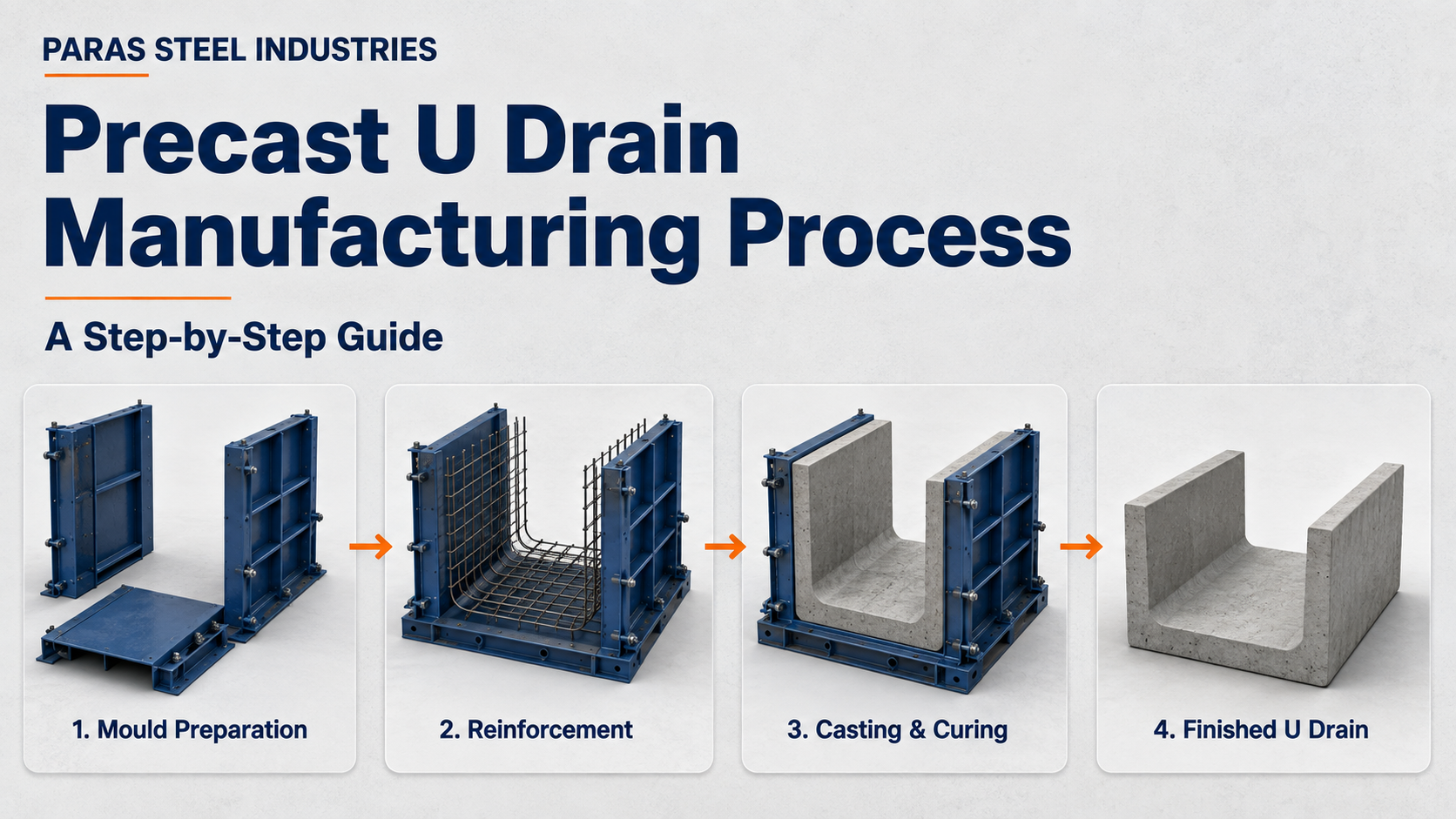
Precast U Drain Manufacturing Process: A Step-by-Step Guide

The precast U drain manufacturing process involves mould preparation, reinforcement checks, concrete placement, curing and inspection. This guide explains each stage and the production details that manufacturers should control when producing concrete drainage channels.

Read article
Steel U Drain Mould: Key Features to Check Before Buying

Precast Mould Guide

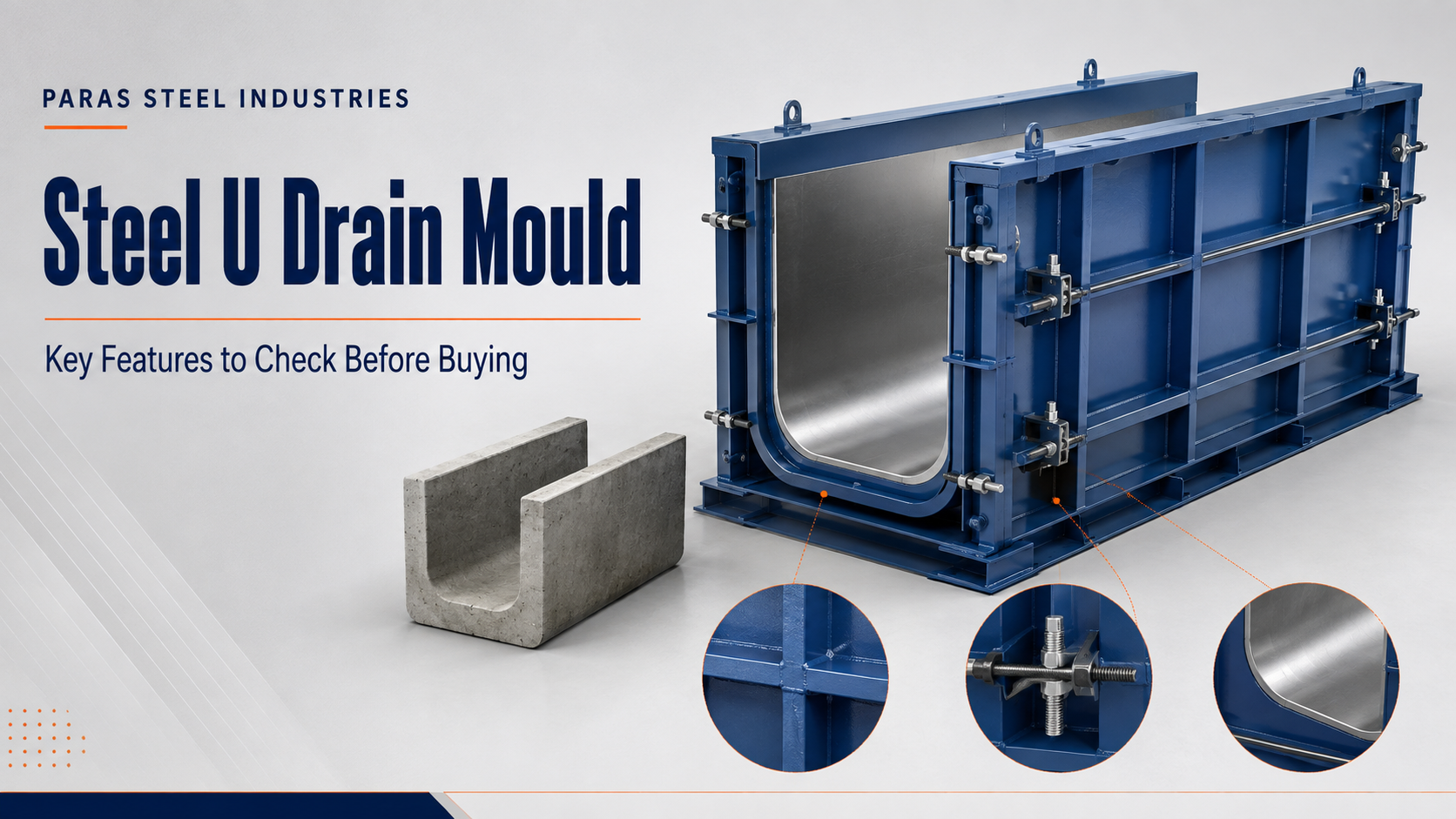
Steel U Drain Mould: Key Features to Check Before Buying

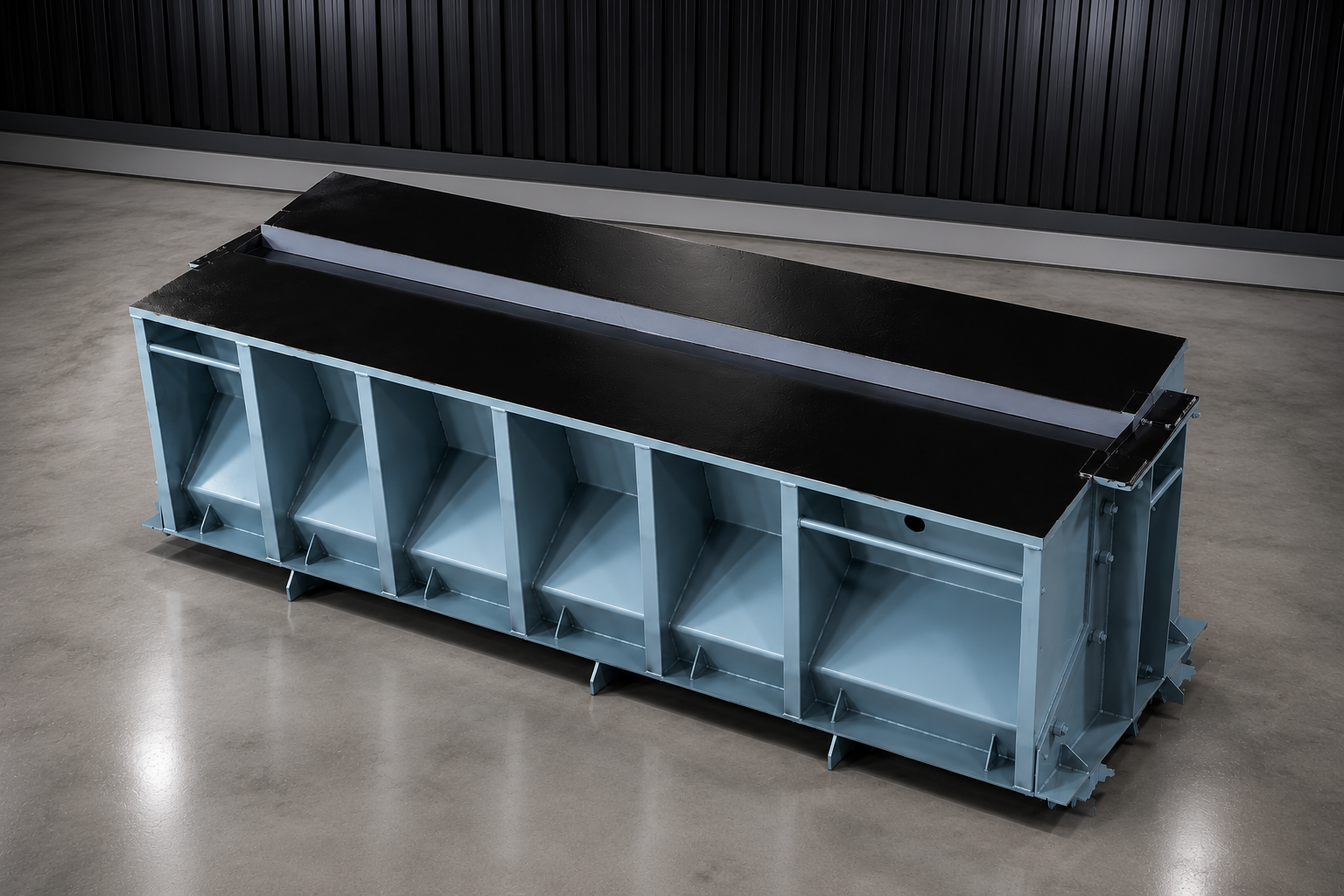
A steel U drain mould should match your finished drain drawing and fit your factory’s production process. Learn which construction details, operating features and inspection requirements to review before purchasing equipment for precast concrete drainage channels.

Read article
U Drain Mould Sizes and Specifications: A Buyer’s Guide

Precast Mould Guide

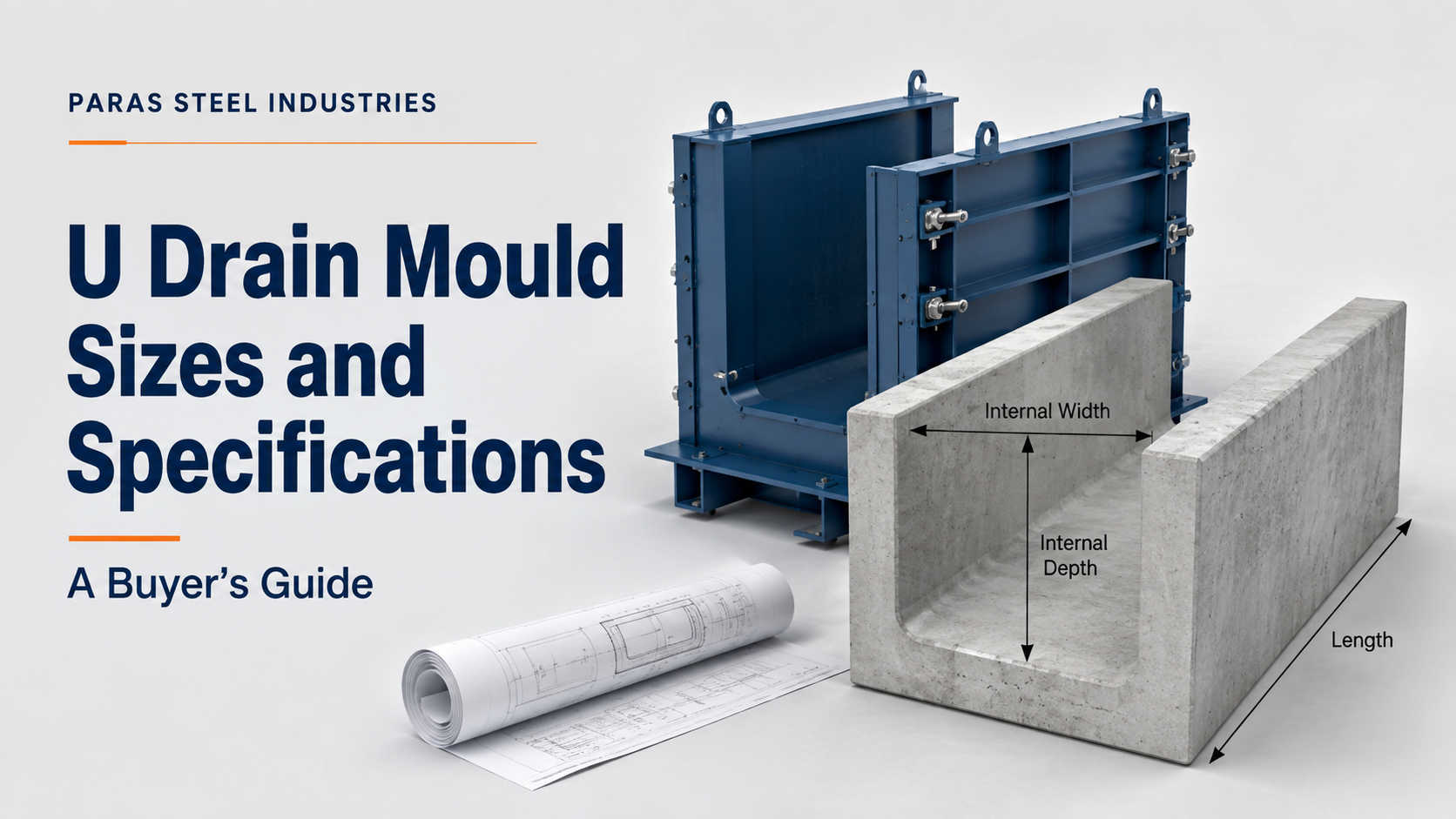
U Drain Mould Sizes and Specifications: A Buyer’s Guide

Choosing the correct U drain mould starts with clearly defined dimensions and an approved drain drawing. This buyer’s guide explains internal and external measurements, wall thickness, joint details and production requirements to help you prepare an accurate mould enquiry.

Read article
U Drain Mould Price in India: Factors That Affect Cost

Precast Mould Guide

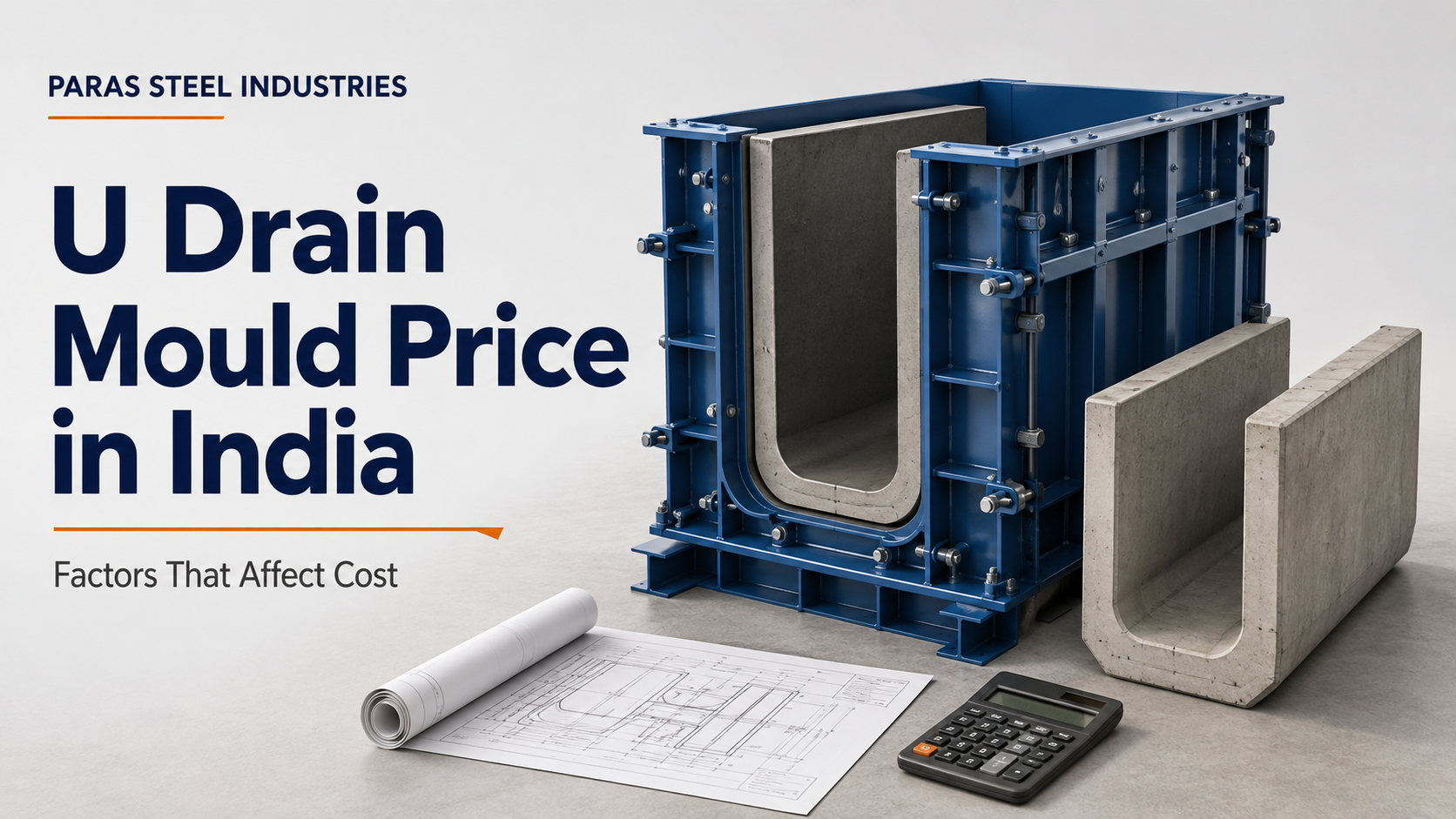
U Drain Mould Price in India: Factors That Affect Cost

U drain mould prices depend on the equipment specification and the scope of supply. Understand how dimensions, fabrication requirements, opening arrangements and delivery terms affect quotations, so you can compare suppliers and plan your purchase with greater clarity.

Read article
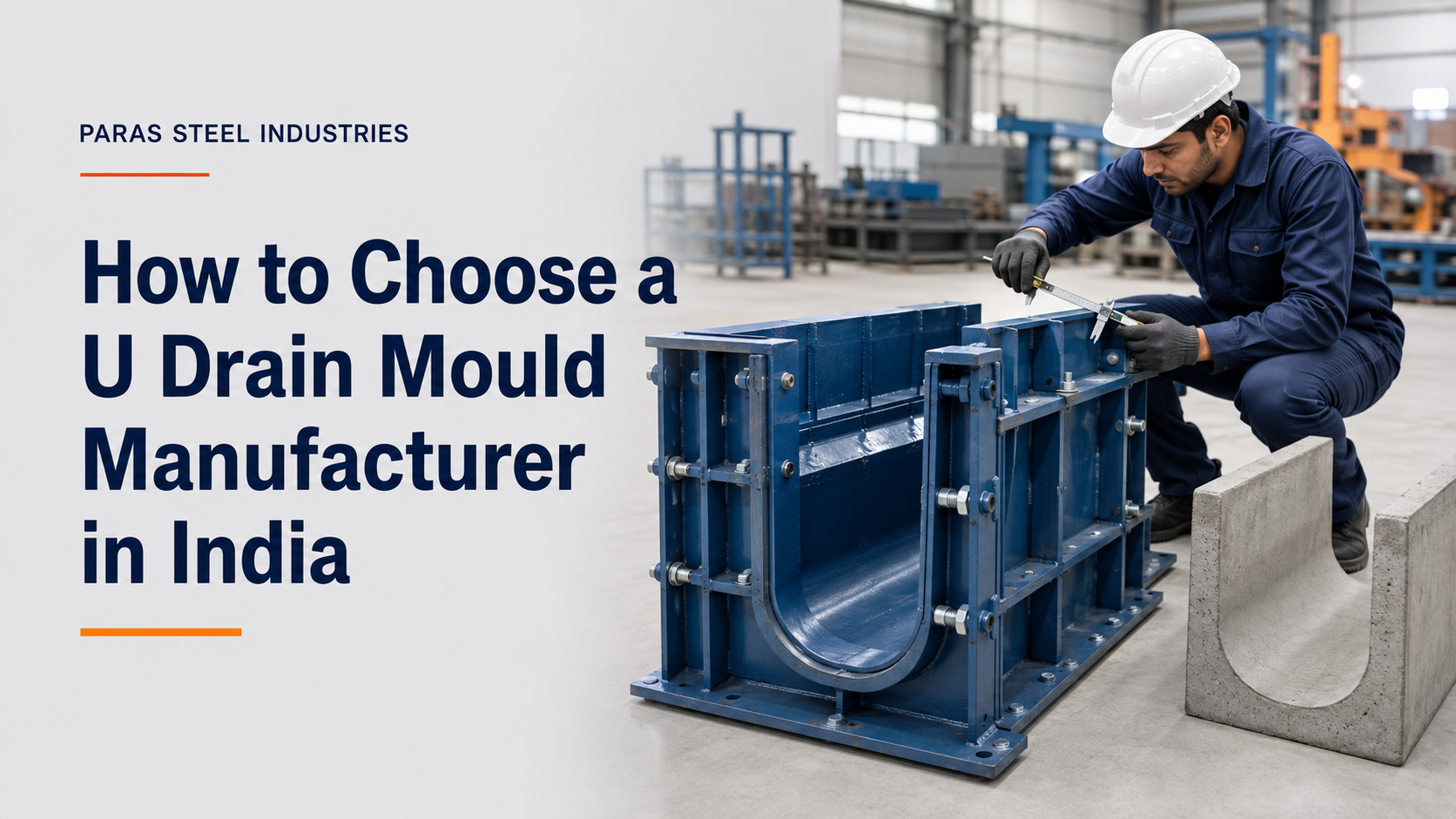
How to Choose a U Drain Mould Manufacturer in India

Precast Mould Guide

How to Choose a U Drain Mould Manufacturer in India

Choosing the right U drain mould manufacturer starts with a clear product drawing and a practical understanding of your production requirements. This guide explains what to check when comparing suppliers, reviewing quotations and ordering a mould for precast concrete drainage channels.

Read article
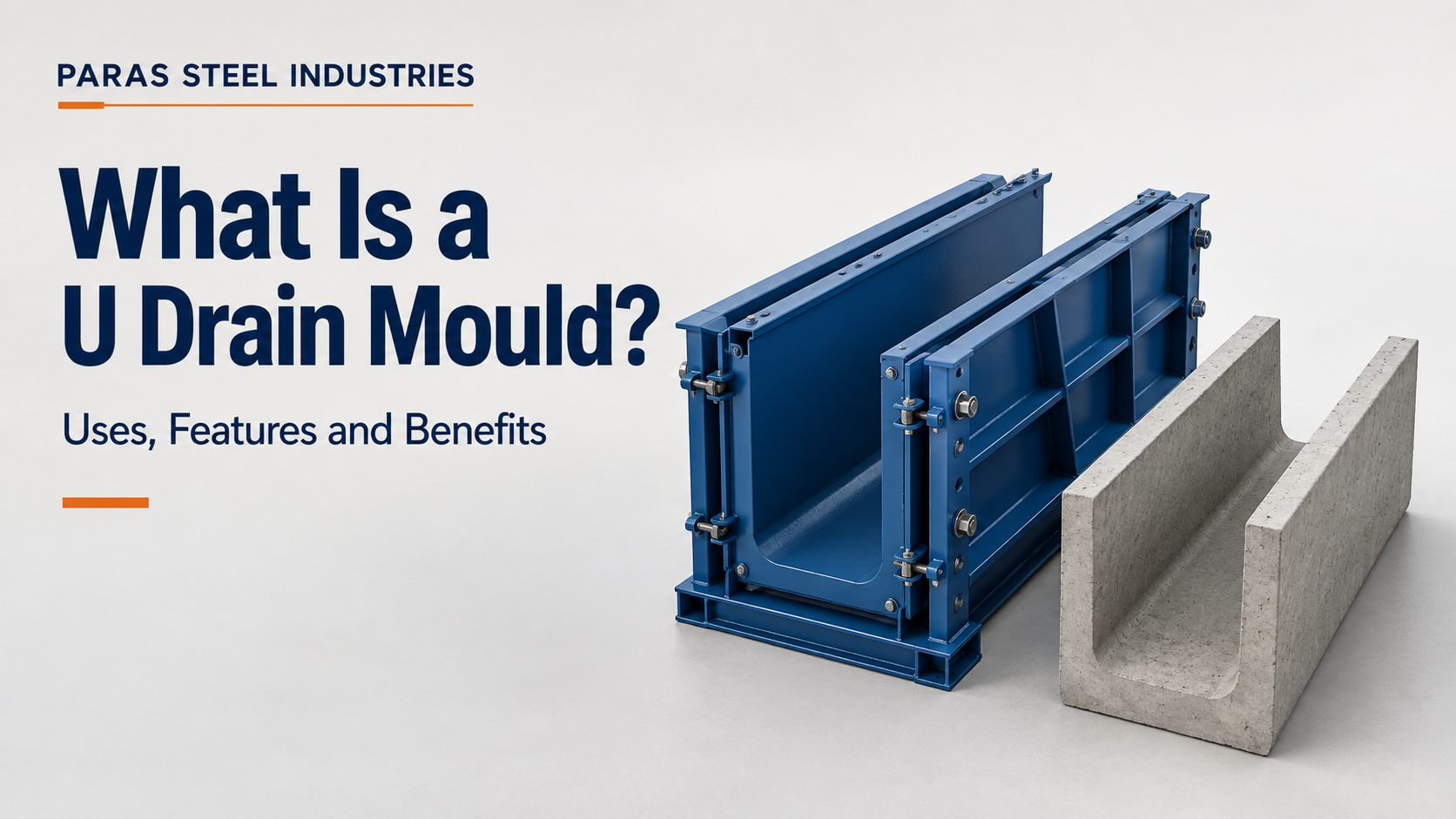
What Is a U Drain Mould? Uses, Features and Benefits

Precast Mould Guide

What Is a U Drain Mould? Uses, Features and Benefits

A U drain mould is used to manufacture U-shaped precast concrete drainage channels. Explore how these moulds work, where the finished drains are used, and which features matter when selecting equipment for your precast production setup.

Read article
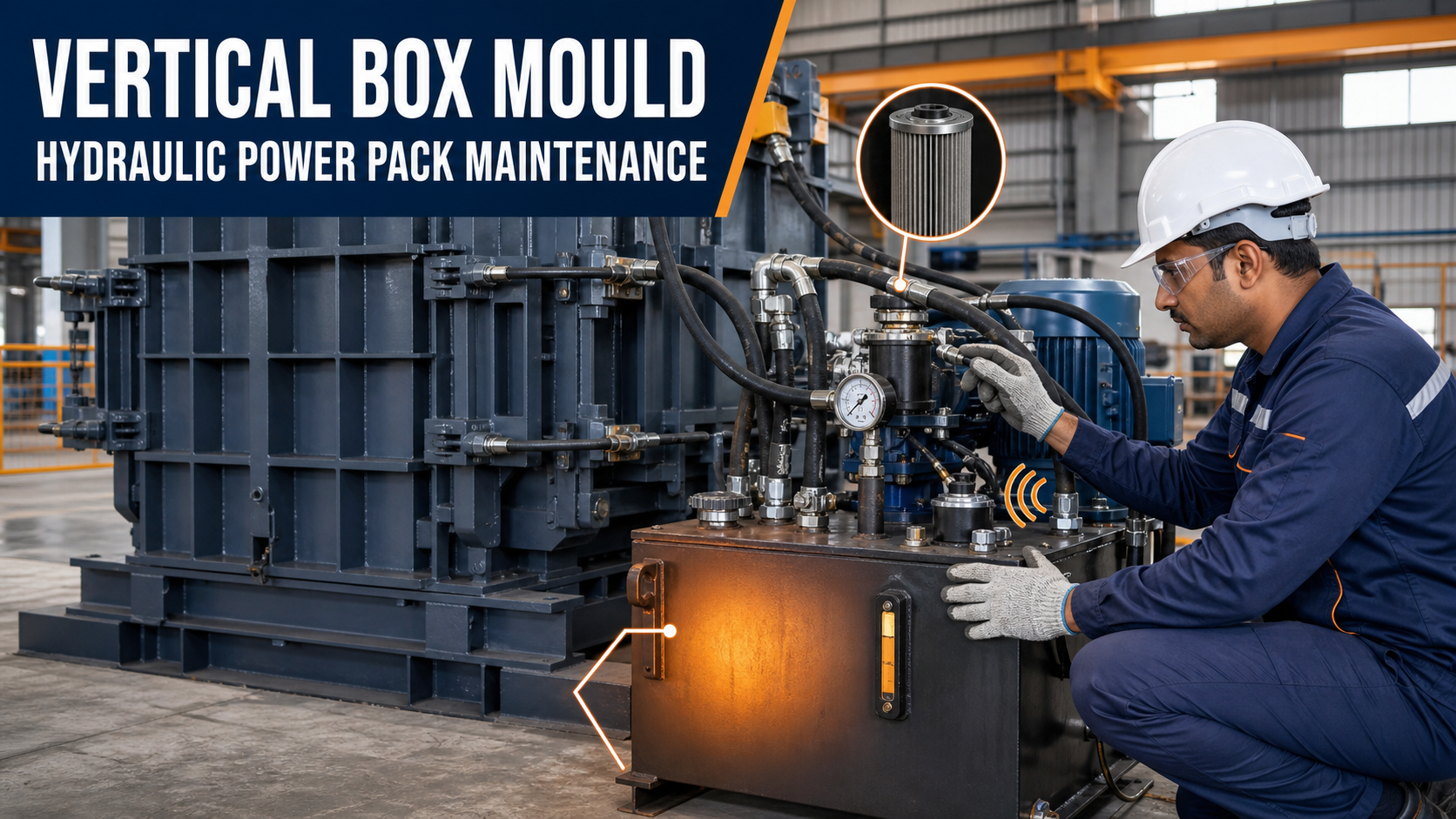
Vertical Box Mould Hydraulic Power Pack Maintenance: Oil Heating, Filter Blockage and Pump Noise

Precast Mould Guide

Vertical Box Mould Hydraulic Power Pack Maintenance: Oil Heating, Filter Blockage and Pump Noise

A hydraulic power pack controls the opening and closing of a heavy-duty iron vertical box mould. Regular inspection of hydraulic oil, filters, pumps, hoses and pressure settings helps prevent uneven shutter movement, production delays and expensive component damage.

Read article
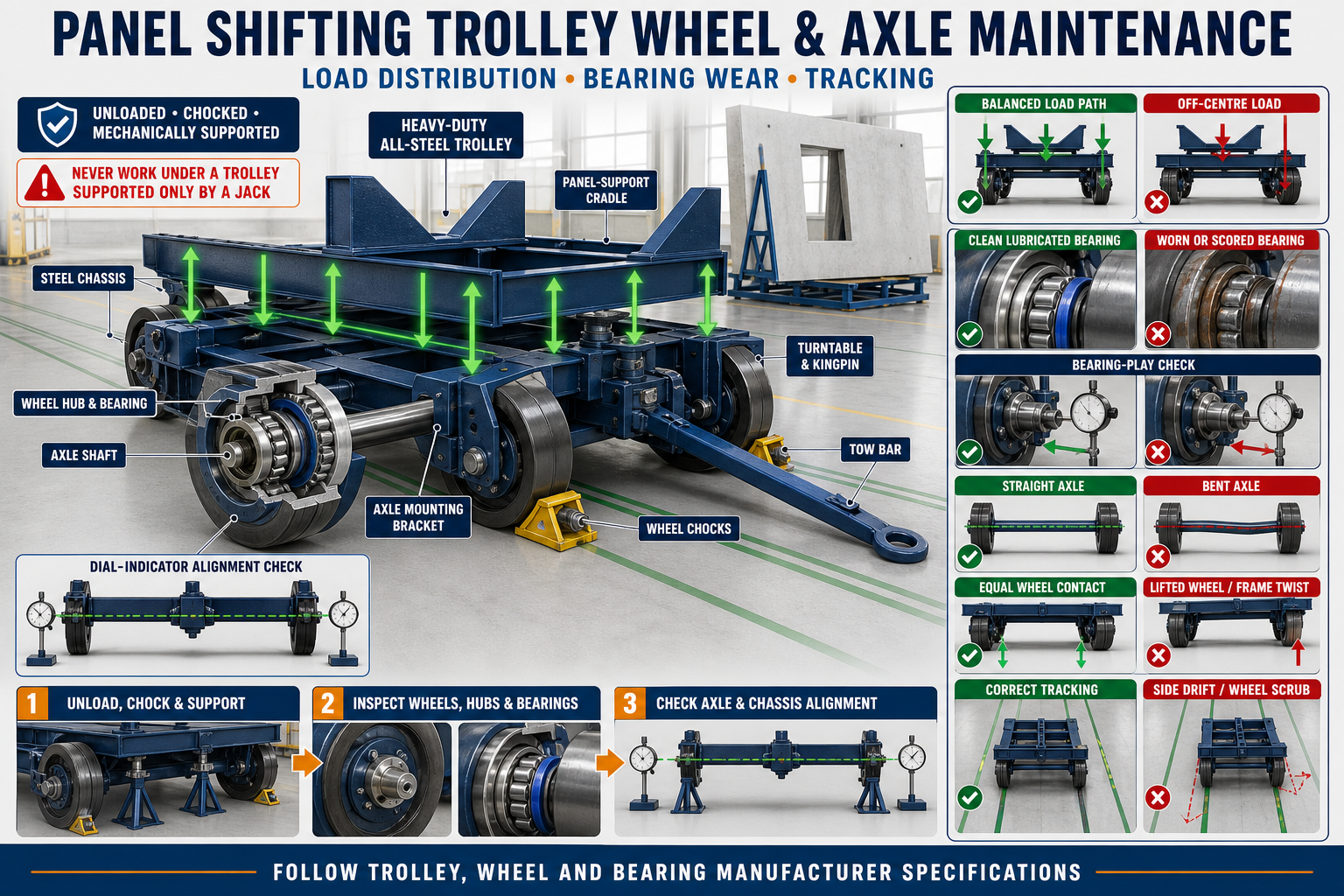
Panel Shifting Trolley Wheel and Axle Maintenance: Load Distribution, Bearing Wear and Tracking

Precast Machinery Guide

Panel Shifting Trolley Wheel and Axle Maintenance: Load Distribution, Bearing Wear and Tracking

The wheels, bearings and axles of a panel shifting trolley carry heavy precast products across the plant. Uneven loading, worn bearings or incorrect wheel alignment can cause difficult movement, tyre wear and poor tracking. This guide explains safe inspection, lubrication and maintenance of an all-steel trolley system.

Read article
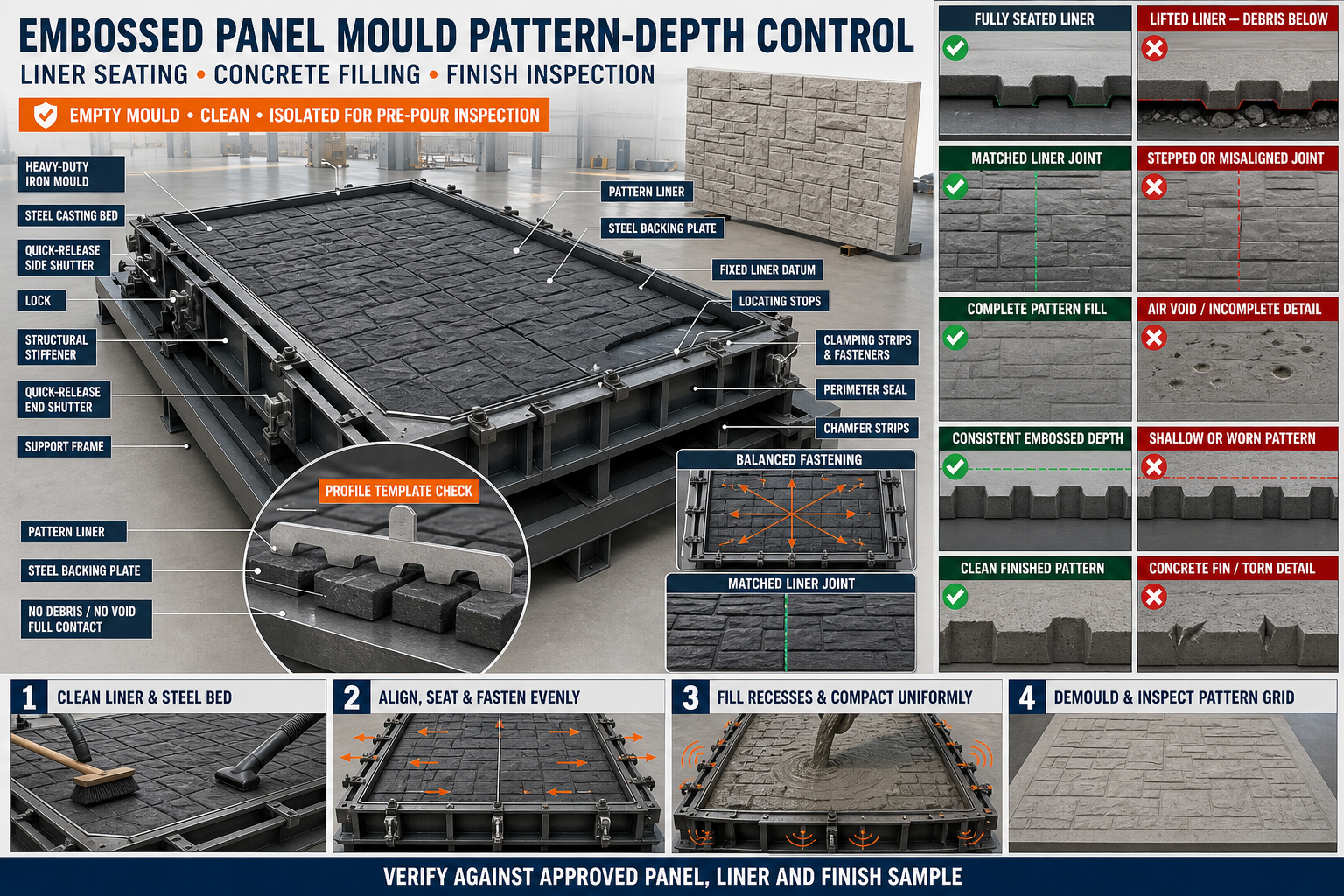
Embossed Panel Mould Pattern Depth Control: Liner Seating, Concrete Filling and Finish Inspection

Precast Wall Solutions

Embossed Panel Mould Pattern Depth Control: Liner Seating, Concrete Filling and Finish Inspection

The pattern depth of an embossed precast wall panel depends on accurate liner seating and complete concrete filling inside every recess. A lifted, distorted or dirty liner can create shallow patterns, visible steps and surface defects. This guide explains liner inspection, fastening, compaction and finish control in heavy-duty iron panel moulds.

Read article
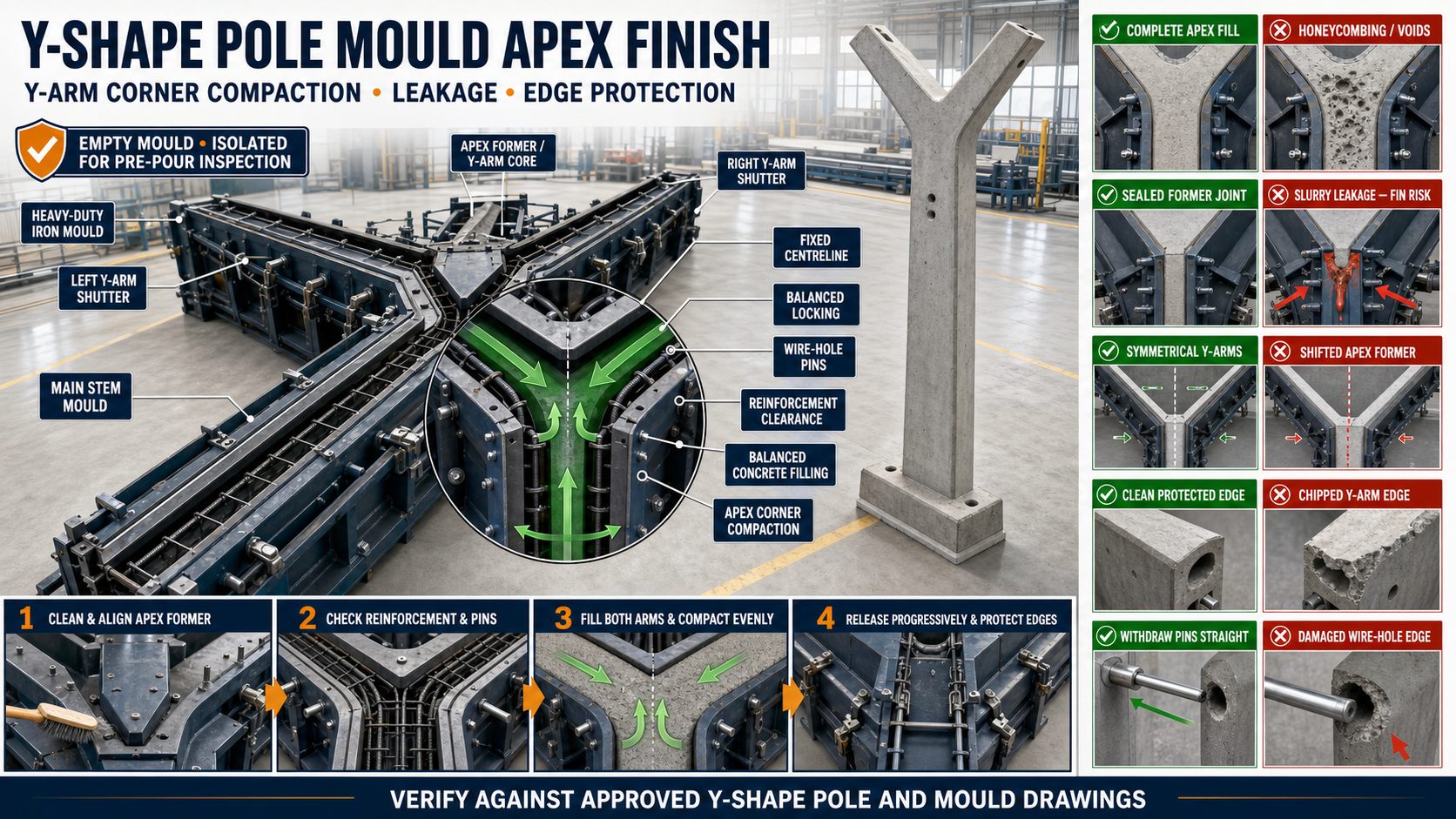
Y-Shape Pole Mould Apex Finish: Y-Arm Corner Compaction, Leakage and Edge Protection

Precast Pole Mould Guide

Y-Shape Pole Mould Apex Finish: Y-Arm Corner Compaction, Leakage and Edge Protection

The apex and two Y-arm corners are among the most difficult areas to cast in a precast Y-shape security pole. Congested reinforcement, poor concrete flow or mould-joint leakage can cause voids, fins and broken edges. This guide explains mould preparation, compaction, sealing and demoulding for a heavy-duty iron Y-pole mould.

Read article
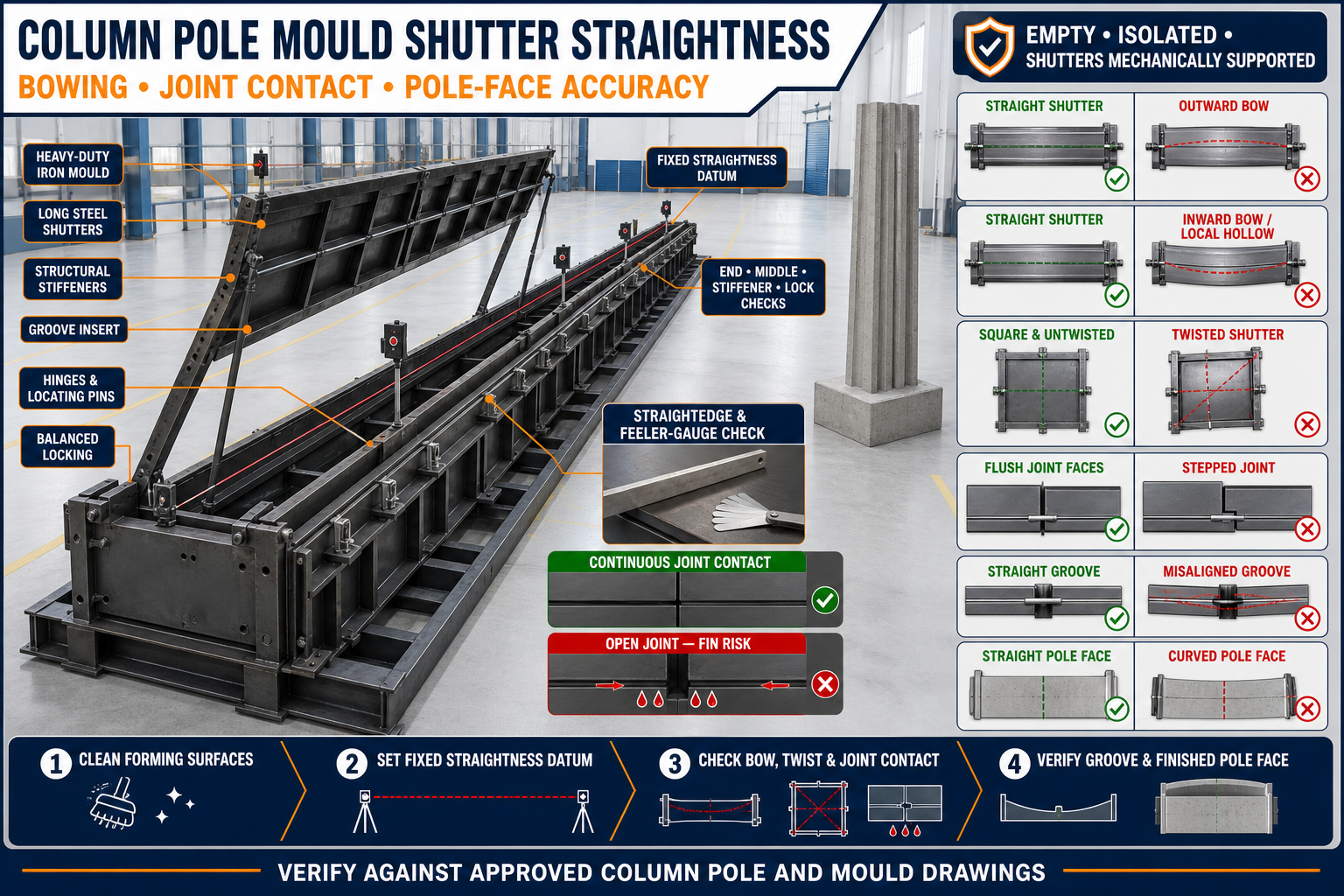
Column Pole Mould Shutter Straightness: Bowing, Joint Contact and Pole-Face Accuracy

Precast Pole Mould Guide

Column Pole Mould Shutter Straightness: Bowing, Joint Contact and Pole-Face Accuracy

Straight shutters are essential for producing precast column poles with uniform faces, consistent cross-sections and properly aligned grooves. Bowed plates, damaged stiffeners or uneven joint contact can distort the finished pole. This guide explains straightness measurement, joint inspection and maintenance of heavy-duty iron column pole moulds.

Read article
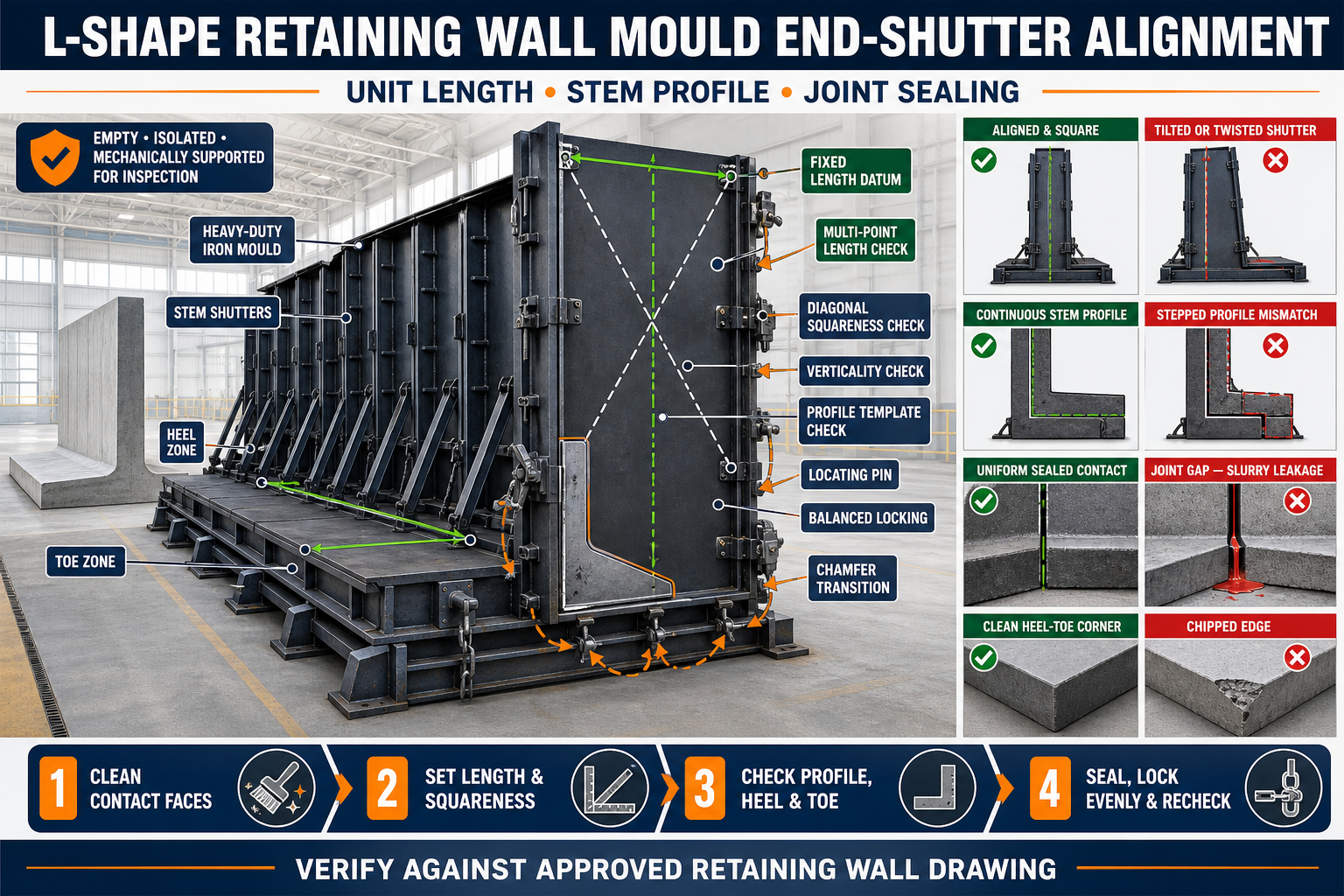
L-Shape Retaining Wall Mould End-Shutter Alignment: Unit Length, Stem Profile and Joint Sealing

Precast Infrastructure Moulds

L-Shape Retaining Wall Mould End-Shutter Alignment: Unit Length, Stem Profile and Joint Sealing

The end shutters of an L-shape retaining wall mould control the finished unit length and close the heel, toe and stem profiles. Incorrect alignment, dirty contact faces or uneven locking can create dimensional variation, slurry leakage and damaged concrete edges. This guide explains end-shutter setup, sealing and inspection.

Read article
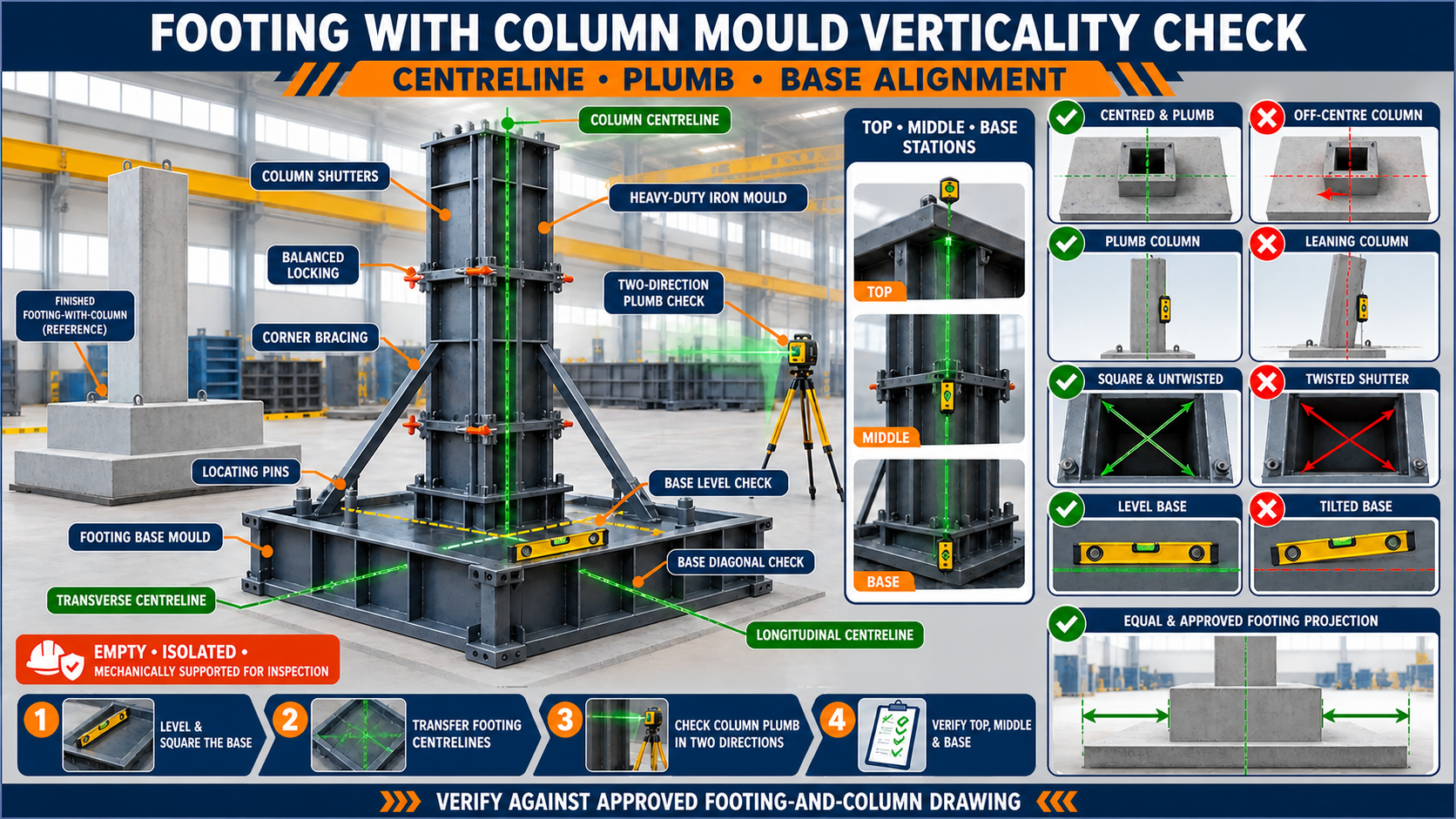
Footing With Column Mould Verticality Check: Centreline, Plumb and Base Alignment Guide

Precast Infrastructure Moulds

Footing With Column Mould Verticality Check: Centreline, Plumb and Base Alignment Guide

A footing-with-column mould produces the foundation base and column in a single concrete pour. If the column shutter is tilted, twisted or off-centre from the footing, the finished unit may create installation and load-alignment problems. This guide explains centreline transfer, plumb checking and base alignment for heavy-duty iron moulds.

Read article
Precast Bridge Girder Mould Soffit Camber: Datum Setup, Profile Checking and Adjustment Guide

Precast Infrastructure Moulds

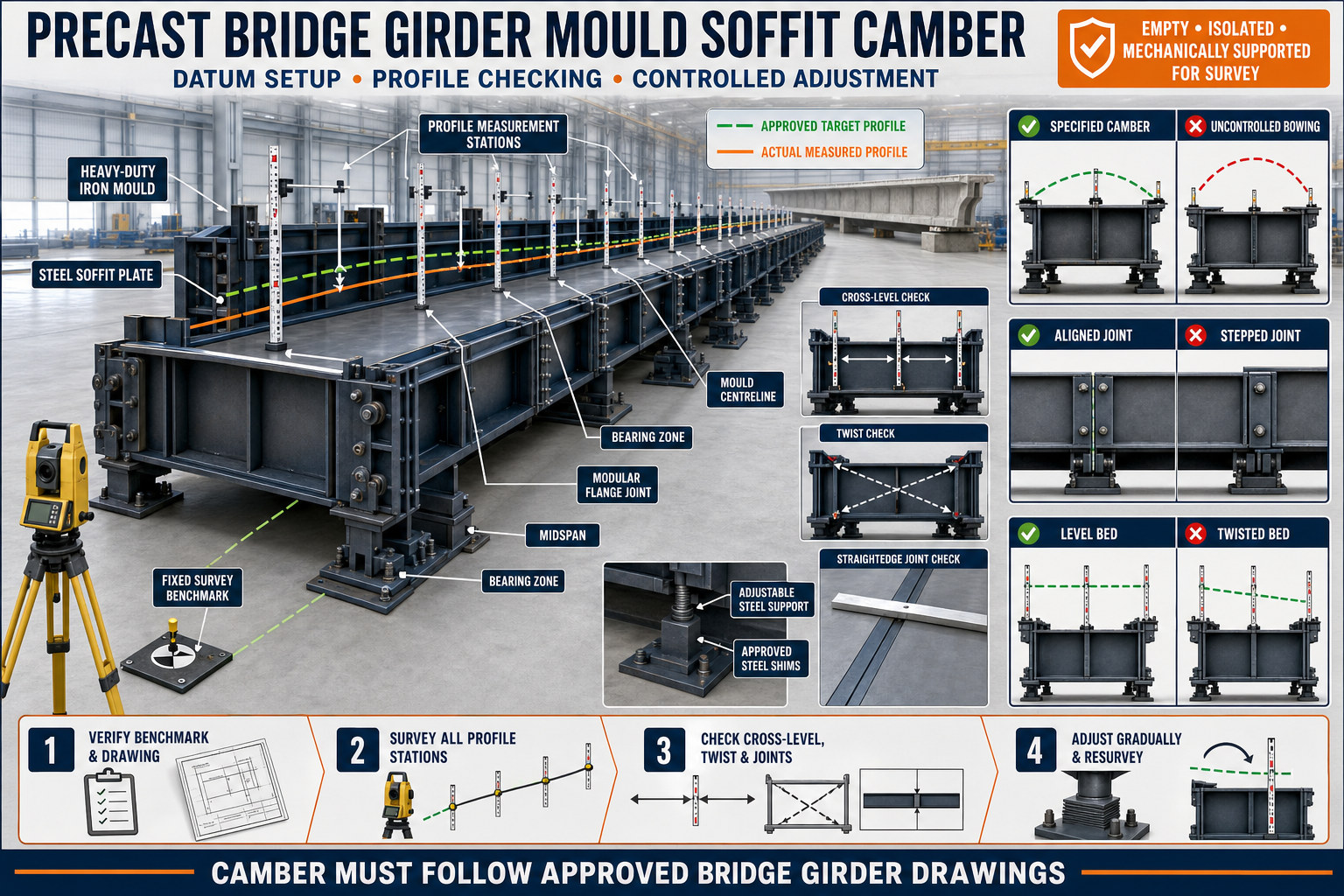
Precast Bridge Girder Mould Soffit Camber: Datum Setup, Profile Checking and Adjustment Guide

The soffit profile of a precast bridge girder is formed by the mould bed. Incorrect datum levels, support settlement or uneven adjustment can change the specified camber and girder geometry. This guide explains survey setup, profile checking and controlled alignment of a heavy-duty iron bridge girder mould.

Read article
Box Culvert Mould Inner-to-Outer Shutter Spacing: Wall Thickness and Core-Shift Inspection

Precast Mould Guide

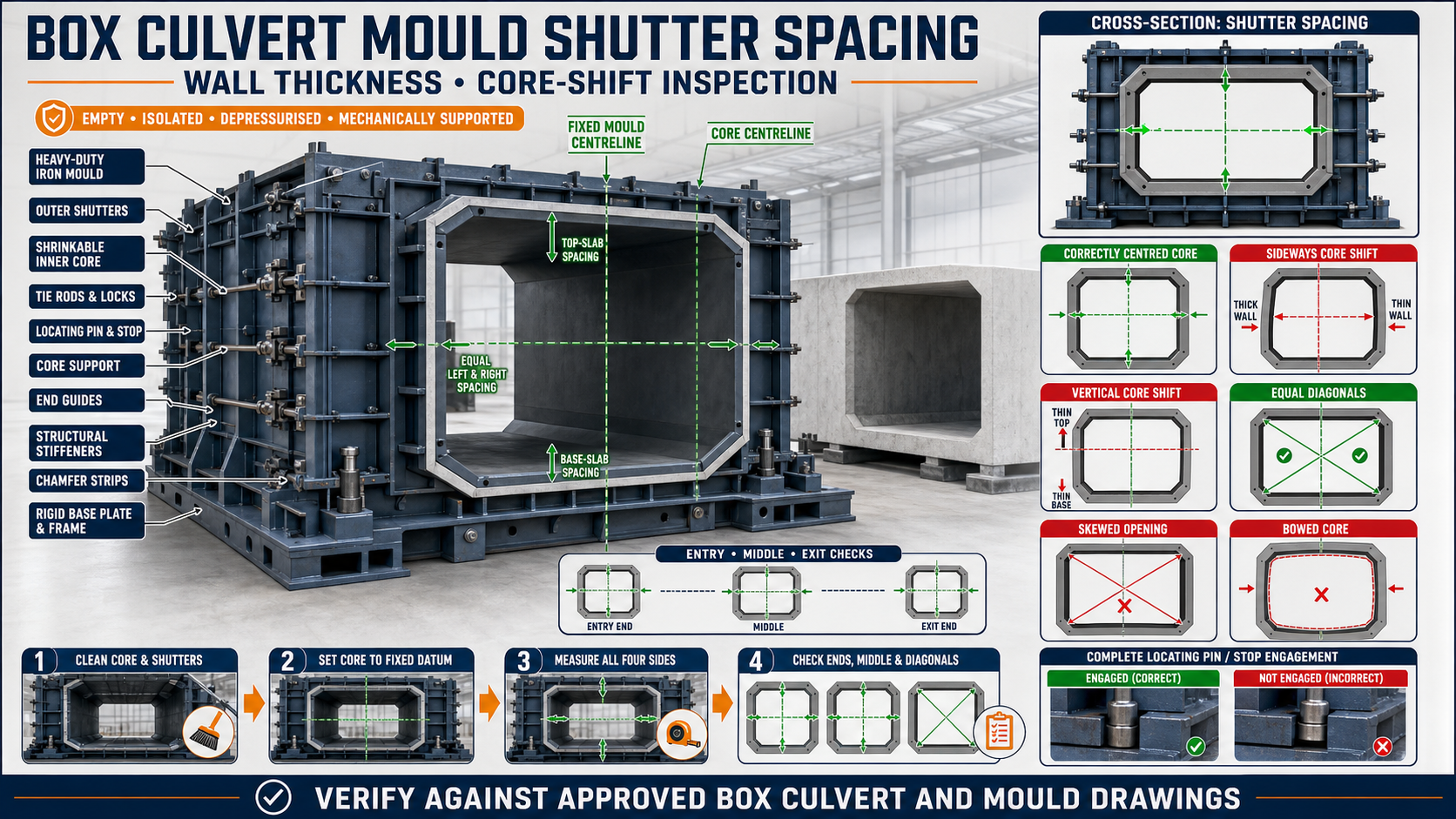
Box Culvert Mould Inner-to-Outer Shutter Spacing: Wall Thickness and Core-Shift Inspection

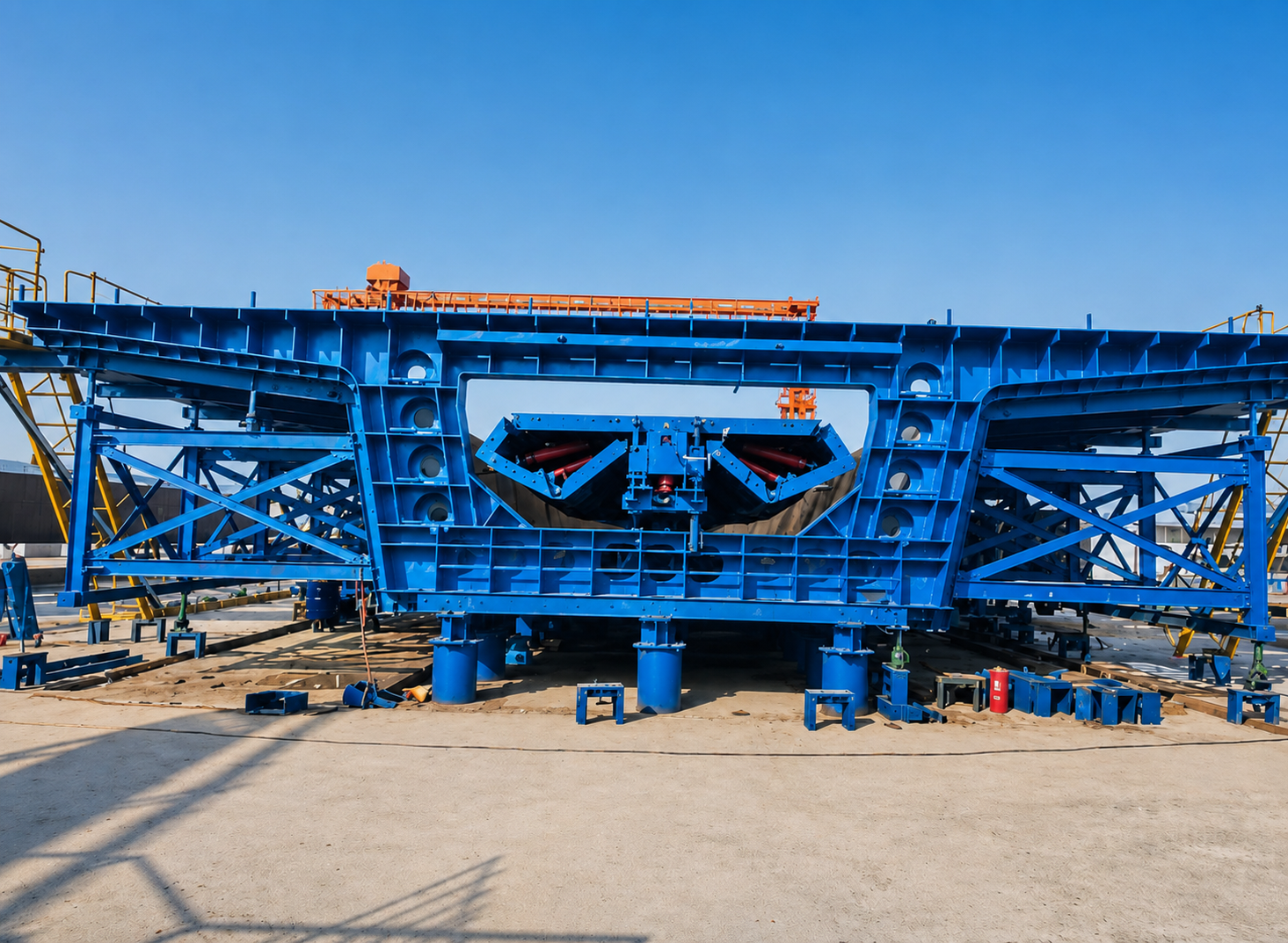
The spacing between a box culvert mould’s inner core and outer shutters determines the concrete wall and slab thickness. A shifted, tilted or bowed core can produce unequal walls, incorrect reinforcement cover and difficult demoulding. This guide explains spacing measurements, core-shift diagnosis and pre-pour alignment checks.

Read article
U Drain Mould Inner-Core Centring: Equal Wall Thickness, Taper and Clearance Checks

Precast Mould Guide

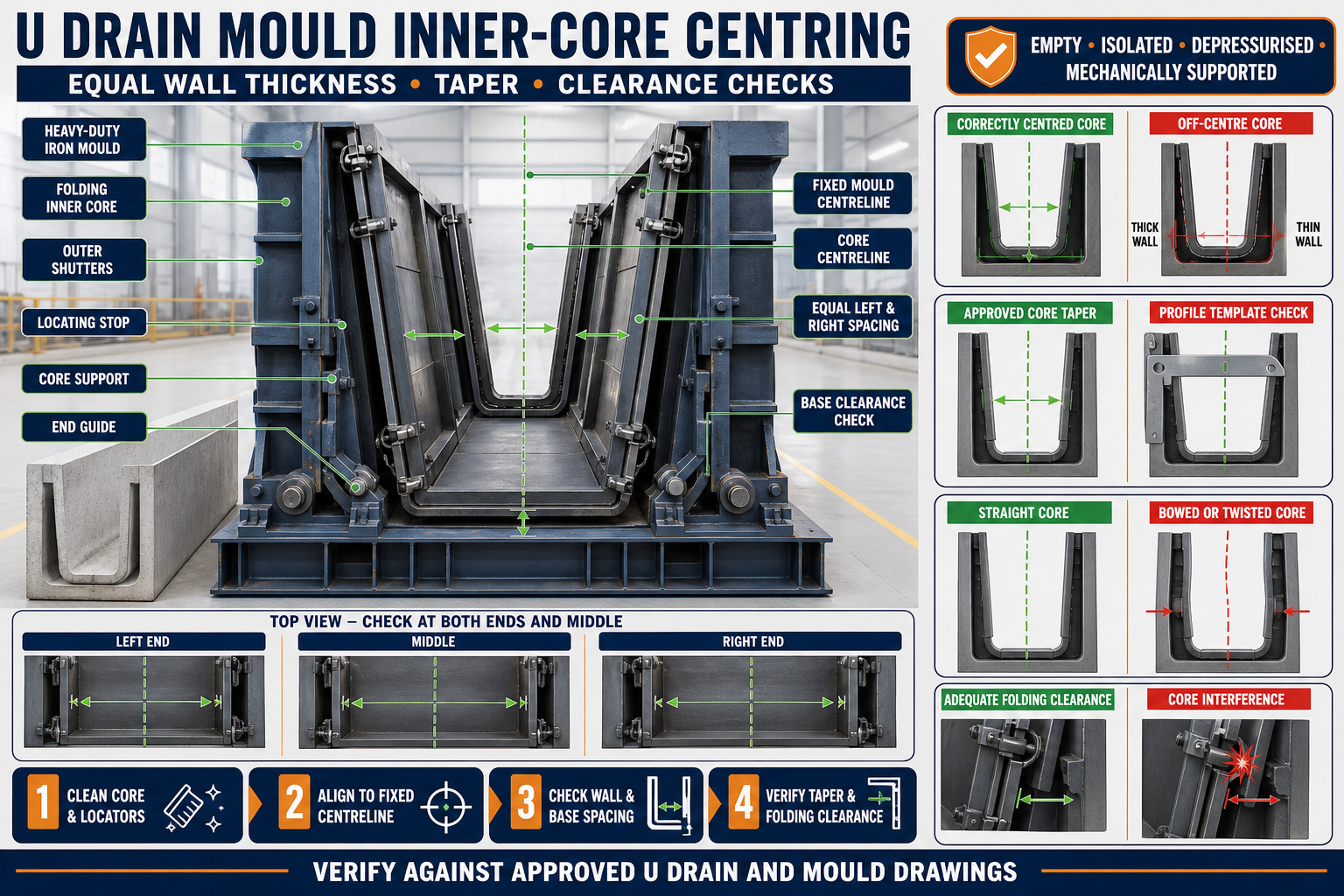
U Drain Mould Inner-Core Centring: Equal Wall Thickness, Taper and Clearance Checks

The inner core forms the internal channel of a precast U Drain. If it is off-centre, tilted or incorrectly locked, the two walls may have different thicknesses and the drain can become difficult to install or demould. This guide explains core centring, taper, clearance and pre-pour checks for heavy-duty iron U Drain moulds.

Read article
Concrete Mixer Discharge Gate Leakage: Seal Wear, Closing Alignment and Slurry Buildup Guide

Precast Machinery Guide

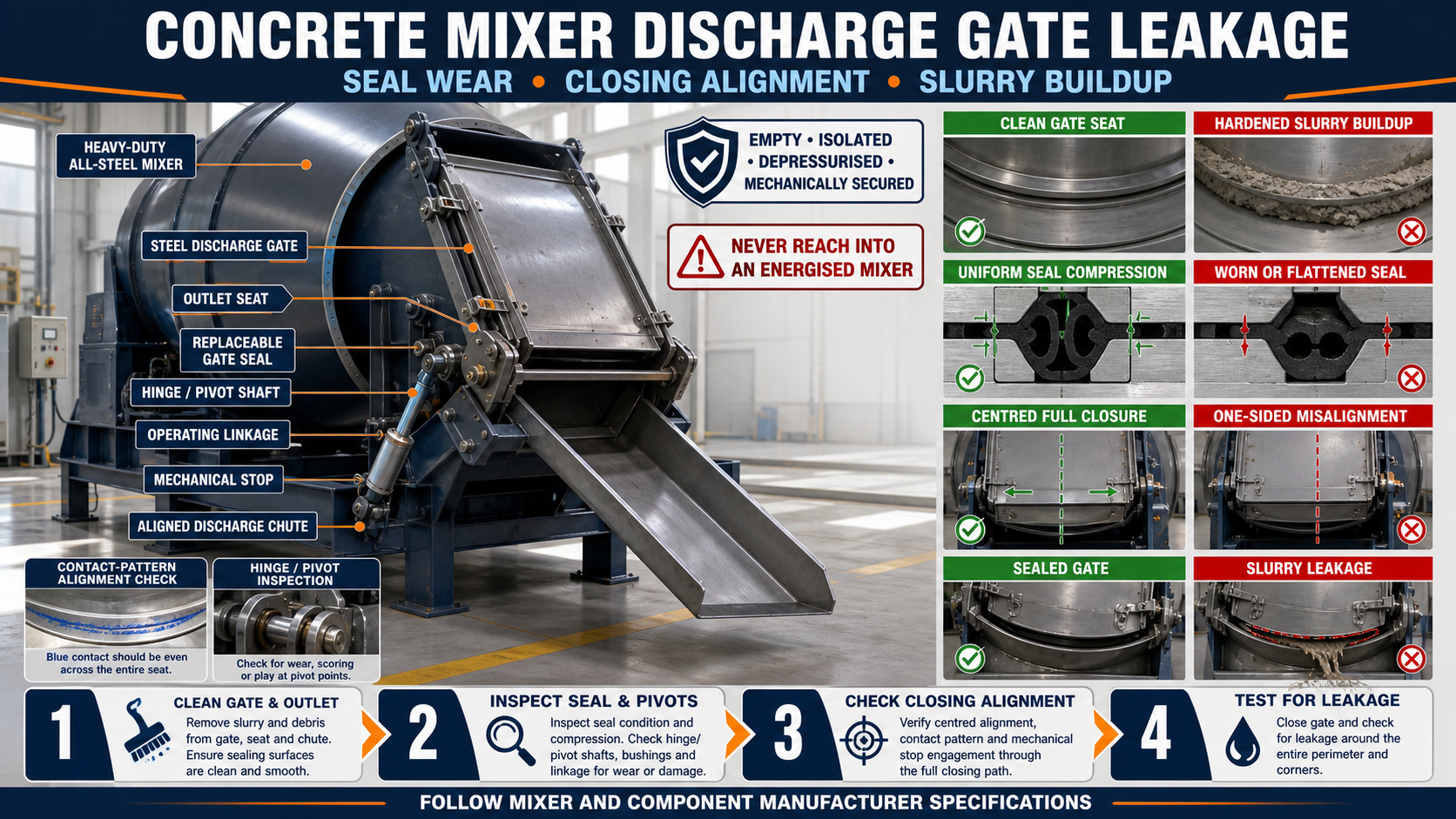
Concrete Mixer Discharge Gate Leakage: Seal Wear, Closing Alignment and Slurry Buildup Guide

A leaking concrete mixer discharge gate can waste cement slurry, contaminate the plant floor and produce inconsistent batches. Common causes include hardened buildup, worn seals, distorted gate plates and incorrect closing alignment. This guide explains safe inspection, cleaning, adjustment and maintenance of an all-steel mixer discharge system.

Read article
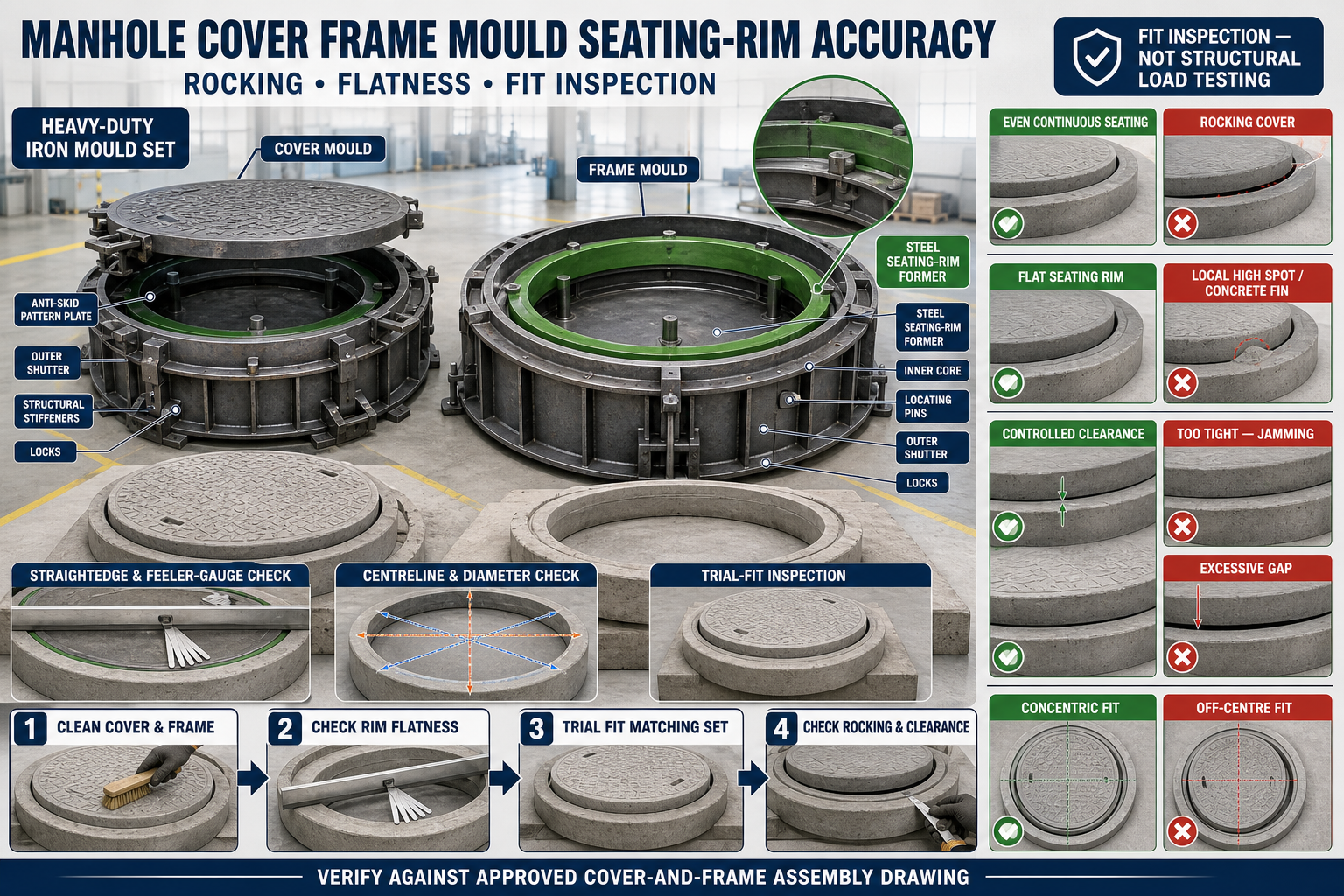
Manhole Cover Frame Mould Seating-Rim Accuracy: Rocking, Flatness and Fit Inspection Guide

Precast Infrastructure Moulds

Manhole Cover Frame Mould Seating-Rim Accuracy: Rocking, Flatness and Fit Inspection Guide

The seating rim determines how evenly a precast manhole cover rests inside its matching frame. Mould distortion, concrete fins or uneven contact surfaces can cause rocking, noise and poor fit. This guide explains seating-rim alignment, flatness checks and cover-to-frame inspection for heavy-duty iron manhole cover mould sets.

Read article
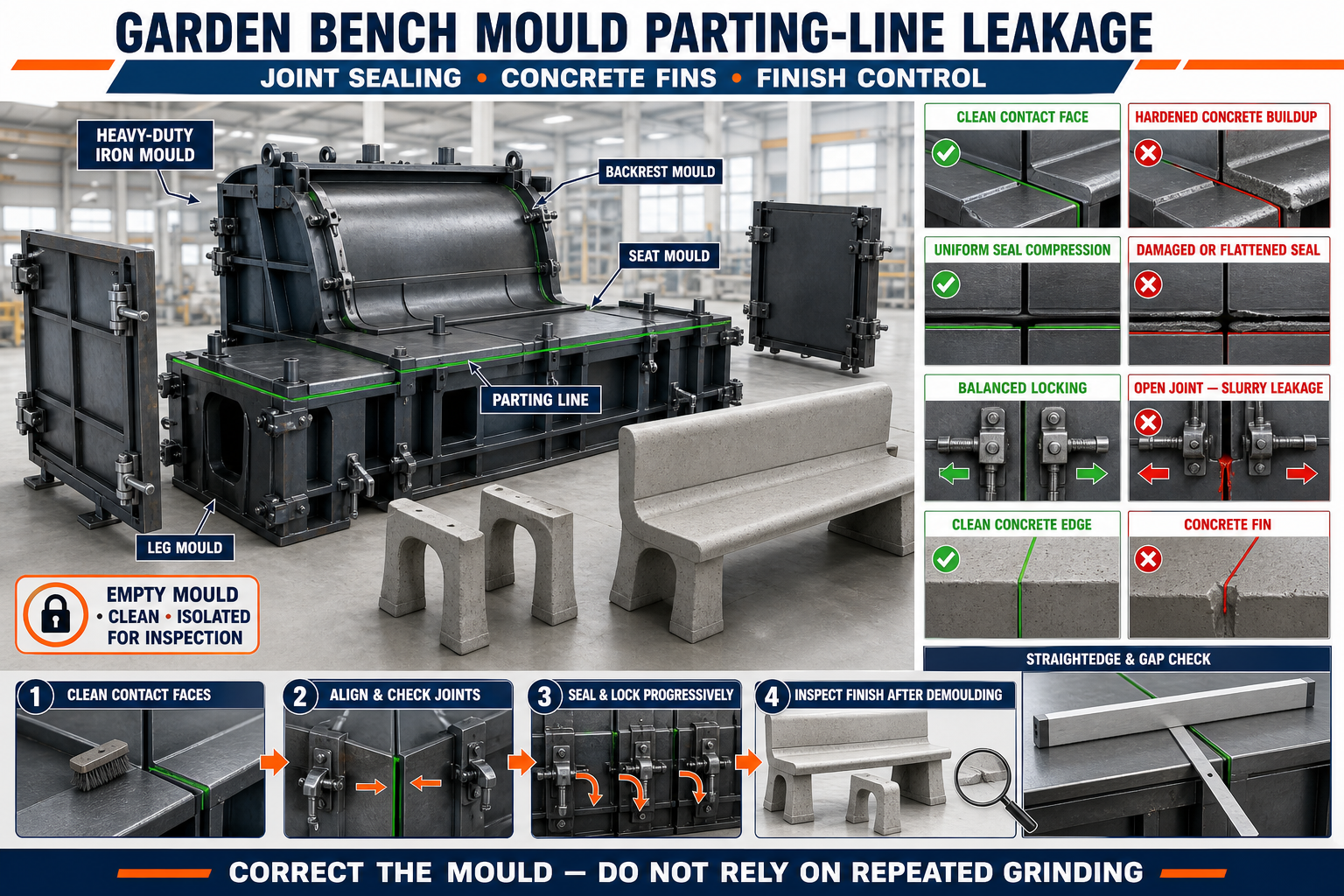
Garden Bench Mould Parting-Line Leakage: Joint Sealing, Concrete Fins and Finish Control

Precast Mould Maintenance Guide

Garden Bench Mould Parting-Line Leakage: Joint Sealing, Concrete Fins and Finish Control

Parting lines occur where the shutters and removable sections of a garden bench mould meet. Dirty contact faces, uneven locking or damaged joints can allow cement slurry to escape and create concrete fins. This guide explains joint inspection, sealing, leakage prevention and finish control for heavy-duty iron garden bench moulds.

Read article
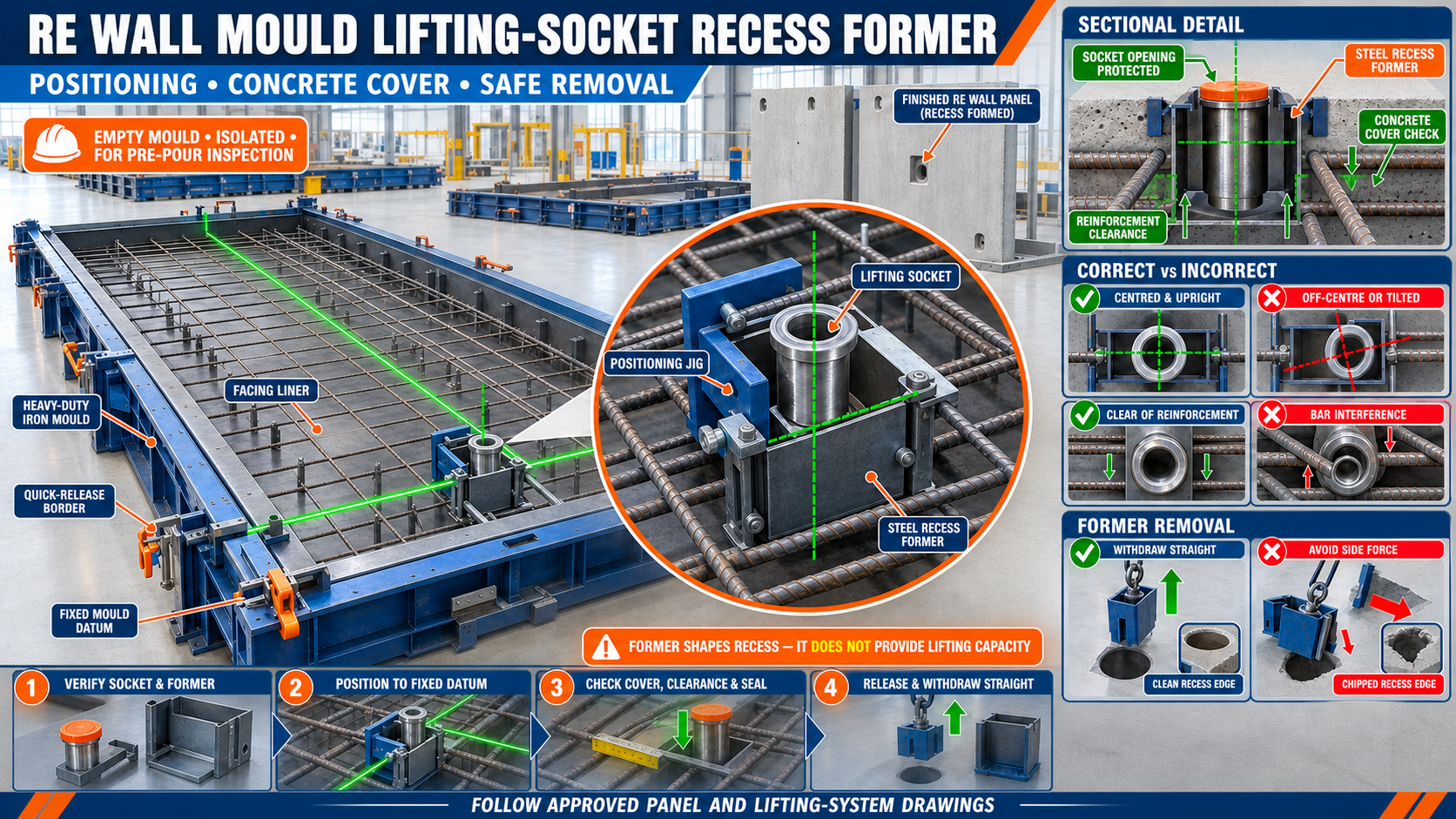
RE Wall Panel Mould Lifting-Socket Recess Former: Positioning, Concrete Cover and Removal Guide

Precast Infrastructure Moulds

RE Wall Panel Mould Lifting-Socket Recess Former: Positioning, Concrete Cover and Removal Guide

A lifting-socket recess former creates controlled access around an engineered lifting insert in a precast RE wall panel. Incorrect positioning, insufficient concrete cover or difficult former removal can damage the recess and affect safe handling. This guide explains accurate setup, reinforcement clearance and removal from a heavy-duty iron mould.

Read article
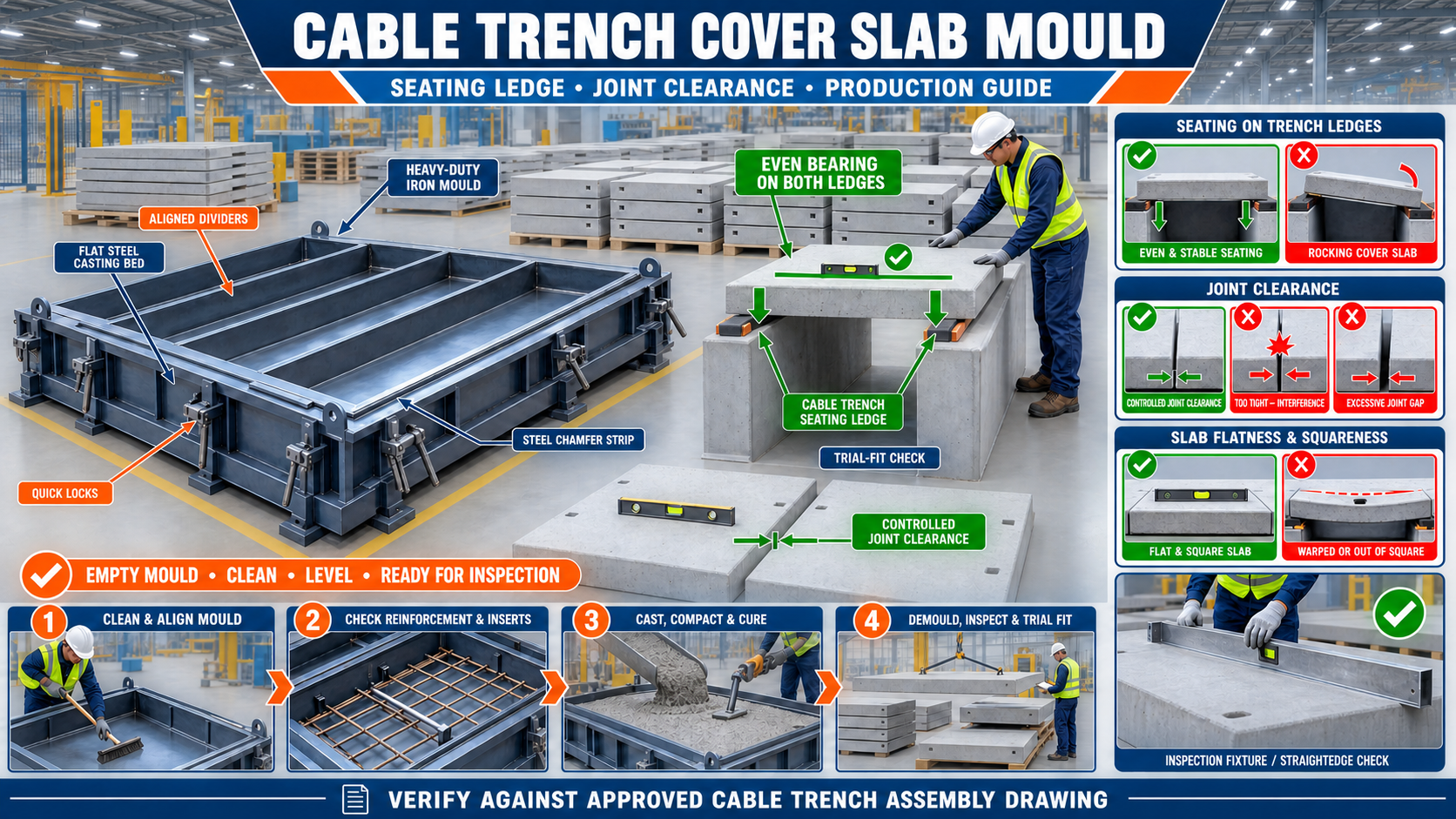
Cable Trench Cover Slab Mould: Seating Ledge, Joint Clearance and Production Guide

Precast Infrastructure Moulds

Cable Trench Cover Slab Mould: Seating Ledge, Joint Clearance and Production Guide

A cable trench cover slab must fit securely on the supporting ledges of a precast cable trench while remaining practical to install and remove. Incorrect slab dimensions, uneven seating faces or uncontrolled joint clearance can cause rocking, edge damage and installation problems. This guide explains iron cover-slab mould setup, casting and fit inspection.

Read article
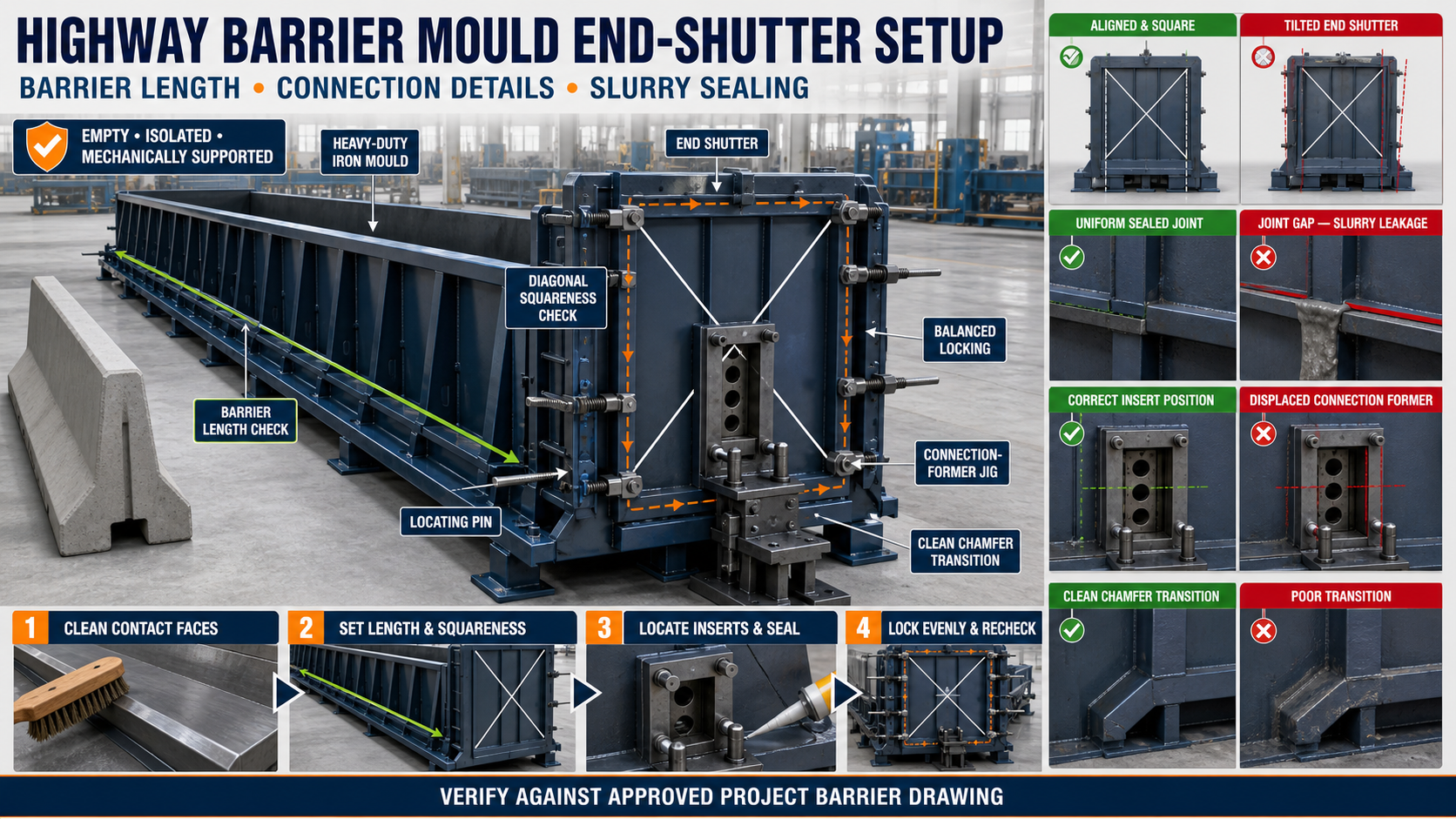
Highway Barrier Mould End-Shutter Setup: Barrier Length, Connection Details and Slurry Sealing

Precast Infrastructure Moulds

Highway Barrier Mould End-Shutter Setup: Barrier Length, Connection Details and Slurry Sealing

An end shutter closes the highway barrier mould and establishes the finished barrier length and end profile. Incorrect alignment, misplaced connection inserts or uneven locking can cause dimensional variation, concrete fins and slurry leakage. This guide explains end-shutter positioning, sealing and inspection for heavy-duty iron highway barrier moulds.

Read article
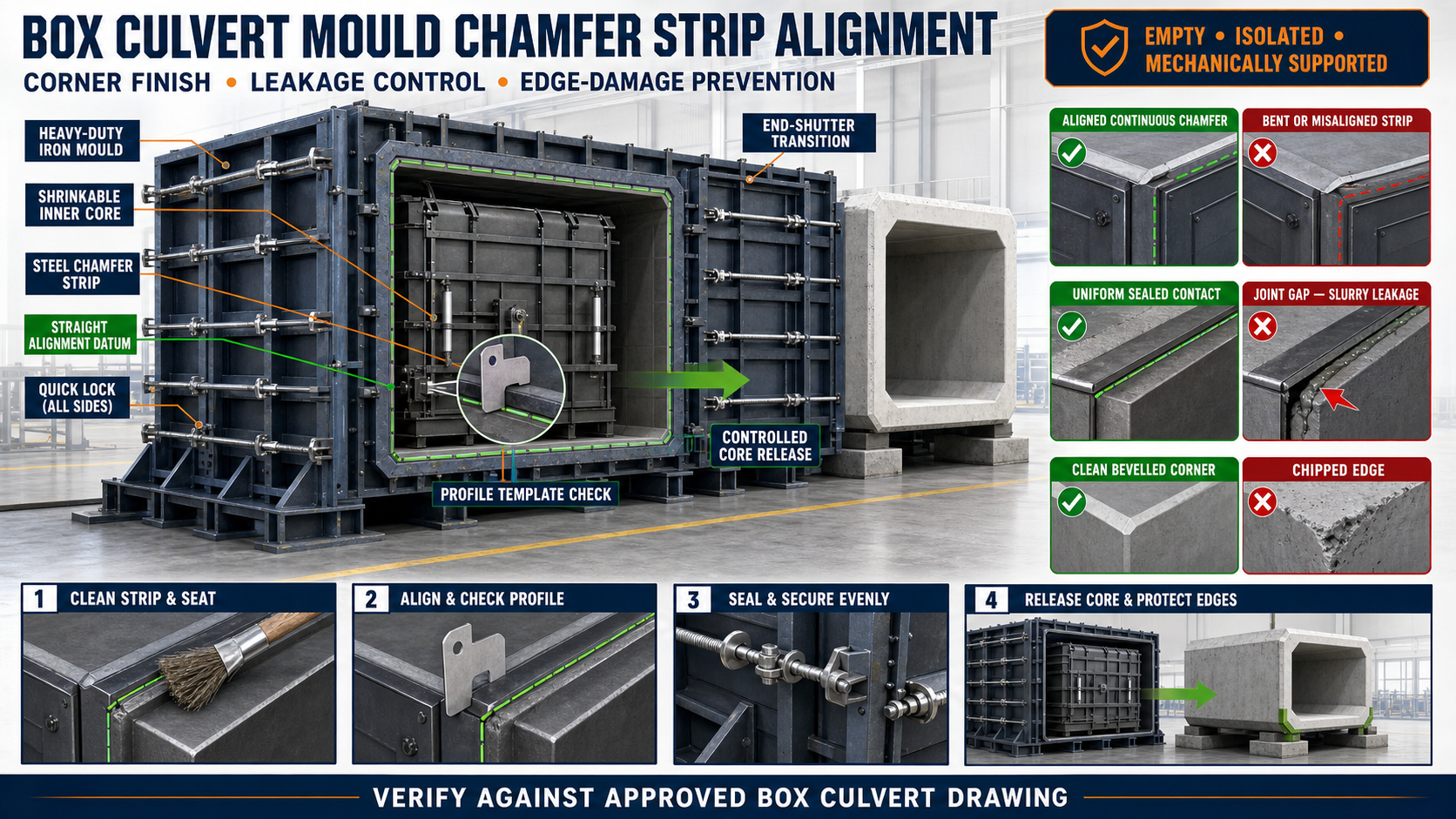
Box Culvert Mould Chamfer Strip Alignment: Corner Finish, Leakage and Edge-Damage Prevention
Precast Mould Guide

Box Culvert Mould Chamfer Strip Alignment: Corner Finish, Leakage and Edge-Damage Prevention

Chamfer strips form the bevelled corners of a precast box culvert and help reduce sharp, fragile concrete edges. Loose, damaged or misaligned strips can cause slurry leakage, uneven chamfers and difficult demoulding. This guide explains chamfer-strip positioning, fastening, sealing and maintenance for heavy-duty iron box culvert moulds.

Read article
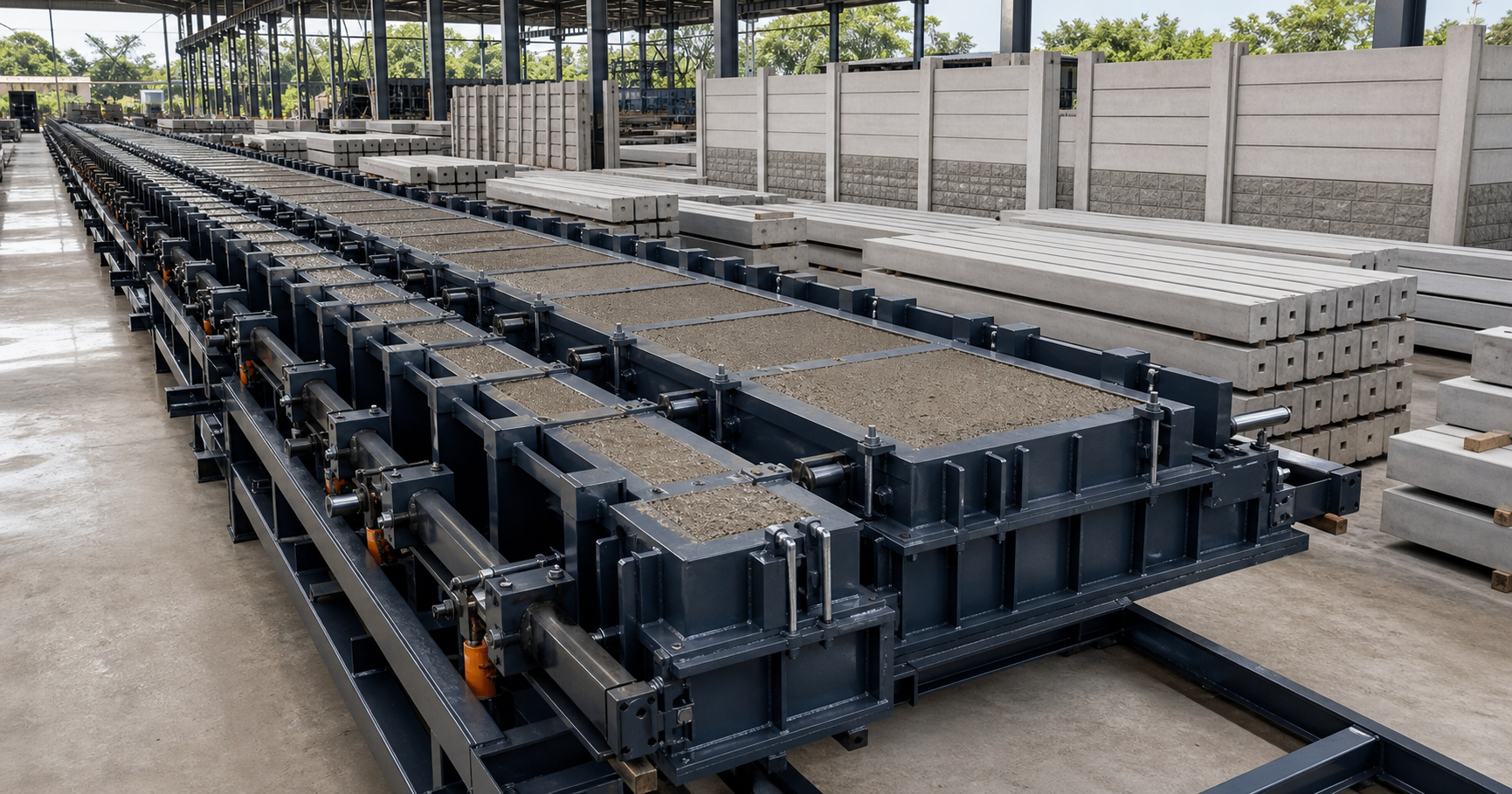
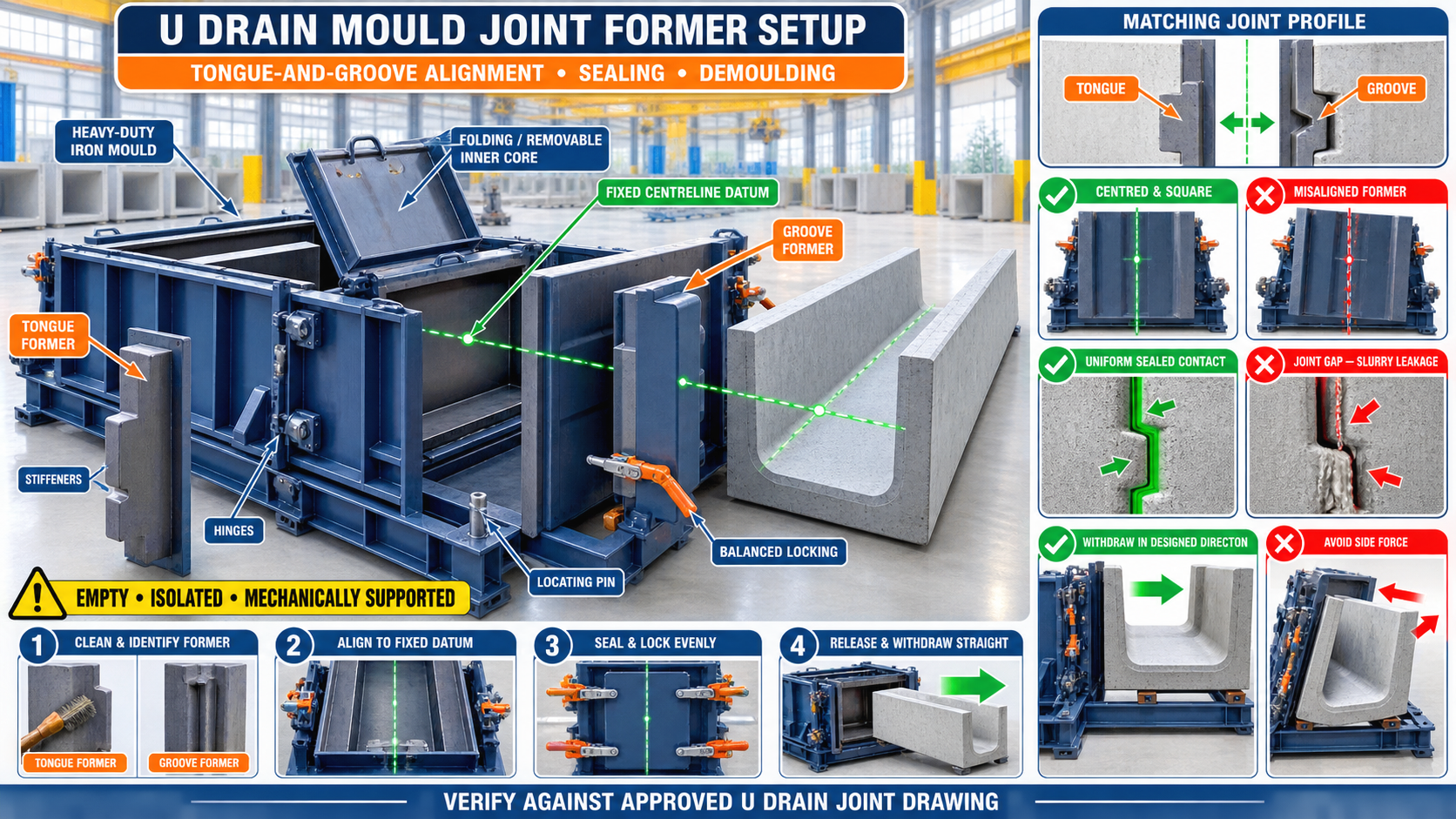
U Drain Mould Joint Former Setup: Tongue-and-Groove Alignment, Sealing and Demoulding Guide

Precast Mould Guide

U Drain Mould Joint Former Setup: Tongue-and-Groove Alignment, Sealing and Demoulding Guide

Joint formers create the tongue-and-groove ends that help precast U drains align during installation. Incorrect former positioning, damaged seals or poor demoulding can produce joint gaps, leakage paths and broken concrete edges. This guide explains alignment, fastening, sealing and safe removal of joint formers in heavy-duty iron U drain moulds.

Read article
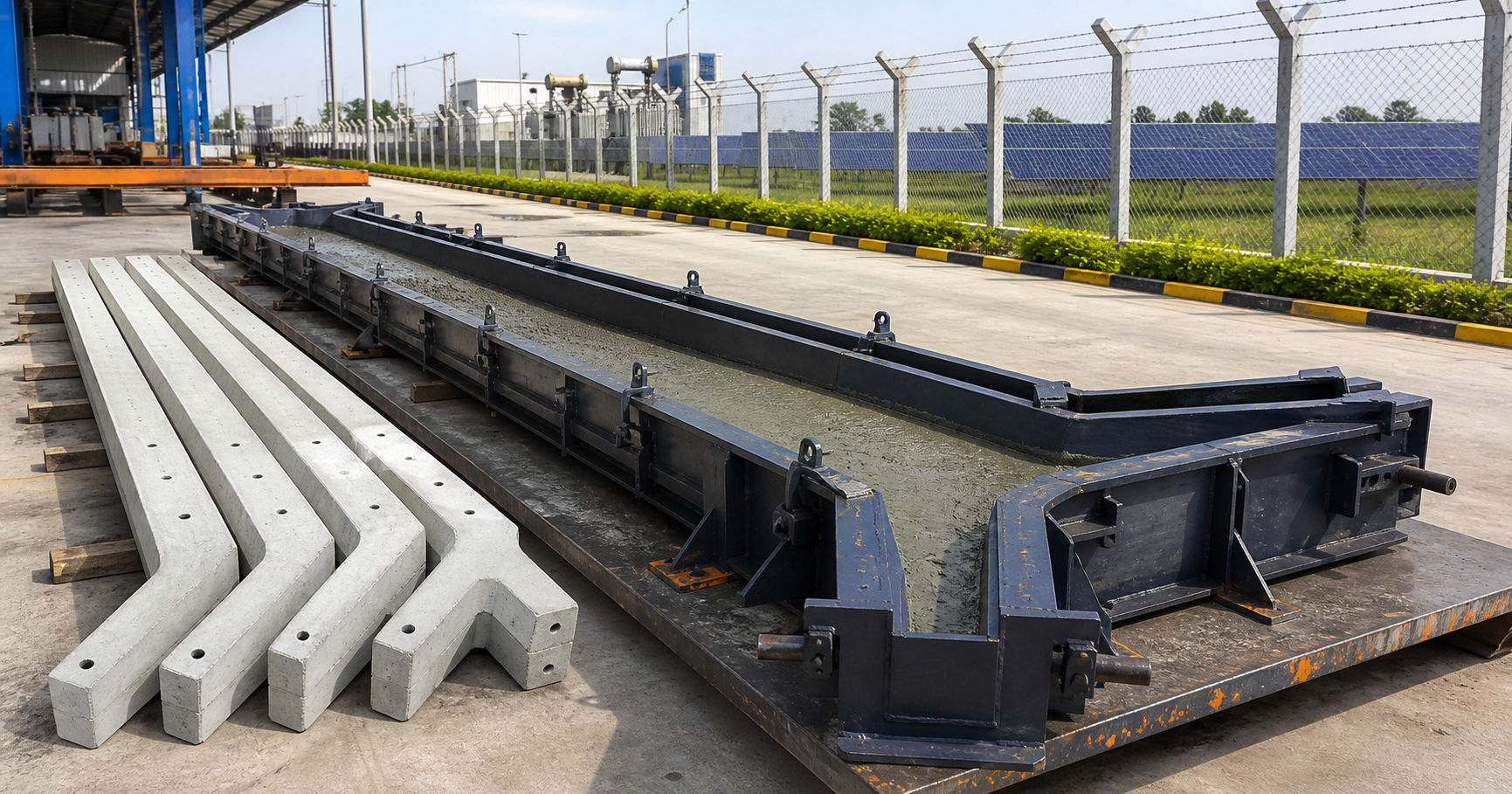
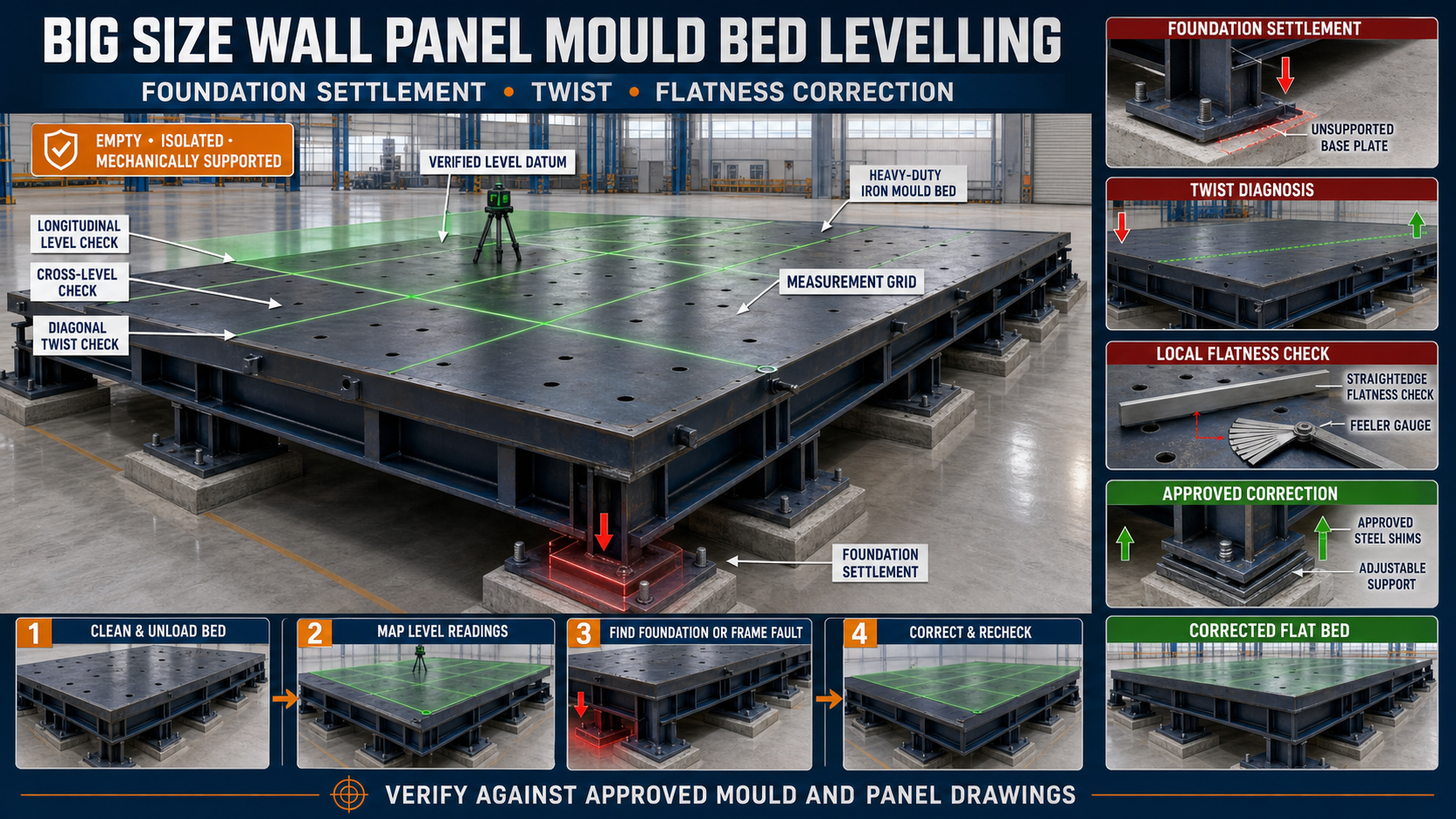
Big Size Wall Panel Mould Bed Levelling: Foundation Settlement, Twist and Flatness Correction

Precast Mould Maintenance Guide

Big Size Wall Panel Mould Bed Levelling: Foundation Settlement, Twist and Flatness Correction

A level and stable mould bed is essential for manufacturing large precast wall panels with consistent thickness, straight edges and flat surfaces. Foundation settlement, uneven supports or frame twist can distort a heavy-duty iron mould and produce bowed panels. This guide explains bed-level checks, settlement diagnosis and controlled flatness correction.

Read article
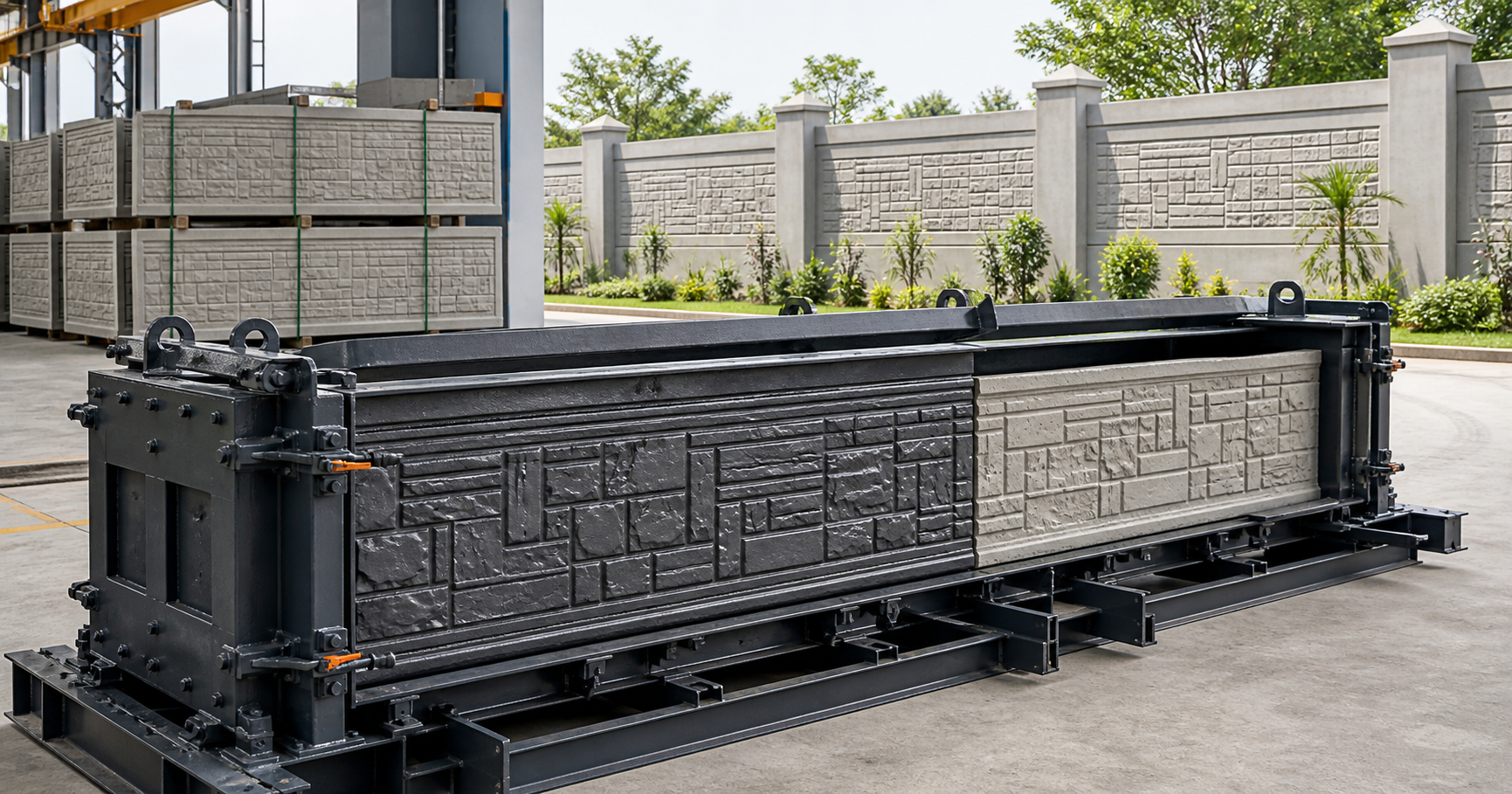
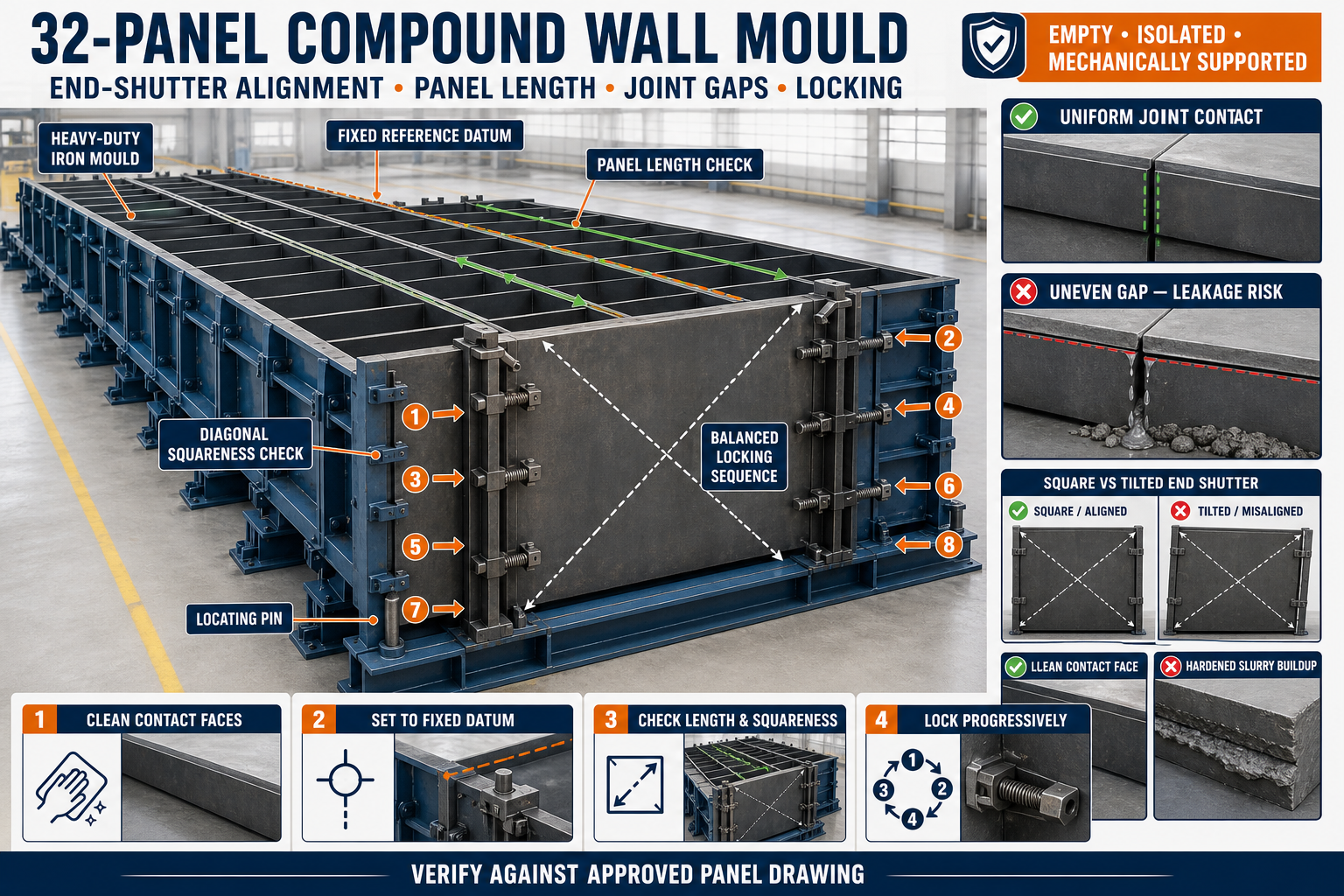
32-Panel Compound Wall Mould End-Shutter Alignment: Panel Length, Joint Gaps and Locking Guide

Precast Mould Maintenance Guide

32-Panel Compound Wall Mould End-Shutter Alignment: Panel Length, Joint Gaps and Locking Guide

End shutters establish the casting length and close the outer ends of a 32-panel compound wall mould. Incorrect positioning, uneven joint gaps or loose locking can produce inconsistent panel lengths, concrete fins and slurry leakage. This guide explains end-shutter inspection, alignment, sealing and locking for heavy-duty iron compound wall moulds.

Read article
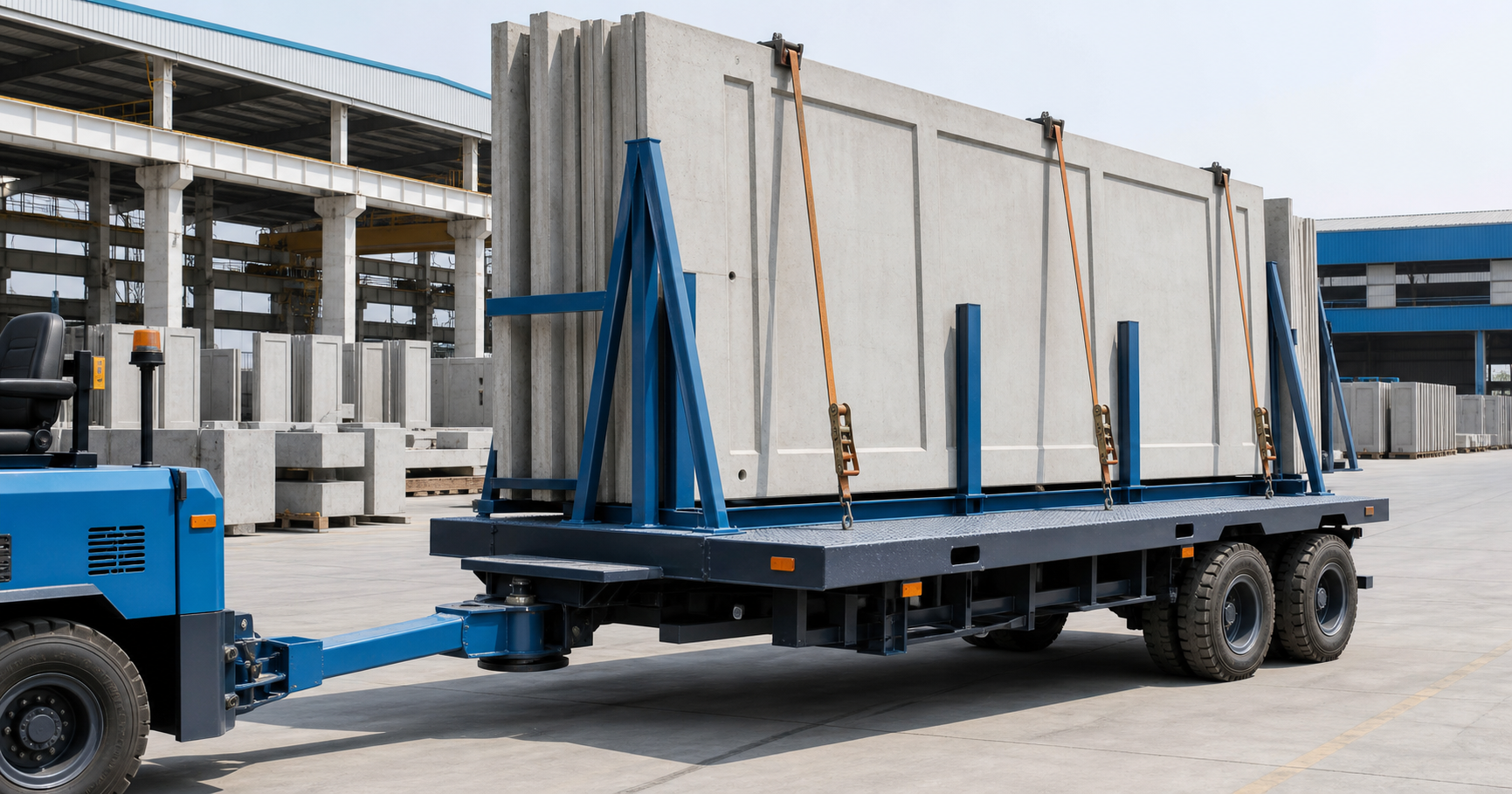
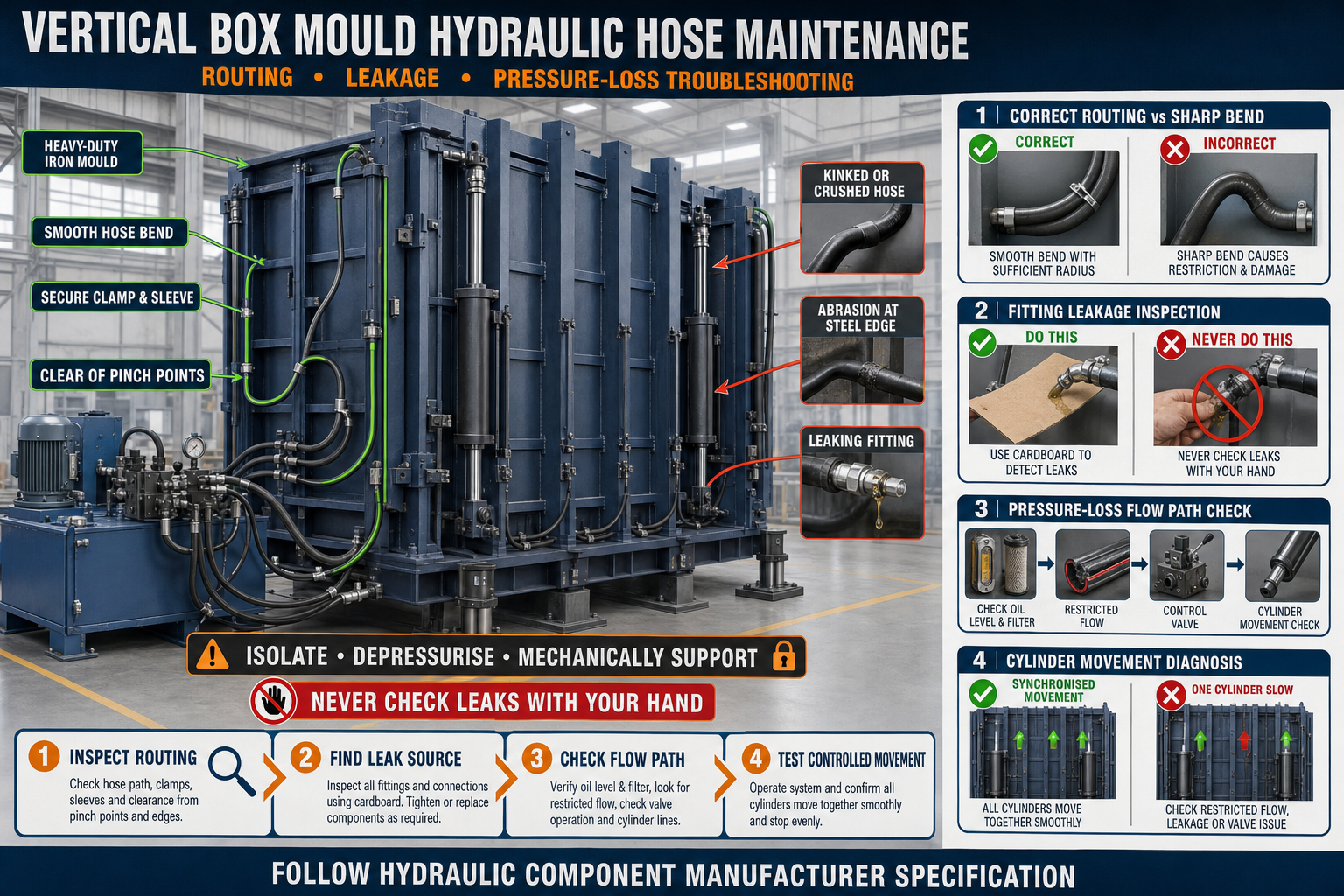
Vertical Box Mould Hydraulic Hose Maintenance: Routing, Leakage and Pressure-Loss Troubleshooting

Precast Mould Maintenance Guide

Vertical Box Mould Hydraulic Hose Maintenance: Routing, Leakage and Pressure-Loss Troubleshooting

Hydraulic hoses control the opening and closing movement of a vertical box mould. Poor routing, oil leakage, damaged fittings or restricted flow can cause uneven shutter movement, pressure loss and production delays. This guide explains safe hose inspection, routing, leakage detection and preventive maintenance for heavy-duty iron vertical box moulds.

Read article

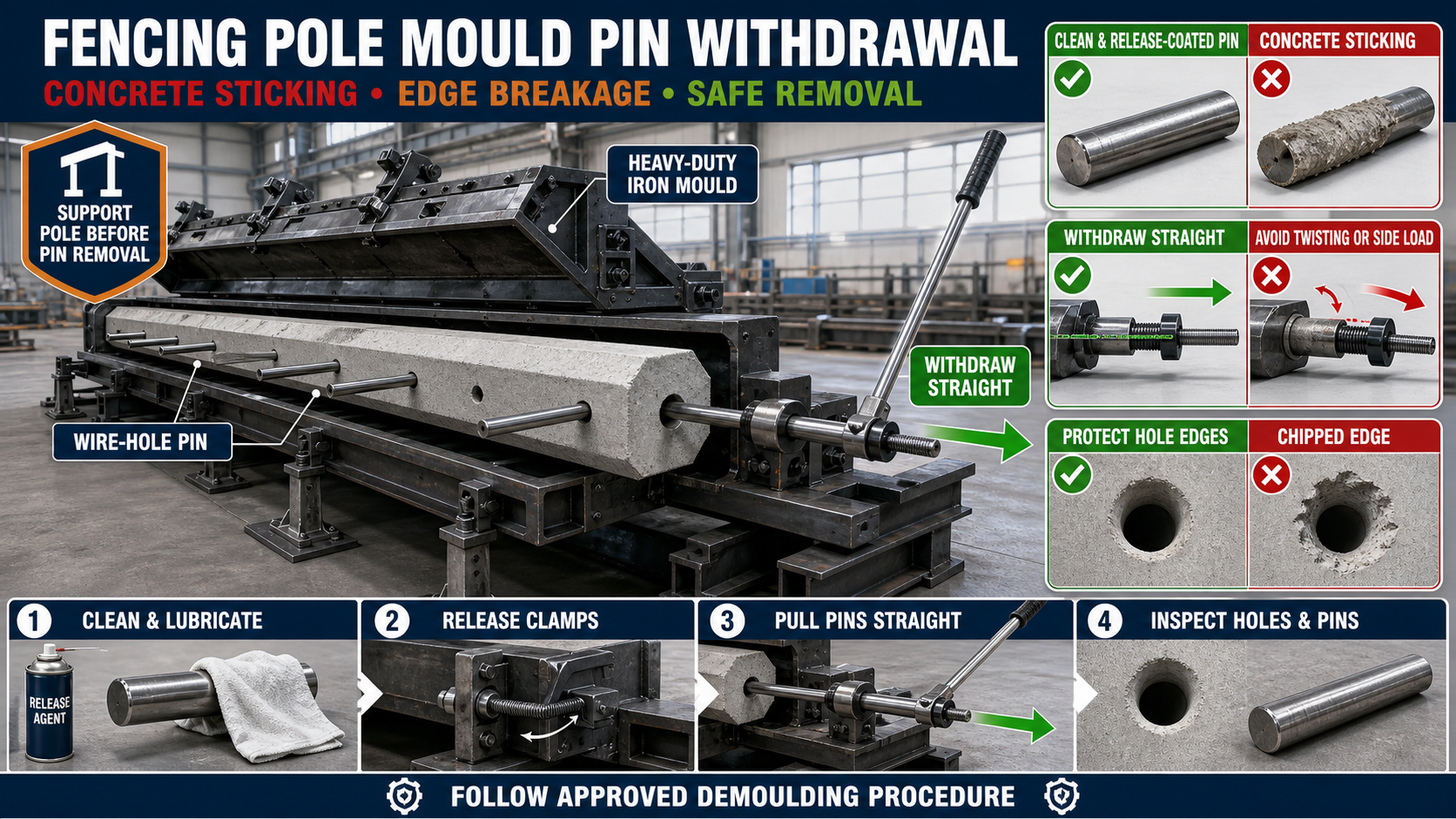
Fencing Pole Mould Wire-Hole Pin Withdrawal: Concrete Sticking, Edge Breakage and Safe Removal Guide

Precast Mould Maintenance Guide

Fencing Pole Mould Wire-Hole Pin Withdrawal: Concrete Sticking, Edge Breakage and Safe Removal Guide

Wire-hole pins create accurate openings in precast fencing poles for installing fencing wire. However, incorrect pin withdrawal can cause concrete sticking, damaged hole edges, bent pins and production delays. This guide explains pin preparation, correct removal sequence, common problems and essential maintenance practices for heavy-duty iron fencing pole moulds.

Read article
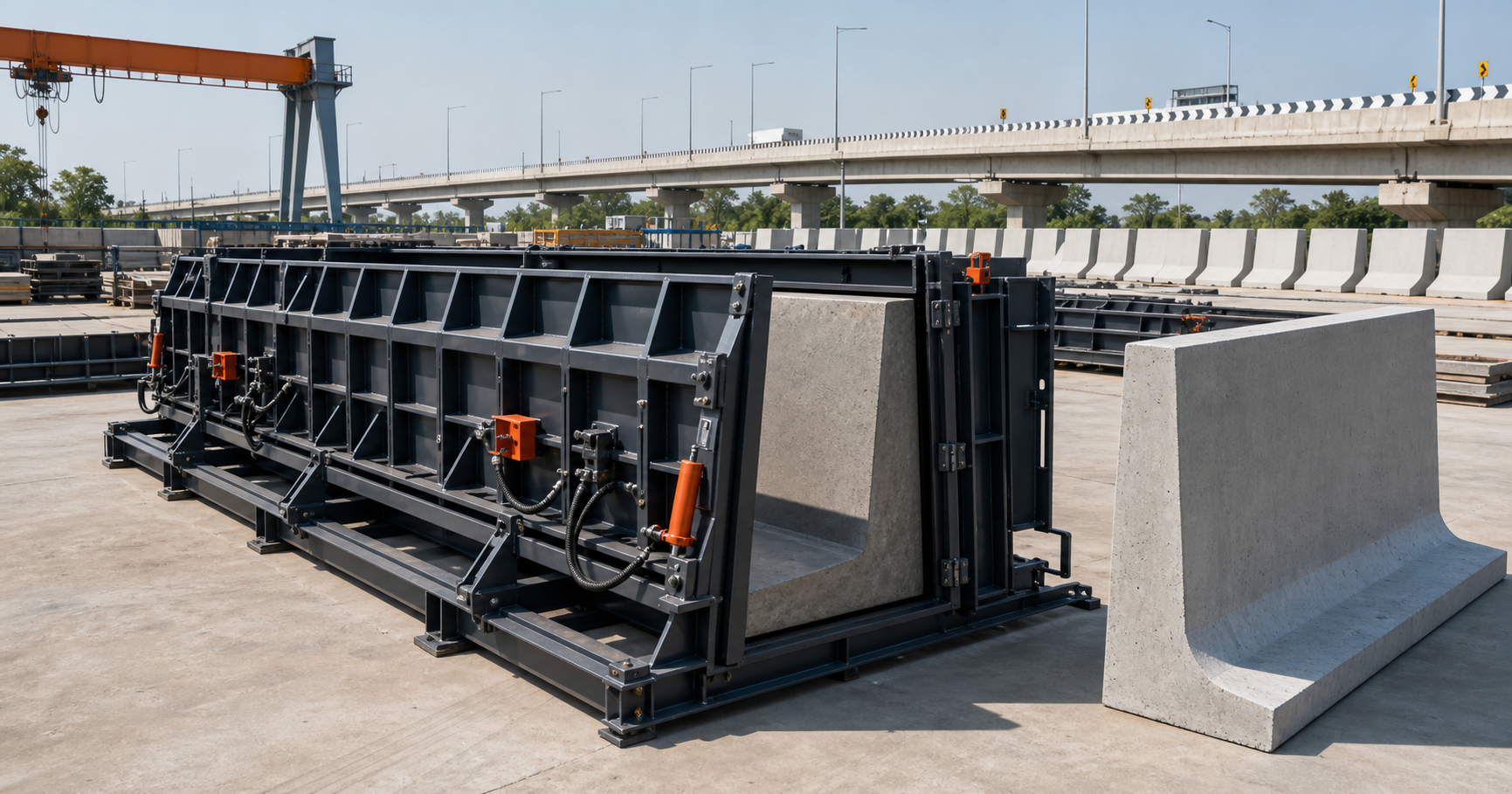
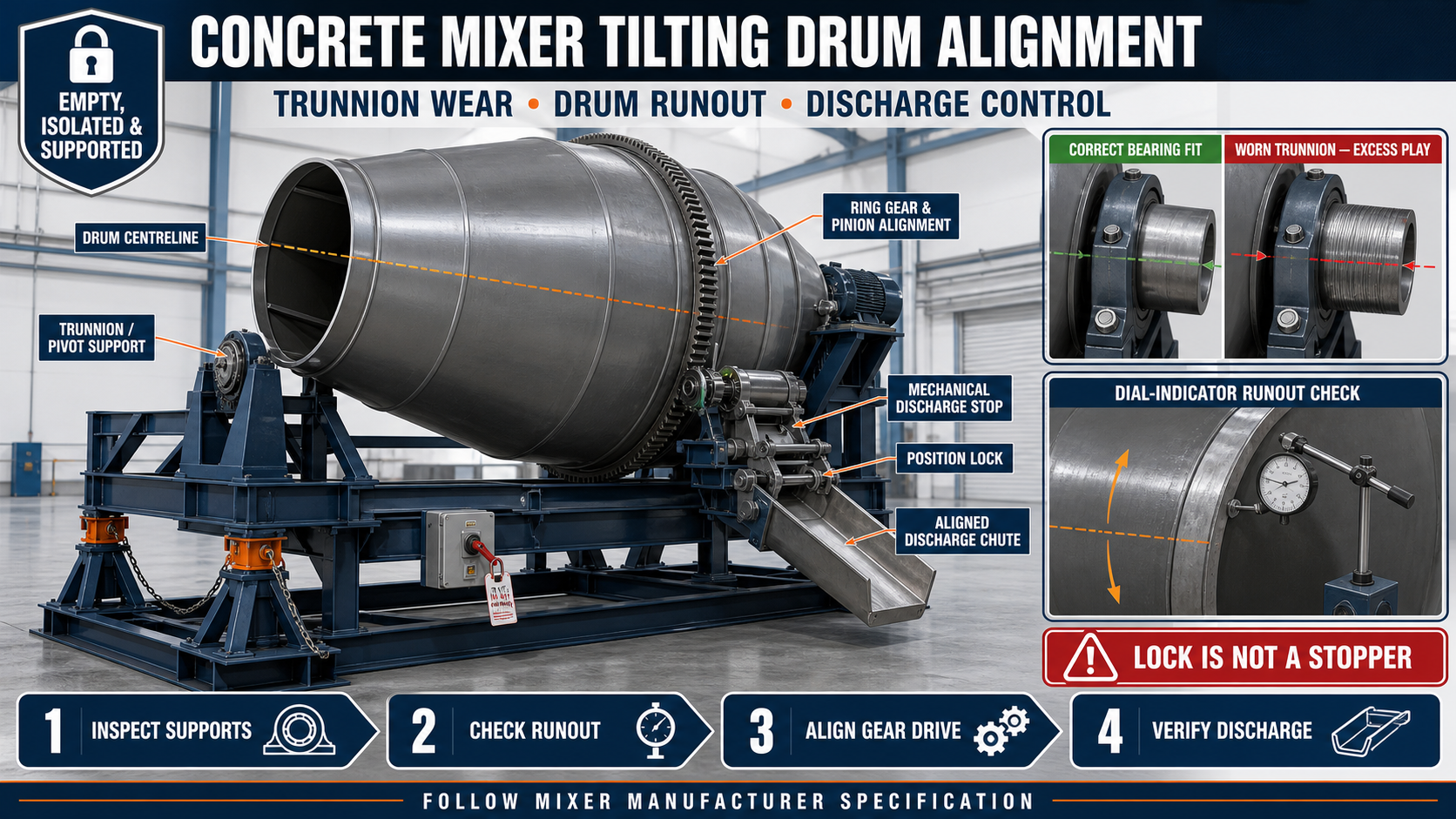
Concrete Mixer Tilting Drum Alignment: Trunnion Wear, Drum Runout and Discharge Control

Precast Machinery Guide

Concrete Mixer Tilting Drum Alignment: Trunnion Wear, Drum Runout and Discharge Control

Trunnion wear, damaged pivots or excessive drum runout can cause vibration, uneven gear contact and poor discharge control. This guide explains safe alignment checks, support inspection and tilting-mechanism maintenance.

Read article
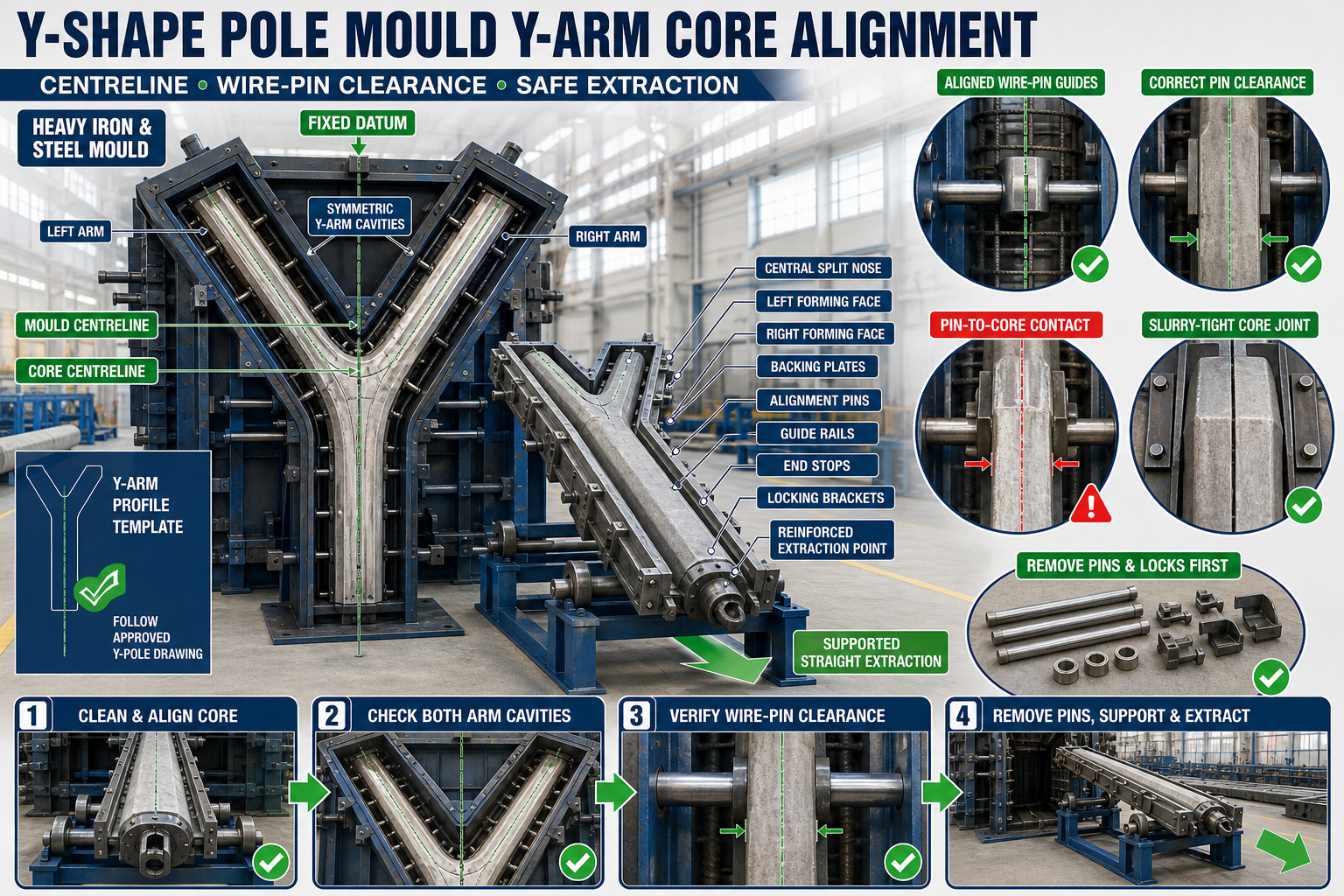
Y-Shape Pole Mould Y-Arm Core Alignment: Centreline, Wire-Pin Clearance and Safe Extraction

Precast Mould Guide

Y-Shape Pole Mould Y-Arm Core Alignment: Centreline, Wire-Pin Clearance and Safe Extraction

A misaligned Y-arm core can produce unequal security arms, displaced wire holes and difficult demoulding. This guide explains fixed-datum centring, wire-pin clearance, balanced locking and safe core extraction.

Read article
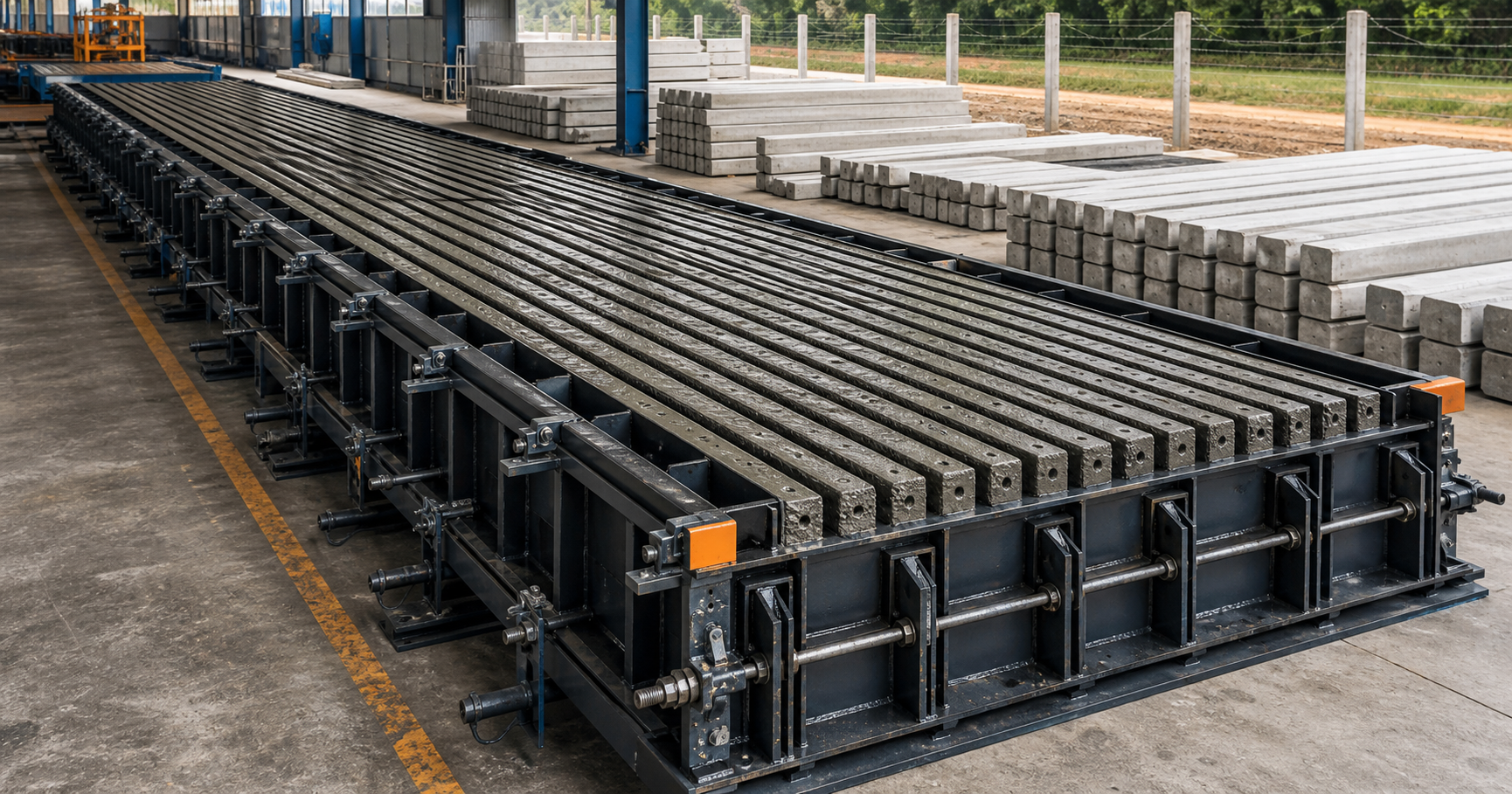
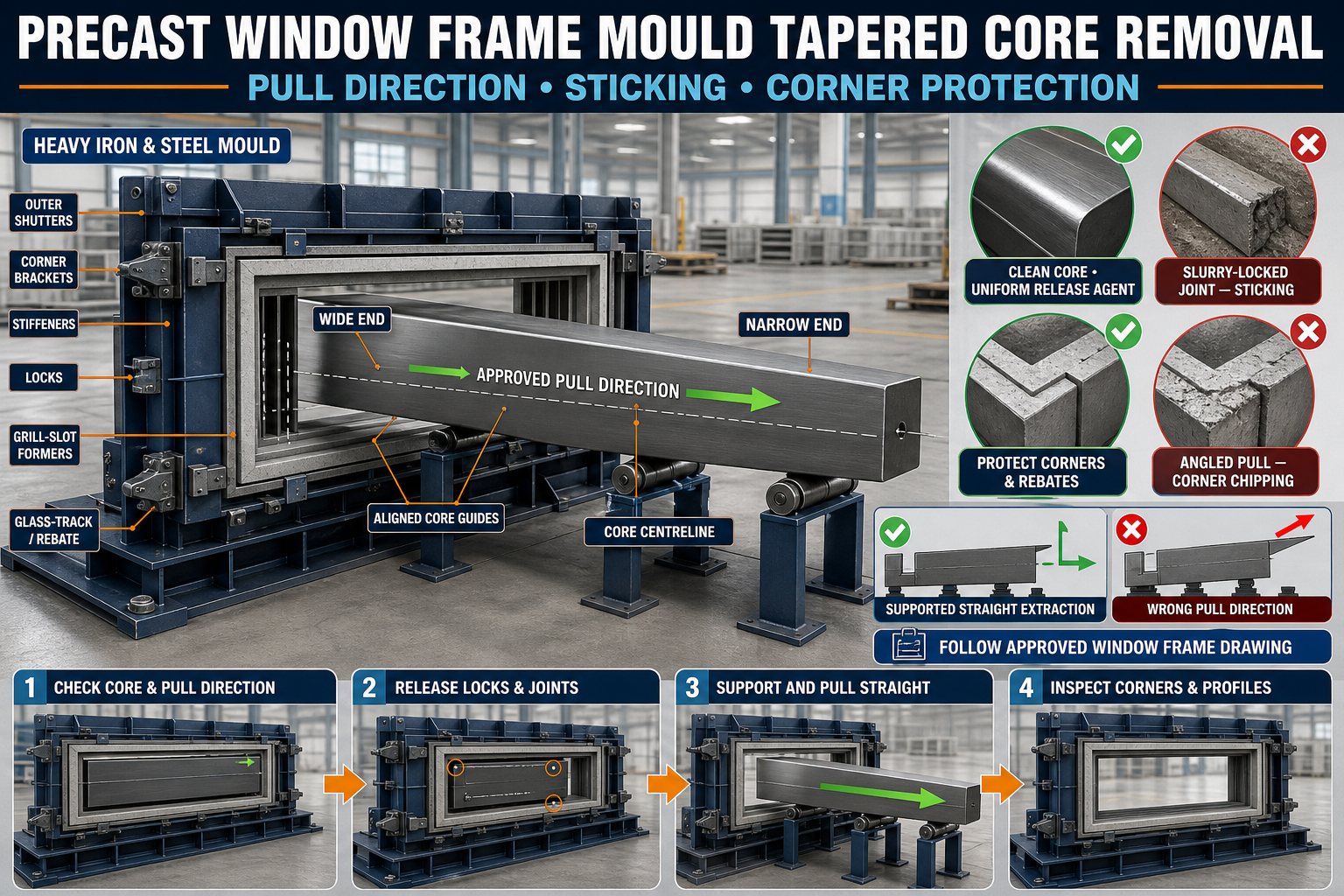
Precast Window Frame Mould Tapered Core Removal: Pull Direction, Sticking and Corner Protection Guide

Precast Mould Guide

Precast Window Frame Mould Tapered Core Removal: Pull Direction, Sticking and Corner Protection Guide

A tapered core must be removed in its designed pull direction to avoid binding, concrete chipping and damaged window-frame corners. This guide explains core preparation, controlled extraction and sticking diagnosis.

Read article
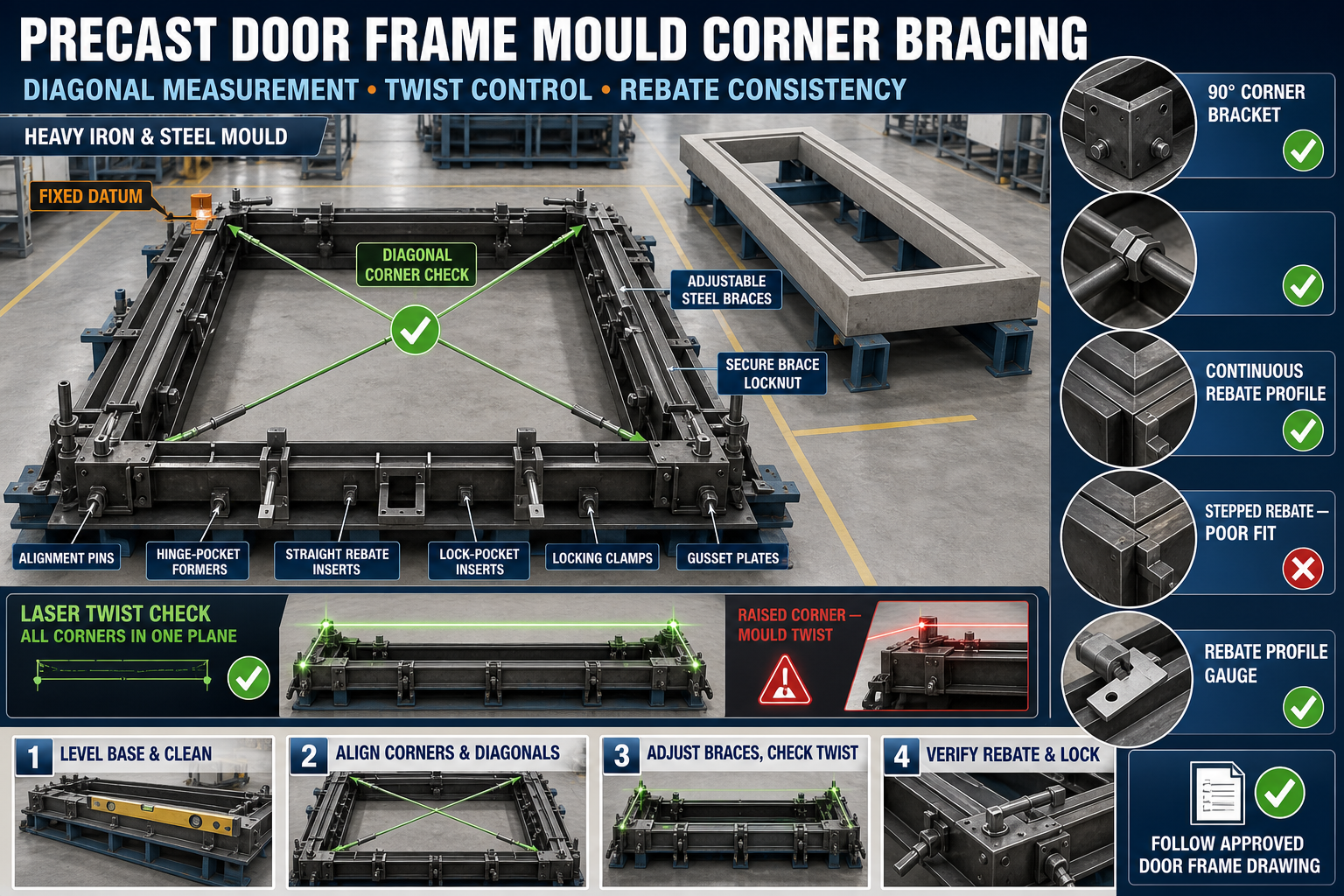
Precast Door Frame Mould Corner Bracing: Diagonal Measurement, Twist Control and Rebate Consistency

Precast Mould Guide

Precast Door Frame Mould Corner Bracing: Diagonal Measurement, Twist Control and Rebate Consistency

Incorrect corner bracing can make a precast door frame mould rack, twist or produce inconsistent rebates. This guide explains fixed-datum setup, diagonal checks, brace adjustment and pre-casting inspection.

Read article
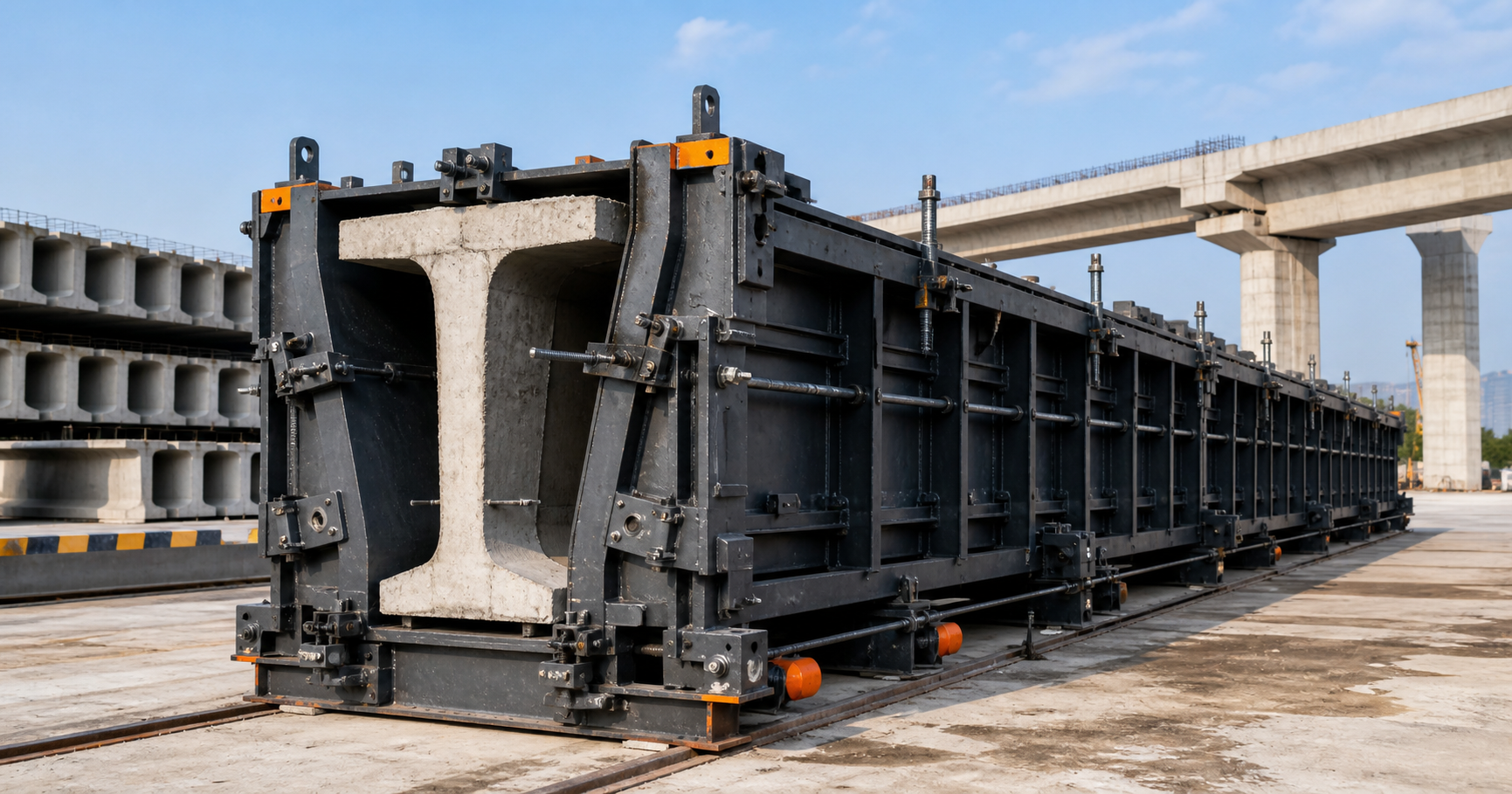
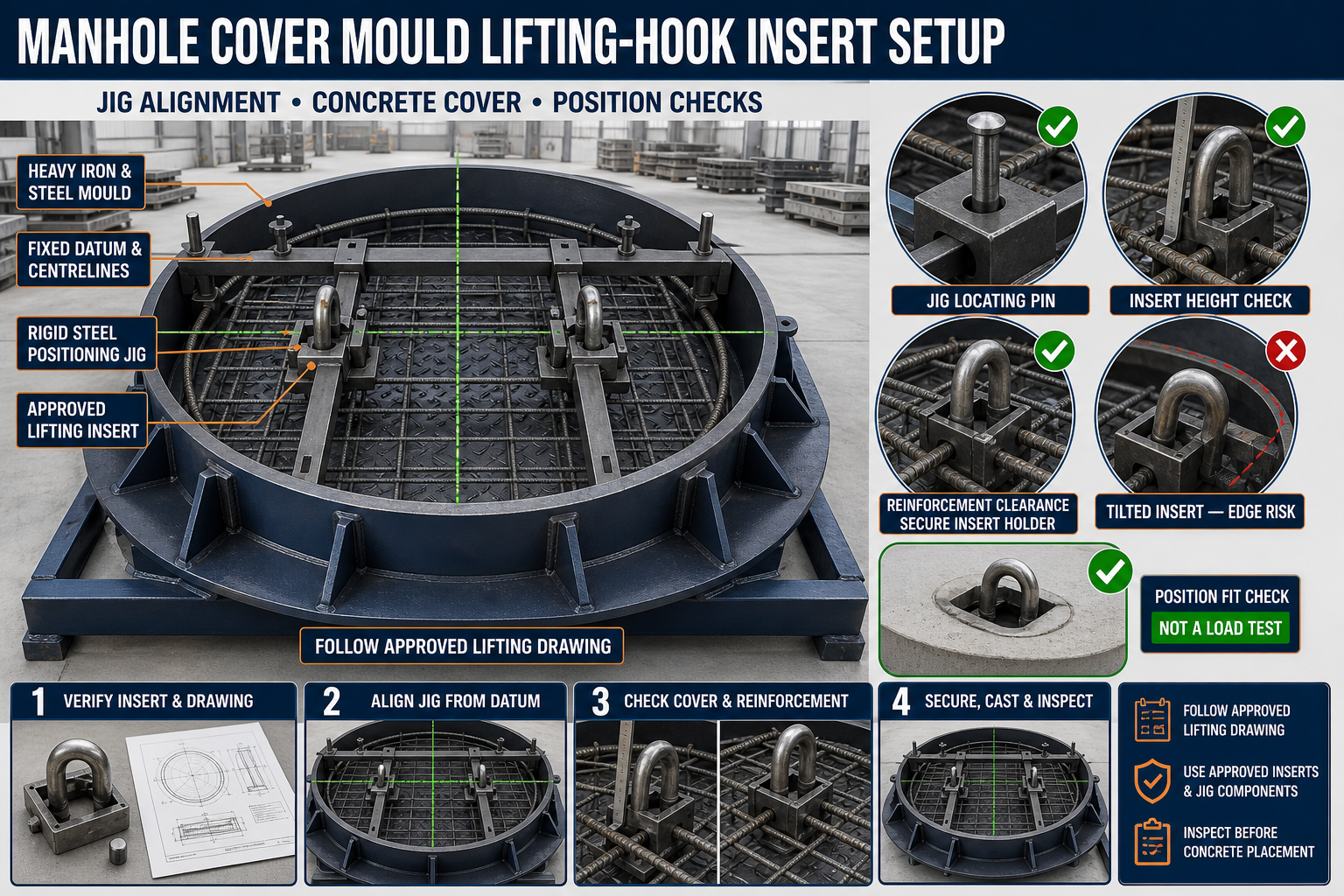
Manhole Cover Mould Lifting-Hook Insert Setup: Jig Alignment, Concrete Cover and Position Checks

Precast Mould Guide

Manhole Cover Mould Lifting-Hook Insert Setup: Jig Alignment, Concrete Cover and Position Checks

Incorrectly positioned lifting-hook inserts can make a precast manhole cover difficult or unsafe to handle. This guide explains jig alignment, insert restraint, concrete cover, reinforcement clearance and post-casting position checks.

Read article
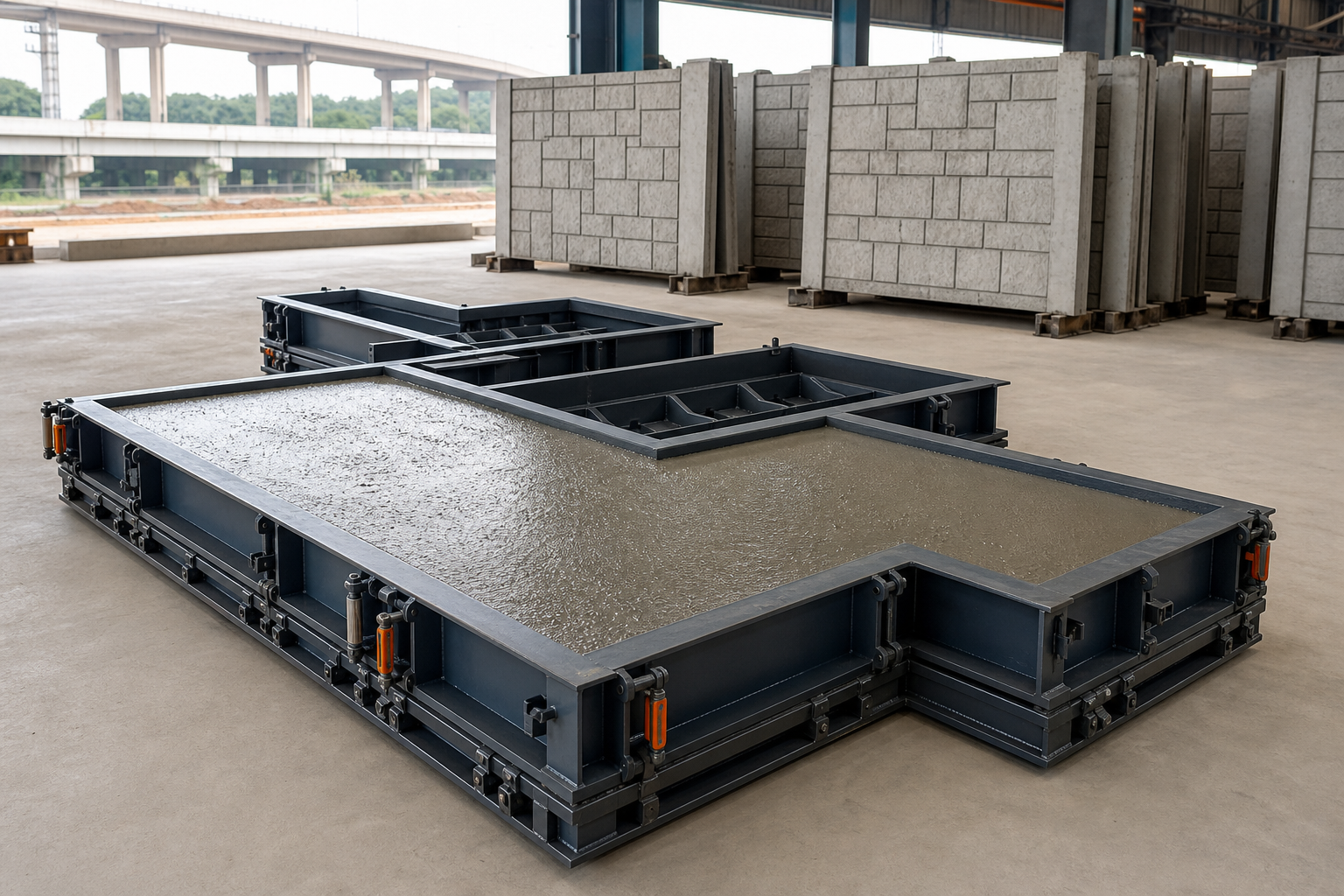
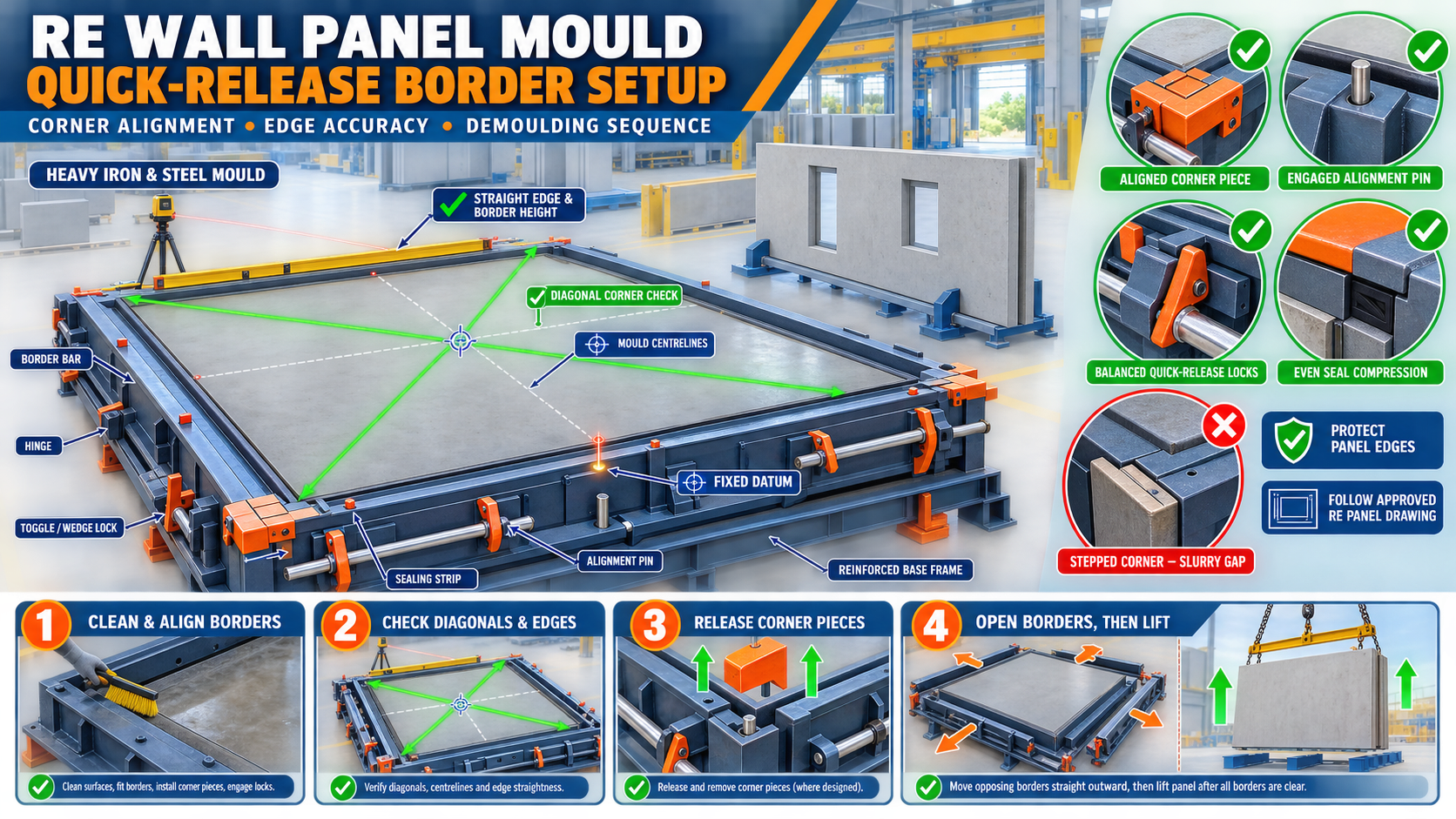
RE Wall Panel Mould Quick-Release Border Setup: Corner Alignment, Edge Accuracy and Demoulding Sequence

Precast Mould Guide

RE Wall Panel Mould Quick-Release Border Setup: Corner Alignment, Edge Accuracy and Demoulding Sequence

Accurate quick-release border setup helps an RE wall panel mould produce straight edges, square corners and consistent joint profiles. This guide explains fixed-datum positioning, lock adjustment, slurry control and safe border removal.

Read article
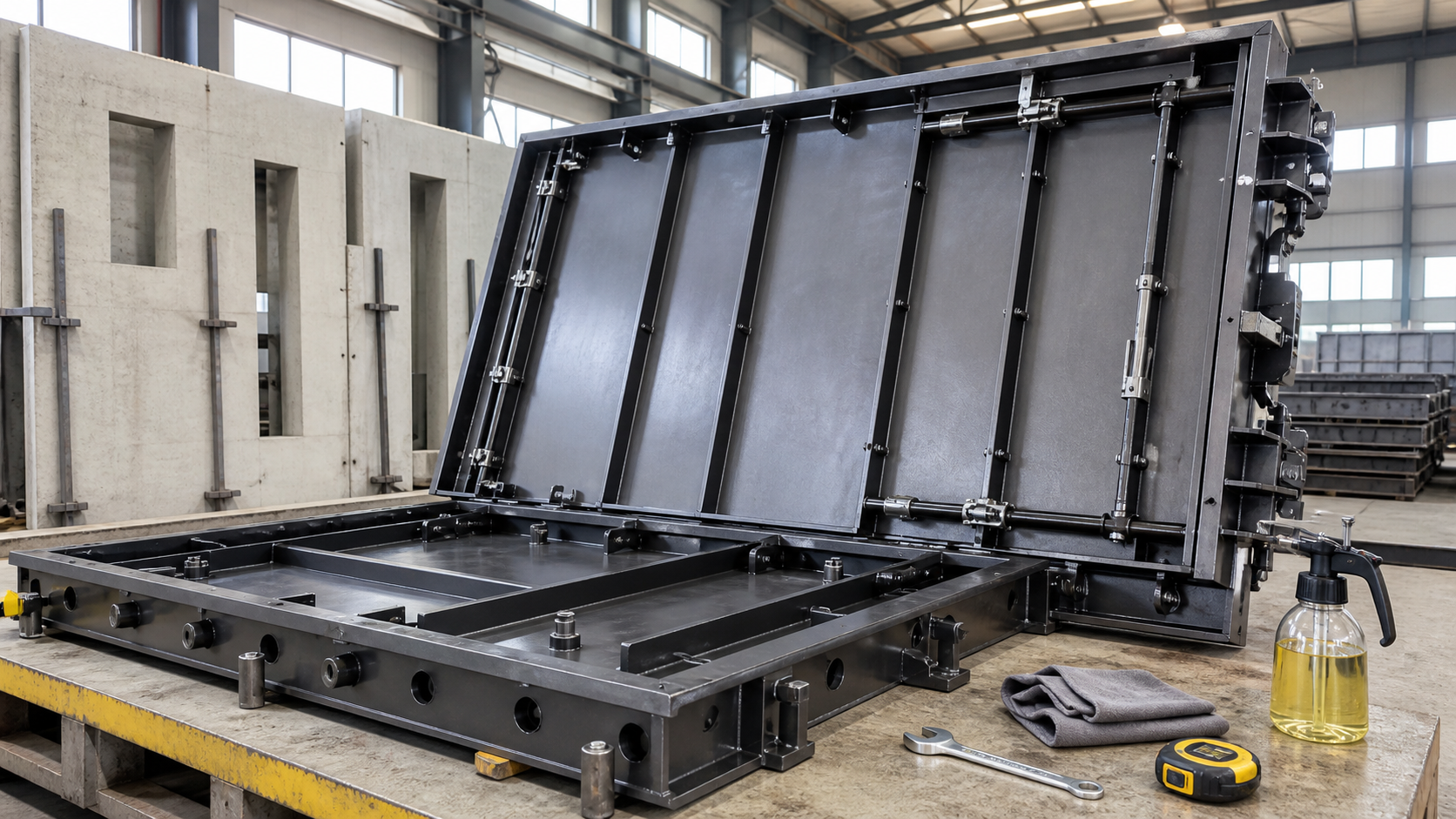
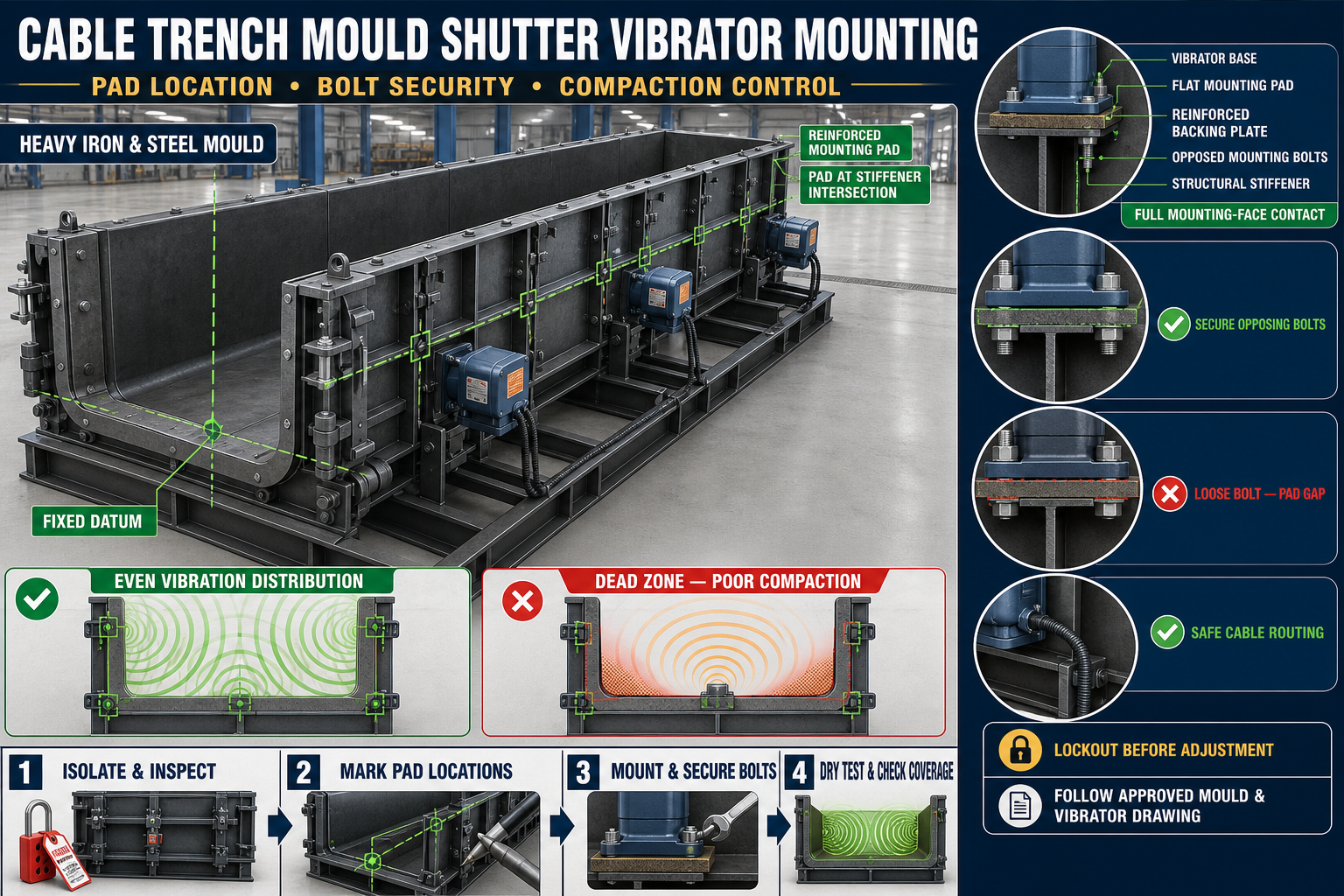
Cable Trench Mould Shutter Vibrator Mounting: Pad Location, Bolt Security and Compaction Control

Precast Mould Guide

Cable Trench Mould Shutter Vibrator Mounting: Pad Location, Bolt Security and Compaction Control

Incorrect shutter-vibrator mounting can create dead zones, loose fasteners, slurry leakage or excessive vibration in a cable trench mould. This guide explains mounting-pad position, bolt inspection and controlled compaction.

Read article
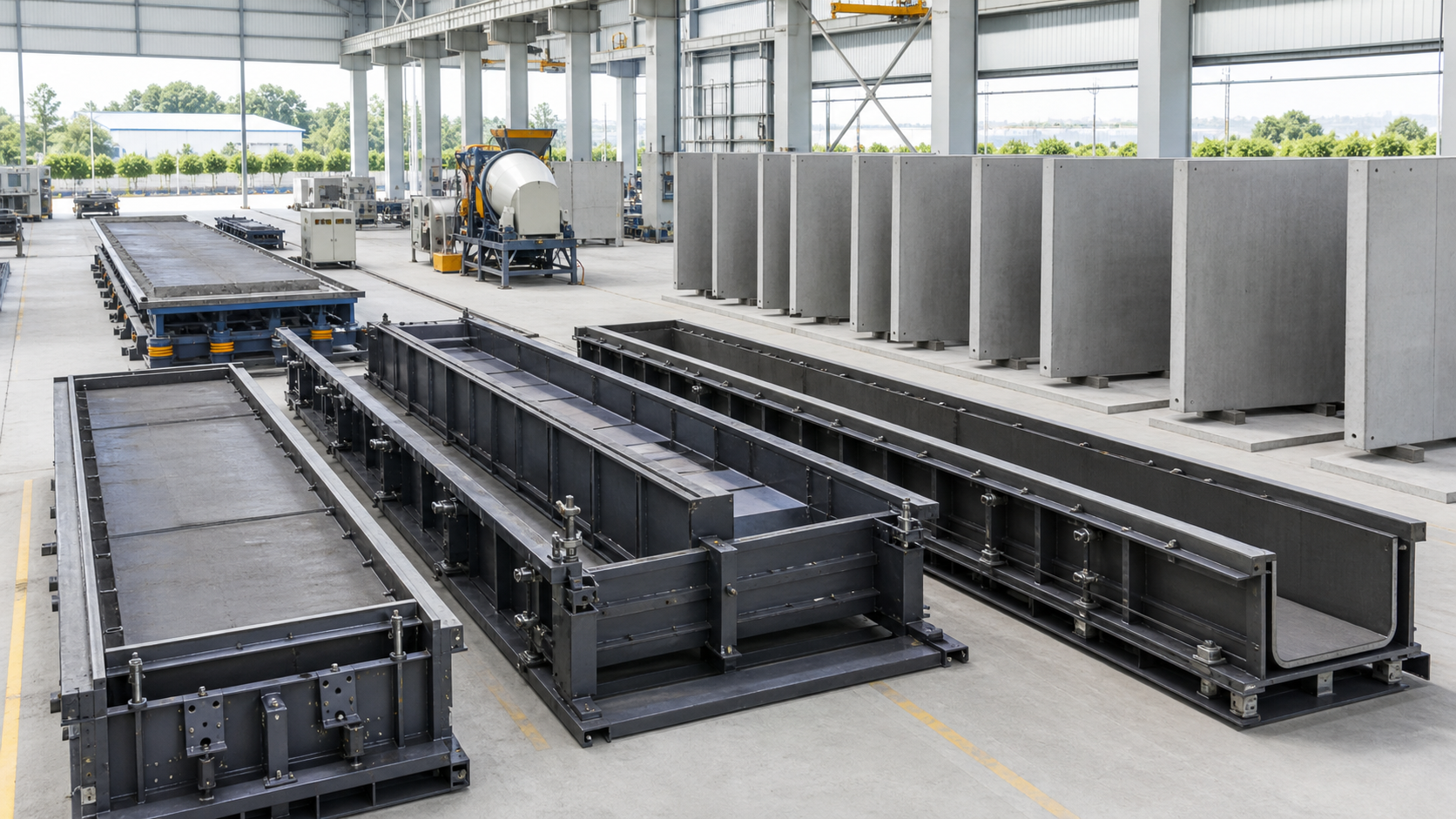
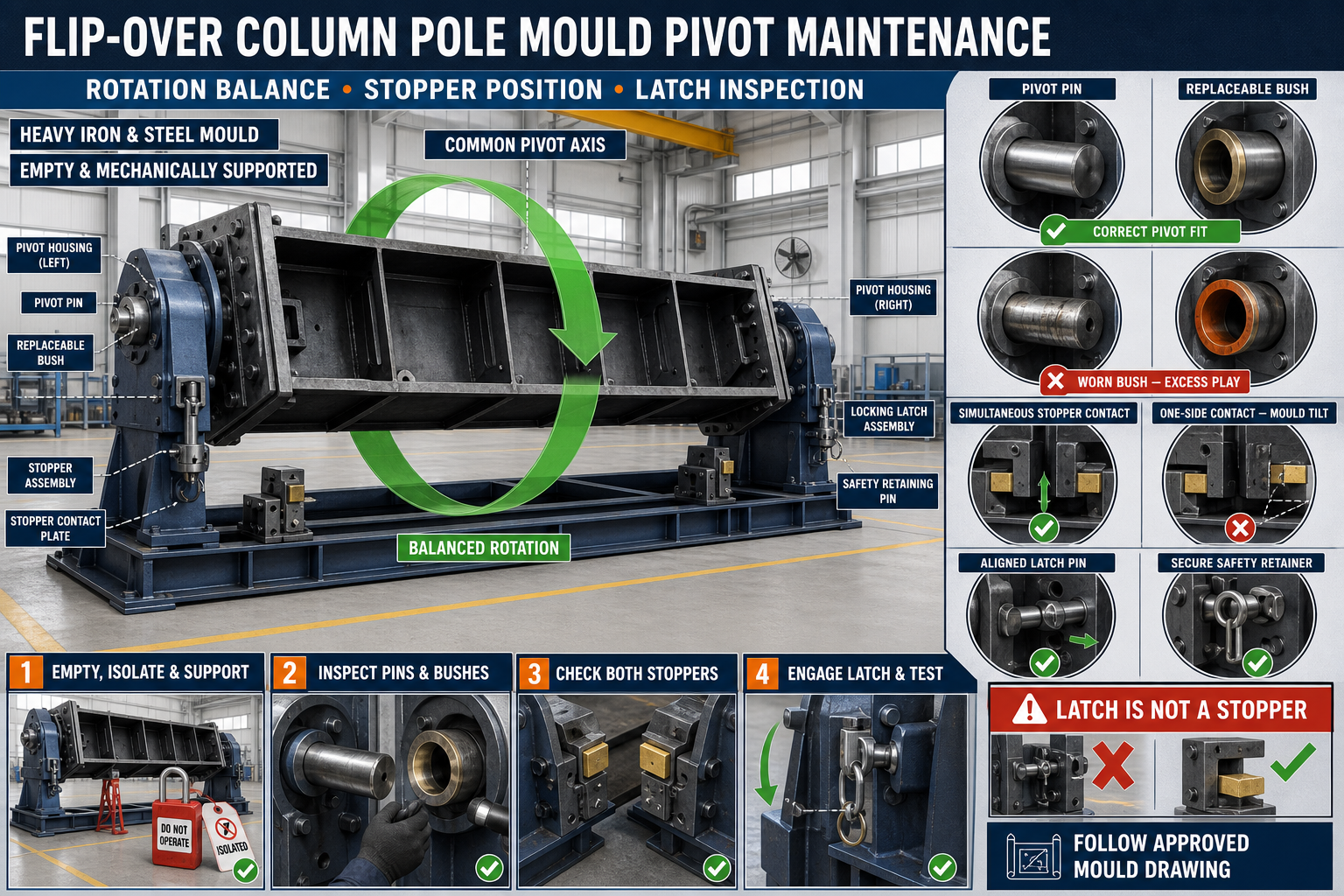
Flip-Over Column Pole Mould Pivot Maintenance: Rotation Balance, Stopper Position and Latch Inspection
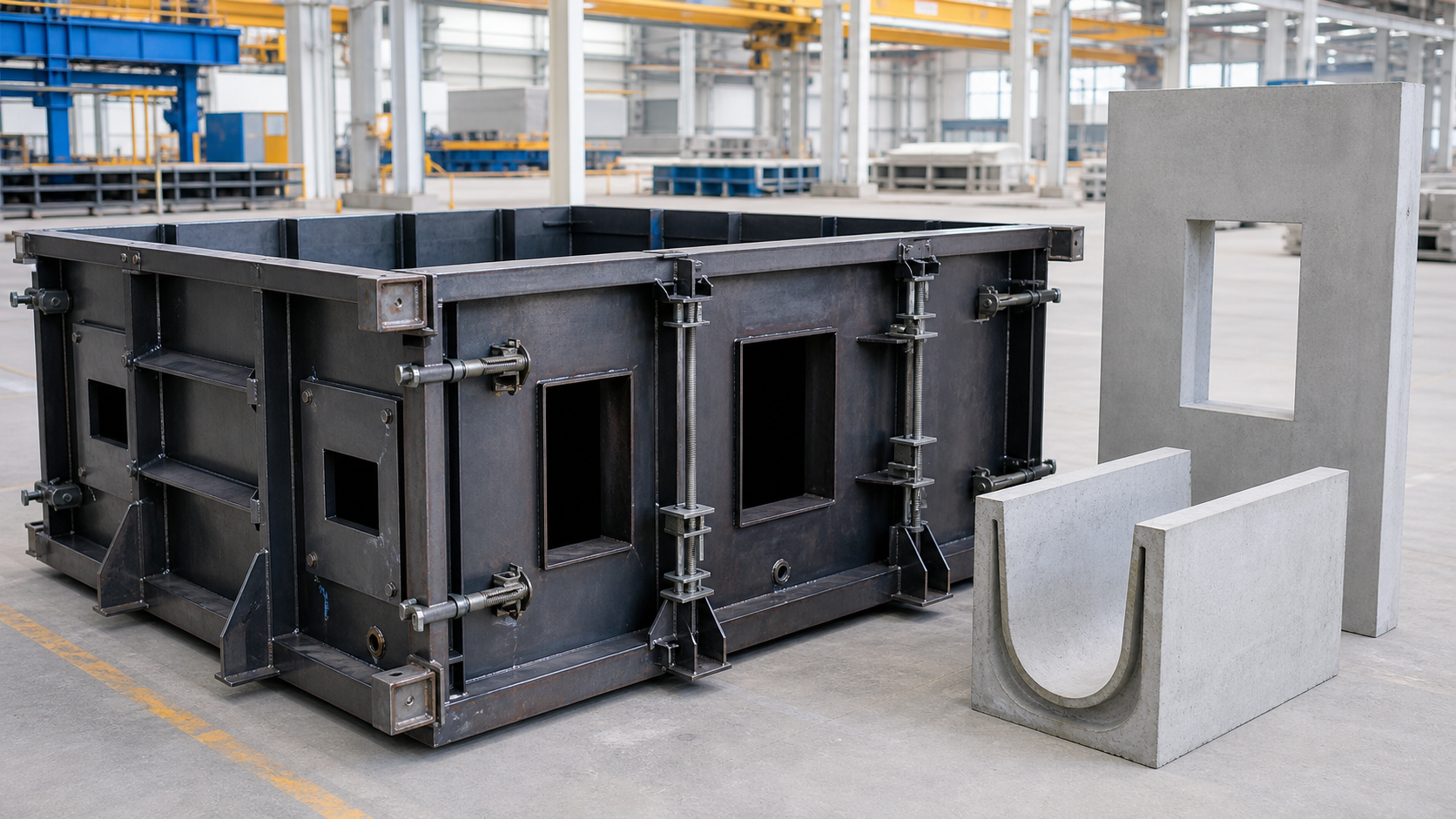
Precast Mould Guide
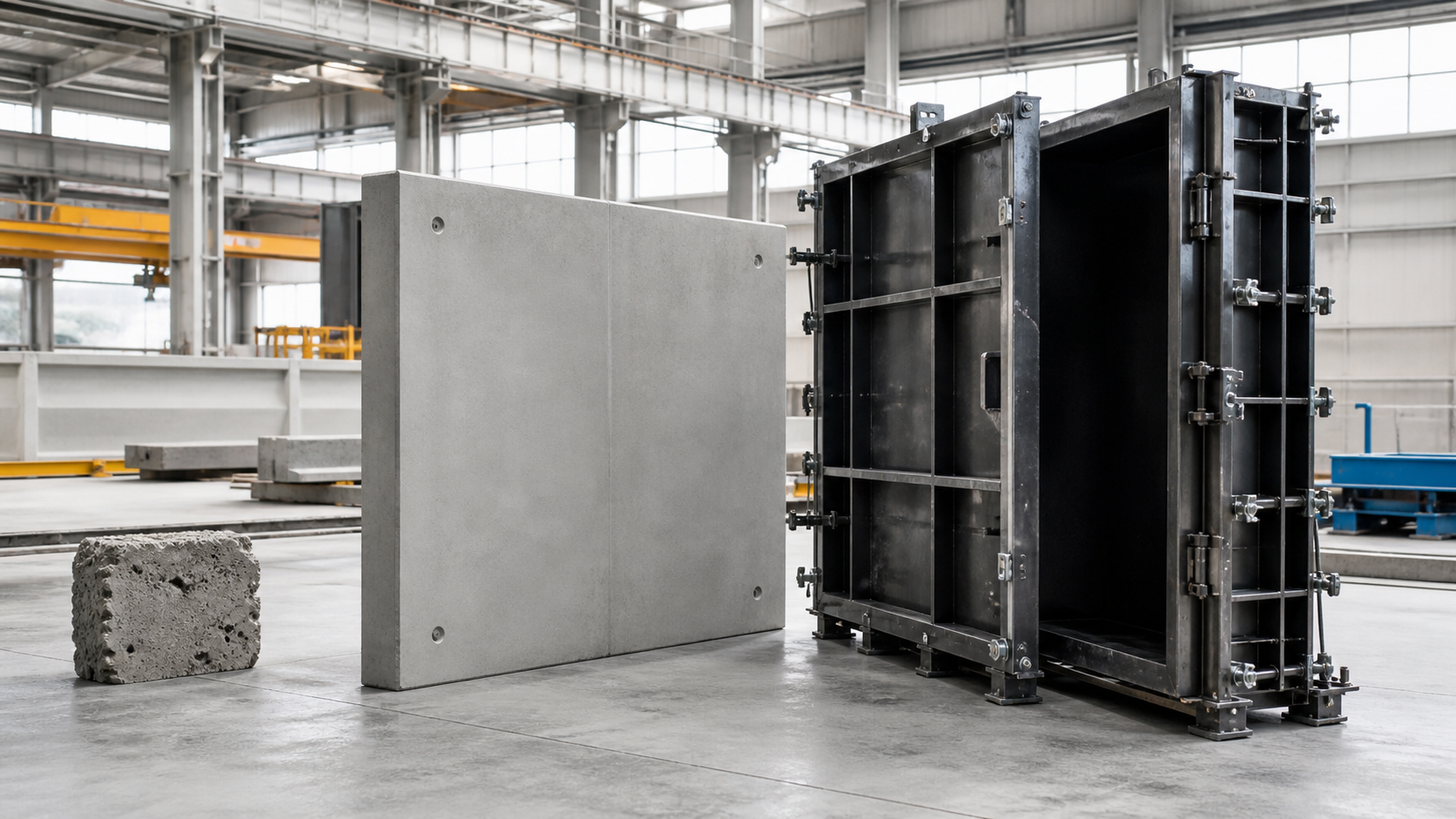
Flip-Over Column Pole Mould Pivot Maintenance: Rotation Balance, Stopper Position and Latch Inspection

A worn pivot, incorrect stopper position or loose latch can make a flip-over column pole mould rotate unevenly or fail to lock securely. This guide explains safe support, pivot wear checks, balanced rotation and latch inspection.

Read article
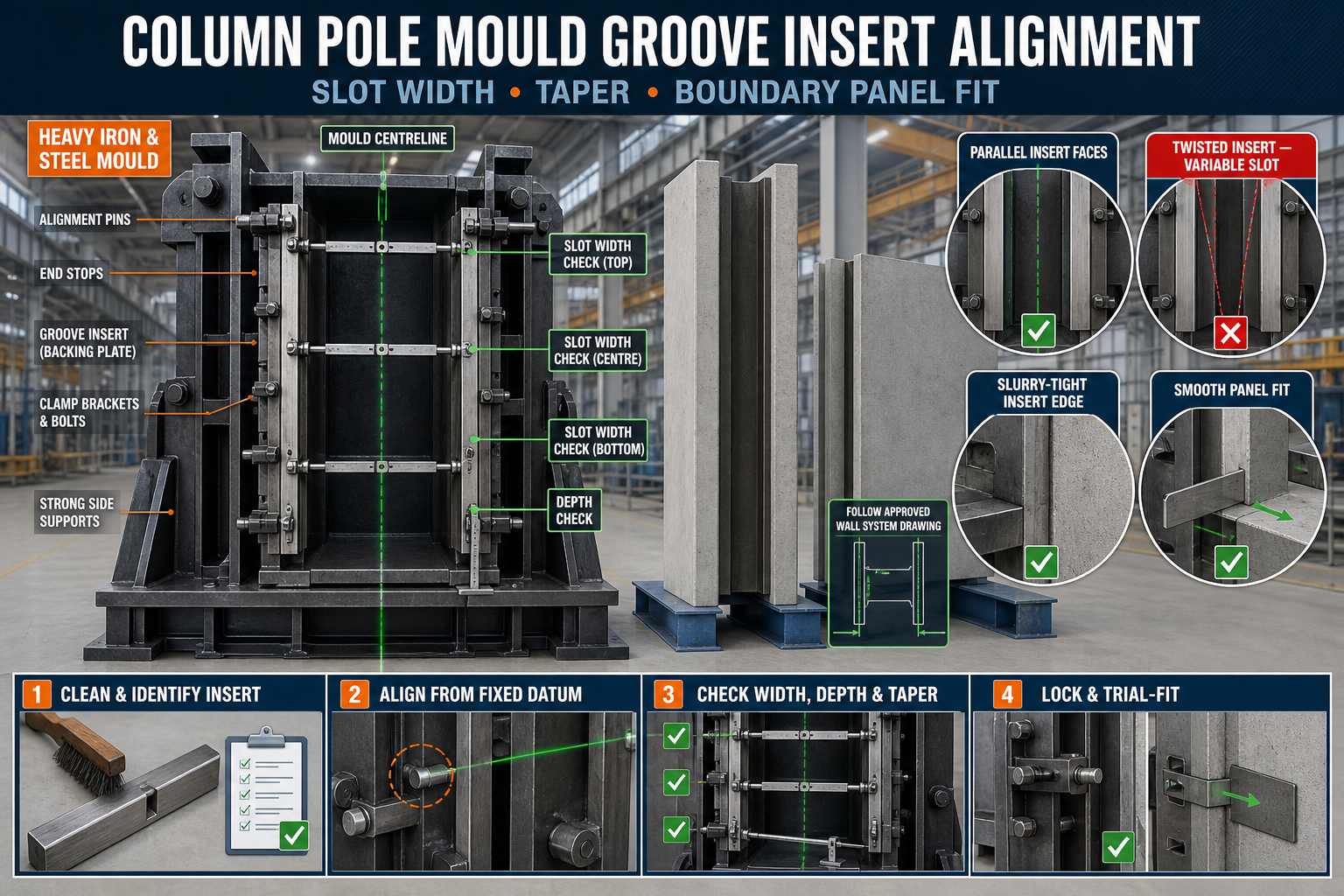
Column Pole Mould Groove Insert Alignment: Slot Width, Taper and Boundary Panel Fit Checks

Precast Mould Guide

Column Pole Mould Groove Insert Alignment: Slot Width, Taper and Boundary Panel Fit Checks

Misaligned groove inserts can produce uneven or tapered slots that prevent boundary wall panels from fitting correctly inside precast columns. This guide explains groove width, depth, taper, parallelism and trial-fit inspection.

Read article
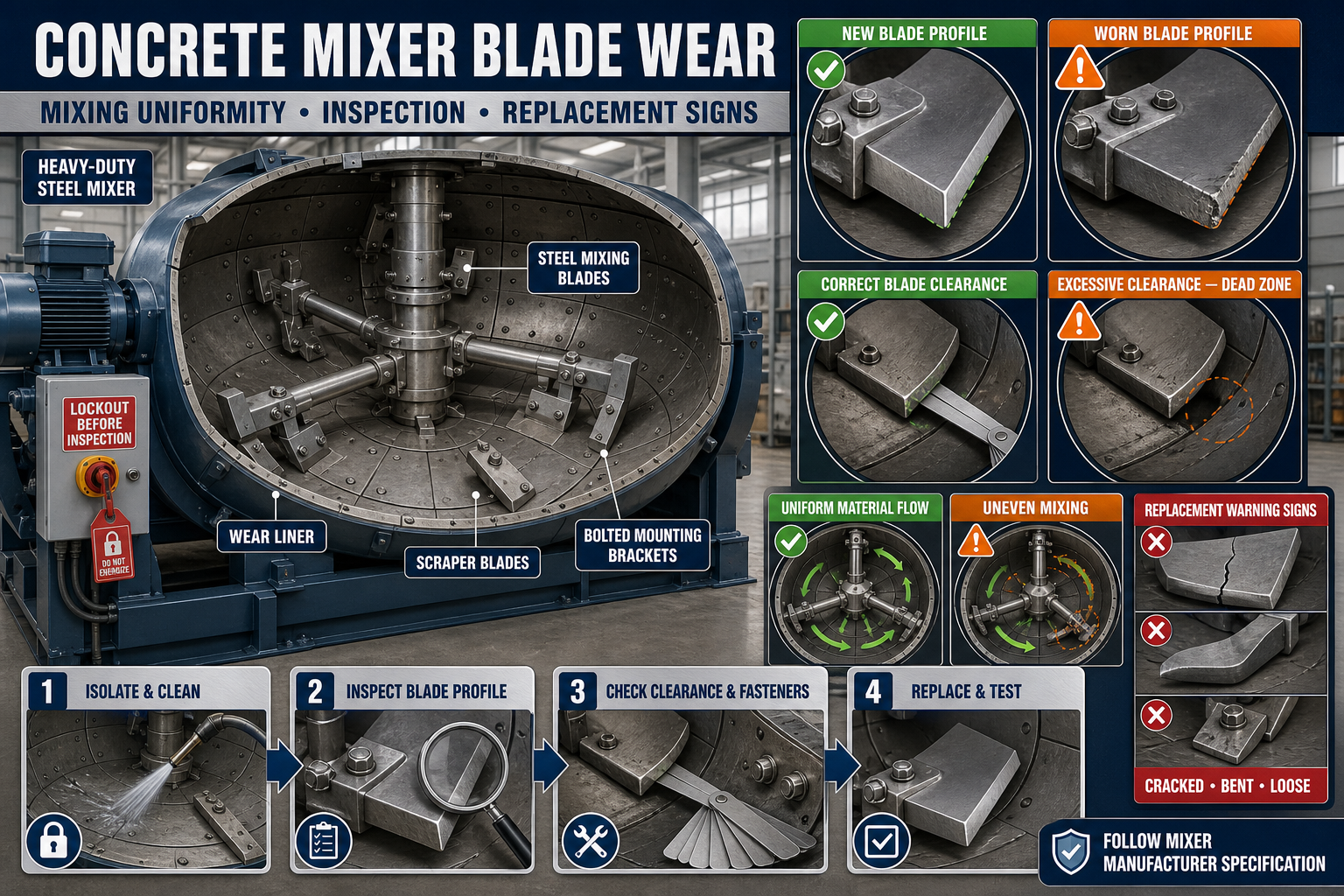
Concrete Mixer Blade Wear: Mixing Uniformity, Inspection and Replacement Warning Signs

Precast Machinery Guide

Concrete Mixer Blade Wear: Mixing Uniformity, Inspection and Replacement Warning Signs

Worn, bent or heavily coated concrete mixer blades can create dead zones and inconsistent concrete batches. This guide explains safe blade inspection, wear comparison, mixing-uniformity checks and replacement warning signs.

Read article
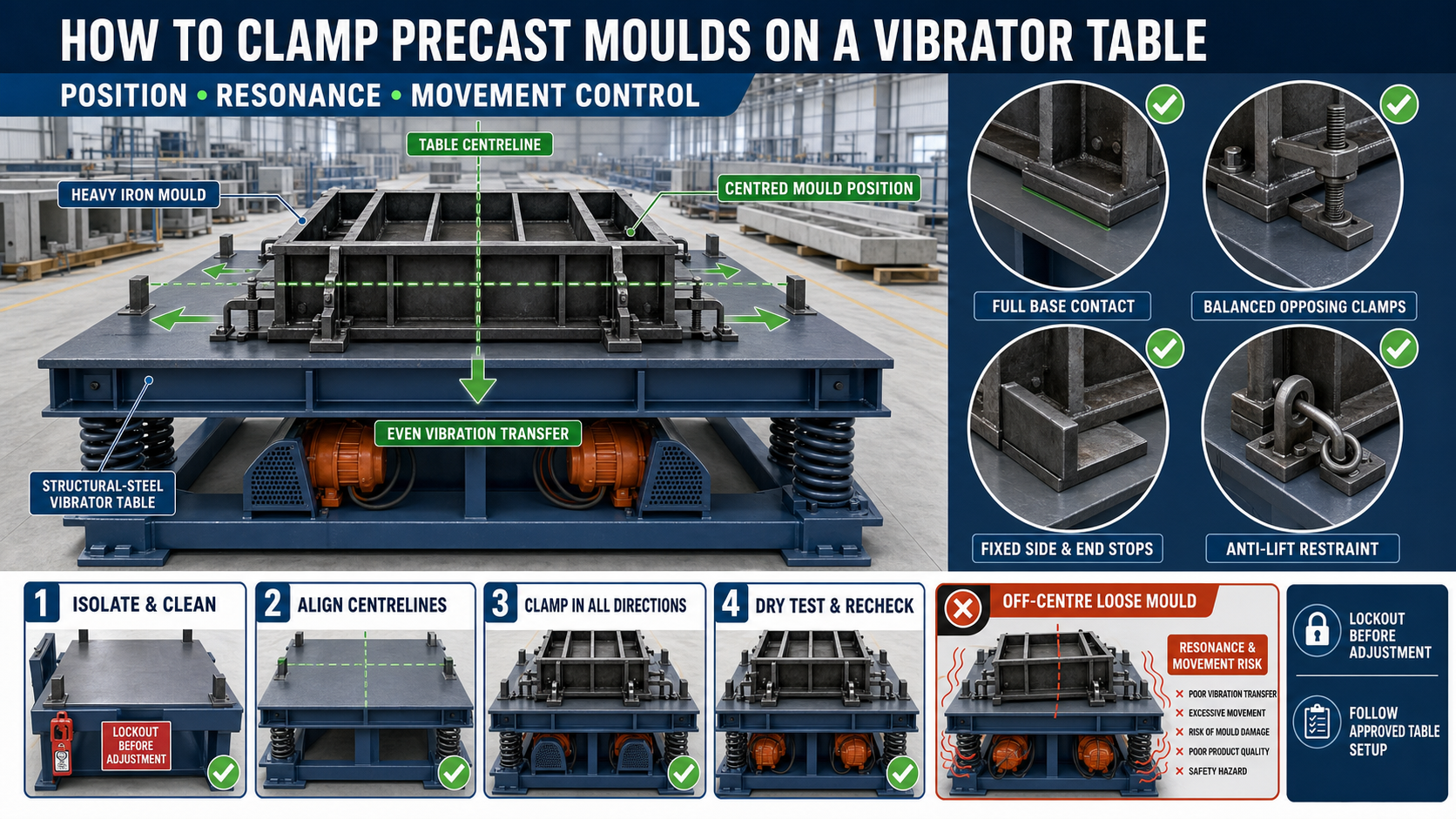
How to Clamp Precast Moulds on a Vibrator Table: Position, Resonance and Movement Control

Precast Machinery Guide

How to Clamp Precast Moulds on a Vibrator Table: Position, Resonance and Movement Control

Incorrect mould positioning or loose clamps can cause movement, noise and uneven concrete compaction on a vibrator table. This guide explains centre-of-gravity placement, clamp positioning, resonance diagnosis and safe test procedures.

Read article
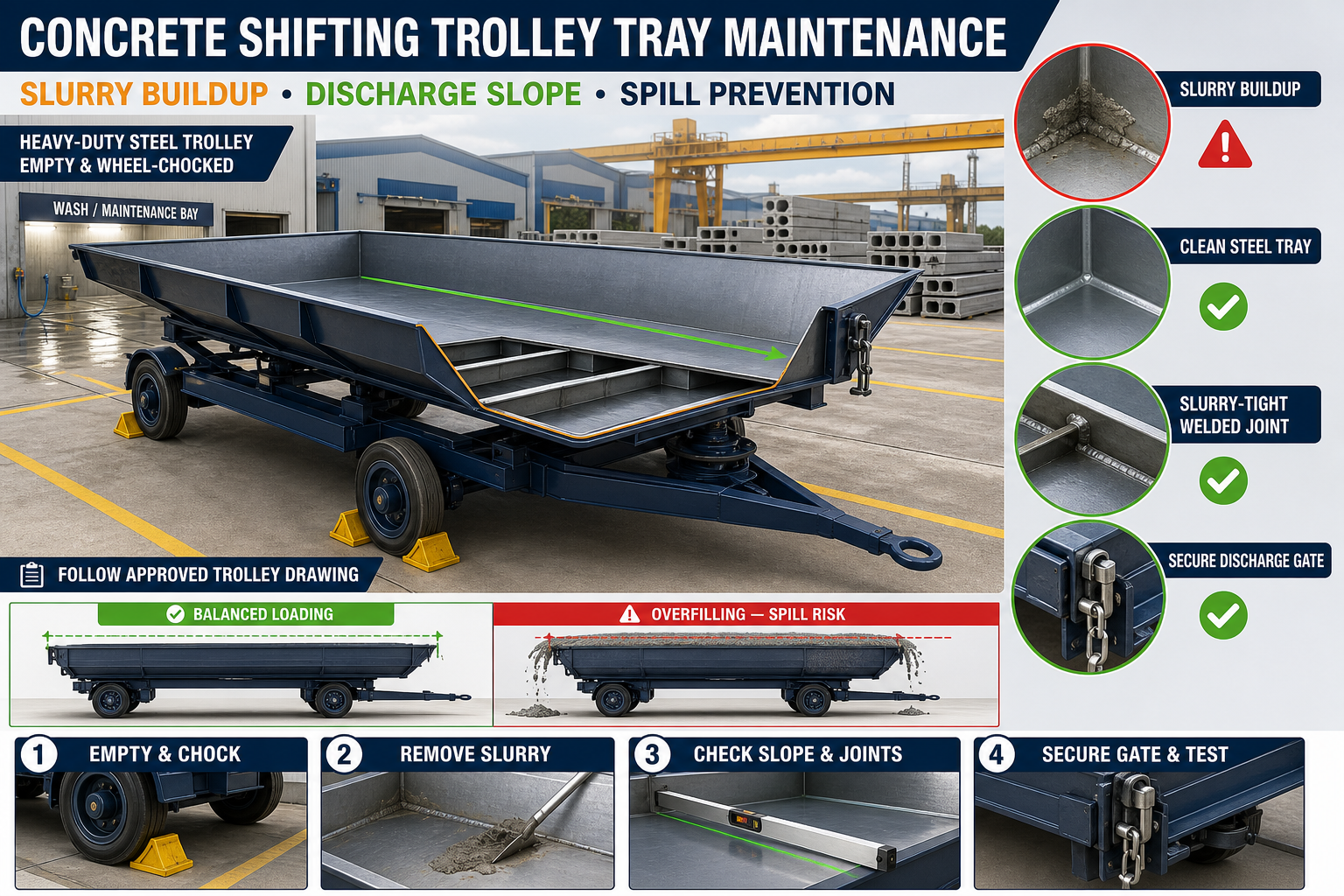
Concrete Shifting Trolley Tray Maintenance: Slurry Buildup, Discharge Slope and Spill Prevention

Precast Machinery Guide

Concrete Shifting Trolley Tray Maintenance: Slurry Buildup, Discharge Slope and Spill Prevention

Hardened slurry, a distorted tray or blocked discharge area can reduce the efficiency of a concrete shifting trolley and cause material spills. This guide explains safe cleaning, tray-slope checks, joint inspection and preventive maintenance.

Read article
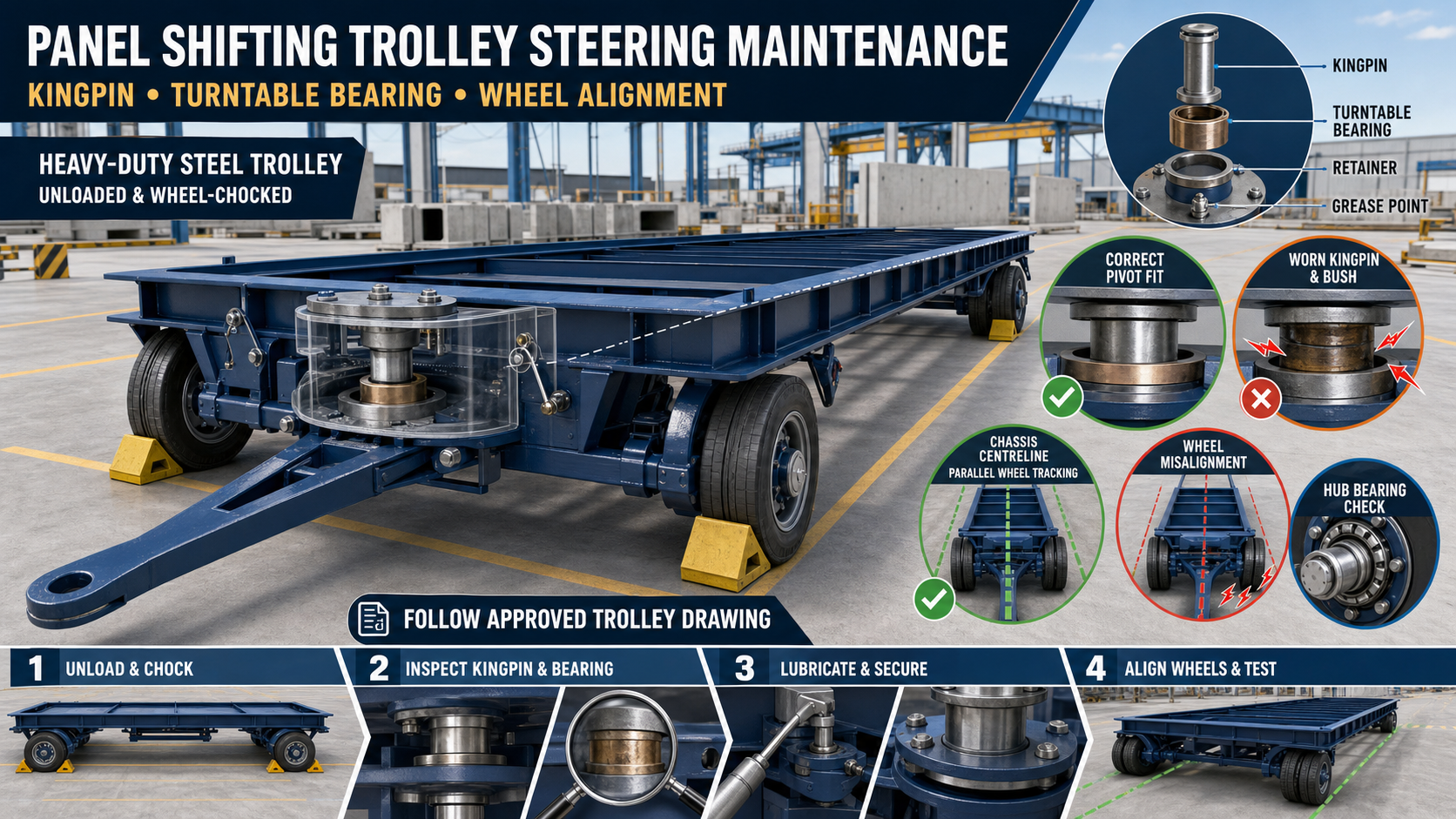
Panel Shifting Trolley Turntable Steering Maintenance: Kingpin, Bearing and Wheel Alignment Guide

Precast Machinery Guide

Panel Shifting Trolley Turntable Steering Maintenance: Kingpin, Bearing and Wheel Alignment Guide

A worn kingpin, loose turntable bearing or incorrect wheel alignment can make a panel shifting trolley difficult to steer and increase tyre or structural wear. This guide explains safe inspection, lubrication, steering adjustment and maintenance.

Read article
Highway Barrier Mould Wedge Lock Maintenance: Clamping Pressure, Wear and Slurry Leakage Guide

Precast Mould Guide

Highway Barrier Mould Wedge Lock Maintenance: Clamping Pressure, Wear and Slurry Leakage Guide

Worn or unevenly adjusted wedge locks can leave gaps in a highway barrier mould and cause slurry leakage, concrete fins or difficult demoulding. This guide explains lock inspection, balanced clamping, wear diagnosis and maintenance.

Read article
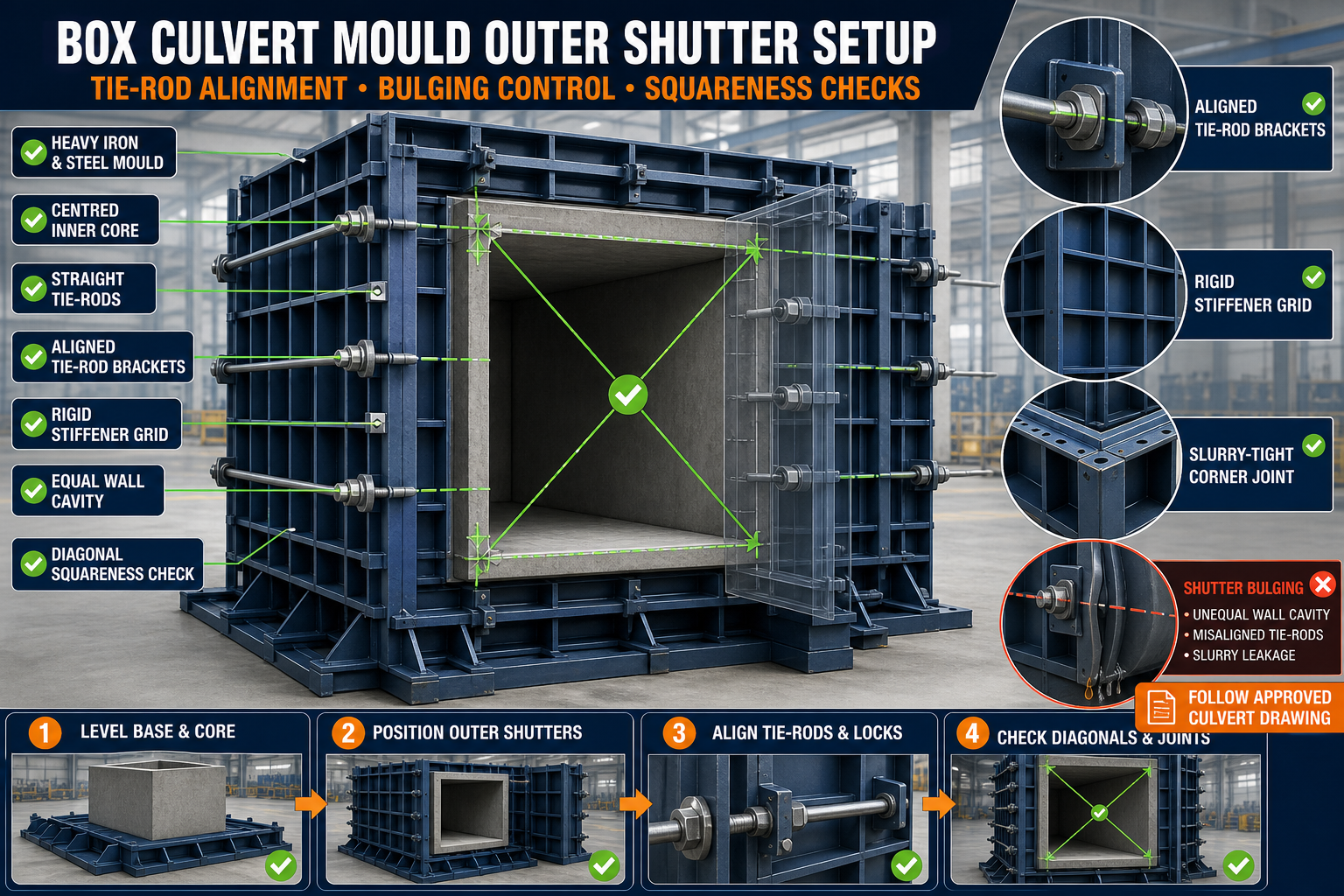
Box Culvert Mould Outer Shutter Setup: Tie-Rod Alignment, Bulging Control and Squareness Checks

Precast Mould Guide

Box Culvert Mould Outer Shutter Setup: Tie-Rod Alignment, Bulging Control and Squareness Checks

Correct outer-shutter setup helps a box culvert mould maintain wall thickness, squareness and slurry-tight joints during casting. This guide explains tie-rod alignment, stiffener inspection, bulging control and diagonal checks.

Read article
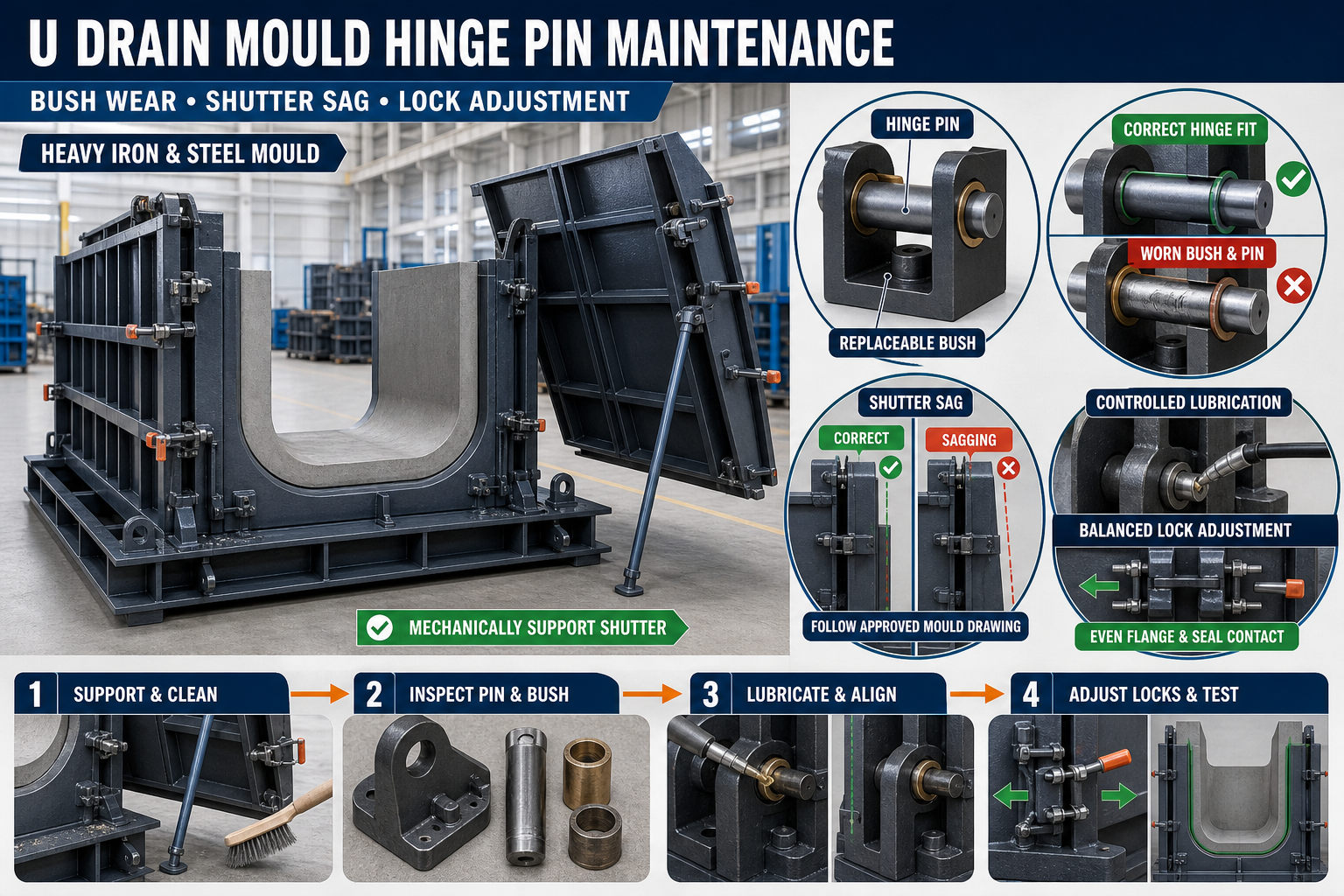
U Drain Mould Hinge Pin Maintenance: Bush Wear, Shutter Sag and Lock Adjustment Guide

Precast Mould Guide

U Drain Mould Hinge Pin Maintenance: Bush Wear, Shutter Sag and Lock Adjustment Guide

Worn hinge pins and bushes can make an iron U drain mould shutter sag, bind or close unevenly. This guide explains hinge inspection, clearance diagnosis, lubrication, pin replacement and lock adjustment for reliable production.

Read article
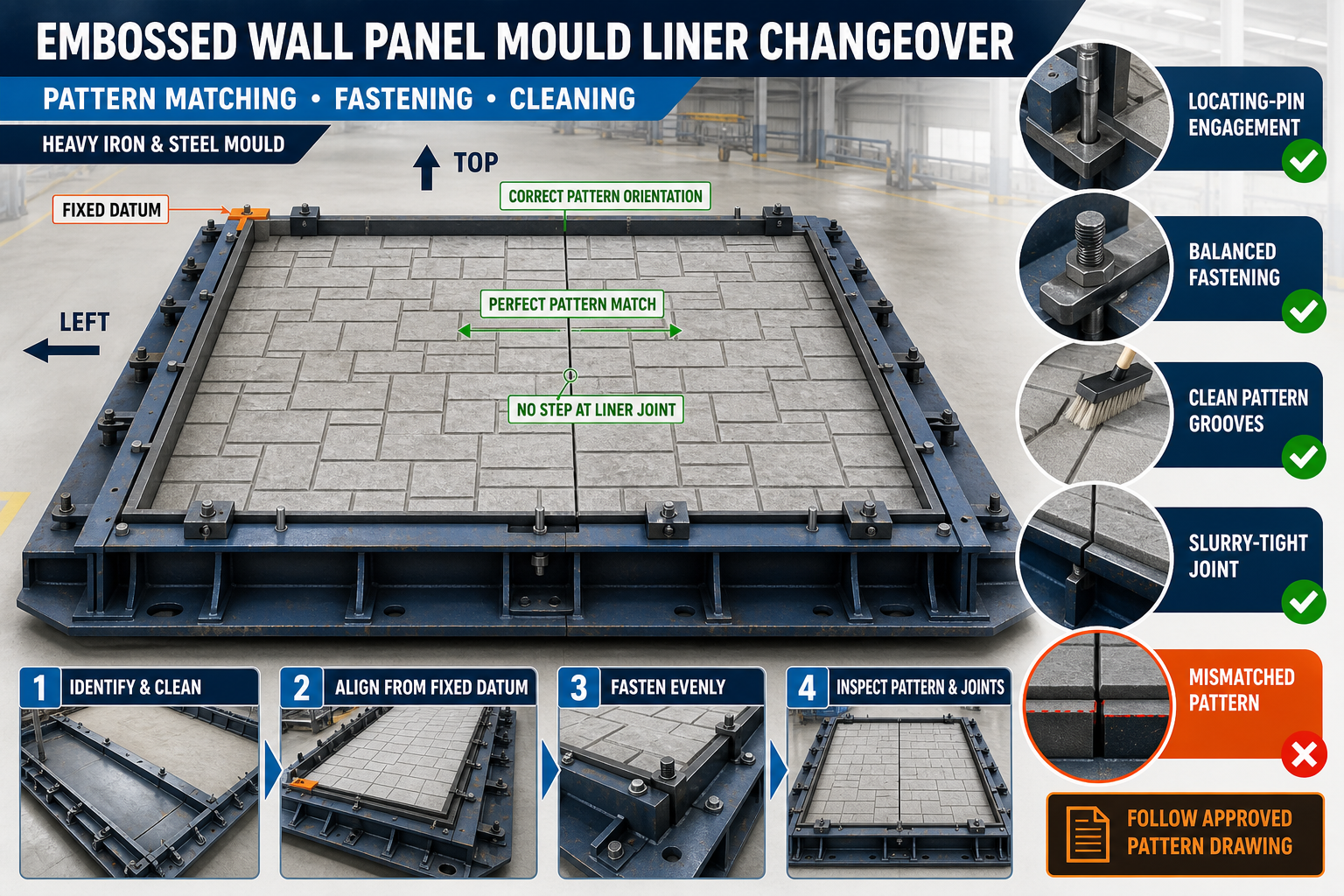
Embossed Wall Panel Mould Liner Changeover: Pattern Matching, Fastening and Cleaning Guide

Precast Mould Guide

Embossed Wall Panel Mould Liner Changeover: Pattern Matching, Fastening and Cleaning Guide

An accurate mould-liner changeover helps produce consistent embossed wall panels without pattern mismatch, joint lines or slurry leakage. This guide explains liner identification, fixed-datum positioning, fastening, cleaning and final inspection.

Read article
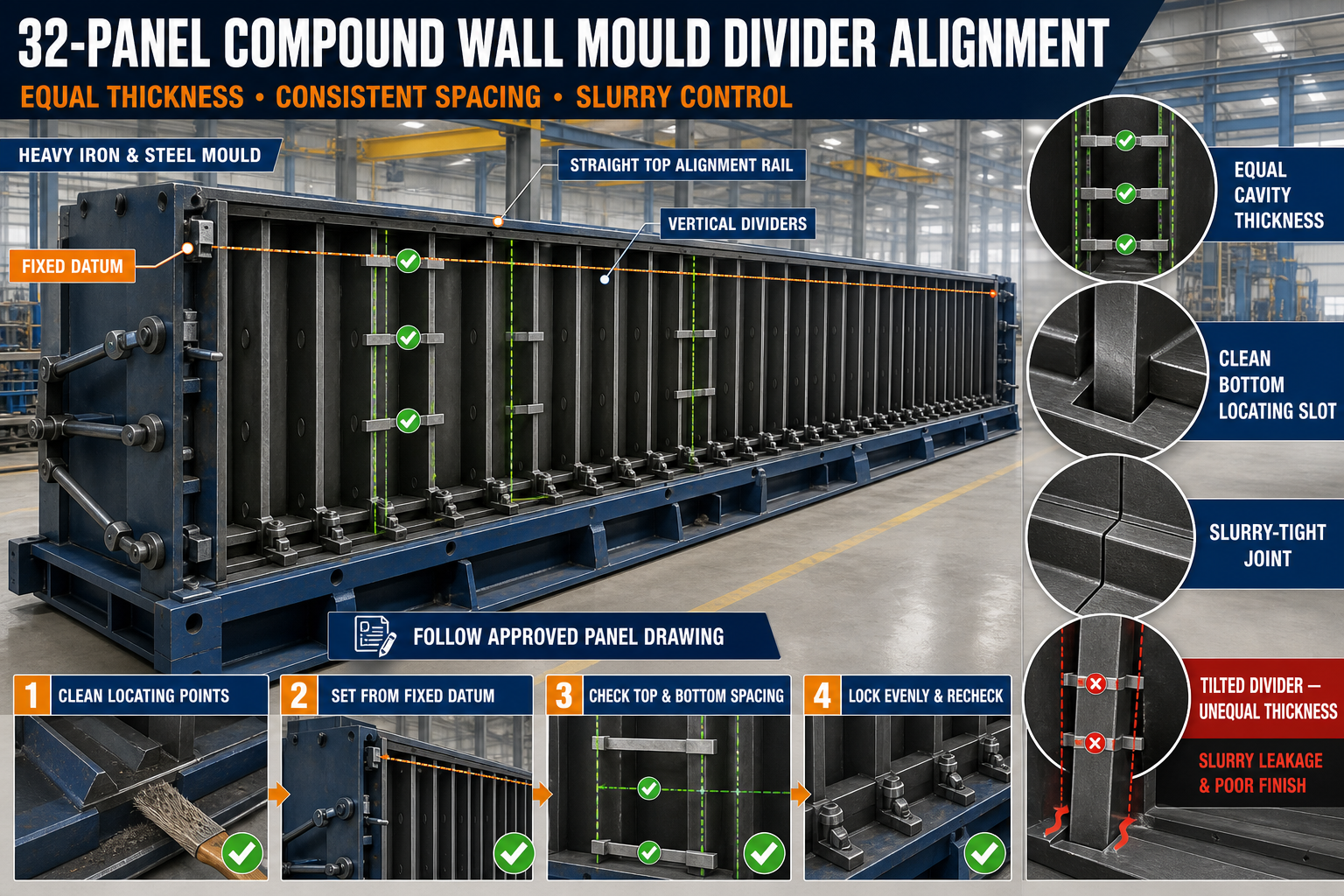
32-Panel Compound Wall Mould Divider Alignment: Equal Panel Thickness, Spacing and Slurry Control

Precast Mould Guide

32-Panel Compound Wall Mould Divider Alignment: Equal Panel Thickness, Spacing and Slurry Control

Accurate divider alignment is essential in a 32-panel compound wall mould because one displaced divider can affect several concrete panels. This guide explains fixed-datum spacing, thickness checks, divider locking and slurry-leakage control.

Read article
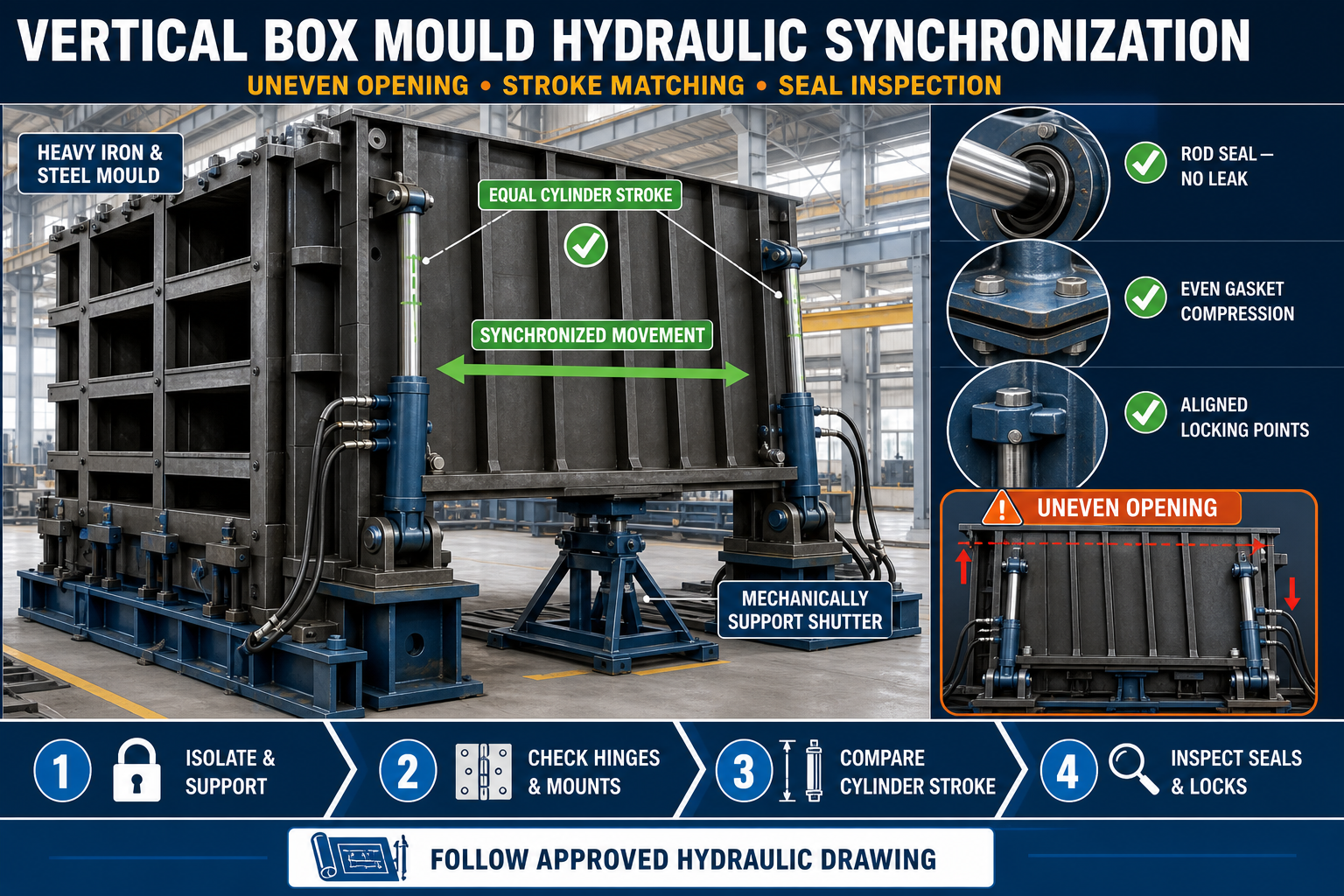
Vertical Box Mould Hydraulic Cylinder Synchronization: Uneven Opening, Stroke Matching and Seal Inspection

Precast Mould Guide

Vertical Box Mould Hydraulic Cylinder Synchronization: Uneven Opening, Stroke Matching and Seal Inspection

Uneven hydraulic-cylinder movement can twist vertical box mould shutters, damage seals and affect panel dimensions. This guide explains how to inspect cylinder synchronization, compare shutter stroke, identify oil leakage and restore balanced opening safely.

Read article
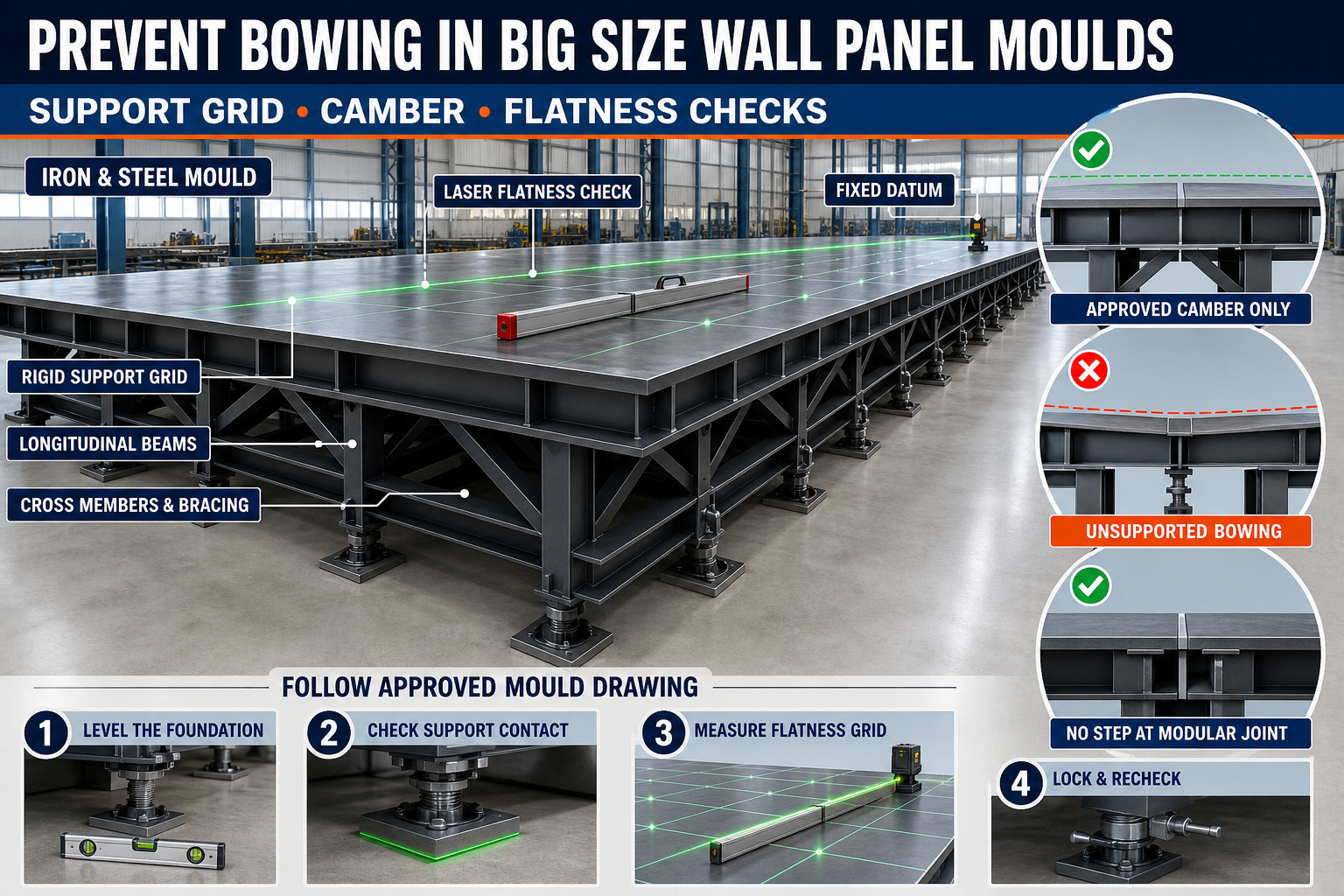
How to Prevent Bowing in Big Size Wall Panel Moulds: Support Grid, Camber and Flatness Checks

Precast Mould Guide

How to Prevent Bowing in Big Size Wall Panel Moulds: Support Grid, Camber and Flatness Checks

Bowing in a big size wall panel mould can produce curved panels, uneven joints and installation problems. This guide explains how iron support grids, approved camber, level foundations and regular flatness checks help maintain mould accuracy.

Read article
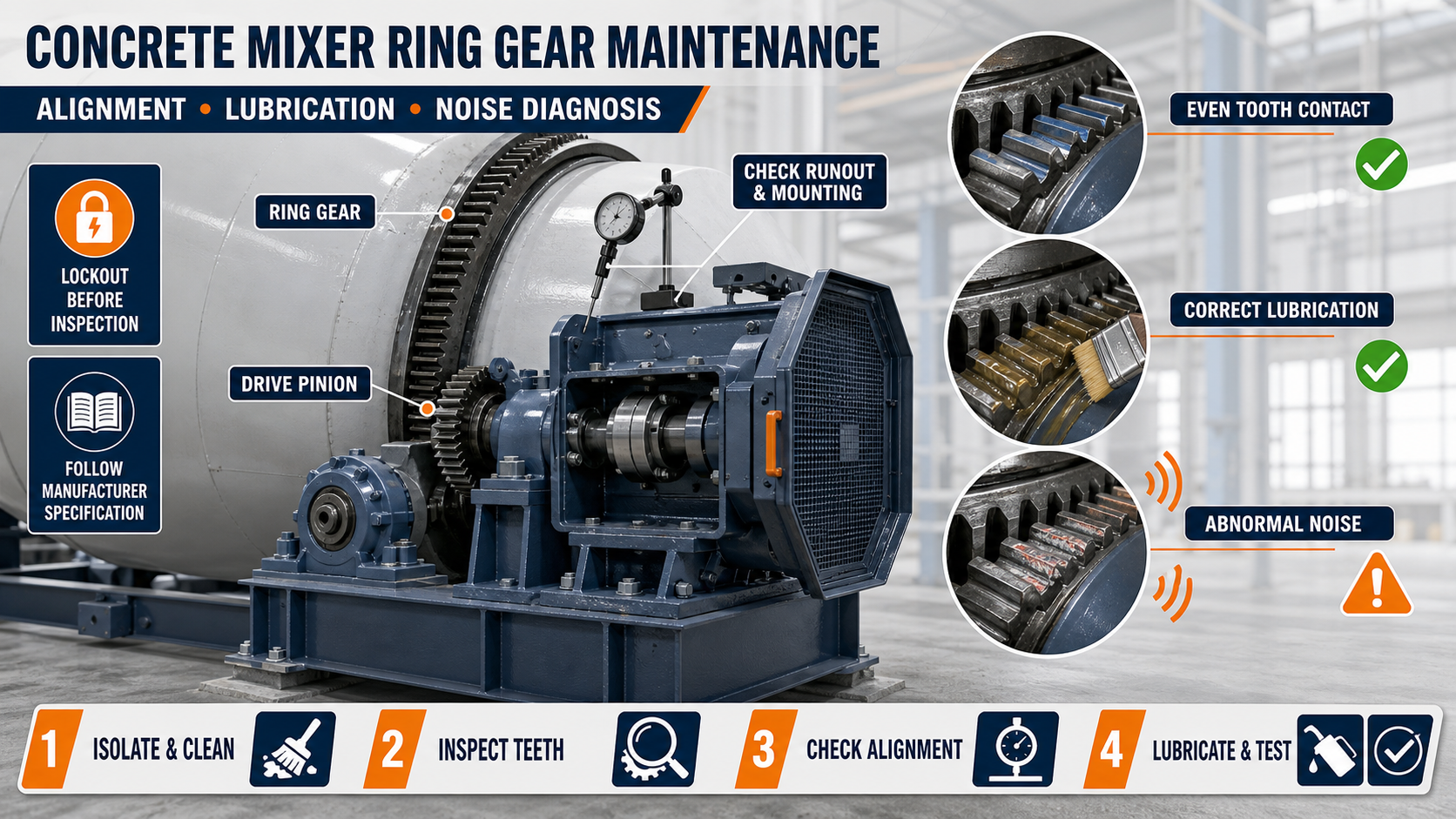
Concrete Mixer Ring Gear Maintenance: Alignment, Lubrication and Noise Diagnosis

Precast Machinery Guide

Concrete Mixer Ring Gear Maintenance: Alignment, Lubrication and Noise Diagnosis

Regular concrete mixer ring gear maintenance helps reduce abnormal noise, uneven tooth wear and unexpected machine stoppages. This guide explains safe inspection, gear and pinion alignment, correct lubrication and common fault diagnosis.

Read article
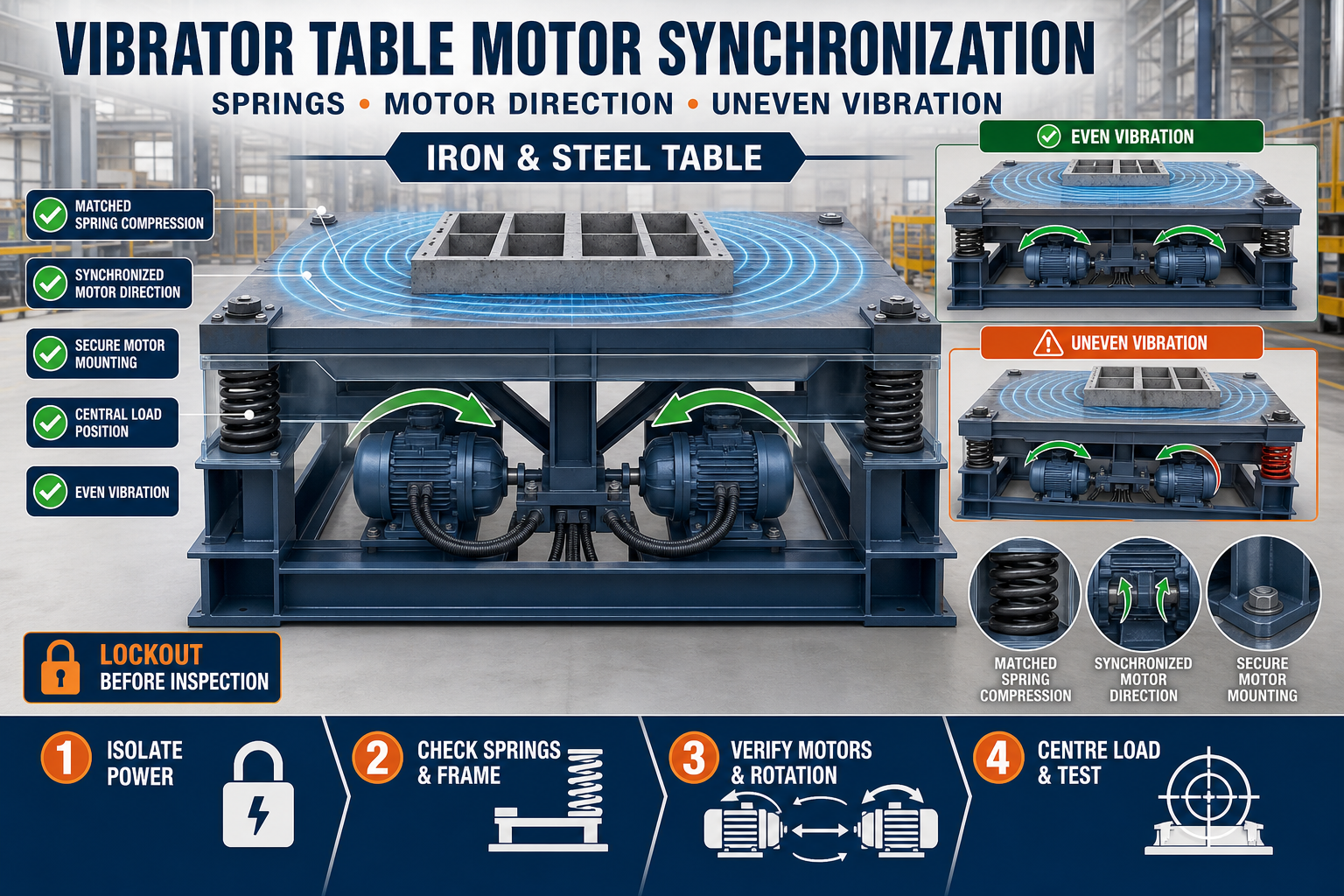
Vibrator Table Spring and Motor Synchronization: Uneven Vibration Troubleshooting Guide

Precast Machinery Guide

Vibrator Table Spring and Motor Synchronization: Uneven Vibration Troubleshooting Guide

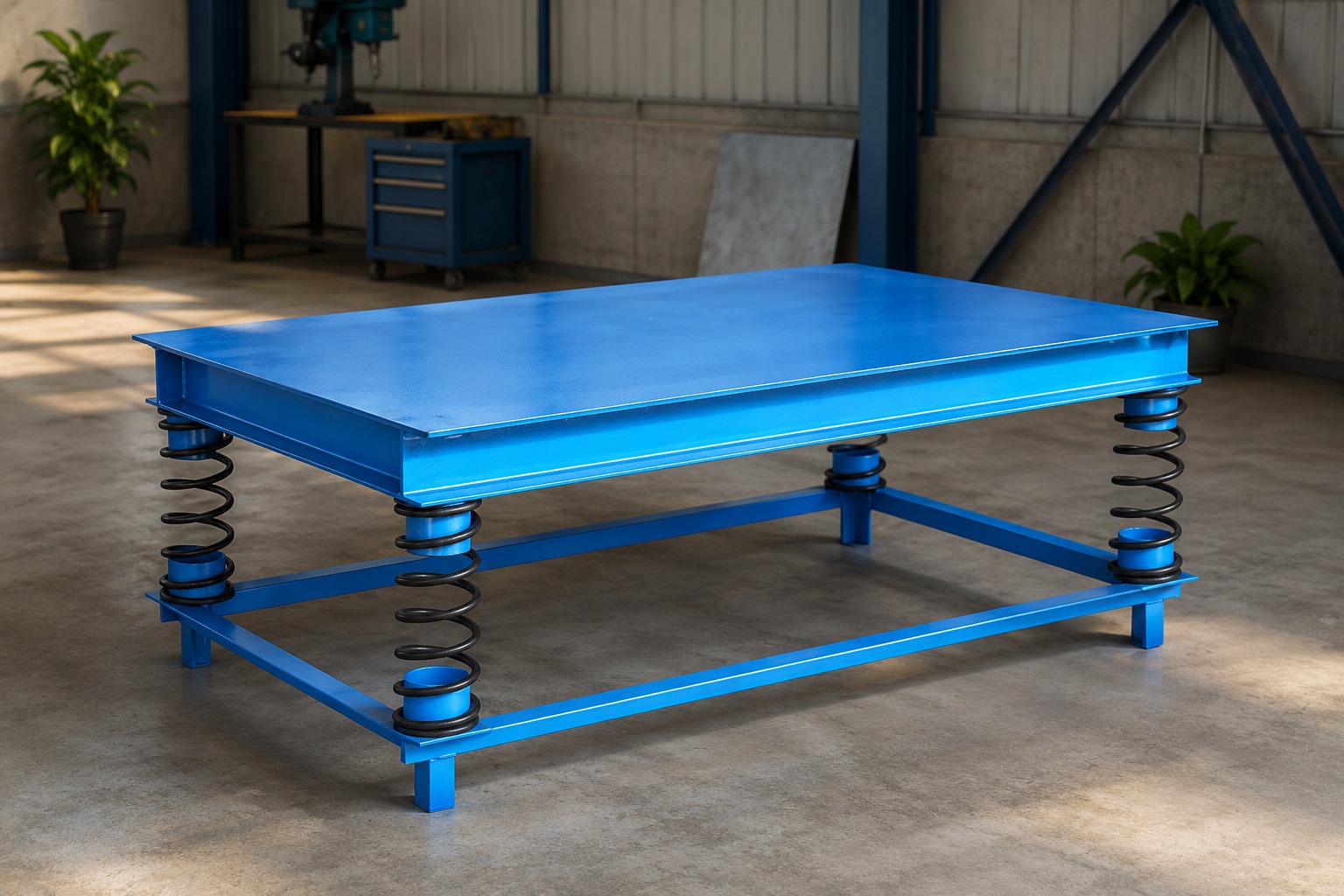
Uneven vibration can cause poor concrete compaction, surface defects and inconsistent precast products. This guide explains how to inspect vibrator table springs, motor synchronization, mounting bolts, rotation direction and load distribution safely.

Read article
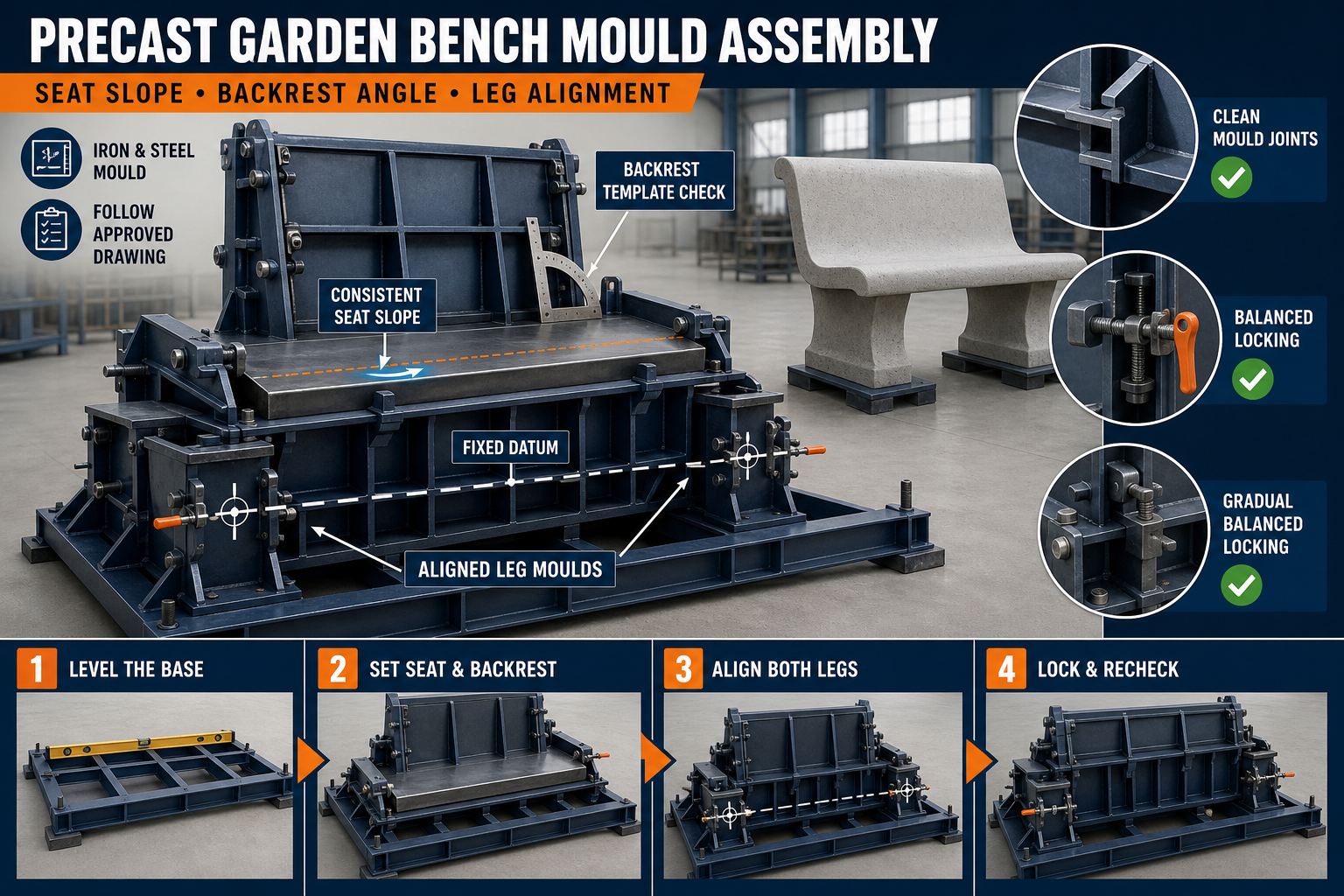
Precast Garden Bench Mould Assembly: Seat Slope, Backrest Angle and Leg Alignment Guide

Precast Mould Guide

Precast Garden Bench Mould Assembly: Seat Slope, Backrest Angle and Leg Alignment Guide

Accurate garden bench mould assembly is essential for producing comfortable, stable and visually consistent precast concrete benches. This guide explains how to check the seat slope, backrest angle, leg alignment, mould joints and locking system before casting.

Read article
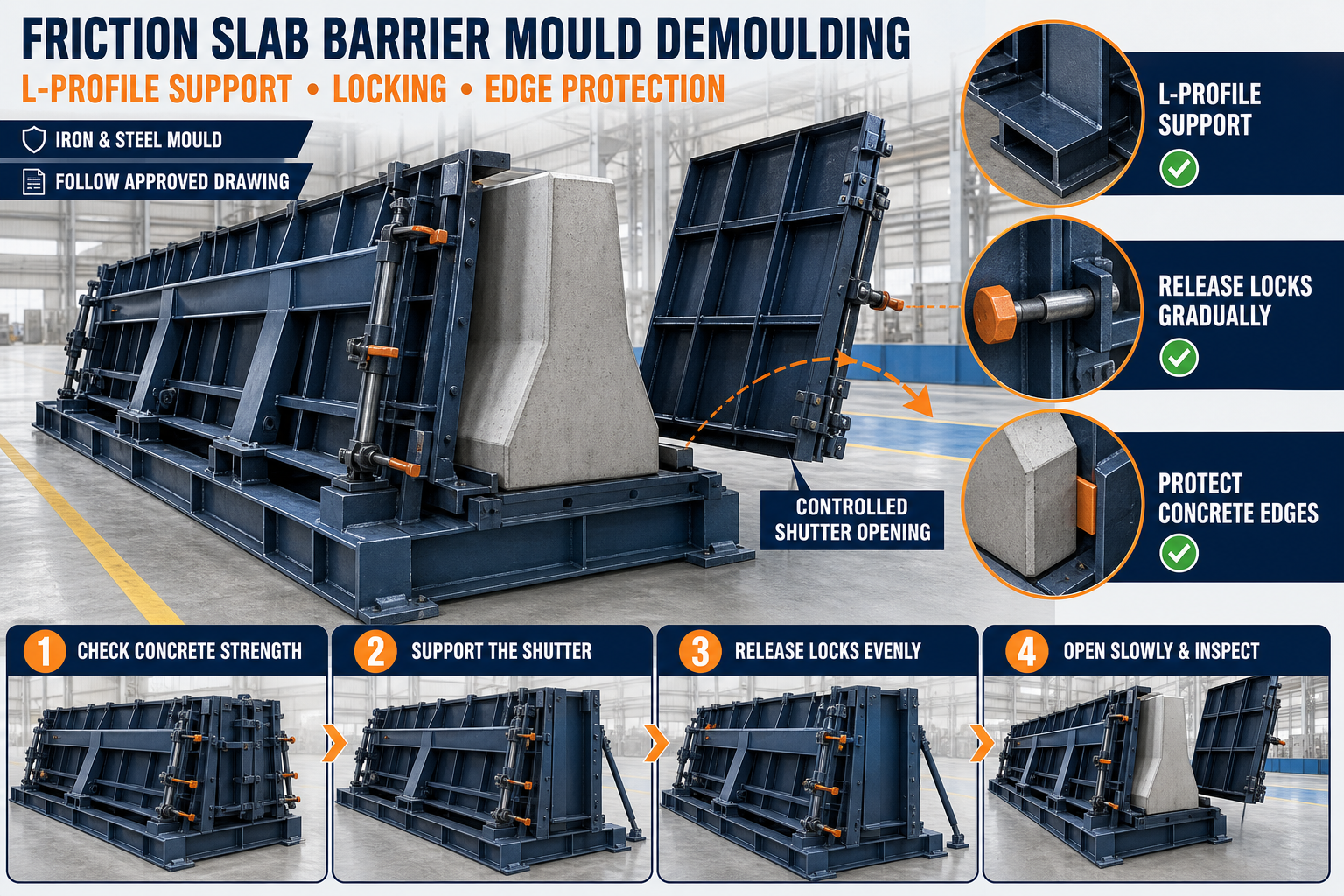
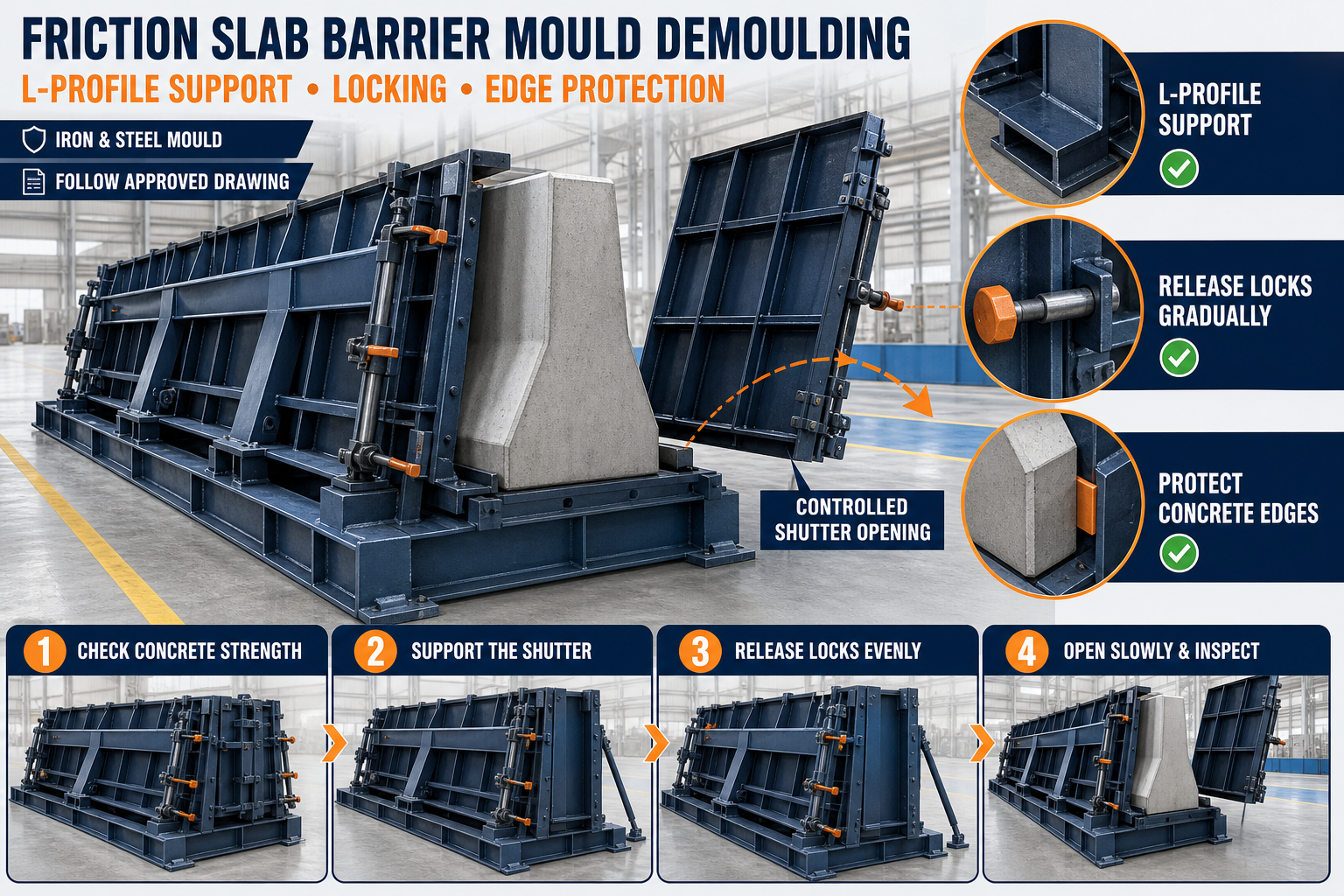
Friction Slab Barrier Mould Demoulding: L-Profile Support, Locking and Edge Protection Guide

Precast Mould Guide

Friction Slab Barrier Mould Demoulding: L-Profile Support, Locking and Edge Protection Guide

Correct demoulding of a precast friction slab barrier depends on stable L-profile support, properly released locking points and careful edge protection. This guide explains a practical demoulding process that helps prevent concrete damage, protect the heavy-duty iron mould and maintain consistent production quality.

Read article
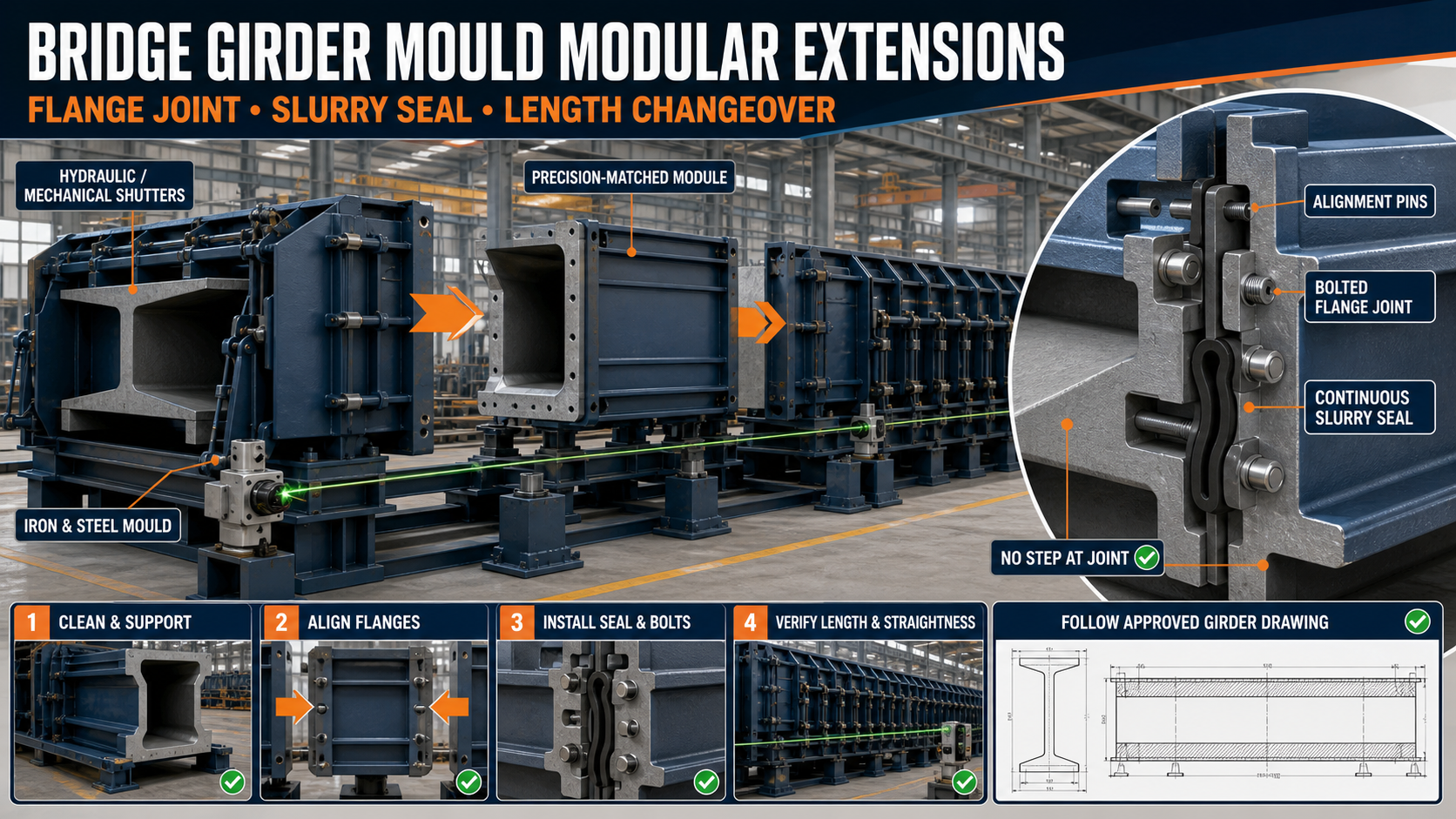
Bridge Girder Mould Modular Extensions: Flange Joint, Slurry Seal and Length Changeover Guide

Precast Infrastructure Moulds

Bridge Girder Mould Modular Extensions: Flange Joint, Slurry Seal and Length Changeover Guide

Modular bridge girder mould extensions allow compatible girder lengths to be produced using accurately matched steel sections. This guide explains flange-joint alignment, slurry sealing, length changeover and dimensional inspection.

Read article
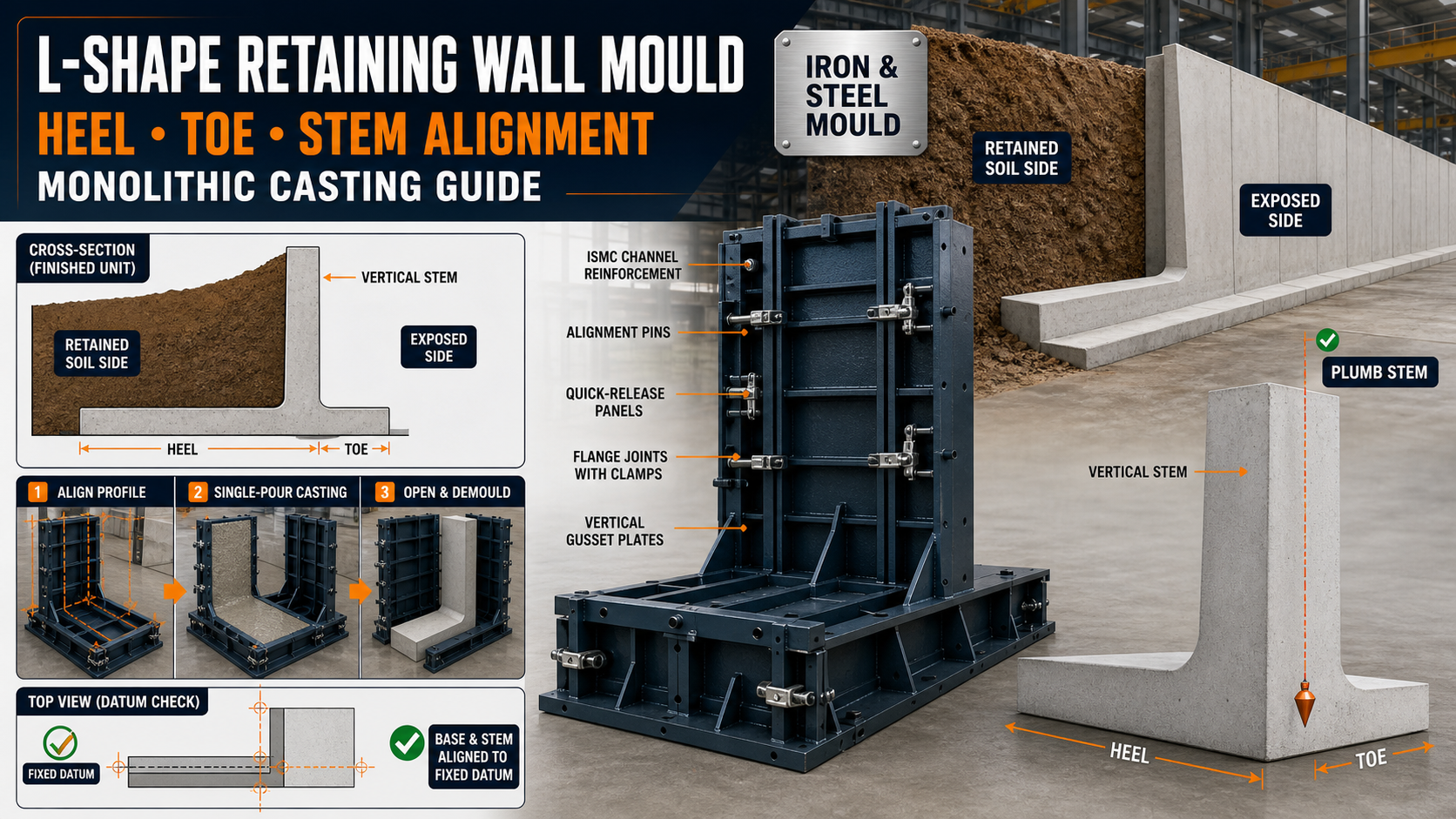
L-Shape Retaining Wall Mould: Heel, Toe, Stem Alignment and Monolithic Casting Guide

Precast Infrastructure Moulds

L-Shape Retaining Wall Mould: Heel, Toe, Stem Alignment and Monolithic Casting Guide

An L-shape retaining wall mould casts the vertical stem and horizontal foundation base as one monolithic concrete unit. This guide explains heel, toe and stem alignment, reinforcement, casting, demoulding and quality checks.

Read article
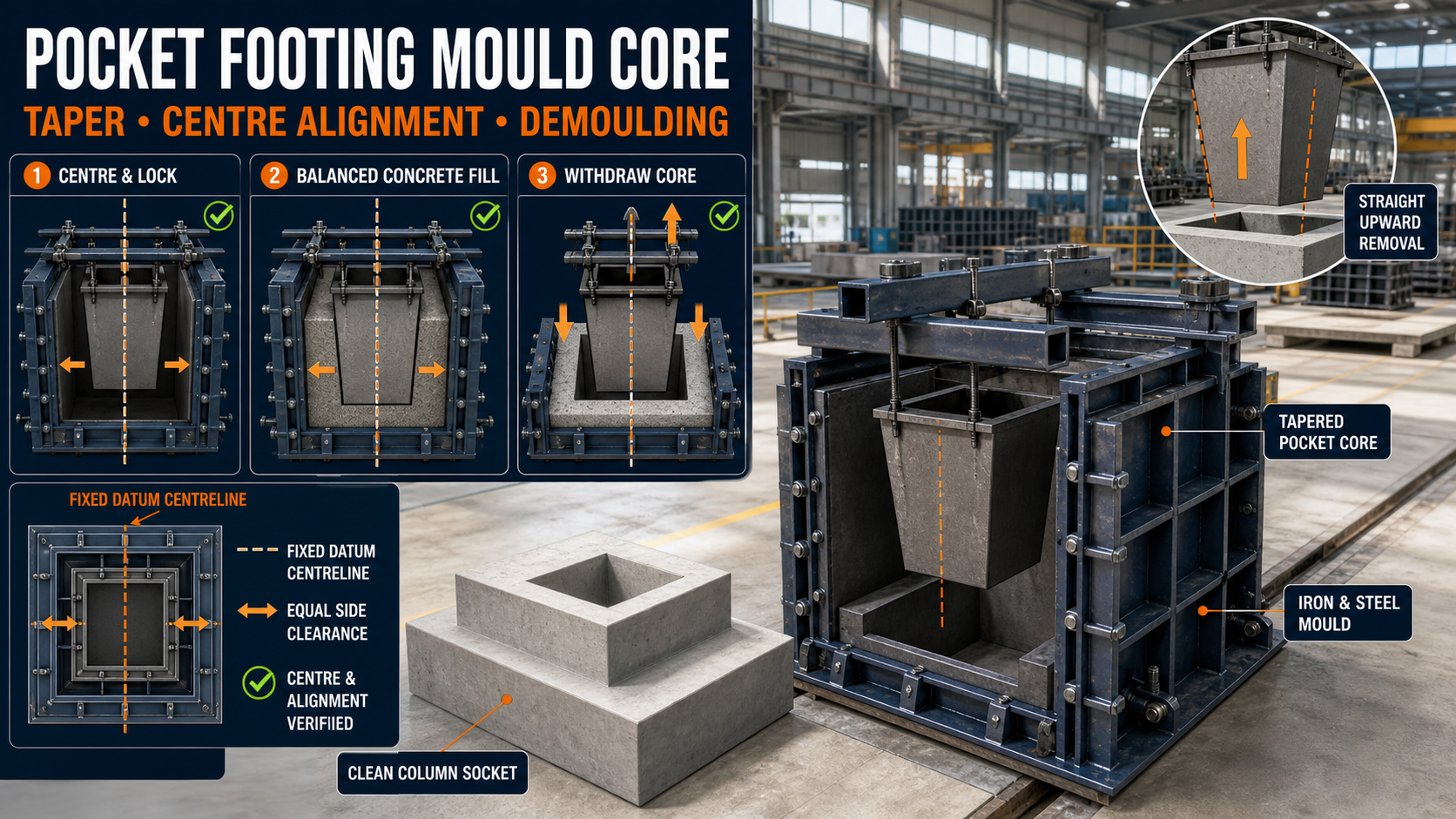
Pocket Footing Mould Core: Taper, Centre Alignment and Easy Demoulding Guide

Precast Infrastructure Moulds

Pocket Footing Mould Core: Taper, Centre Alignment and Easy Demoulding Guide

A tapered and correctly centred pocket core forms the column socket inside a precast footing. This guide explains core taper, centre alignment, locking, casting, demoulding and maintenance requirements.

Read article
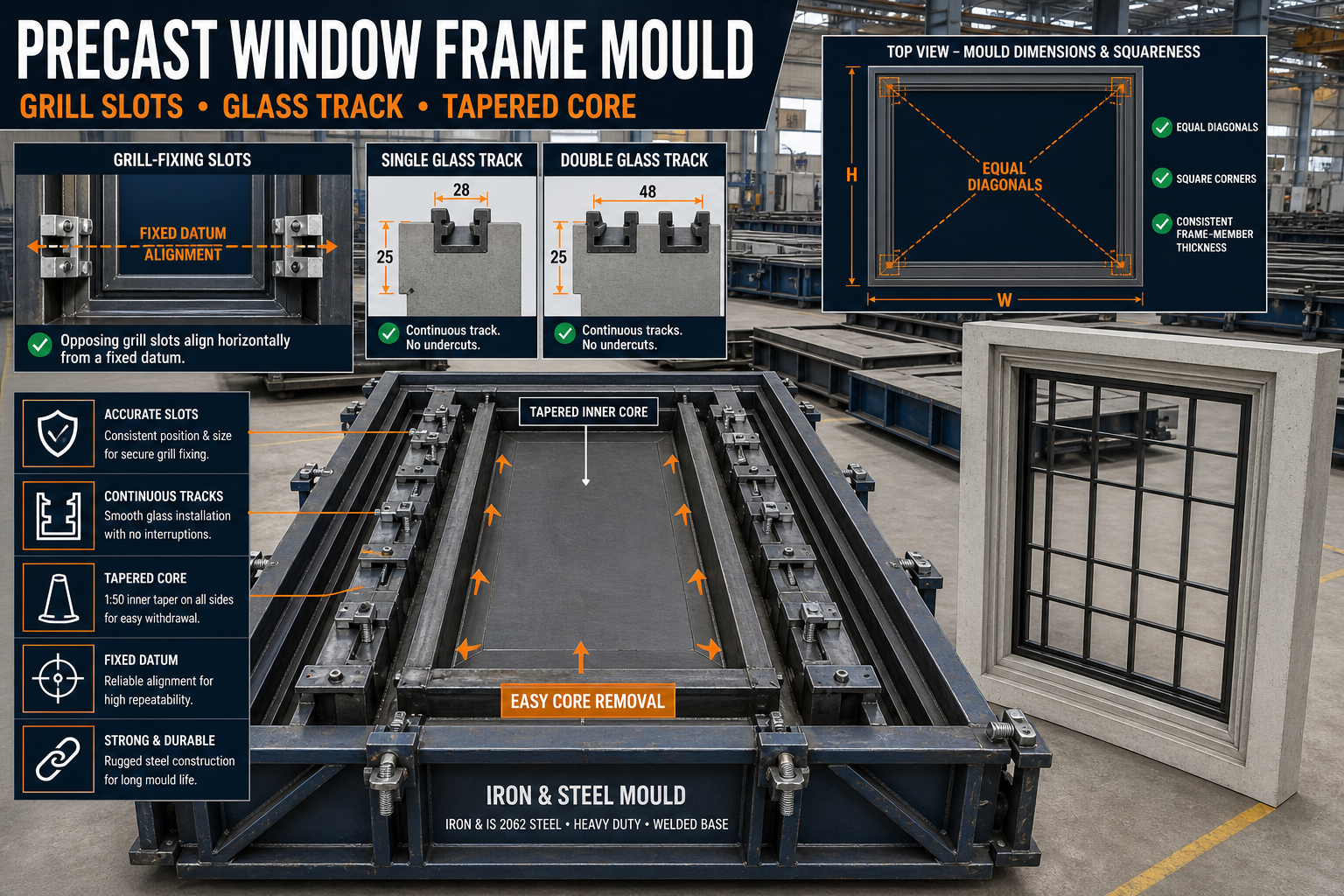
Precast Window Frame Mould Slot Design: Grill Fixing, Glass Track and Tapered Core Guide

Precast Building Solutions

Precast Window Frame Mould Slot Design: Grill Fixing, Glass Track and Tapered Core Guide

Accurate grill-fixing slots, glass-track grooves and tapered core design improve the fit and finish of precast concrete window frames. This guide explains slot positioning, mould alignment, casting, demoulding and quality checks.

Read article
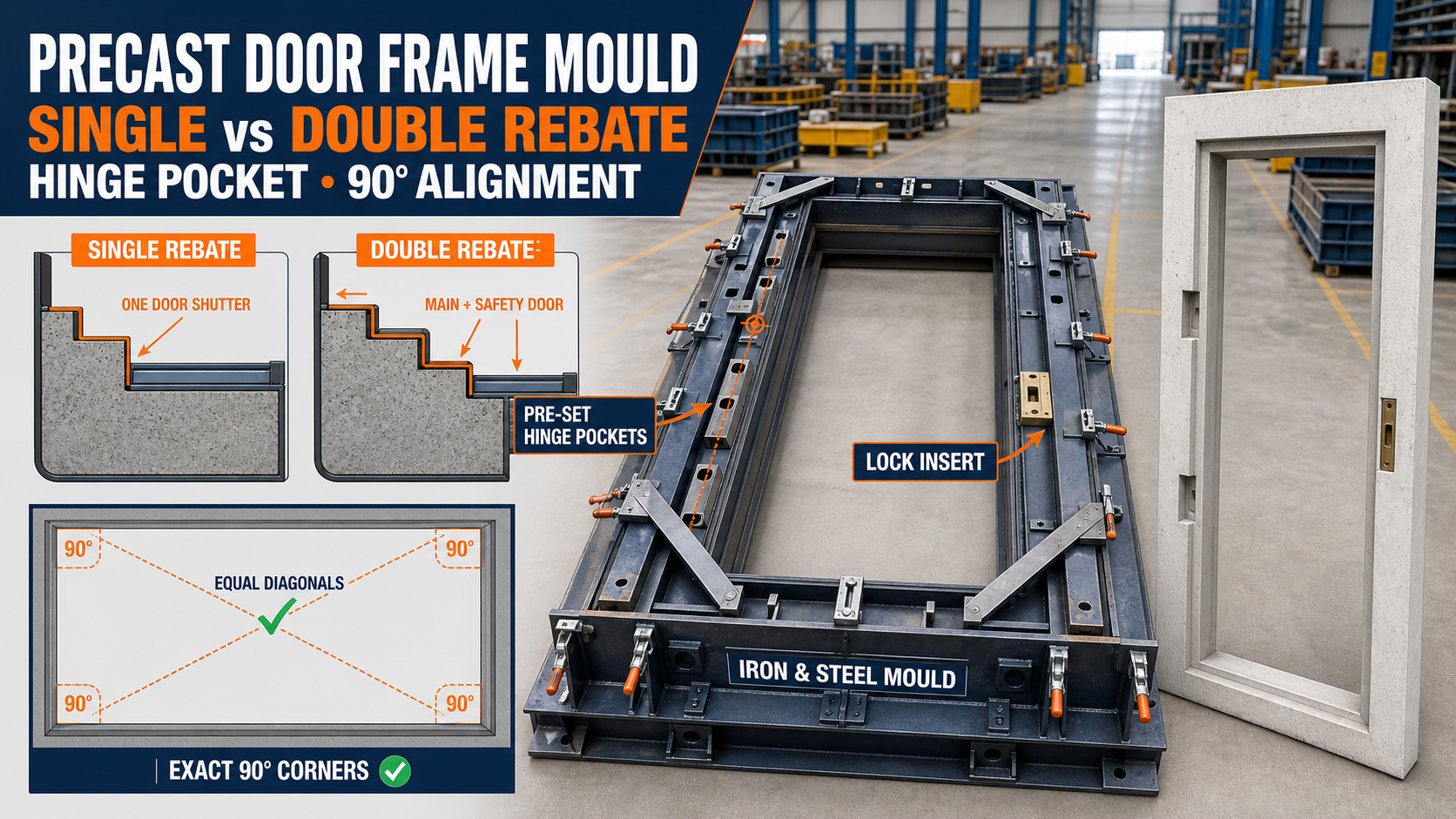
Precast Door Frame Mould Rebate System: Single vs Double Rebate, Hinge Pocket and Alignment Guide

Precast Building Solutions

Precast Door Frame Mould Rebate System: Single vs Double Rebate, Hinge Pocket and Alignment Guide

The rebate profile, hinge-pocket position and 90-degree alignment of a precast door frame directly affect door installation. This guide explains single and double rebate mould systems, insert positioning, casting and quality checks.

Read article
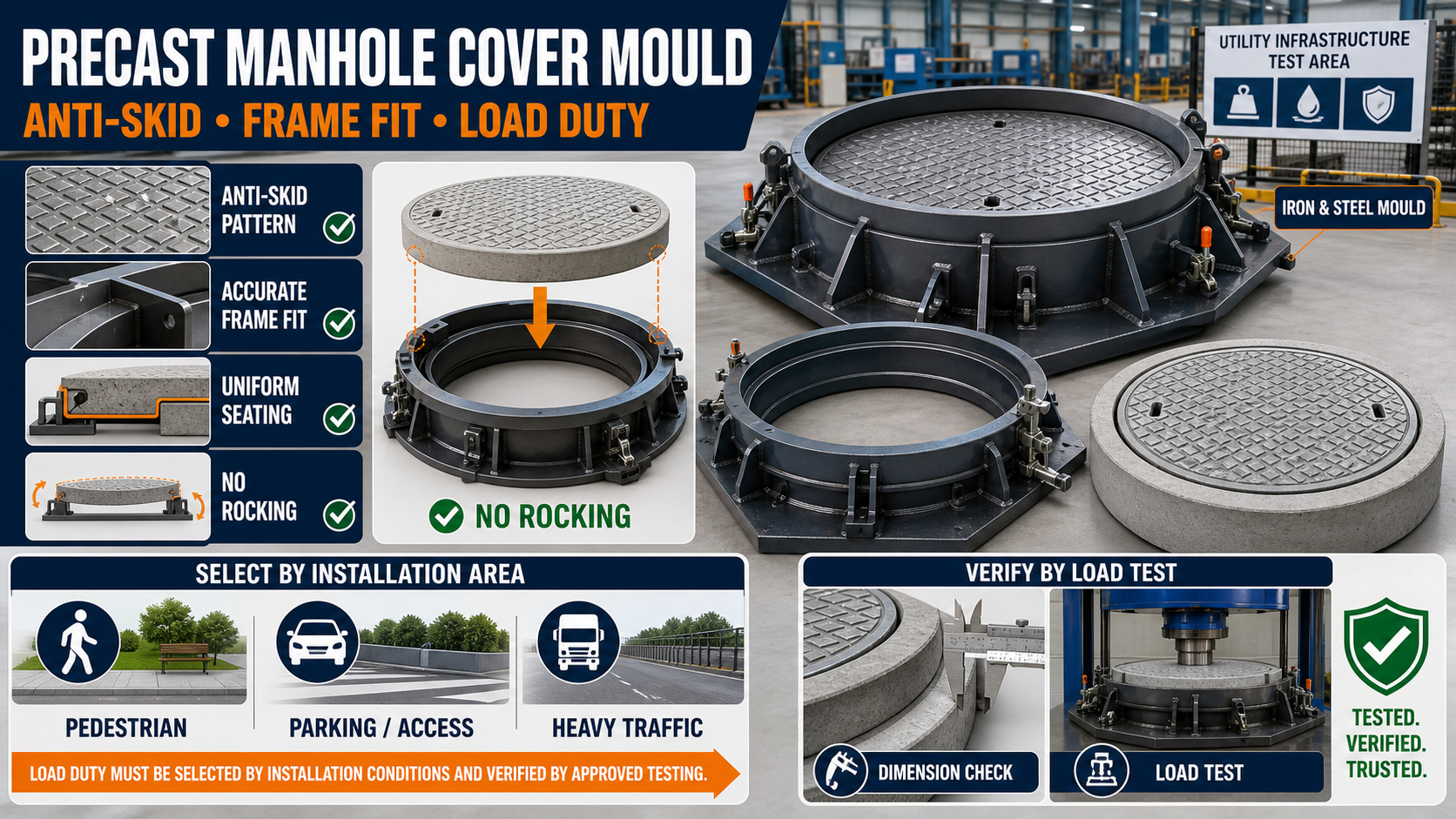
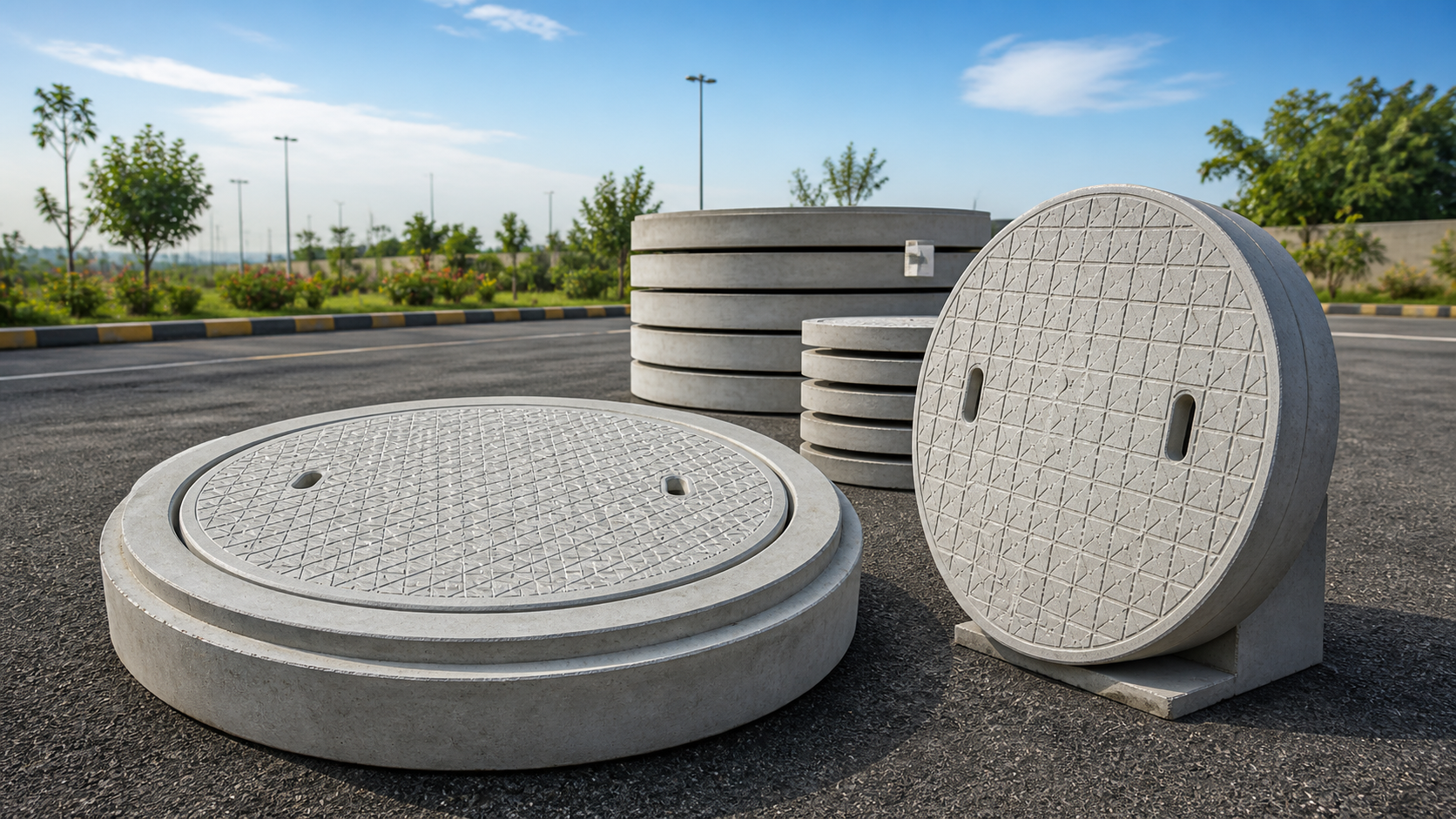
Precast Manhole Cover Mould: Anti-Skid Pattern, Frame Fit and Load-Duty Selection

Precast Mould Guide

Precast Manhole Cover Mould: Anti-Skid Pattern, Frame Fit and Load-Duty Selection

A precast manhole cover mould must produce an accurate anti-skid surface, consistent cover-to-frame seating and the specified dimensions. This guide explains mould patterns, frame fit, load-duty selection, production and quality checks.

Read article
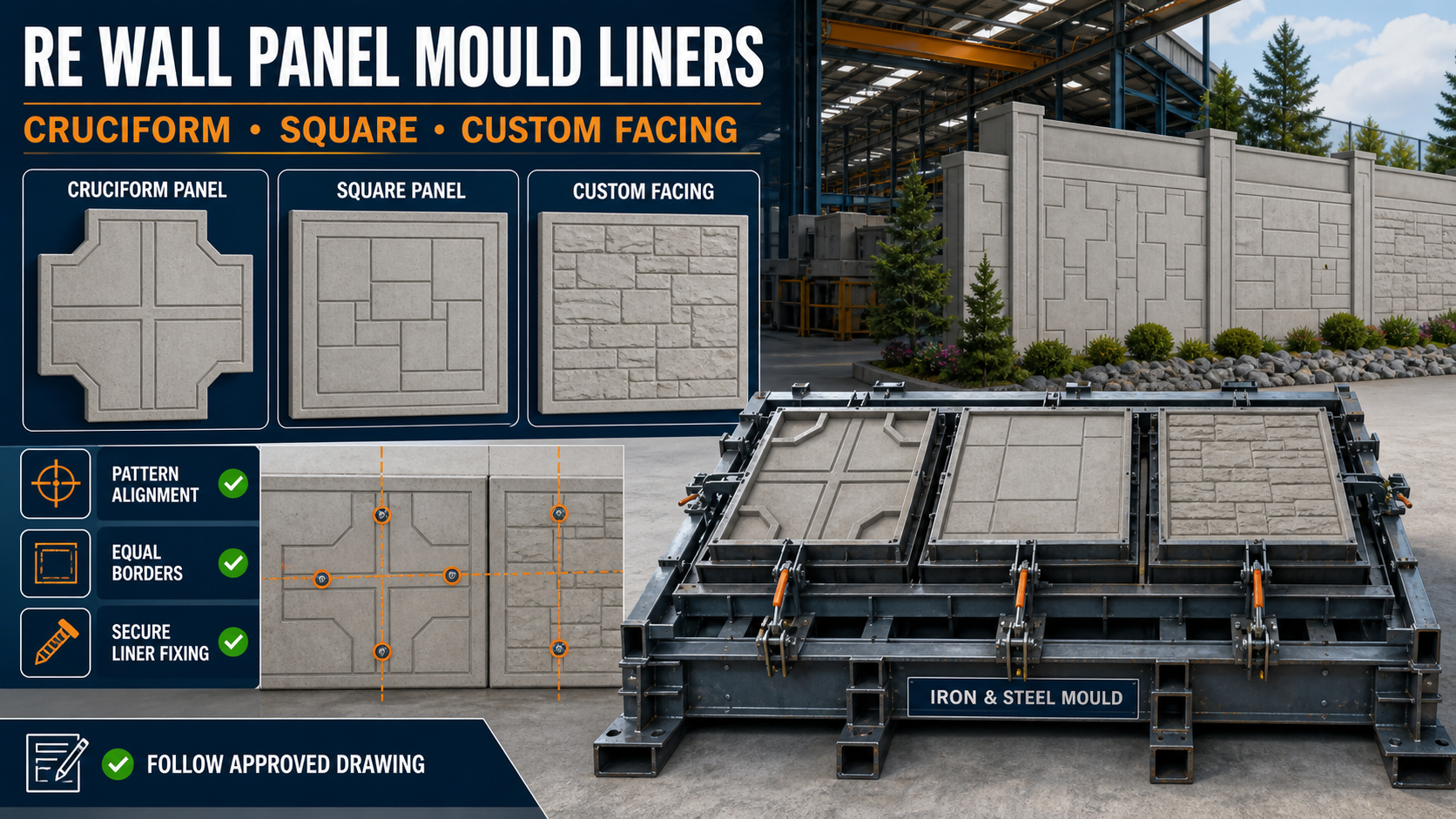
RE Wall Panel Mould Liners: Cruciform, Square and Custom Facing Designs

Precast Mould Guide

RE Wall Panel Mould Liners: Cruciform, Square and Custom Facing Designs

RE wall panel mould liners create the visible architectural pattern on precast reinforced-earth wall panels. This guide compares cruciform, square and custom facing designs while explaining liner alignment, installation, production and maintenance.

Read article
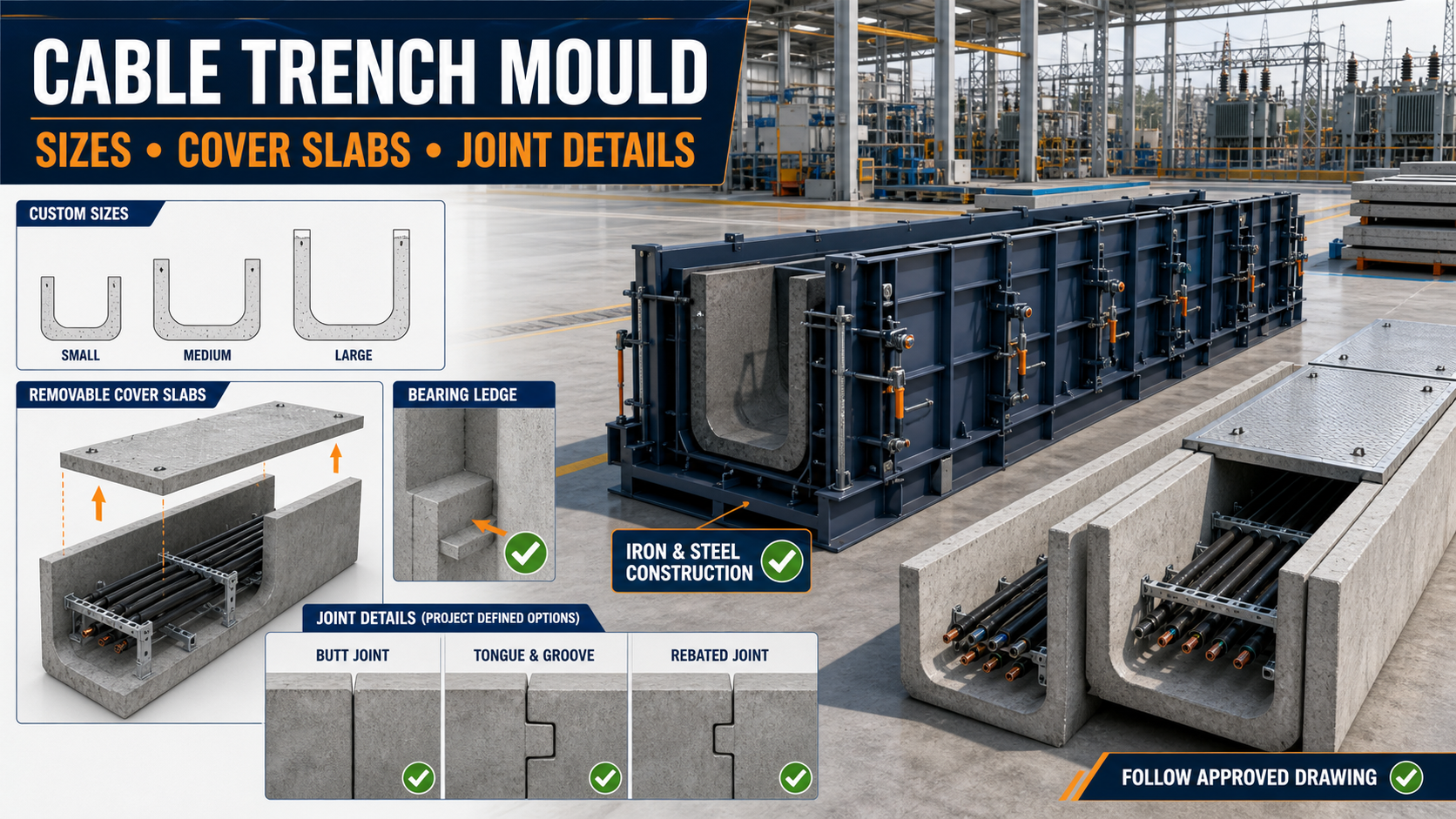
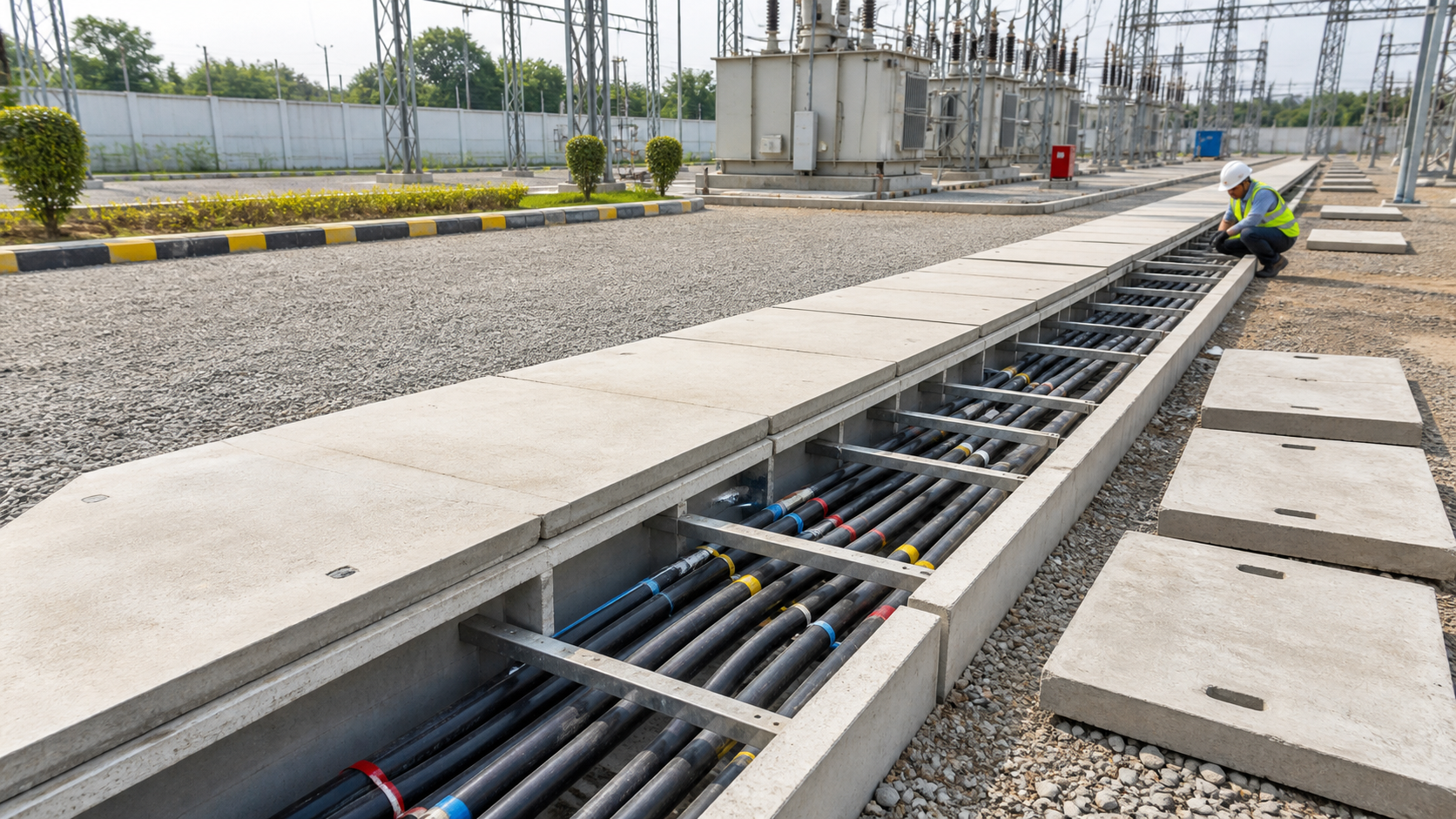
Cable Trench Mould for Electrical Projects: Sizes, Cover Slabs and Joint Details

Precast Mould Guide

Cable Trench Mould for Electrical Projects: Sizes, Cover Slabs and Joint Details

A precast cable trench system provides a protected and accessible route for electrical, communication and control cables. This guide explains cable trench mould sizes, cover-slab options, joint details and heavy-duty iron and steel mould requirements.

Read article
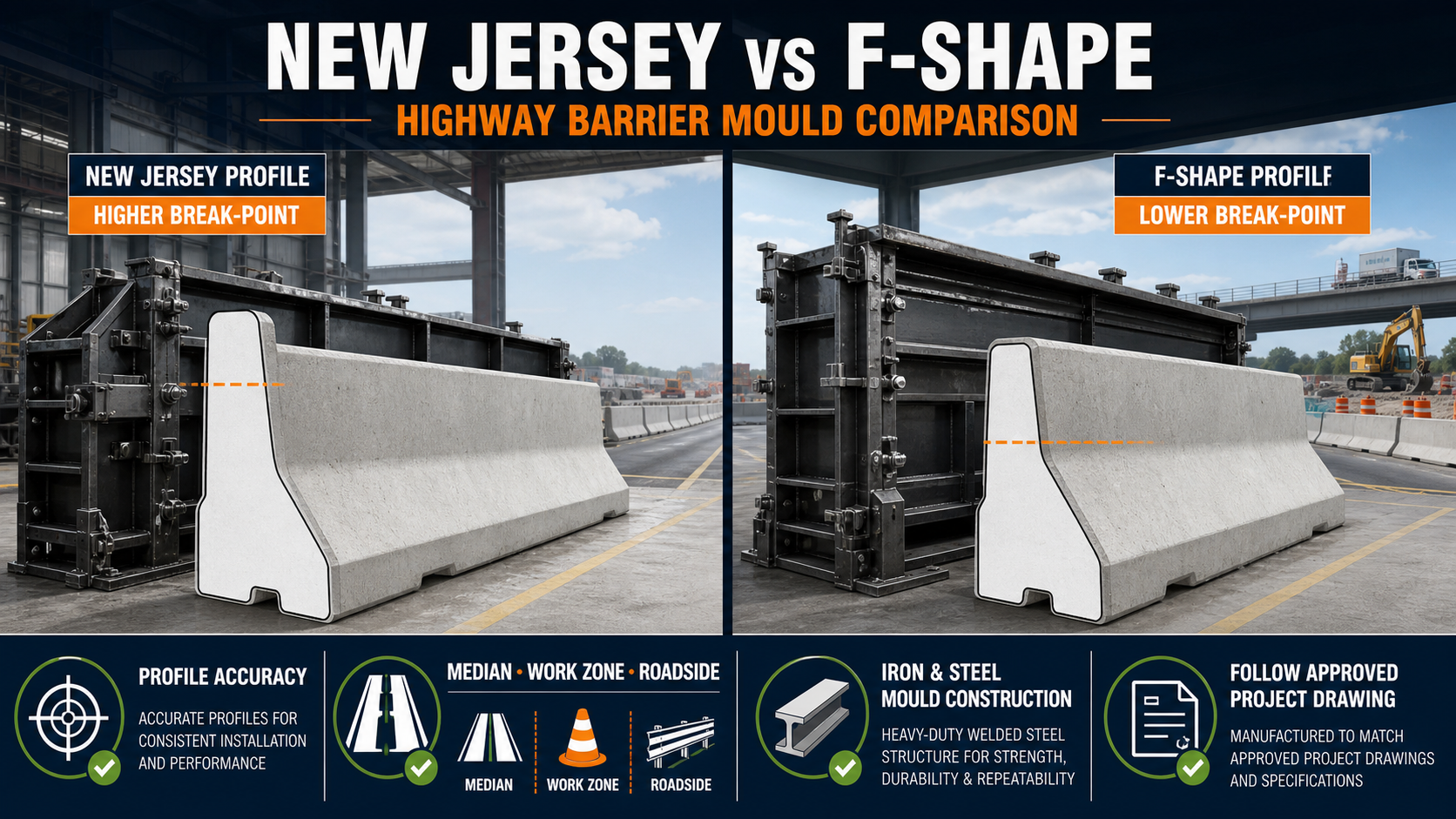
New Jersey vs F-Shape Highway Barrier Mould: Profile and Application Comparison

Precast Mould Guide

New Jersey vs F-Shape Highway Barrier Mould: Profile and Application Comparison

New Jersey and F-shape barriers have similar concrete safety profiles, but their slope transition points and performance characteristics differ. This guide compares their profiles, applications and heavy-duty iron and steel mould requirements.

Read article
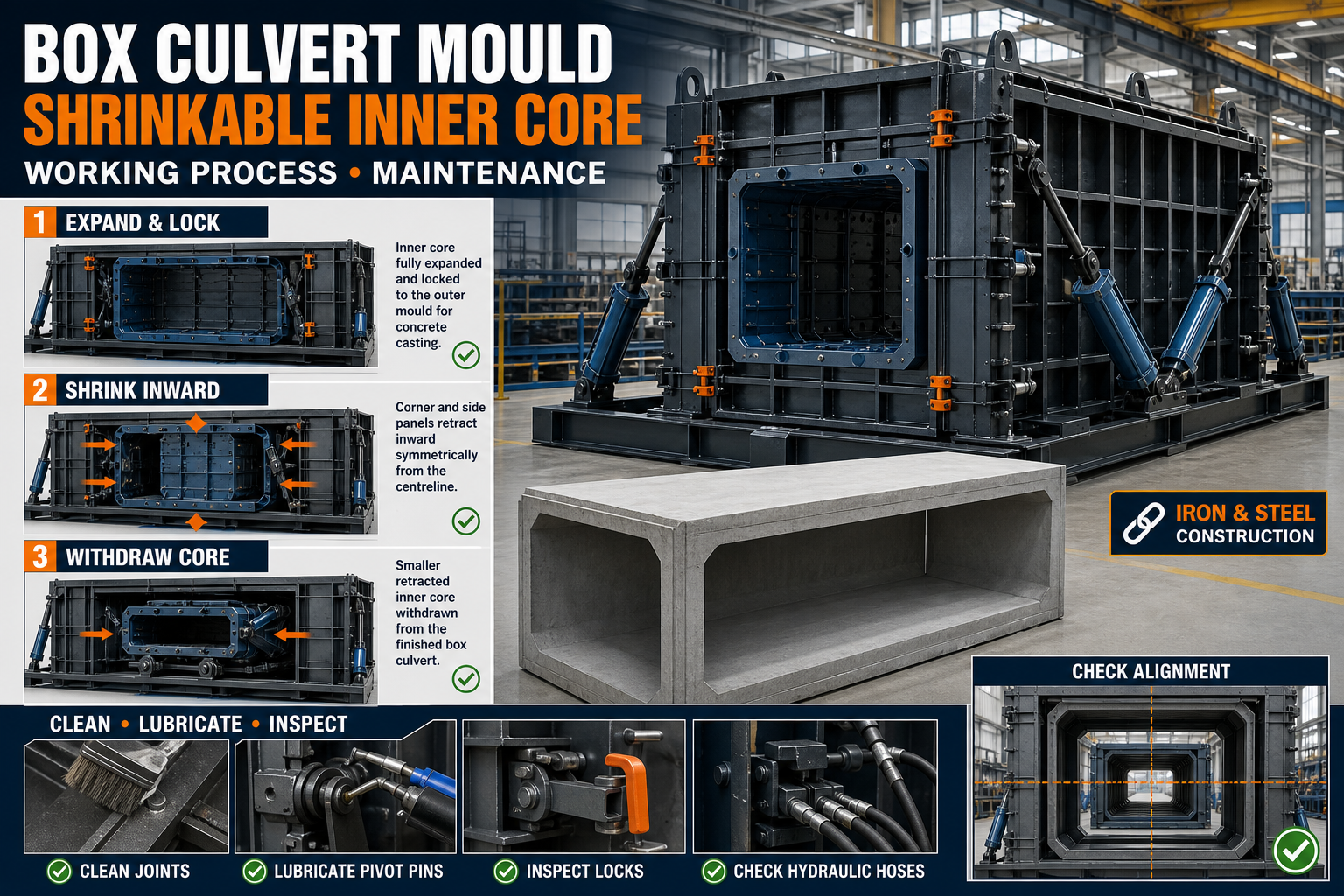
Box Culvert Mould Shrinkable Inner Core: Working Process and Maintenance Guide

Precast Mould Guide

Box Culvert Mould Shrinkable Inner Core: Working Process and Maintenance Guide

A shrinkable inner core creates sufficient clearance for removing the internal shutter from a precast box culvert. This guide explains its working process, locking sequence, alignment, safe demoulding and maintenance requirements.

Read article
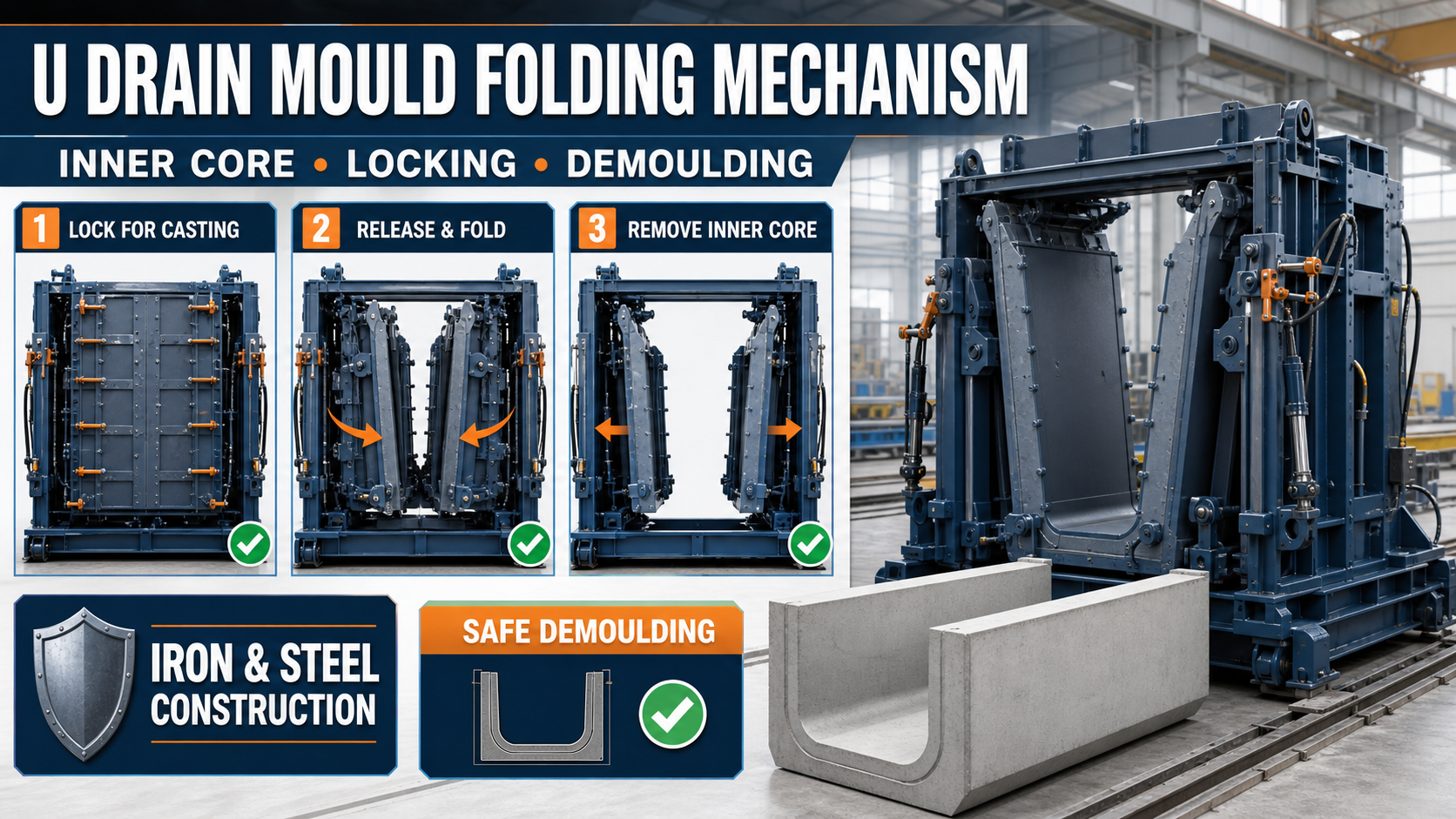
U Drain Mould Folding Mechanism: Inner Core Removal, Locking and Demoulding Guide

Precast Mould Guide

U Drain Mould Folding Mechanism: Inner Core Removal, Locking and Demoulding Guide

A folding U drain mould simplifies inner-core removal and helps protect the freshly cast concrete during demoulding. This guide explains the folding mechanism, locking arrangement, alignment checks, operating sequence and maintenance requirements of a heavy-duty iron and steel U drain mould.

Read article
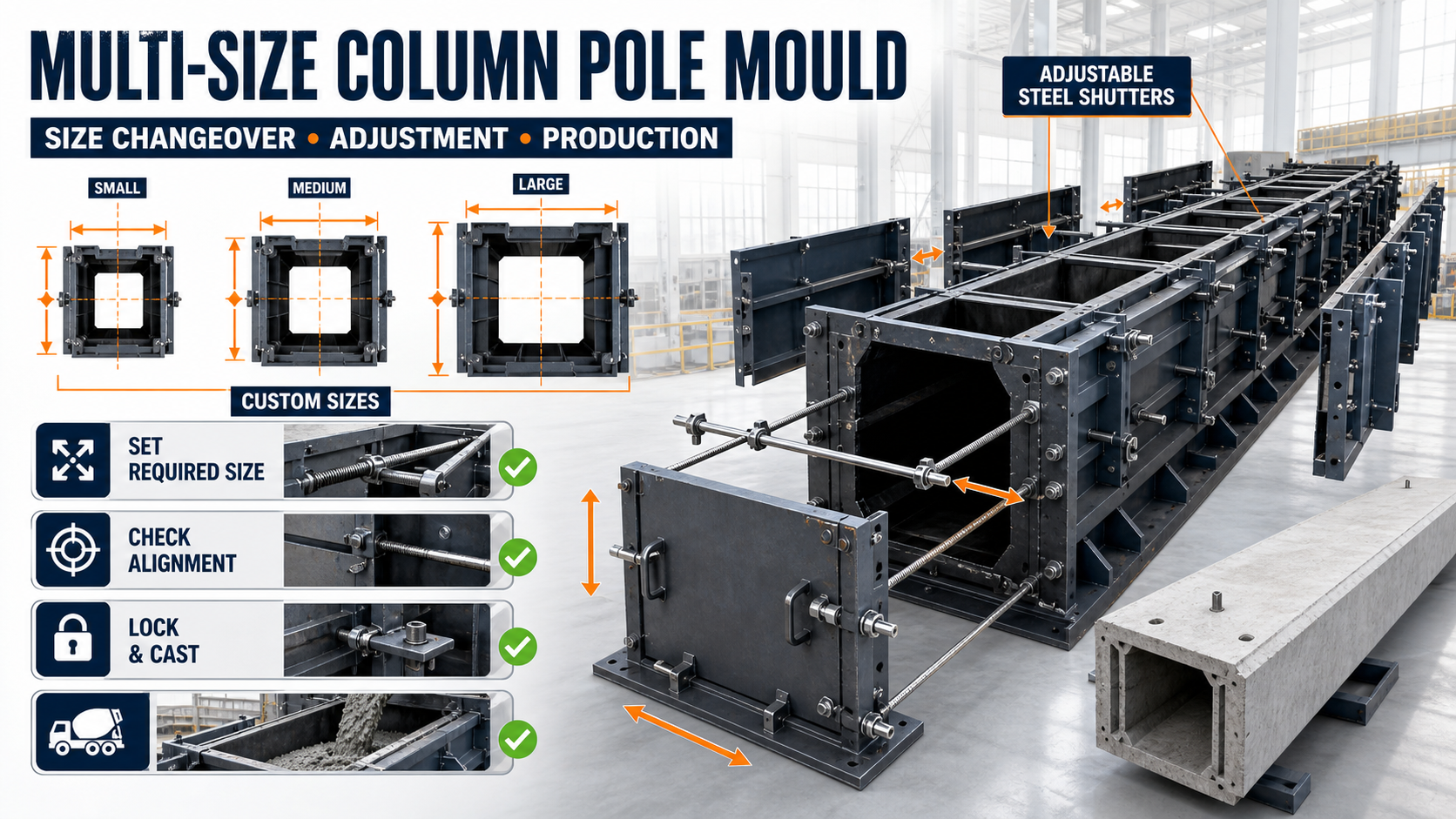
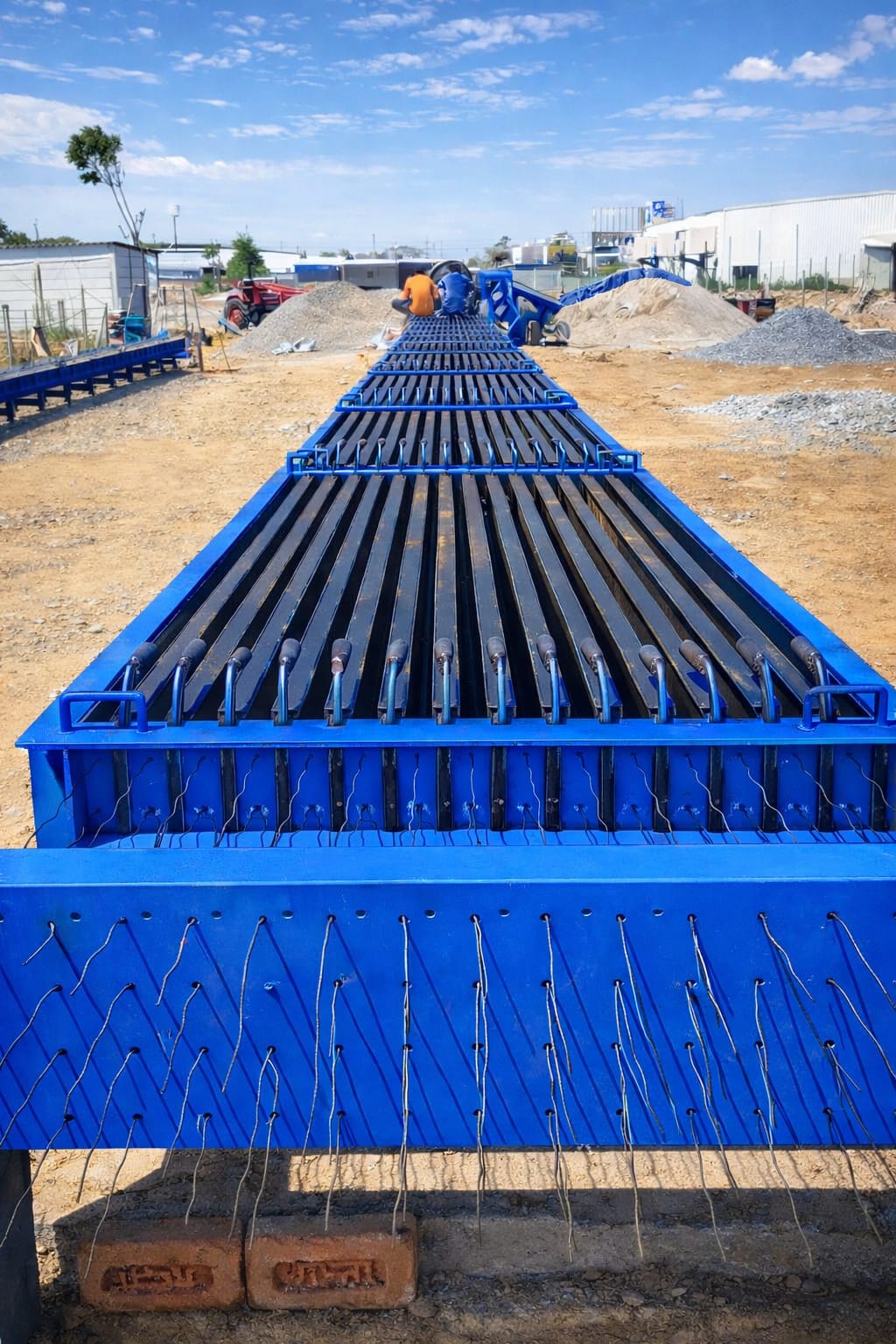
Multi-Size Column Pole Mould: Size Changeover, Adjustment and Production Guide

Precast Mould Guide

Multi-Size Column Pole Mould: Size Changeover, Adjustment and Production Guide

A multi-size column pole mould allows precast manufacturers to produce concrete columns or poles in different dimensions using one adjustable heavy-duty iron and steel mould system. This guide explains the size changeover process, adjustment methods, alignment checks, production planning and important buying considerations.

Read article
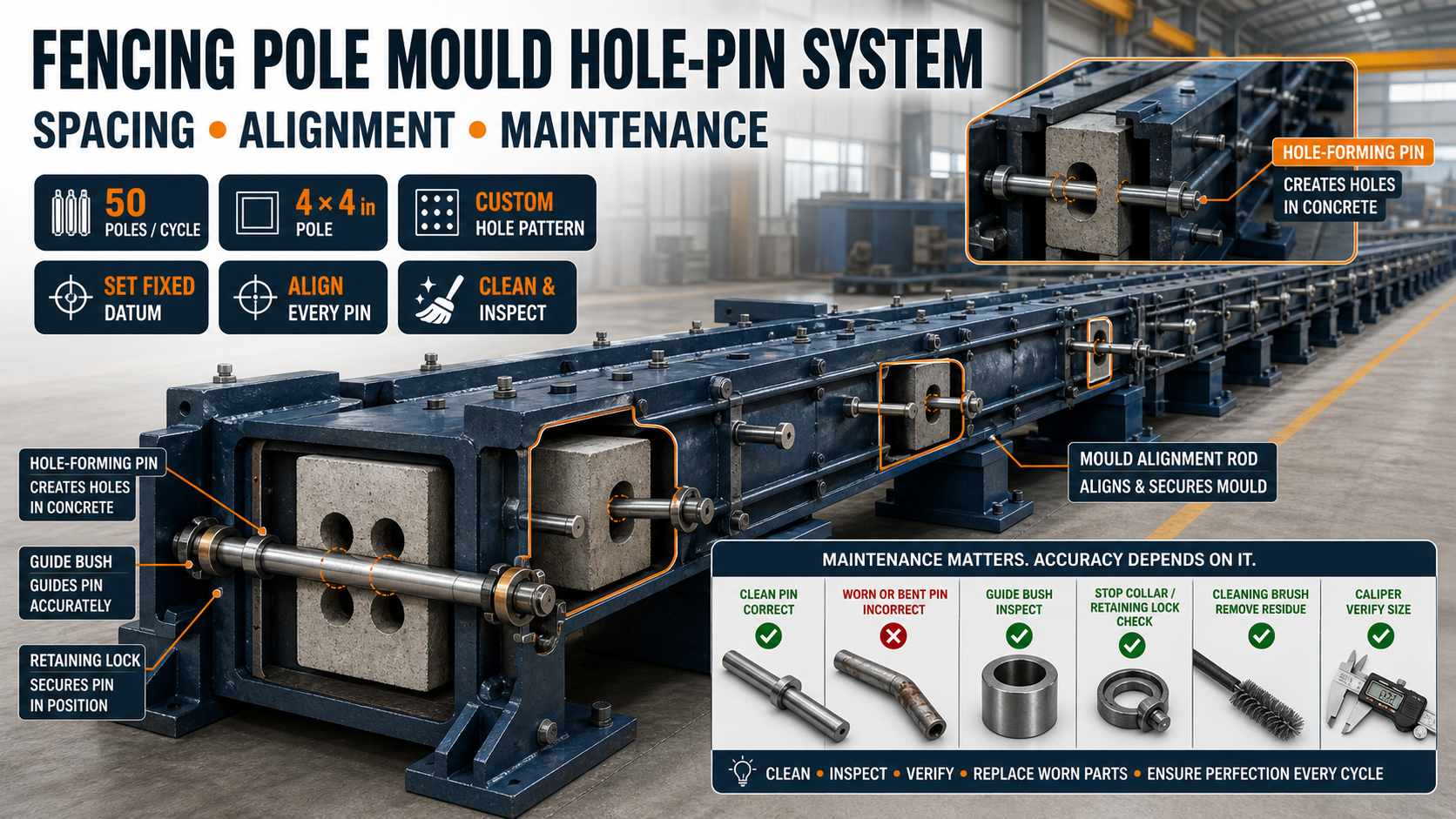
Fencing Pole Mould Hole-Pin System: Spacing, Alignment and Maintenance Guide

Precast Pole Mould Guide

Fencing Pole Mould Hole-Pin System: Spacing, Alignment and Maintenance Guide

Hole-forming pins create accurately positioned openings in precast fencing poles for fencing wire and project connections. This guide explains custom hole spacing, pin alignment, casting preparation, demoulding and maintenance.

Read article
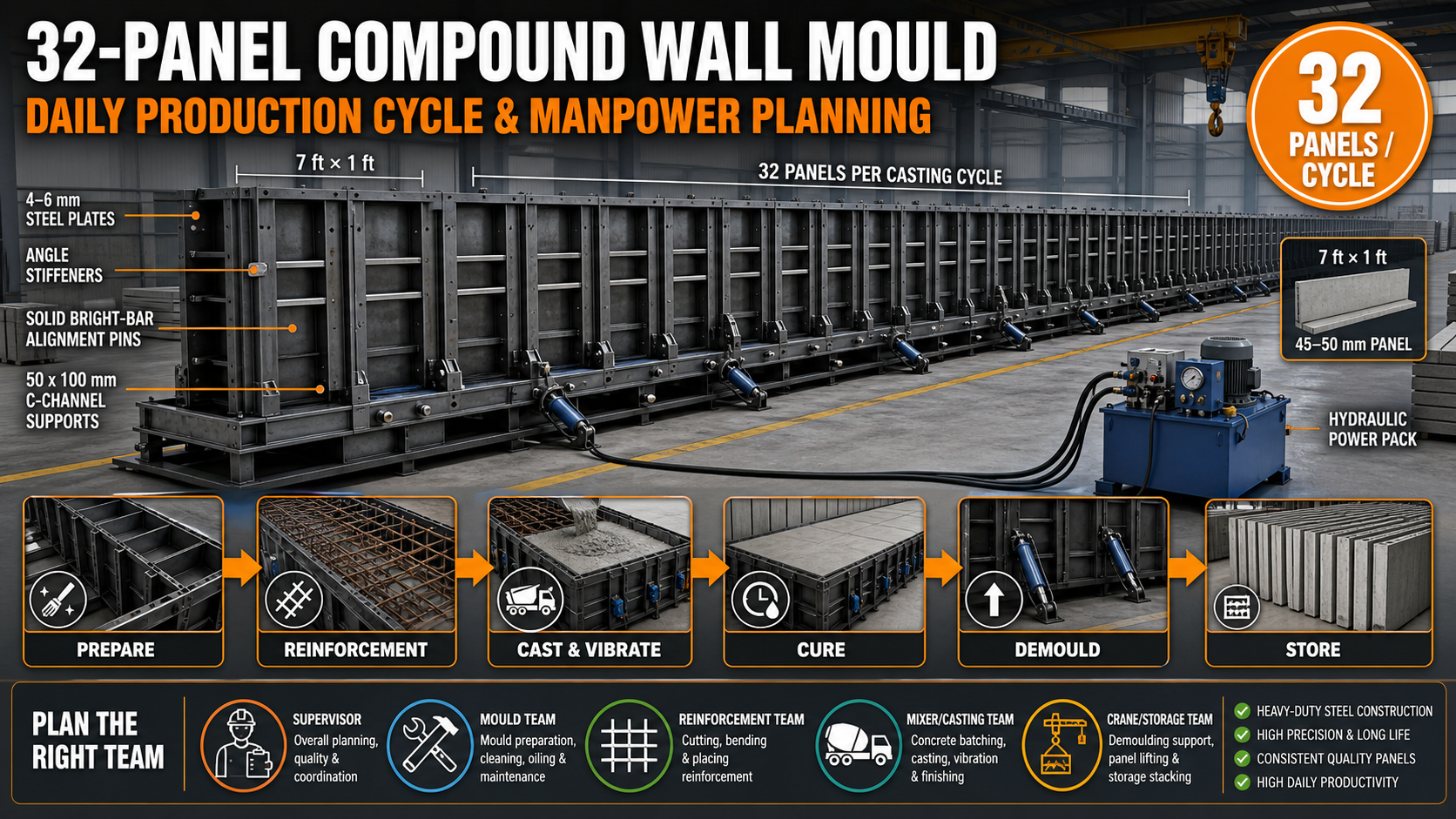
32-Panel Compound Wall Mould: Daily Production Cycle and Manpower Planning

Precast Wall Solutions

32-Panel Compound Wall Mould: Daily Production Cycle and Manpower Planning

A 32-panel compound wall mould produces an entire batch of precast wall panels in one casting cycle. This guide explains production scheduling, labour allocation, concrete flow, hydraulic operation and daily output planning.

Read article
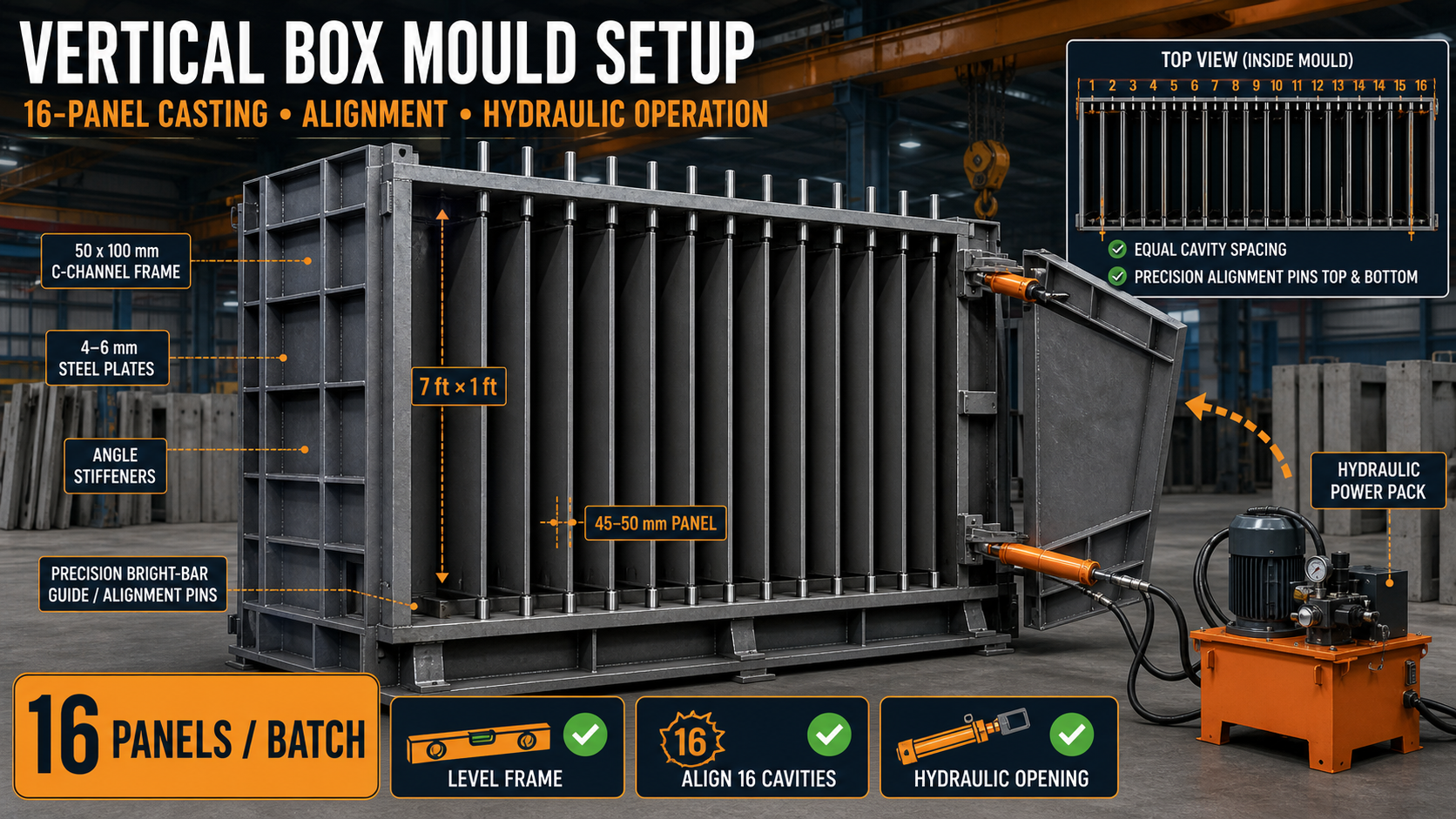
Vertical Box Mould Setup Guide: 16-Panel Casting, Alignment and Hydraulic Operation

Precast Wall Solutions

Vertical Box Mould Setup Guide: 16-Panel Casting, Alignment and Hydraulic Operation

A vertical box mould can manufacture 16 precast boundary wall panels in one casting batch. This guide covers foundation preparation, cavity alignment, hydraulic operation, casting, demoulding and routine inspection.

Read article
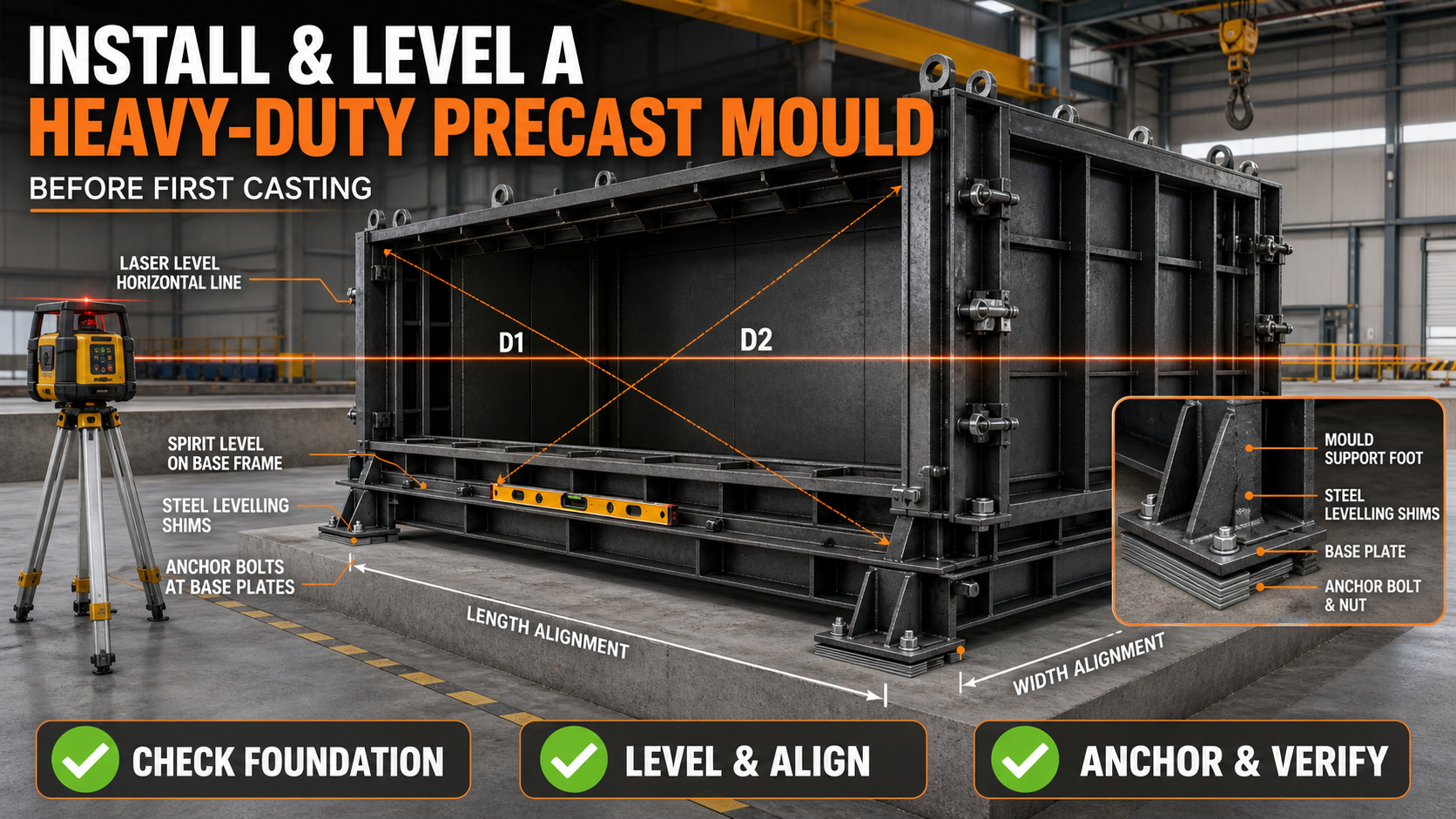
How to Install and Level a Heavy-Duty Precast Mould Before First Casting

Precast Mould Installation Guide

How to Install and Level a Heavy-Duty Precast Mould Before First Casting

Correct installation and levelling protect a heavy-duty iron precast mould from twisting, leakage and dimensional errors. This guide covers foundation checks, lifting, positioning, alignment, anchoring and trial inspection before first casting.

Read article
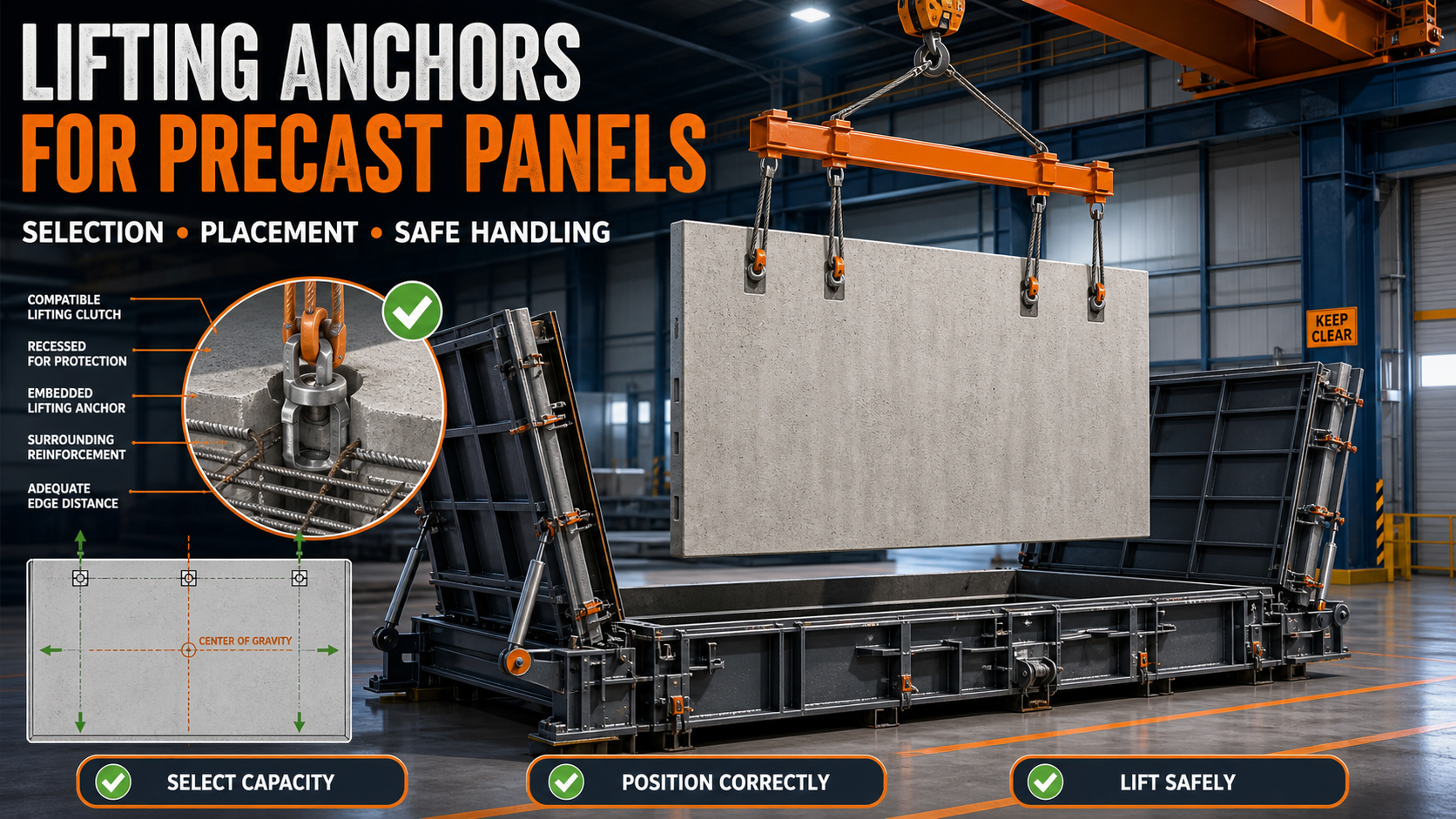
Lifting Anchors for Precast Panels: Selection, Placement and Safe Handling Guide

Precast Production Guide

Lifting Anchors for Precast Panels: Selection, Placement and Safe Handling Guide

Correct lifting-anchor selection and placement are essential for safely demoulding, shifting and installing precast panels. This guide covers panel weight, anchor capacity, concrete strength, edge distance, lifting angles and inspection.

Read article
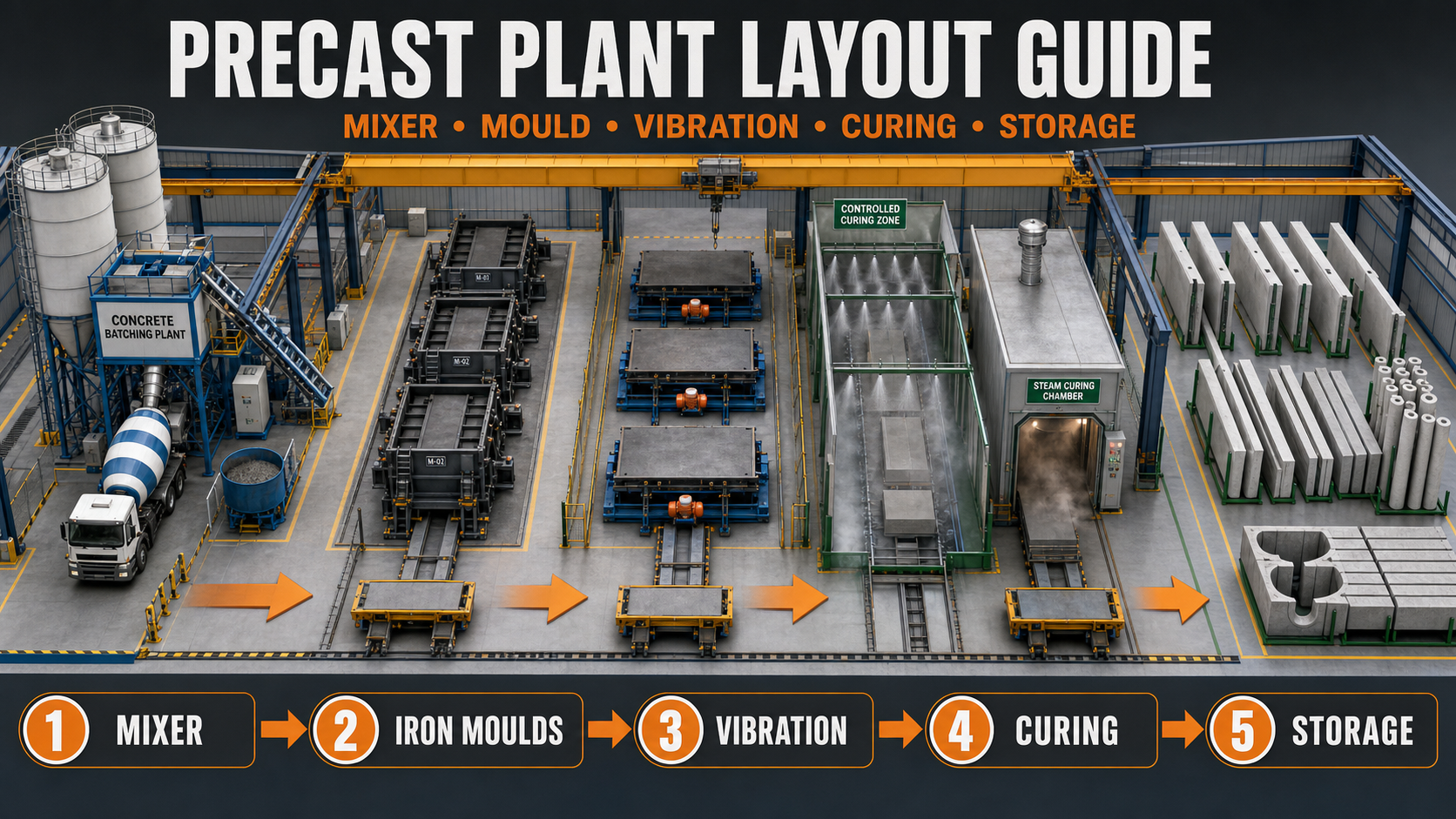
Precast Plant Layout Guide: Mixer, Mould, Vibration, Curing and Storage Planning

Precast Plant Setup Guide

Precast Plant Layout Guide: Mixer, Mould, Vibration, Curing and Storage Planning

A well-planned precast plant layout improves production speed, product quality and workplace safety. This guide explains how to position the mixer, heavy-duty iron moulds, vibration system, curing area and finished-product storage.

Read article
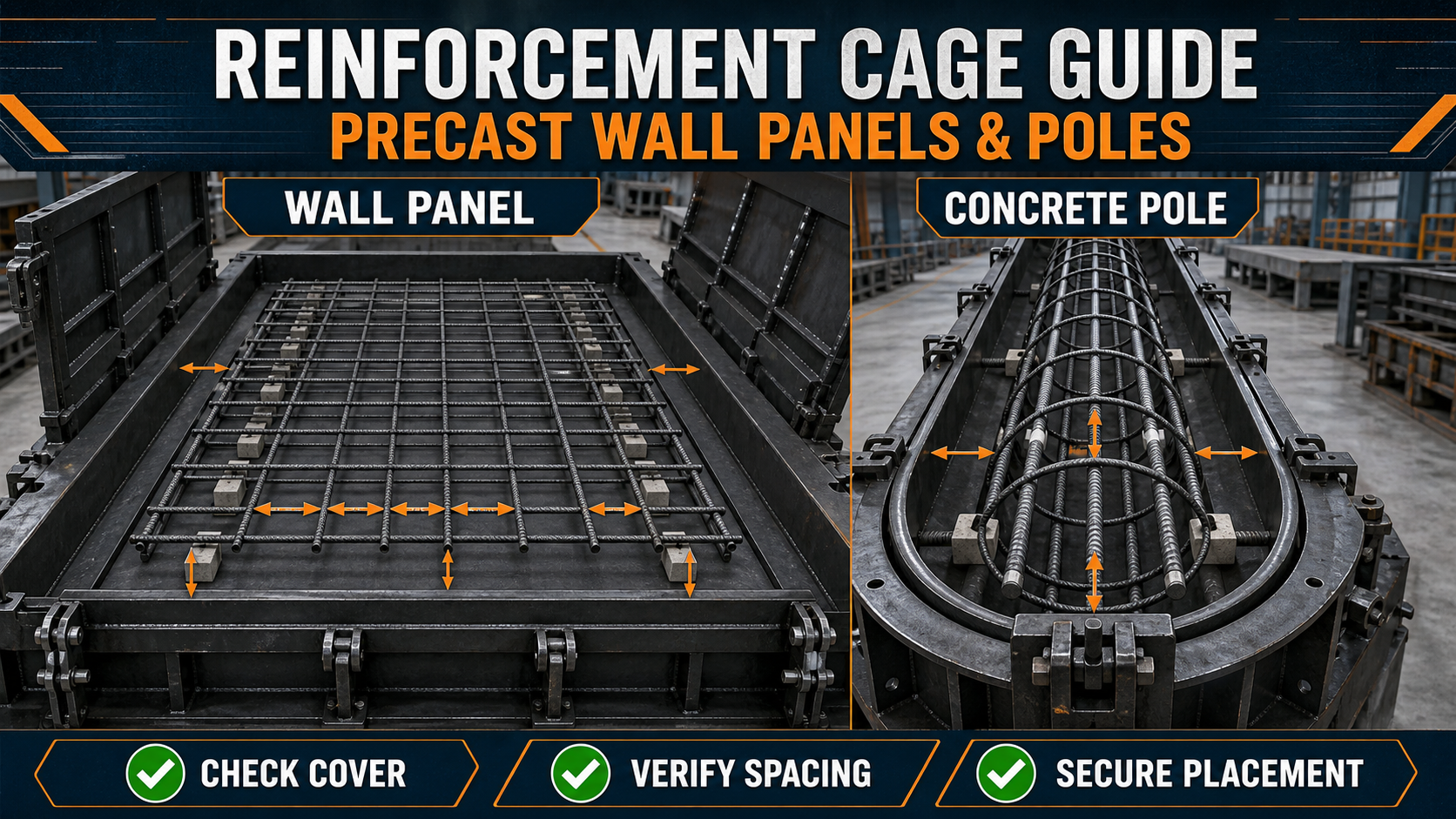
Reinforcement Cage for Precast Wall Panels and Poles: Cover, Spacing and Placement Guide

Precast Production Guide

Reinforcement Cage for Precast Wall Panels and Poles: Cover, Spacing and Placement Guide

Correct reinforcement cage placement is essential for the strength, durability and dimensional accuracy of precast wall panels and poles. This guide explains concrete cover, bar spacing, cage support and pre-pour inspection.

Read article
Water Curing vs Steam Curing for Precast Concrete: Time, Cost and Strength Comparison

Precast Production Guide

Water Curing vs Steam Curing for Precast Concrete: Time, Cost and Strength Comparison

Water curing and steam curing can both produce durable precast concrete when properly controlled. This guide compares their curing time, cost, early strength, equipment and suitability for different production requirements.

Read article
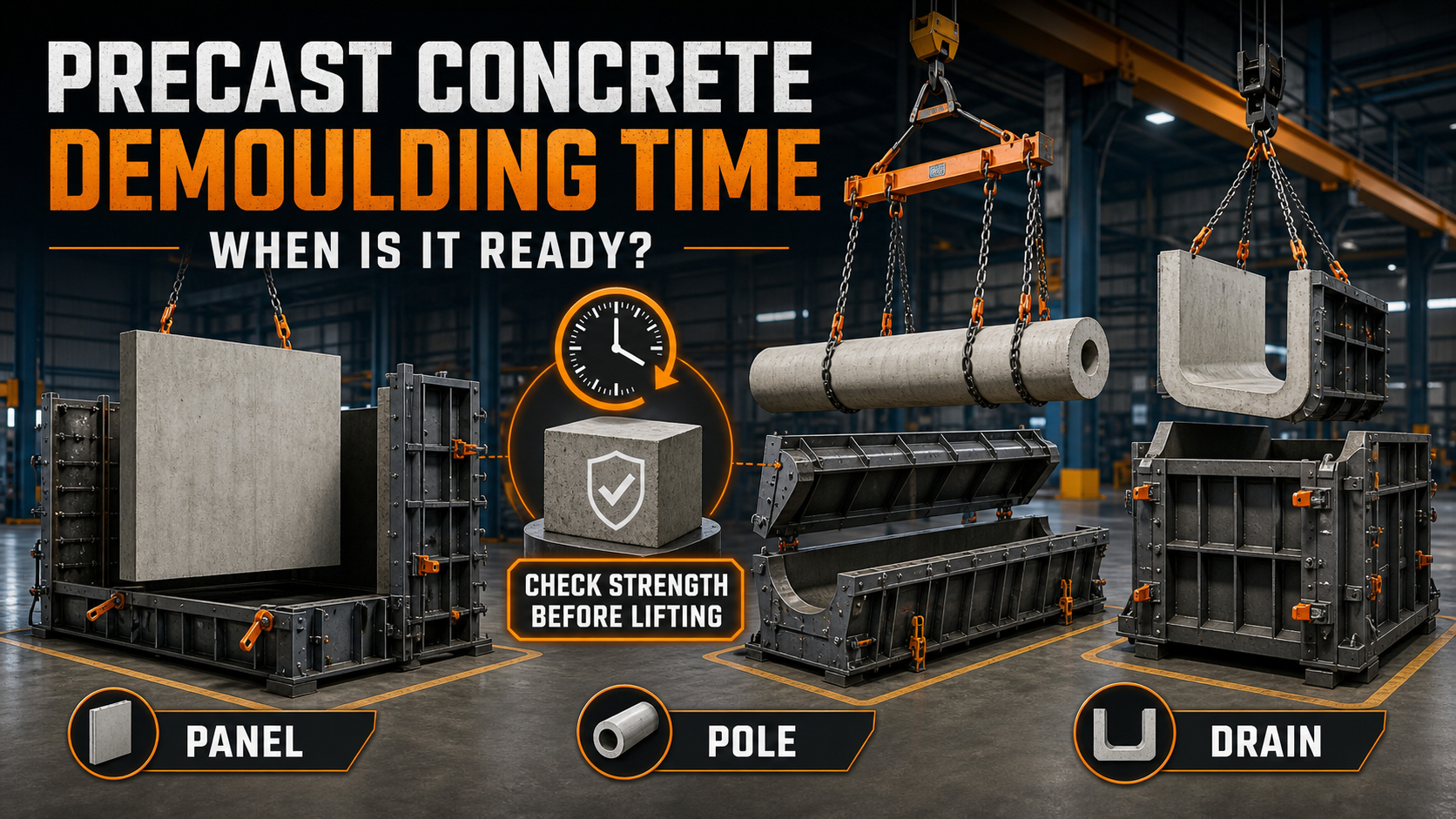
Precast Concrete Demoulding Time: When Is a Panel, Pole or Drain Ready?

Precast Production Guide

Precast Concrete Demoulding Time: When Is a Panel, Pole or Drain Ready?

Correct demoulding time protects precast panels, poles and drains from cracks, broken edges and deformation. This guide explains the factors and checks required before opening a heavy-duty iron precast mould.

Read article
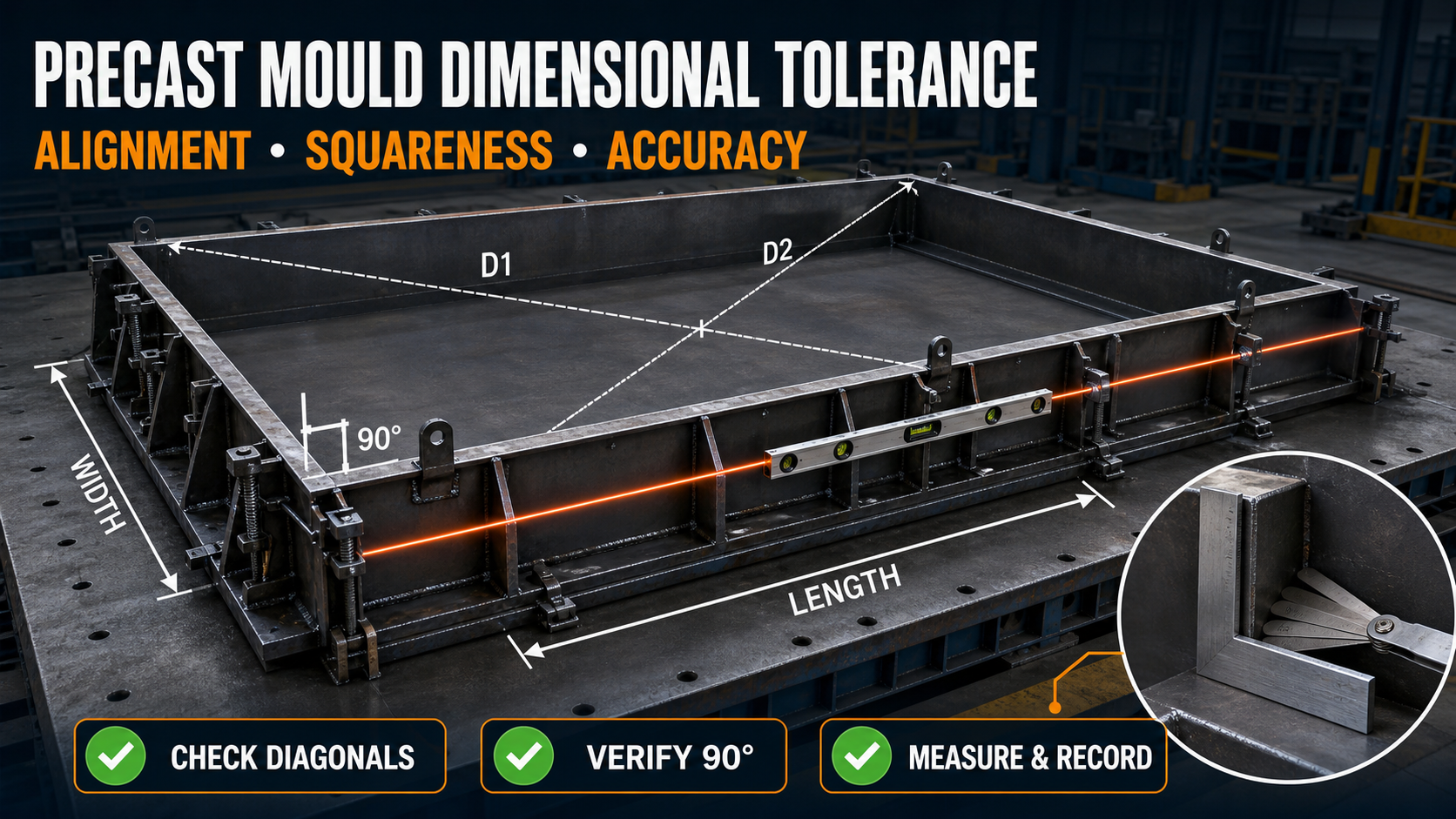
Precast Mould Dimensional Tolerance: How to Check Alignment, Squareness and Accuracy

Precast Mould Quality Guide

Precast Mould Dimensional Tolerance: How to Check Alignment, Squareness and Accuracy

Dimensional accuracy is essential for producing precast components that fit correctly at the project site. This guide explains how to inspect the alignment, squareness, straightness and dimensions of heavy-duty iron precast moulds.

Read article
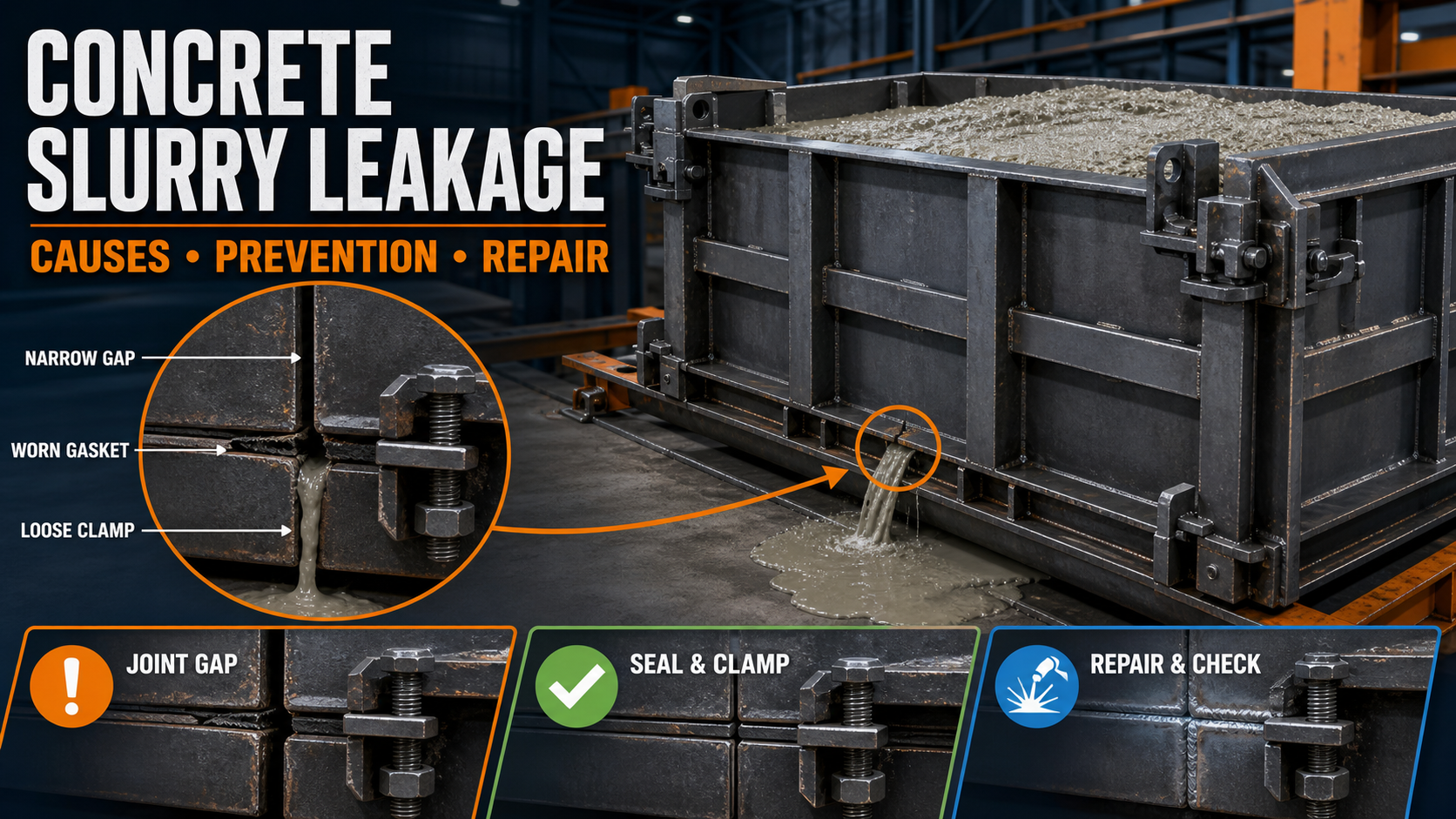
Concrete Slurry Leakage From Precast Moulds: Causes, Prevention and Repair

Precast Mould Maintenance

Concrete Slurry Leakage From Precast Moulds: Causes, Prevention and Repair

Concrete slurry leakage can cause honeycombing, poor edges, dimensional errors and material waste in precast production. This guide explains how to identify, prevent and repair leakage in heavy-duty iron precast moulds.

Read article
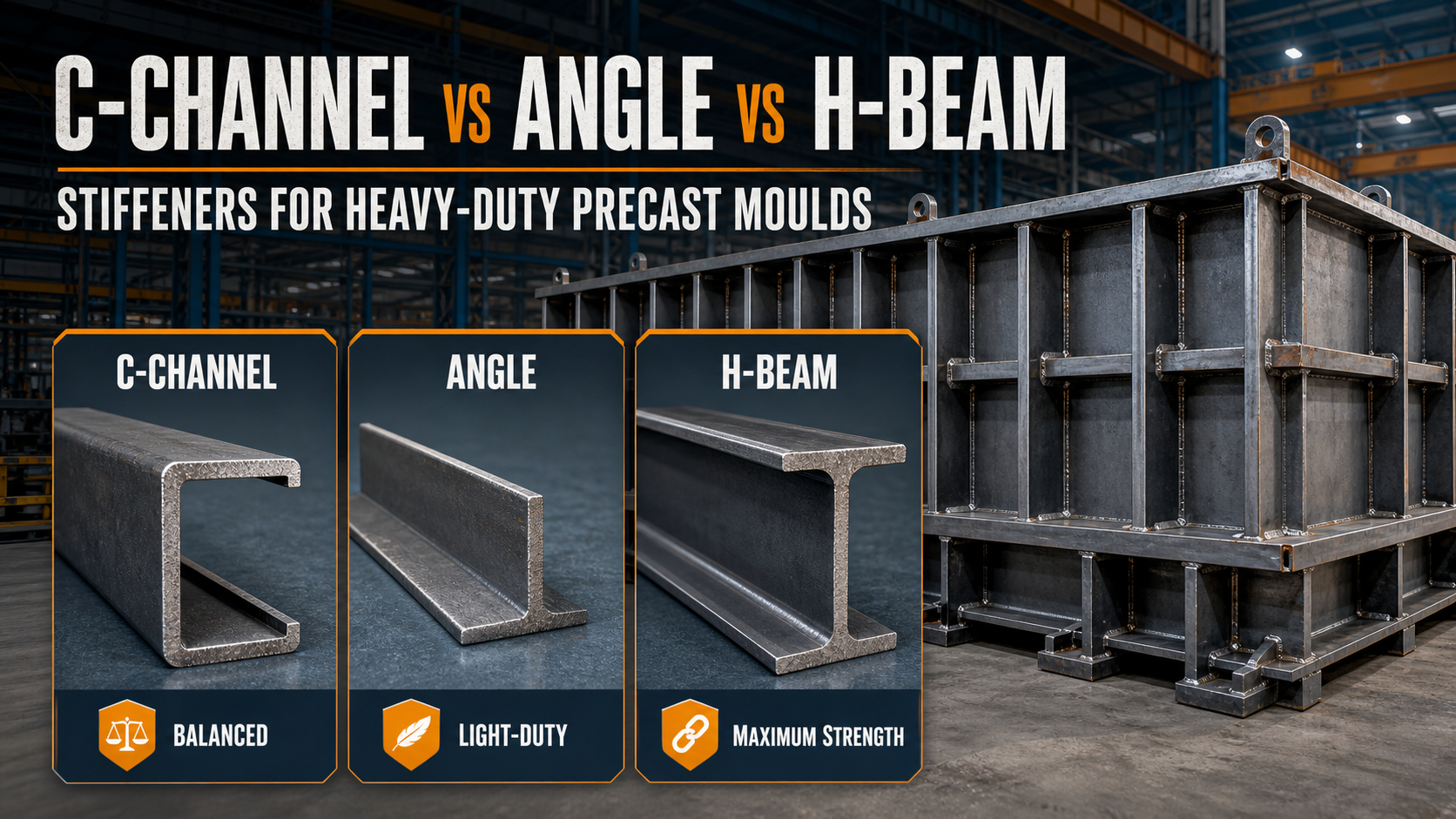
C-Channel vs Angle vs H-Beam Stiffeners for Heavy-Duty Precast Moulds

Precast Mould Guide

C-Channel vs Angle vs H-Beam Stiffeners for Heavy-Duty Precast Moulds

Choosing the correct stiffener is essential for manufacturing strong, accurate and durable iron precast moulds. This guide compares C-channel, angle and H-beam stiffeners based on strength, weight, cost and applications.

Read article
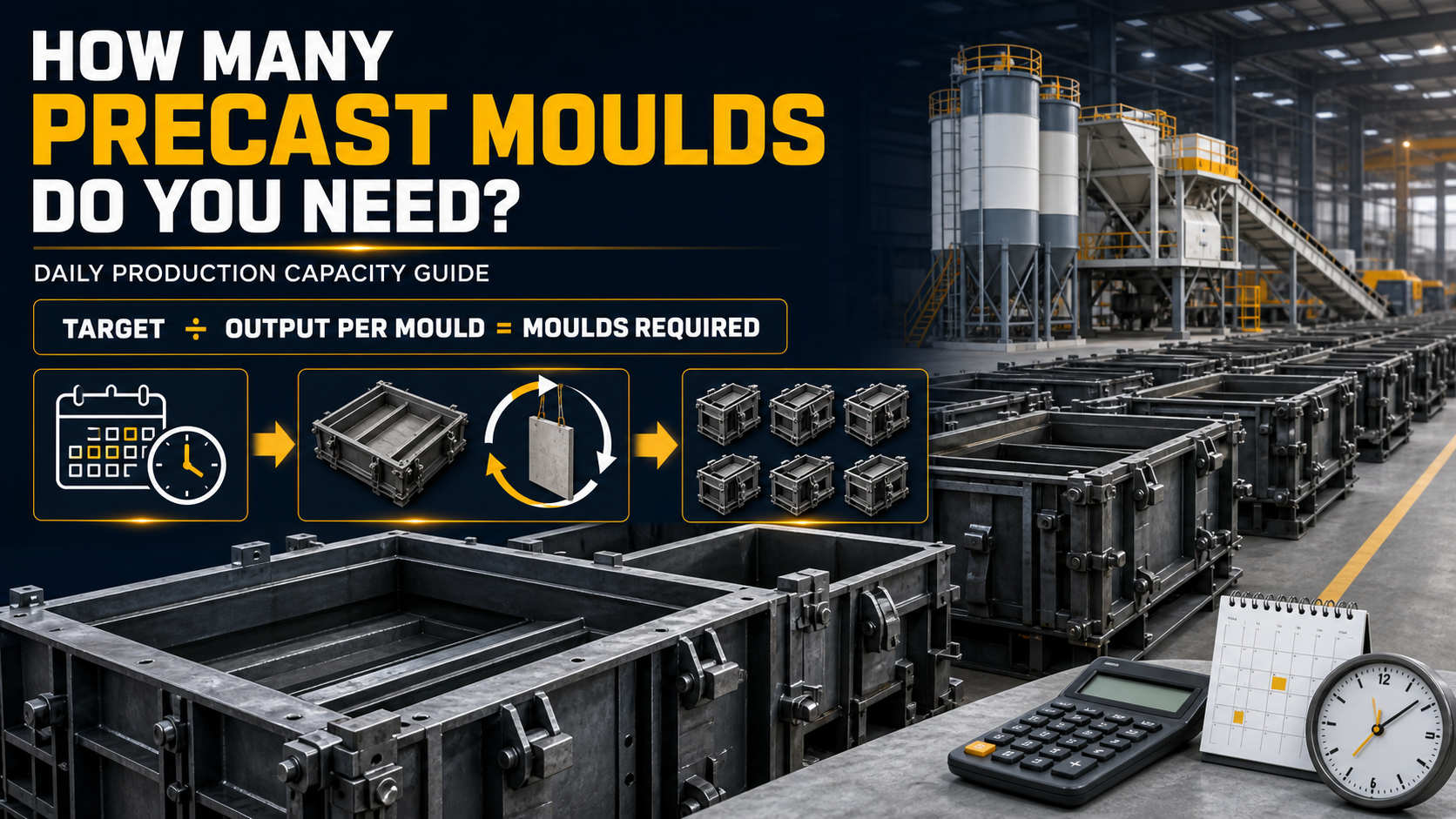
How Many Precast Moulds Do You Need? Daily Production Capacity Calculation Guide

Precast Production Guide

How Many Precast Moulds Do You Need? Daily Production Capacity Calculation Guide

Use a practical production-capacity formula to calculate the number of precast moulds required for wall panels, poles, drains and other concrete products.

Read article
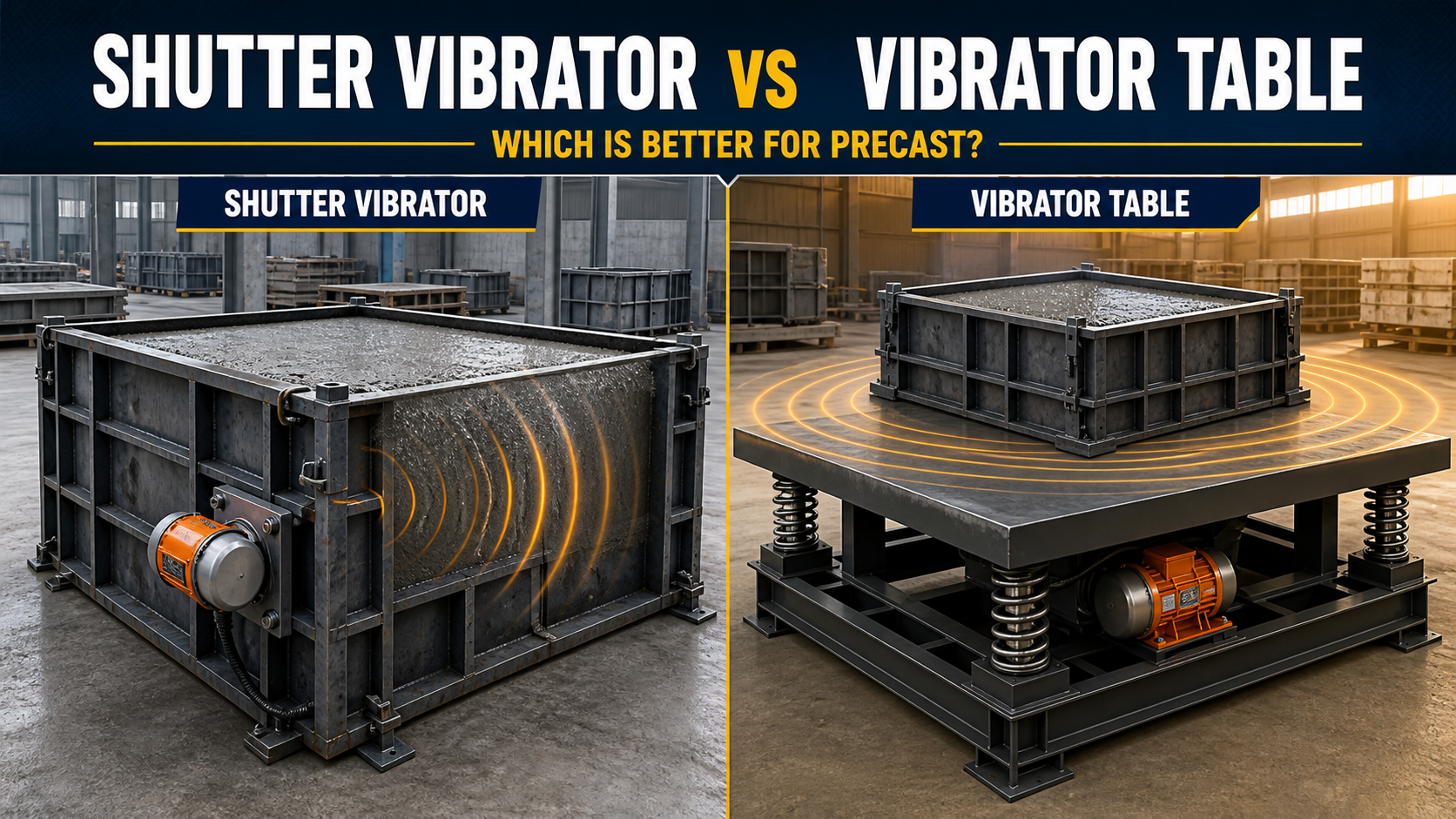
Shutter Vibrator vs Vibrator Table: Which Is Better for Precast Production?

Precast Machinery Guide

Shutter Vibrator vs Vibrator Table: Which Is Better for Precast Production?

Shutter vibrators transfer vibration directly into a mould, while vibrator tables compact the complete mould from below. Compare both systems for different precast products.

Read article
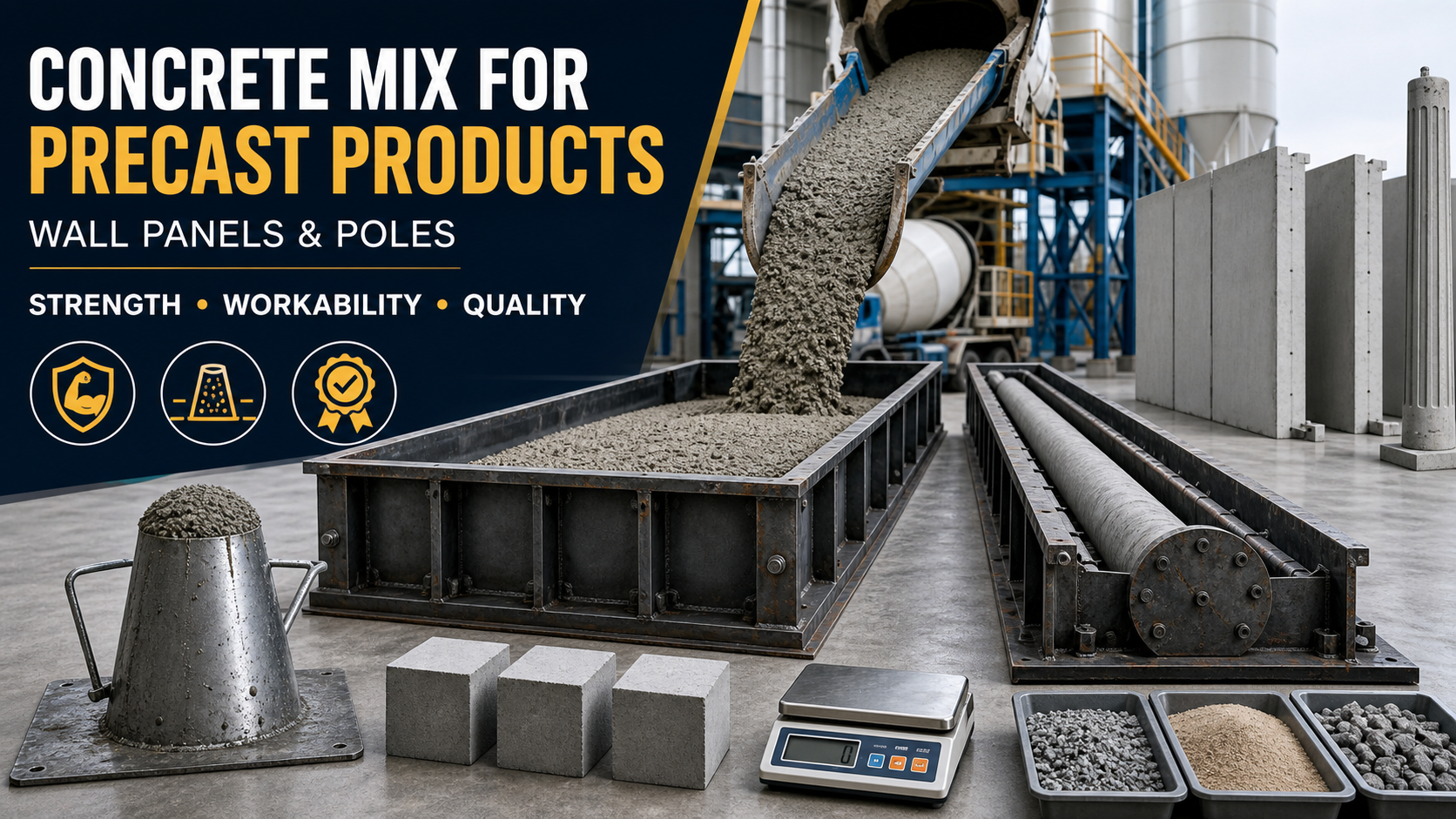
Concrete Mix for Precast Wall Panels and Poles: Strength, Workability and Quality Guide

Precast Production Guide

Concrete Mix for Precast Wall Panels and Poles: Strength, Workability and Quality Guide

A controlled concrete mix helps precast wall panels and poles achieve strength, smooth finish and dimensional accuracy. Explore mix-design, workability, curing and testing factors.

Read article
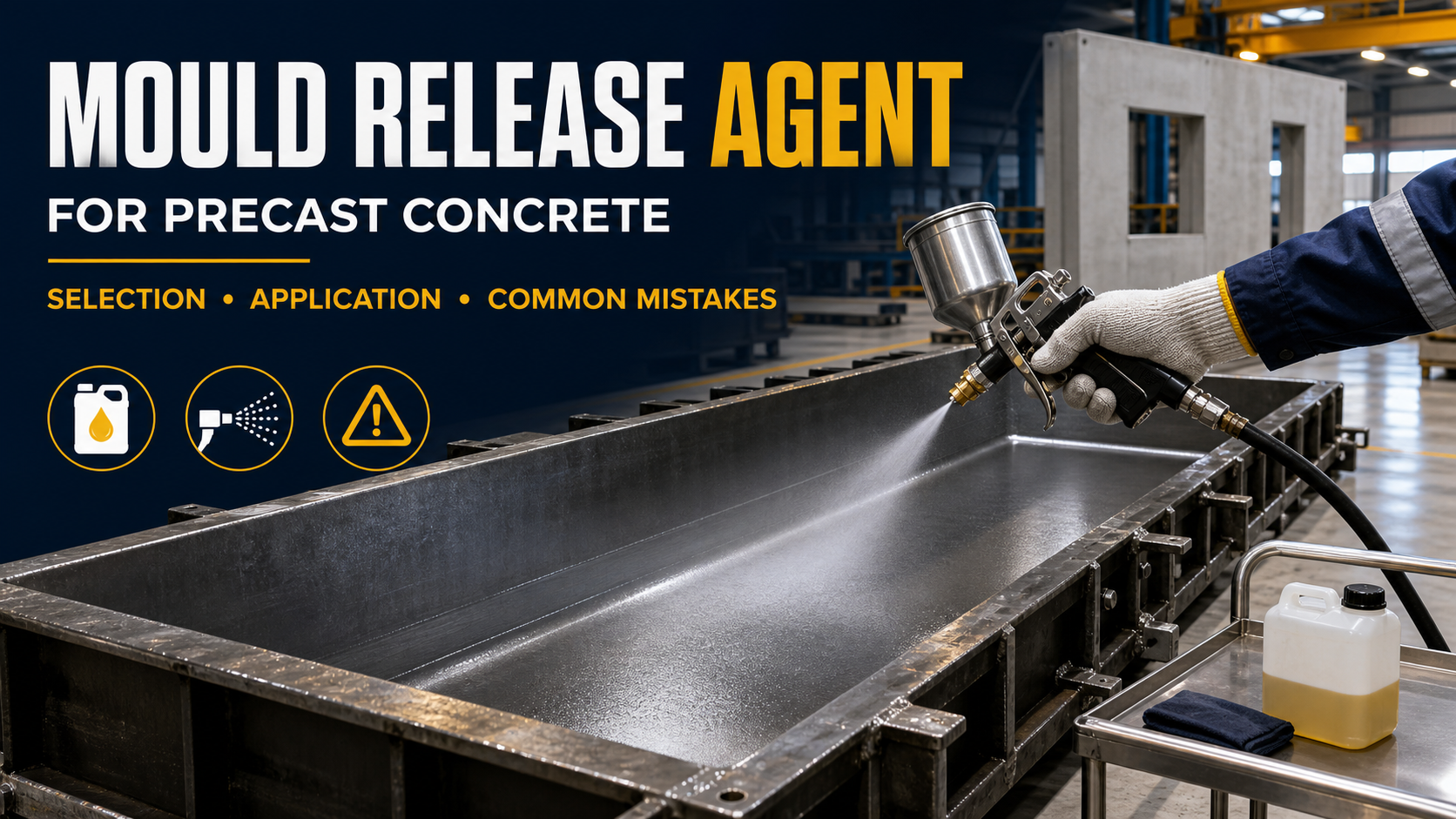
Mould Release Agent for Precast Concrete: Selection, Application and Common Mistakes

Precast Production Guide

Mould Release Agent for Precast Concrete: Selection, Application and Common Mistakes

The correct mould release agent simplifies demoulding, improves concrete finish and protects heavy-duty iron moulds. Learn its types, application process and common mistakes.

Read article
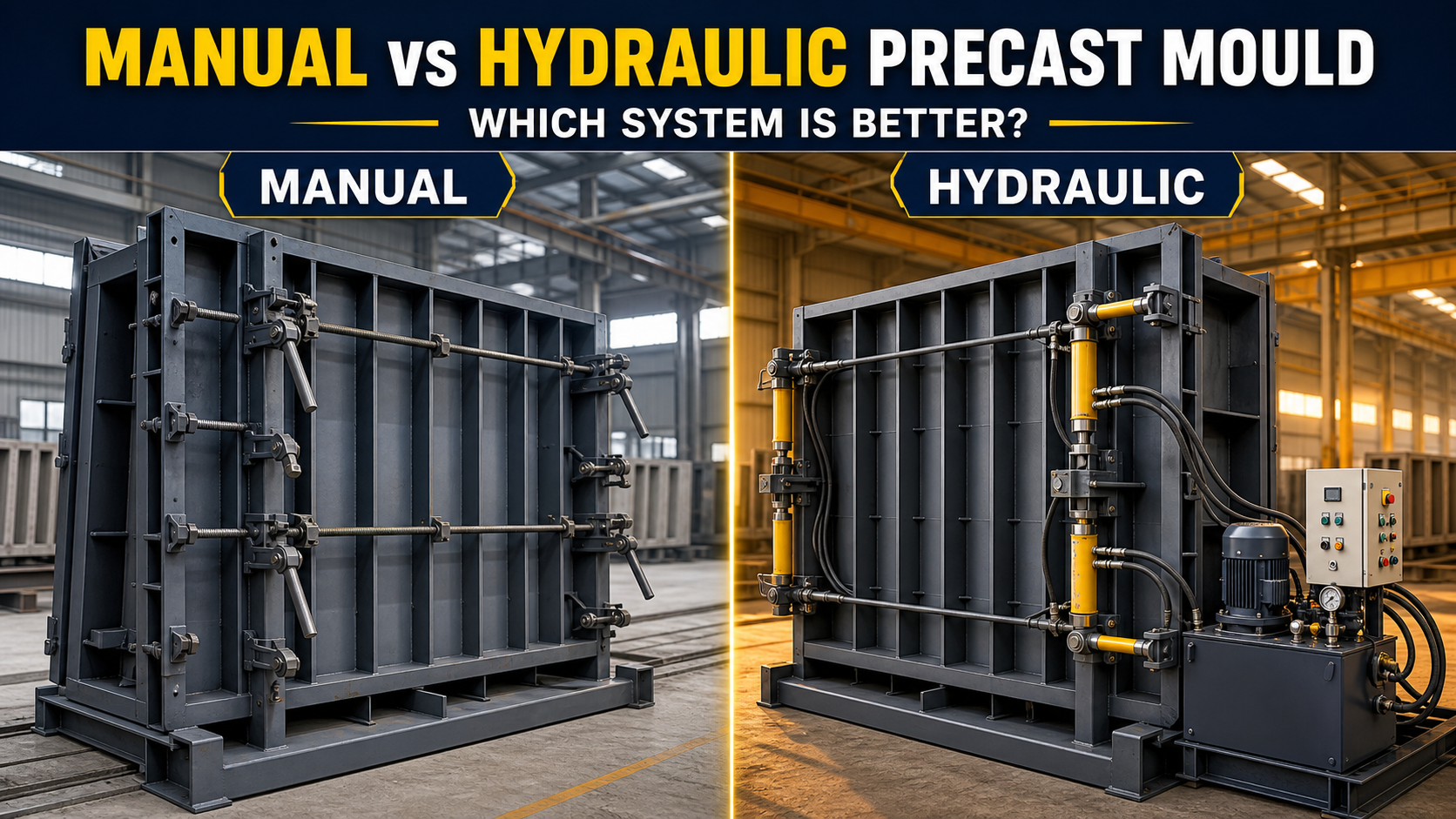
Manual vs Hydraulic Precast Mould: Which System Is Better for Your Plant?

Precast Mould Guide

Manual vs Hydraulic Precast Mould: Which System Is Better for Your Plant?

Manual and hydraulic precast moulds differ in operating speed, labour, investment and maintenance. Compare both systems to select the right solution for your production plant.

Read article
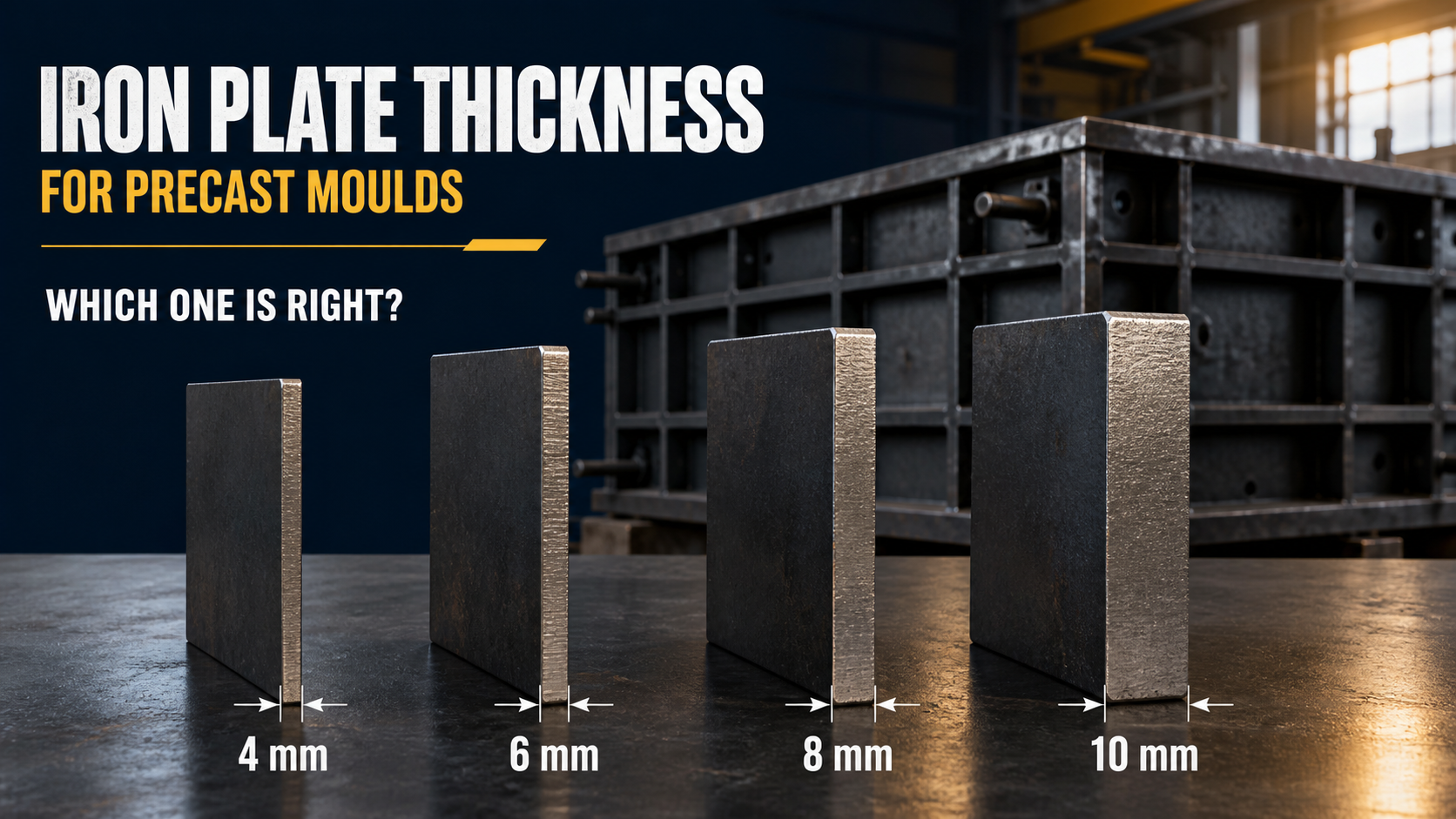
Iron Plate Thickness for Precast Moulds: 4 mm, 6 mm, 8 mm or 10 mm?

Precast Mould Guide

Iron Plate Thickness for Precast Moulds: 4 mm, 6 mm, 8 mm or 10 mm?

Selecting the correct iron plate thickness improves mould accuracy, durability and production quality. Compare 4 mm, 6 mm, 8 mm and 10 mm options for different precast products.

Read article
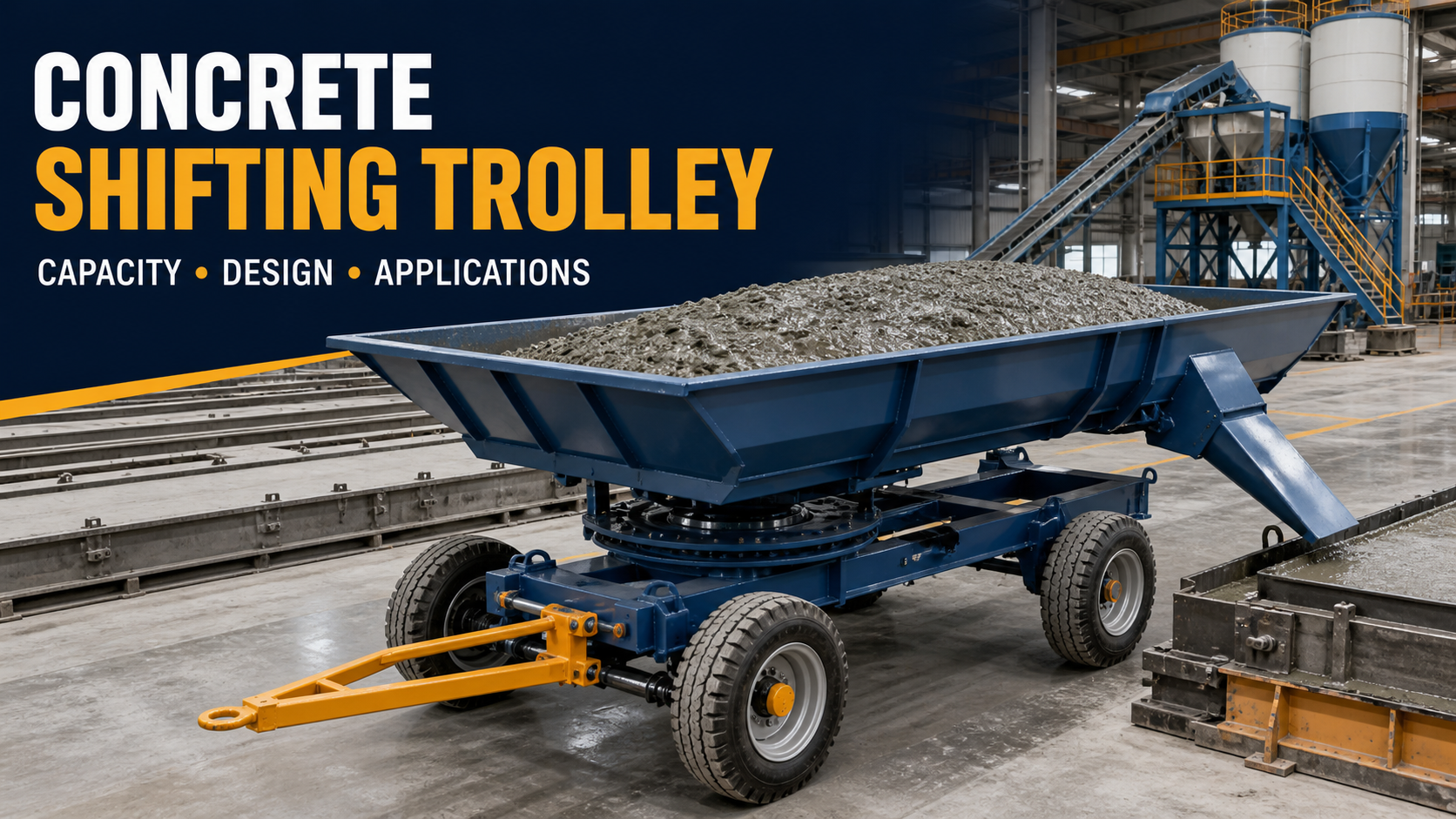
Concrete Shifting Trolley for Precast Plants: Capacity, Design and Applications

Precast Machinery Guide

Concrete Shifting Trolley for Precast Plants: Capacity, Design and Applications

A concrete shifting trolley transports wet concrete and raw materials between mixers and casting moulds. Learn about its capacity, design, applications and buying factors.

Read article
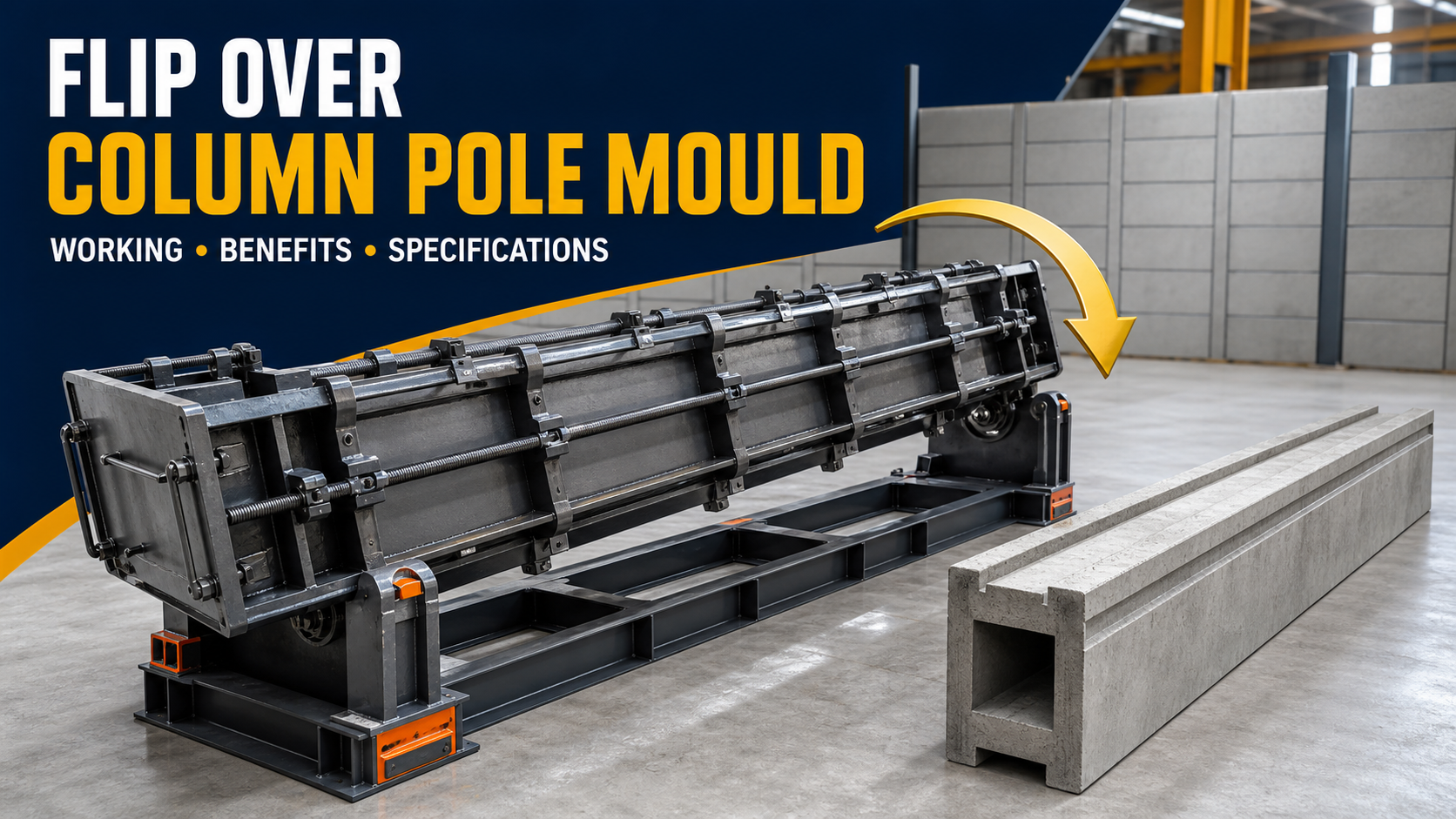
Flip Over Column Pole Mould: Working Process, Benefits and Specifications

Precast Pole Mould Guide

Flip Over Column Pole Mould: Working Process, Benefits and Specifications

A flip over column pole mould produces grooved precast H-posts for boundary wall panels. Explore its working process, sizes, benefits, specifications and selection factors.

Read article
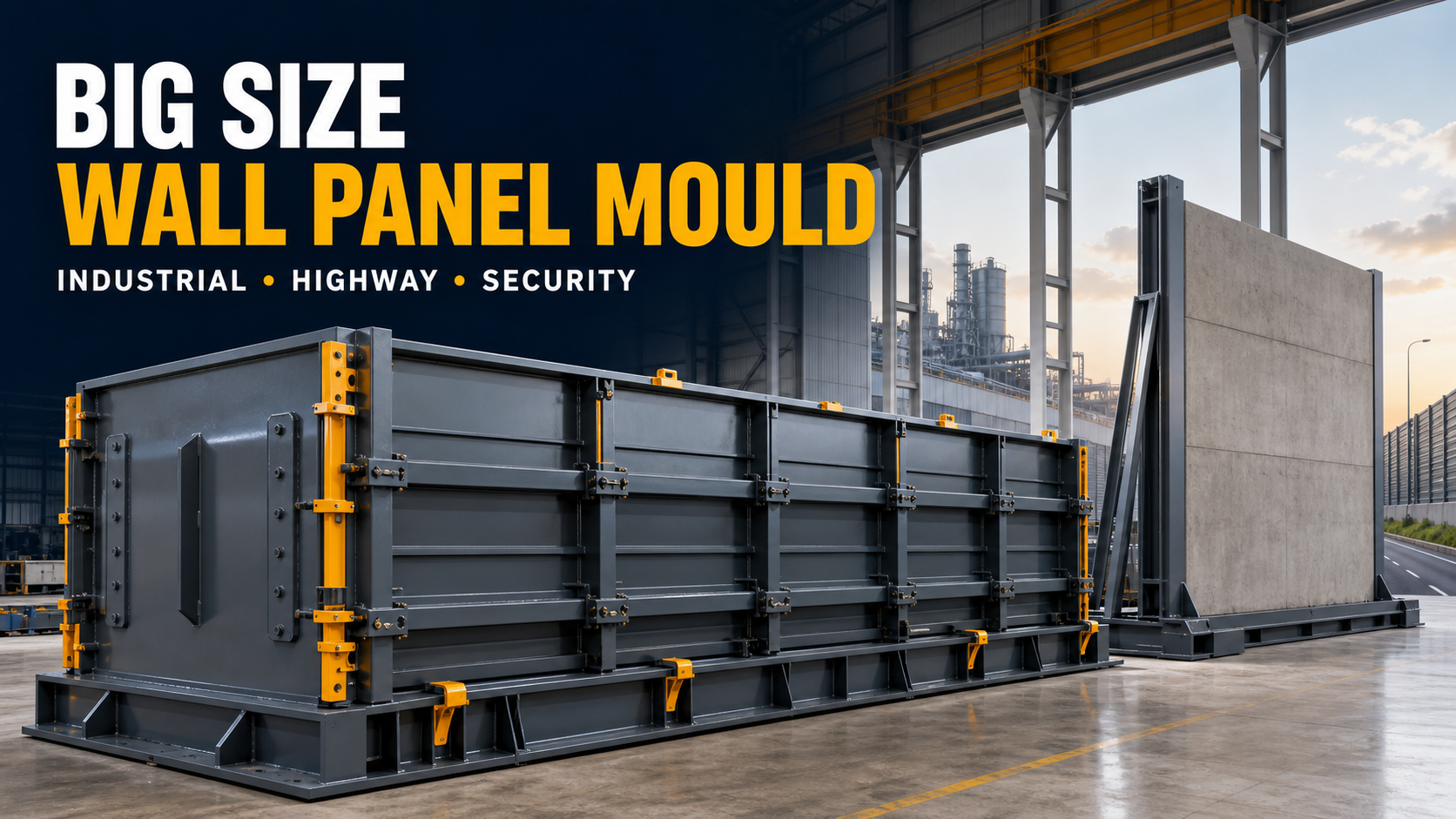
Big Size Wall Panel Mould for Industrial, Highway and Security Projects

Precast Infrastructure Moulds

Big Size Wall Panel Mould for Industrial, Highway and Security Projects

Big size wall panel moulds manufacture large precast concrete panels for industrial plants, highways and security walls. Explore their sizes, construction, production process and buying factors.

Read article
Footing With Column Mould: Monolithic Precast Foundation Manufacturing Guide

Precast Infrastructure Moulds

Footing With Column Mould: Monolithic Precast Foundation Manufacturing Guide

A footing with column mould produces a complete precast foundation unit in a single concrete pour. Learn about its sizes, iron construction, manufacturing process, applications and important buying factors.

Read article
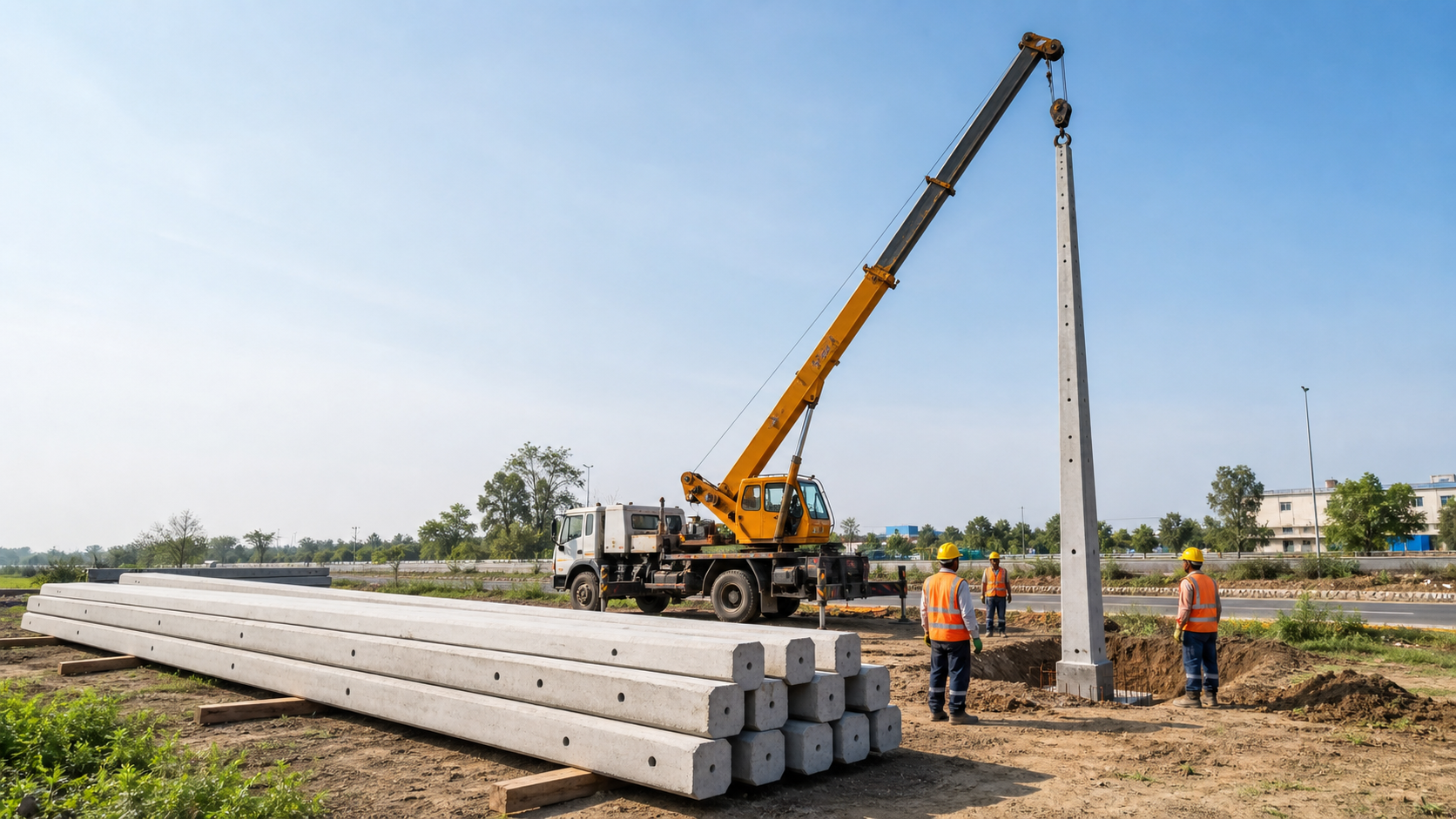
Precast Column Pole Mould: Sizes, Production Capacity and Buying Guide

Precast Infrastructure Moulds

Precast Column Pole Mould: Sizes, Production Capacity and Buying Guide

Learn about precast column pole mould sizes, production capacity, heavy-duty iron construction and key factors to check before buying a mould line.

Read article
Y Shape Concrete Pole Mould for Security Fencing: Complete Manufacturing Guide

Precast Infrastructure Moulds

Y Shape Concrete Pole Mould for Security Fencing: Complete Manufacturing Guide

Explore Y shape concrete pole mould sizes, security-fencing applications and the complete RCC Y-post manufacturing process from casting to demoulding.

Read article
Embossed Boundary Wall Panel Mould: Designs, Benefits and Production Guide

Precast Wall Solutions

Embossed Boundary Wall Panel Mould: Designs, Benefits and Production Guide

Learn how heavy-duty iron embossed panel moulds produce decorative precast boundary walls with accurate patterns, consistent sizes and smooth finishes.

Read article
Panel Shifting Trolley for Precast Plants: Capacity, Design and Safety Guide

Precast Machinery Guide

Panel Shifting Trolley for Precast Plants: Capacity, Design and Safety Guide

Learn how to select and safely operate a panel shifting trolley for transporting concrete panels, poles, slabs and other products inside a precast plant.

Read article
Precast Garden Bench Mould: Manufacturing Process, Designs and Business Opportunity

Precast Business Guide

Precast Garden Bench Mould: Manufacturing Process, Designs and Business Opportunity

Explore precast garden bench mould designs, sizes and the complete manufacturing process for starting or expanding an outdoor concrete furniture business.

Read article
Friction Slab Barrier Mould: Applications, Specifications and Buying Guide

Precast Infrastructure Moulds

Friction Slab Barrier Mould: Applications, Specifications and Buying Guide

Learn how to select a friction slab barrier mould by comparing barrier dimensions, iron plate thickness, opening system and project applications.

Read article
Precast Window Frame Mould: Types, Sizes and Manufacturing Process

Precast Building Solutions

Precast Window Frame Mould: Types, Sizes and Manufacturing Process

Learn about precast window frame mould types, standard dimensions, iron construction and the complete process for manufacturing RCC khidki chaukhat.

Read article
Fencing Pole Mould Buying Guide: Sizes, Production Capacity and Iron Plate Thickness

Precast Mould Guide

Fencing Pole Mould Buying Guide: Sizes, Production Capacity and Iron Plate Thickness

Learn how to select a fencing pole mould based on pole dimensions, casting capacity, iron plate thickness, hole pattern and operating requirements.

Read article
Concrete Mixer Machine for Precast Products: Capacity, Motor and Selection Guide

Precast Machinery Guide

Concrete Mixer Machine for Precast Products: Capacity, Motor and Selection Guide

Compare concrete mixer machine capacity, motor options, mixing features and applications to select the right machine for your precast production unit.

Read article
Precast Concrete Bridge Mould: Complete Guide for Bridge and Infrastructure Projects

Precast Infrastructure Moulds

Precast Concrete Bridge Mould: Complete Guide for Bridge and Infrastructure Projects

Explore the types, dimensions, working features and applications of heavy-duty iron precast concrete bridge moulds for major infrastructure projects.

Read article
RE Wall Panel Mould: Types, Sizes, Price Factors and Applications

Precast Infrastructure Moulds

RE Wall Panel Mould: Types, Sizes, Price Factors and Applications

Learn how to select the right RE wall panel mould by comparing panel shapes, standard sizes, steel construction, price factors and infrastructure applications.

Read article
Precast Concrete Mould Maintenance Checklist for Long Production Life

Precast Mould Guide

Precast Concrete Mould Maintenance Checklist for Long Production Life

Heavy-duty iron precast moulds can deliver reliable production for many casting cycles, but only when they are cleaned, inspected and maintained properly. A simple maintenance routine reduces mould damage, product rejection and avoidable repair cost.

Read article
How to Improve Precast Production Speed Without Compromising Quality

Precast Production Guide

How to Improve Precast Production Speed Without Compromising Quality

Fast production is important for every precast concrete unit, but speed should never lead to poor finish, dimensional errors or product rejection. The right moulds, machinery and process planning help increase output while maintaining reliable quality.

Read article
Custom Precast Moulds: When Standard Sizes Are Not Enough

Precast Mould Guide

Custom Precast Moulds: When Standard Sizes Are Not Enough

Standard precast moulds work for common products, but many infrastructure and construction projects need specific sizes, shapes and technical details. Custom precast moulds help manufacturers produce accurate products with less waste and better site fitting.

Read article
Common Precast Concrete Casting Defects and How Better Moulds Help Prevent Them

Precast Mould Guide

Common Precast Concrete Casting Defects and How Better Moulds Help Prevent Them

Precast concrete quality depends on the right concrete mix, vibration, curing and most importantly, a strong and accurate mould. Learn how better iron moulds help prevent common casting defects.

Read article
How a Concrete Vibrator Table Improves Precast Product Quality

Precast Machinery Guide

How a Concrete Vibrator Table Improves Precast Product Quality

A concrete vibrator table helps compact fresh concrete inside moulds, reducing air pockets and supporting a denser, smoother precast finish.

Read article
Box Culvert vs U Drain: Which Precast Drainage Solution Should You Choose?

Precast Mould Guide

Box Culvert vs U Drain: Which Precast Drainage Solution Should You Choose?

Box culverts and U drains both support effective water management, but they serve different site conditions. This guide helps you choose the right precast drainage solution.

Read article
How to Select the Right Size U Drain Mould for Your Drainage Project

Precast Mould Guide

How to Select the Right Size U Drain Mould for Your Drainage Project

Choosing the correct U Drain Mould size is essential for producing durable precast drainage channels that fit the project requirement and install smoothly on site.

Read article
10 Questions to Ask Before Buying a Precast Concrete Mould

Precast Mould Guide

10 Questions to Ask Before Buying a Precast Concrete Mould

Buying a precast concrete mould is a long-term production decision. The right questions help you avoid sizing mistakes, poor output quality and unnecessary maintenance costs.

Read article
How to Start a Precast Concrete Boundary Wall Manufacturing Unit in India

Precast Business Guide

How to Start a Precast Concrete Boundary Wall Manufacturing Unit in India

A precast boundary wall unit can supply fast, durable and uniform wall solutions for farms, residential sites, industries and commercial projects. This guide explains the basic setup requirements.

Read article
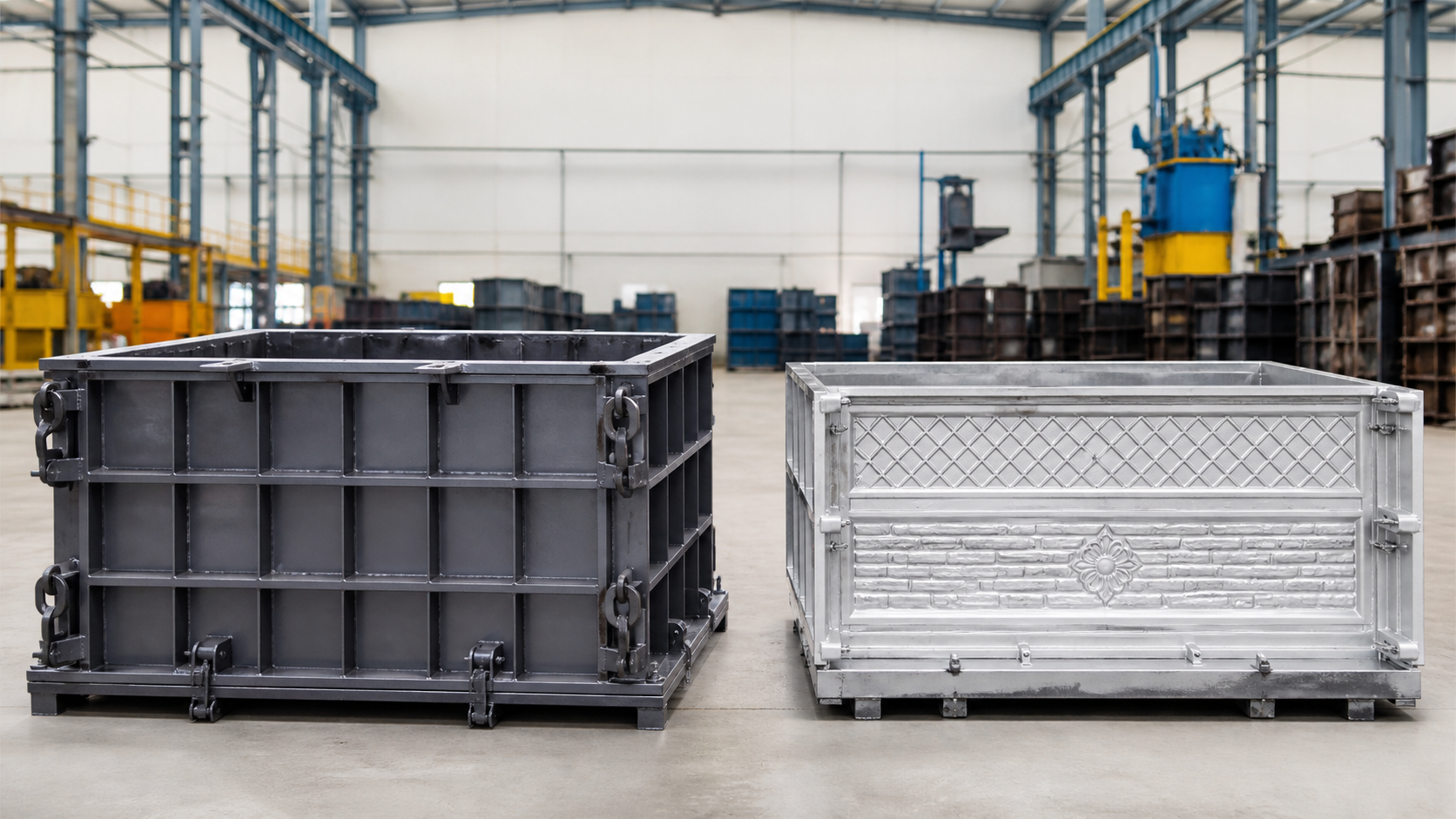
Iron vs Aluminium Precast Mould: Which Material Is Right for Your Project?

Precast Mould Guide

Iron vs Aluminium Precast Mould: Which Material Is Right for Your Project?

Choosing the right mould material affects precast production quality, speed and long-term operating cost. This guide compares heavy-duty iron and aluminium precast moulds to help you select the right option.

Read article
Precast Concrete Footing Mould: Types, Benefits and Applications

Precast Infrastructure Moulds

Precast Concrete Footing Mould: Types, Benefits and Applications

Precast concrete footing moulds help manufacturers produce strong, accurately sized foundations for poles, columns, boundary walls and infrastructure projects.

Read article
Retaining Wall Mould Manufacturer for Infrastructure Projects

Precast Infrastructure Moulds

Retaining Wall Mould Manufacturer for Infrastructure Projects

Retaining wall moulds help precast manufacturers produce strong, uniform concrete wall units for roads, slopes, landscaping and infrastructure projects.

Read article
Precast Door Frame Mould: Faster Concrete Door Frame Production

Precast Building Solutions

Precast Door Frame Mould: Faster Concrete Door Frame Production

Precast door frame moulds help manufacturers produce strong, uniform concrete door frames with accurate dimensions for residential and commercial construction projects.

Read article
Precast Concrete Manhole Cover Mould Manufacturer in India

Precast Infrastructure Moulds

Precast Concrete Manhole Cover Mould Manufacturer in India

Precast concrete manhole cover moulds help manufacturers produce strong, accurately shaped covers for drainage, sewerage and utility infrastructure projects.

Read article
Highway Barrier Mould: Steel Moulds for Precast Road Safety Barriers

Precast Infrastructure Moulds

Highway Barrier Mould: Steel Moulds for Precast Road Safety Barriers

Highway barrier moulds help precast manufacturers produce strong, uniform concrete road safety barriers for highways, bridges, medians and infrastructure projects.

Read article
Cable Trench Mould Manufacturer: Precast Solutions for Utility Projects

Precast Infrastructure Moulds

Cable Trench Mould Manufacturer: Precast Solutions for Utility Projects

Cable trench moulds help precast manufacturers produce strong, accurate concrete cable trenches for safe underground utility and electrical cable management.

Read article
Precast Concrete Pole Mould Manufacturer in India

Precast Infrastructure Moulds

Precast Concrete Pole Mould Manufacturer in India

Precast concrete pole moulds help manufacturers produce strong, uniform and durable concrete poles for fencing, boundary walls, electrical and infrastructure applications.

Read article
Precast Wall Panel Mould: How to Choose the Right Steel Mould

Precast Wall Solutions

Precast Wall Panel Mould: How to Choose the Right Steel Mould

A high-quality steel wall panel mould helps precast manufacturers produce durable, uniform and attractive concrete wall panels efficiently.

Read article
Compound Wall Mould Manufacturer in India: Benefits of Precast Boundary Walls

Precast Wall Solutions

Compound Wall Mould Manufacturer in India: Benefits of Precast Boundary Walls

Compound wall moulds help manufacturers produce strong, attractive and uniform precast boundary wall panels for residential, commercial and industrial projects. 5:20 PM

Read article
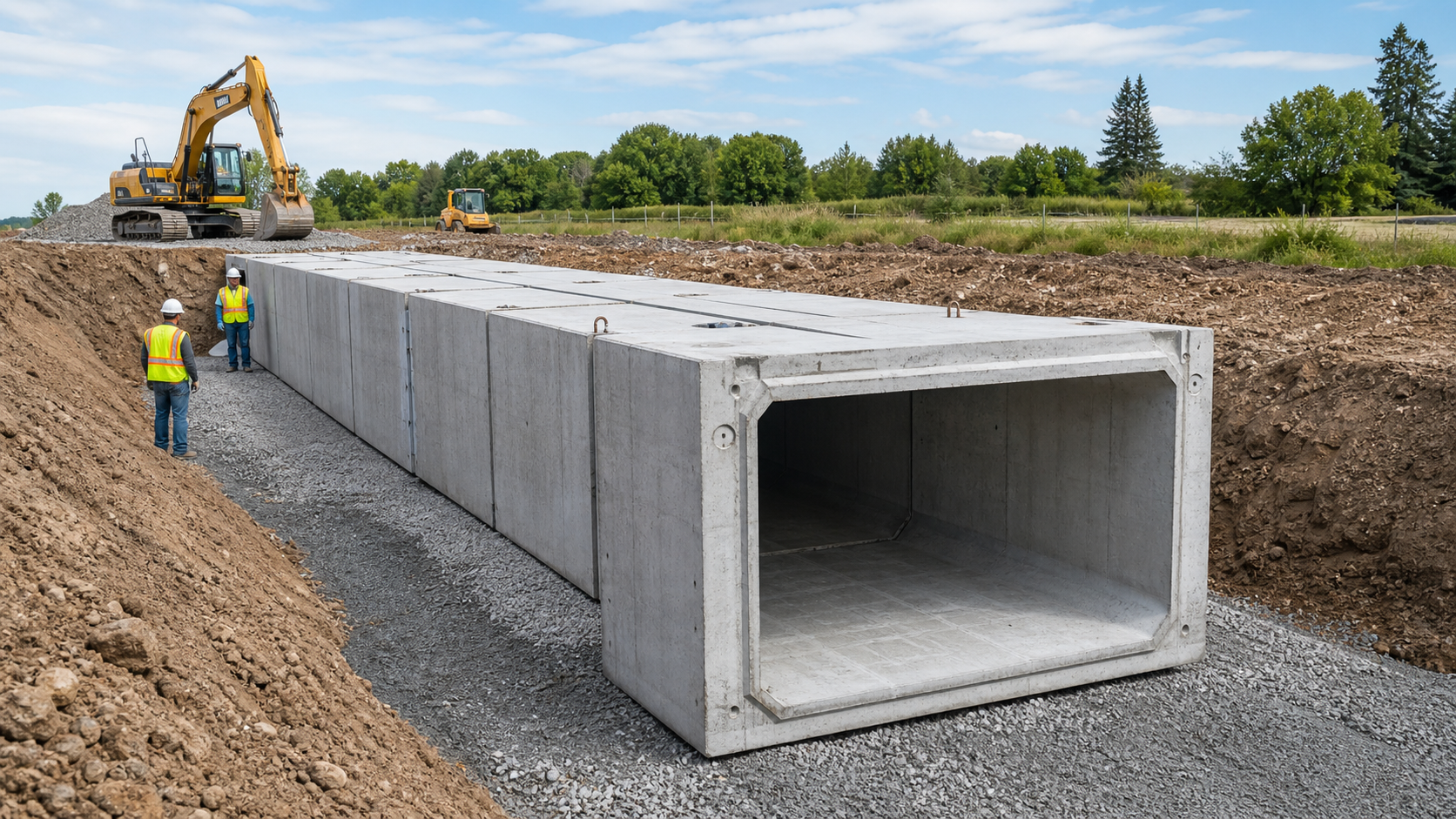
Box Culvert Mould Manufacturer in India: Complete Precast Production Guide

Precast Infrastructure Moulds

Box Culvert Mould Manufacturer in India: Complete Precast Production Guide

Box culvert moulds help precast manufacturers produce strong, dimensionally accurate concrete culverts for drainage, road and infrastructure projects.

Read article
Vertical Box Mould Manufacturer in India: Durable Steel Moulds for Precast Concrete Production

Precast Infrastructure Moulds

Vertical Box Mould Manufacturer in India: Durable Steel Moulds for Precast Concrete Production

Vertical box moulds help precast manufacturers produce strong, accurate and uniform concrete box units for drainage, infrastructure and construction projects.

Read article
U Drain Mould Manufacturer in India: Complete Guide for Precast Drainage Solutions

Precast Drainage Solutions

U Drain Mould Manufacturer in India: Complete Guide for Precast Drainage Solutions

Learn how high-quality U drain moulds help create strong, accurate and long-lasting precast drainage channels for infrastructure projects.

Read article
How to Choose Precast Concrete Moulds for Durable, High-Quality Concrete Products

Precast Mould Guide

How to Choose Precast Concrete Moulds for Durable, High-Quality Concrete Products

Choosing the right precast concrete mould improves product quality, production speed and long-term manufacturing efficiency. Here is what every buyer should check.

Read article
How to Choose the Right Precast Boundary Wall Mould

Precast Mould Guide

How to Choose the Right Precast Boundary Wall Mould

A practical guide to mould capacity, steel construction, panel size and hydraulic compatibility.

Read article
7 Precast Concrete Mould Maintenance Tips for Longer Service Life

Manufacturing Tips

7 Precast Concrete Mould Maintenance Tips for Longer Service Life

Keep your steel moulds clean, aligned and ready for reliable production with these practical maintenance checks.

Read article
Why Precision Steel Moulds Improve Precast Concrete Quality

Quality & Technology

Why Precision Steel Moulds Improve Precast Concrete Quality

Accurate fabrication, strong frames and reliable locking systems directly affect precast product quality.

Read article
U Drain, Cable Trench or Box Culvert: Drawing Checklist

Drainage Specification

U Drain, Cable Trench or Box Culvert: Drawing Checklist

Separate drainage and cable duct requirements, then prepare the dimensions and release details needed for a comparable mould quotation.

Read article
Plan a Wall Panel Casting Line: Capacity, Finish and Handling

Wall Production Planning

Plan a Wall Panel Casting Line: Capacity, Finish and Handling

Match the wall panel geometry and finish to a casting system, then check curing space and material handling before selecting capacity.

Read article
Square Column, H-Pole or Y-Post: Select a Precast Post Profile

Post Selection

Square Column, H-Pole or Y-Post: Select a Precast Post Profile

Identify the function of the post before specifying its profile, grooves, wire-hole positions and mould release arrangement.

Read article
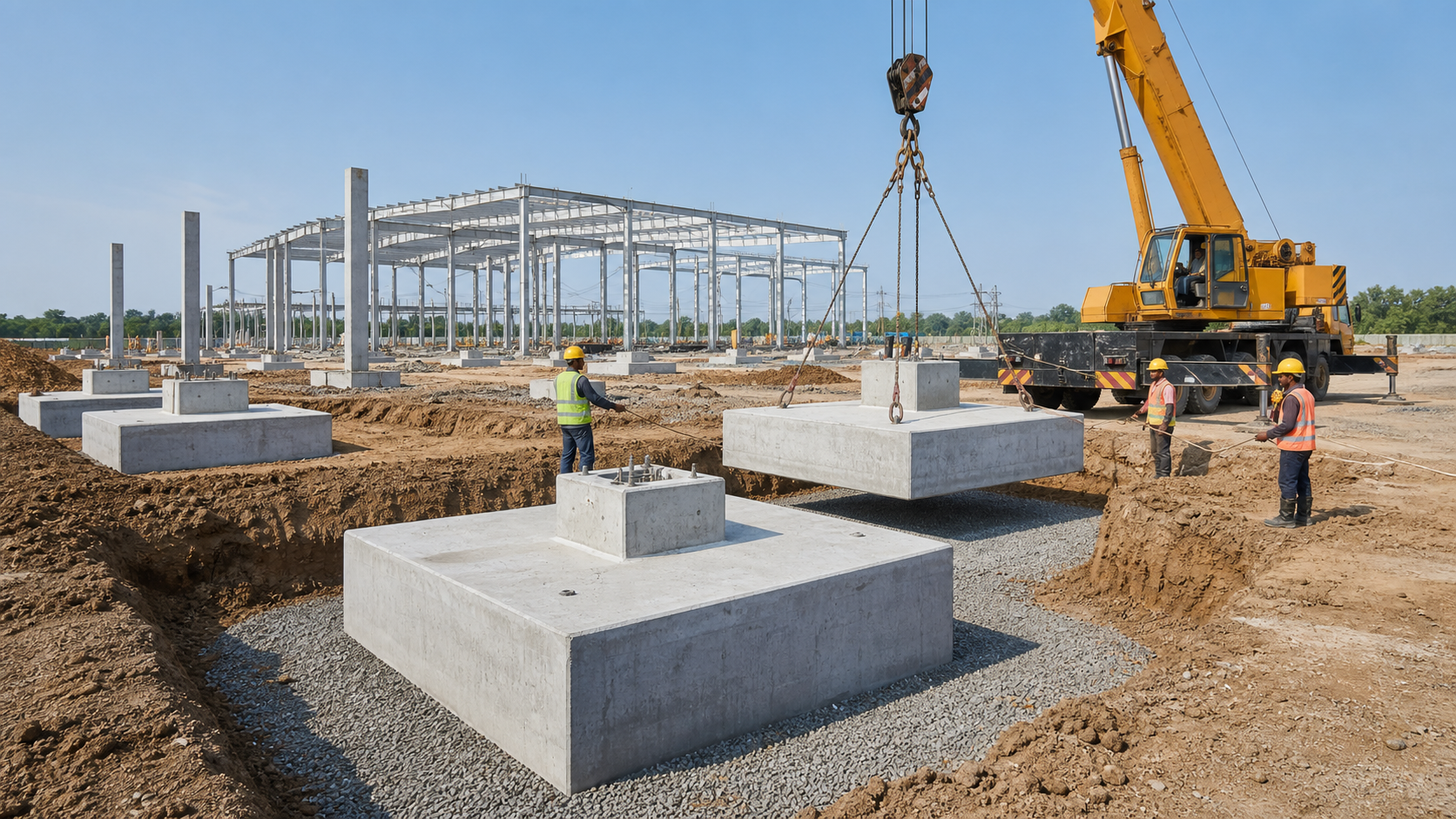
Bridge and Foundation Moulds: What to Include in the Drawing

Structural Mould Planning

Bridge and Foundation Moulds: What to Include in the Drawing

Separate the structural component design from the fabrication scope and check cores, inserts and release clearance before ordering.

Read article
Specify Highway Barriers, Friction Slabs and RE Facing Panels

Infrastructure Specification

Specify Highway Barriers, Friction Slabs and RE Facing Panels

Define the highway component, approved geometry and connection details so related mould systems are quoted against the correct scope.

Read article
RCC Frames and Bench Moulds: Rebates, Cores and Set Details

Precast Component Details

RCC Frames and Bench Moulds: Rebates, Cores and Set Details

Prepare opening and rebate details for chaukhat moulds, or seat and support drawings for concrete bench mould sets.

Read article
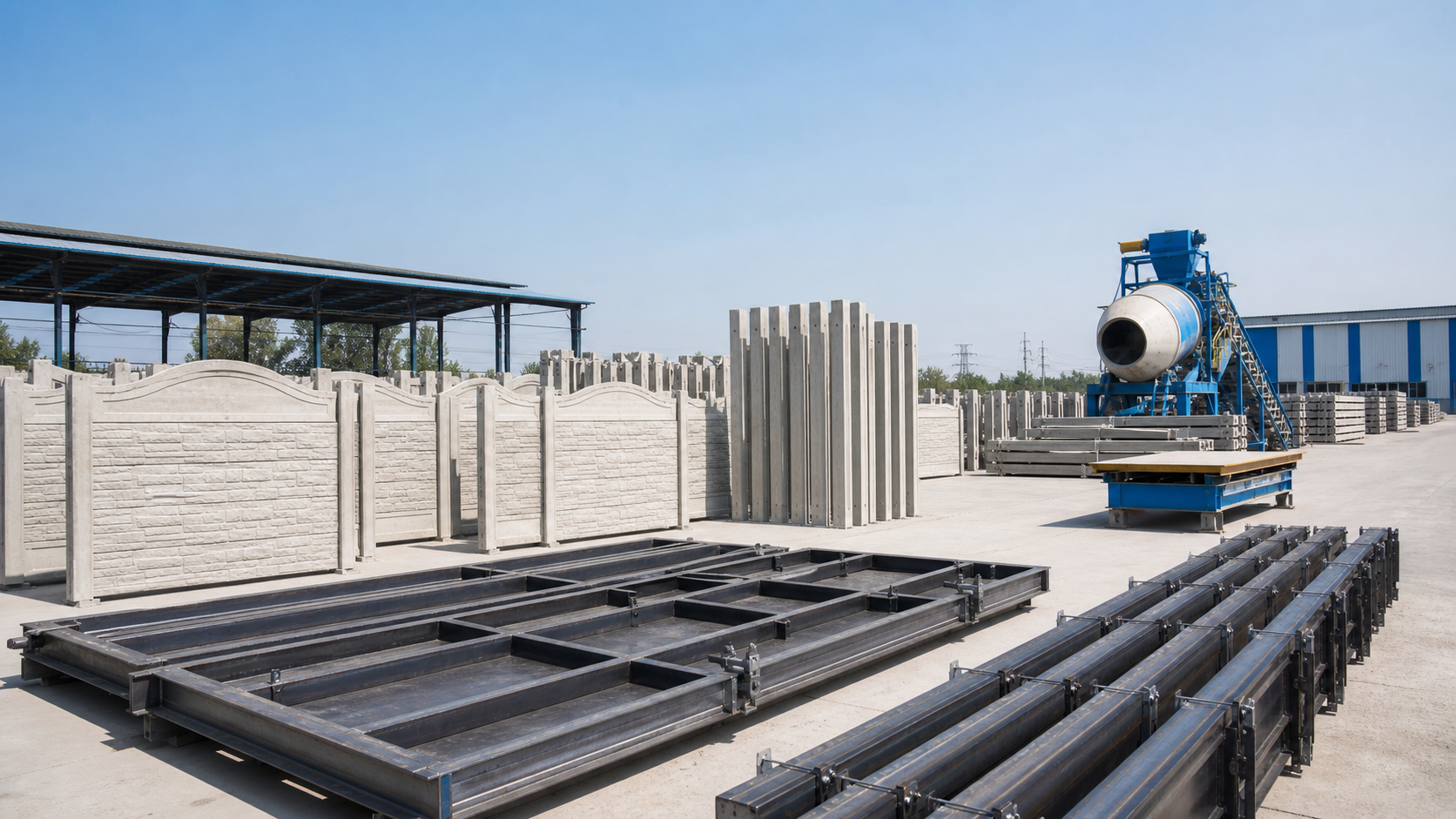
Match a Concrete Mixer, Vibrating Table and Trolleys to Your Yard

Machinery Selection

Match a Concrete Mixer, Vibrating Table and Trolleys to Your Yard

Review the whole concrete and handling workflow before selecting individual machine capacities.

Read article