
Precast Machinery Guide
Concrete Shifting Trolley for Precast Plants: Capacity, Design and Applications
A concrete shifting trolley transports wet concrete and raw materials between mixers and casting moulds. Learn about its capacity, design, applications and buying factors.
By Paras Steel Industries ·
Concrete Shifting Trolley for Precast Plants: Capacity, Design and Applications
Concrete Shifting Trolley for Precast Plants: Capacity, Design and Applications
Efficient material movement is essential for maintaining production speed inside a precast concrete plant. Wet concrete must be transported from the mixer or batching unit to different casting moulds before it begins losing workability.
Carrying concrete manually requires considerable labour, increases production time and may cause material spillage. A concrete shifting trolley provides a practical system for moving wet concrete, mortar, aggregates and other production materials across the precast yard.
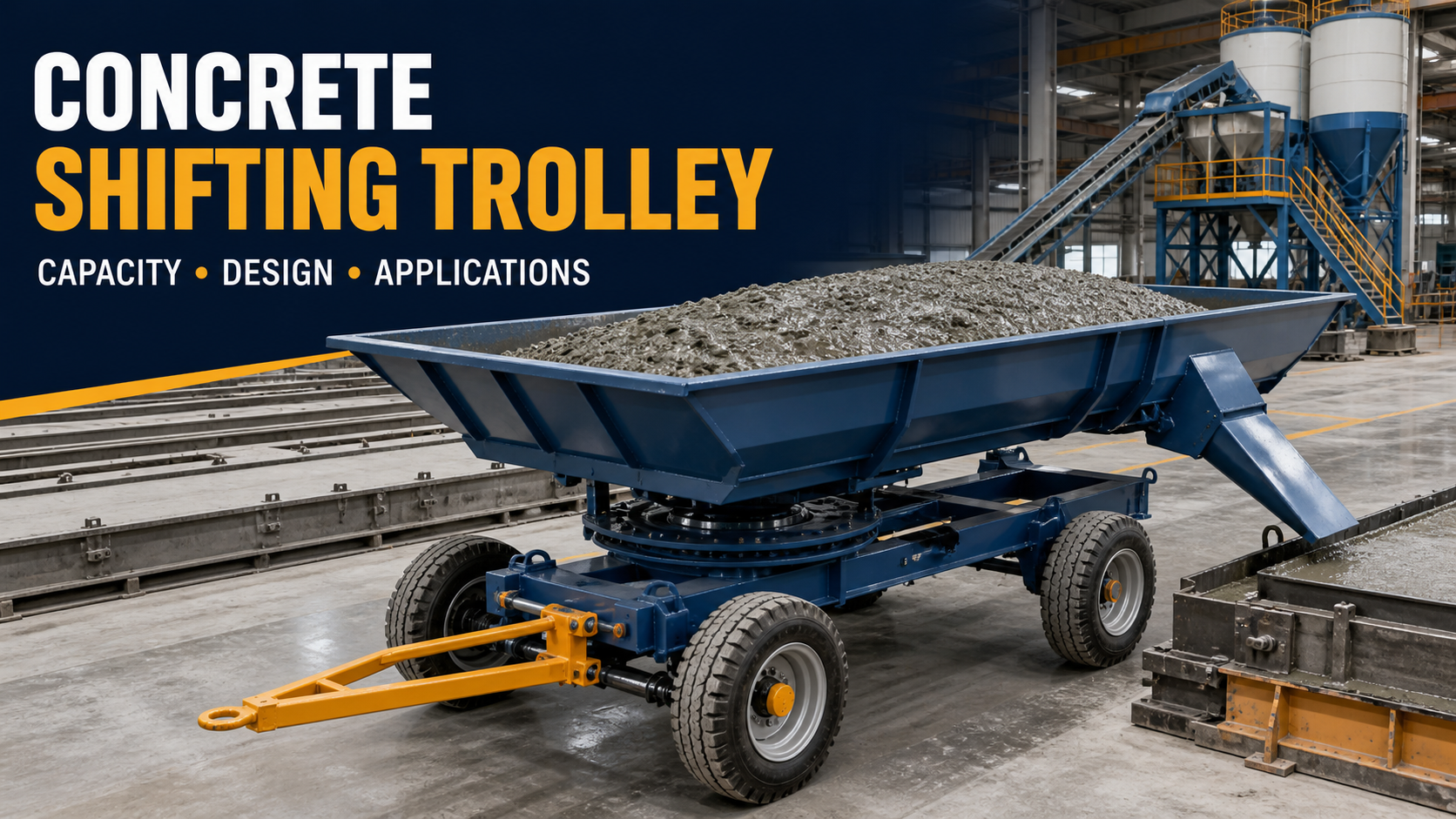
The trolley generally contains a heavy-duty flared tray, reinforced chassis, pneumatic tyres, turntable steering and a towing arrangement. Its design allows it to operate between batching areas, mixer machines, moulding lines and storage locations.
This guide explains concrete shifting trolley capacity, construction, working process, applications, benefits, customisation options and important buying factors.
What Is a Concrete Shifting Trolley?
A concrete shifting trolley is a heavy-duty material transport trailer used inside precast plants and concrete casting yards.
Its primary purpose is to carry wet concrete from a batching plant or mixer machine to wall panel, column, pole, drain, foundation and other precast moulds.
The trolley can also transport:
Sand
Aggregates
Mortar
Cement bags
Concrete slurry
Mould accessories
Vibration equipment
Maintenance tools
Unlike a normal flat trolley, a concrete shifting trolley has a tray with raised and flared side walls. This tub-shaped construction helps contain wet material and minimise slurry spillage during movement.
How Does a Concrete Shifting Trolley Work?
The trolley is positioned near the mixer or batching unit. Concrete is discharged into its tray according to the trolley’s safe load capacity.
A tractor, forklift or suitable yard-towing vehicle then moves the trolley to the required casting location. Its front turntable steering system allows it to turn inside narrow factory aisles and between moulding beds.
At the casting point, concrete can be unloaded using:
Manual shovelling
Bucket discharge
Chute arrangement
Mechanical tilting arrangement, where provided
Custom discharge opening
The exact unloading method depends on the trolley configuration and plant workflow.
After unloading, the tray is washed and returned to the batching area for the next production cycle.
Main Components of a Concrete Shifting Trolley
Spill-Proof Tray
The upper tray holds wet concrete or raw materials. It usually contains sloped or flared side walls that reduce spillage during transportation.
Tray Deck Plate
Heavy-duty mild-steel plates create the tray floor. Plate thickness is selected according to payload capacity, tray size and expected usage.
Main Chassis
The chassis carries the entire load of the concrete and tray. Heavy ISMC channels and cross-members provide structural support.
Cross Stiffeners
Cross stiffeners distribute the load across the chassis and help prevent tray sagging.
Front Turntable Assembly
A front turntable or kingpin swivel arrangement allows the front axle to rotate during steering.
Tow Bar
The tow bar connects the trolley to a tractor, forklift or suitable yard vehicle.
Axle Assembly
Heavy-duty solid axles support the trolley and transmit the payload to the wheels.
Bearing Hubs
Taper roller bearing hubs support smooth wheel rotation under heavy loads.
Pneumatic Tyres
Truck or tractor-type pneumatic tyres help the trolley operate on factory floors, gravel, compacted soil and uneven casting yards.
Side-Wall Supports
External supports reinforce the tray walls against the pressure of wet concrete and bulk material.
Anti-Rust Coating
Industrial primer and paint protect the chassis and tray from moisture, cement slurry and outdoor conditions.
Concrete Shifting Trolley Capacity
Trolley capacity should be selected according to the concrete volume required during each trip.
Common payload configurations may include:
2-ton capacity
3-ton capacity
5-ton capacity
Custom 10-ton or higher capacity
A commonly used standard model may have:
Tray size: Approximately 6 ft × 4 ft
Metric tray size: Approximately 1800 mm × 1200 mm
Payload capacity: Approximately 3 to 5 tons
Tyre size: 7.50-16 pneumatic tyres
Steering: Front turntable steering
Towing: Heavy-duty tow-bar hitch
Custom deck lengths may include:
5 ft
6 ft
8 ft
10 ft or longer
Custom tray widths may include:
3 ft
4 ft
5 ft
The trolley’s safe payload must be based on the complete structural design, axle rating, bearing capacity, tyre rating and towing system. Tray dimensions alone do not determine carrying capacity.
Concrete Volume and Payload Calculation
Concrete is considerably heavier than it appears. Normal concrete may weigh approximately 2,300 to 2,500 kilograms per cubic metre, depending on the mix and aggregates.
For example:
0.5 cubic metre of concrete may weigh around 1.15 to 1.25 tons.
1 cubic metre may weigh around 2.3 to 2.5 tons.
2 cubic metres may weigh around 4.6 to 5 tons.
These figures are indicative. Actual concrete density should be confirmed from the mix design.
The trolley must also carry the weight of its tray and chassis. Manufacturers should never load concrete only according to the available tray volume without checking the rated payload.
Tray Plate Thickness Options
Common tray plate thicknesses may include:
5 mm
6 mm
8 mm
10 mm for selected heavy-duty designs
The required plate thickness depends on:
Tray dimensions
Rated payload
Number of chassis supports
Distance between cross-members
Material being transported
Loading method
Unloading method
Frequency of use
Condition of the factory floor
A thicker plate does not automatically create a higher-capacity trolley. Chassis channels, axles, tyres, bearings and towing arrangements must also be designed for the same payload.
Chassis Design
The chassis is one of the most important parts of a concrete shifting trolley.
A heavy-duty trolley may use approximately 125 mm or 150 mm ISMC channels as main longitudinal members. Cross-channels and stiffeners connect these members to form a rigid grid structure.
A properly designed chassis helps prevent:
Tray bending
Frame twisting
Uneven tyre loading
Axle misalignment
Cracking near welded joints
Unstable movement
Premature structural failure
The chassis design should consider both static load and additional forces produced while travelling over uneven surfaces.
Spill-Proof Flared Tray Design
Wet concrete can spill from a normal flat trolley during turning, braking or movement over uneven ground.
A flared tray uses sloped side walls to direct the material toward the centre. It also provides easier access during manual unloading.
Benefits of the flared design include:
Reduced concrete spillage
Cleaner casting-yard movement
Improved wet-material containment
Easy manual shovelling
Convenient chute discharge
Better handling of sand and aggregates
Reduced material wastage
The side-wall height should be selected according to the material type, tray volume and unloading process.
Available Side-Wall Configurations
Fixed Flared Side Walls
Fixed walls provide a simple and strong construction for wet concrete and bulk-material transport.
Drop-Down Side Walls
A drop-down side can simplify unloading and tray cleaning. The hinges and locking system must be suitable for the rated load.
Removable Side Walls
Removable panels allow the trolley to handle different types of materials.
Box-Type Enclosure
A deeper enclosure increases holding volume but must remain within the rated weight capacity.
Custom Discharge Gate
A discharge opening can be designed for controlled concrete or aggregate unloading.
Turntable Steering System
A concrete shifting trolley may use a 360-degree front turntable steering assembly.
In this system, the front axle rotates relative to the main chassis when the towing vehicle changes direction.
Turntable steering provides:
Reduced turning radius
Improved factory manoeuvrability
Easier movement between moulding beds
Better alignment during towing
Convenient operation in storage aisles
Reduced tyre dragging during turns
Although the turntable may rotate through a wide angle, operators must avoid extremely sharp turns at high speed because they can destabilise a loaded trolley.
Tyre Options
Pneumatic truck or tractor tyres are commonly used for concrete shifting trolleys.
Typical tyre sizes may include:
7.50-16
8.25-16
The correct tyre size depends on:
Payload capacity
Trolley dimensions
Axle configuration
Factory floor conditions
Outdoor yard conditions
Operating speed
Required ground clearance
Pneumatic tyres absorb some shock when the trolley travels across uneven surfaces. They are suitable for factory floors, gravel yards, compacted soil and selected unpaved areas.
All tyres must have an adequate combined load rating for the trolley’s maximum loaded weight.
Importance of Ground Clearance
Casting yards may contain uneven surfaces, concrete deposits, gravel and temporary pathways.
Adequate ground clearance helps prevent the chassis from contacting the ground. It also makes movement easier on outdoor factory routes.
However, excessive trolley height can create unloading and stability problems. The design should maintain a practical balance between:
Ground clearance
Tray loading height
Centre of gravity
Unloading convenience
Tyre diameter
Factory route conditions
Applications of a Concrete Shifting Trolley
Wet Concrete Distribution
The primary application is transporting wet concrete from the mixer or batching plant to casting moulds.
Boundary Wall Production
Concrete can be moved to wall-panel, column and footing moulds installed at different positions across the plant.
Pole and Column Manufacturing
The trolley supports concrete delivery to long pole, fencing-post and column moulding lines.
Drain and Infrastructure Products
It can transport concrete for U-drain, trench, kerb stone, barrier and other infrastructure moulds.
Raw Material Transportation
Sand, coarse aggregates, cement bags and dry production materials can be moved around the factory.
Mortar and Slurry Movement
The flared tray can transport mortar and suitable cement-based materials.
Mould Accessories
When clean and empty, the trolley may be used for selected mould components and production accessories, subject to safe loading.
Maintenance Equipment
Tools, vibration equipment and maintenance supplies can be transported across large precast yards.
Benefits for Precast Plants
Reduced Manual Labour
One loaded trolley can replace multiple manual trips using pans or wheelbarrows.
Faster Concrete Delivery
Concrete can be delivered quickly from the mixer to different production beds.
Lower Material Wastage
Raised flared sides help reduce spillage during transportation.
Improved Factory Workflow
A planned trolley route can connect batching, reinforcement, moulding and cleaning areas.
Suitable for Heavy Loads
Reinforced chassis, axles and pneumatic tyres support industrial material handling.
Better Manoeuvrability
Turntable steering allows operation inside narrow casting aisles.
Customisable Design
Tray dimensions, payload, side walls, tyre sizes and towing arrangements can be modified.
Multiple Applications
The same trolley can handle wet concrete, mortar, sand, aggregates and selected factory materials.
Concrete Shifting Trolley Working Process
Step 1: Inspect the Trolley
Before each shift, inspect the tyres, wheel nuts, axle, tow bar, turntable, bearings and chassis.
Step 2: Clean the Tray
Remove hardened concrete from the previous cycle. A dirty tray reduces capacity and increases unnecessary trolley weight.
Step 3: Check the Route
Ensure that the transport route is clear of workers, tools, reinforcement and other obstructions.
Step 4: Position Near the Mixer
Park the trolley on stable and level ground beneath or beside the mixer discharge point.
Step 5: Load the Concrete
Distribute concrete evenly across the tray. Avoid concentrated loading at one end.
Step 6: Confirm the Payload
Do not exceed the trolley’s rated load, axle rating, tyre capacity or towing-vehicle limit.
Step 7: Connect the Towing Vehicle
Attach the tow bar securely to the approved hitch point. Use a safety pin or secondary retention arrangement where specified.
Step 8: Move at Low Speed
Transport the loaded trolley at a controlled speed. Avoid sudden acceleration, braking and sharp turns.
Step 9: Position Near the Mould
Align the trolley so workers can unload concrete safely without standing between the trolley and mould.
Step 10: Unload the Concrete
Unload using shovels, buckets, chutes or the provided discharge arrangement.
Step 11: Return for Cleaning
Wash the tray before the remaining concrete hardens. Avoid directing wash water into bearings and steering components.
How to Select the Right Capacity
Before ordering, calculate the amount of concrete required during one trip.
Consider:
Concrete volume per mould
Number of moulds filled per trip
Concrete density
Distance from mixer to mould
Number of daily casting cycles
Factory aisle width
Towing-vehicle capacity
Required unloading time
Available workers
Ground conditions
A large trolley reduces the number of trips but may be difficult to manoeuvre. A small trolley is easier to operate but may increase transportation time.
The correct capacity should match the production cycle rather than simply selecting the largest available model.
Safety Considerations
Never overload the trolley.
Use a correctly rated tractor, forklift or yard vehicle.
Inspect the tow bar before movement.
Keep workers away from the turning radius.
Avoid sudden steering movements.
Reduce speed on slopes and uneven ground.
Do not allow workers to ride on the trolley.
Use wheel chocks while loading on a slope.
Maintain safe clearance from open moulds.
Do not stand beneath elevated or tilted trays.
Check tyre pressure regularly.
Use appropriate personal protective equipment.
A loaded concrete trolley has a high total weight and must be operated only by trained personnel.
Maintenance Requirements
Daily Cleaning
Wash wet concrete from the tray after every production shift.
Turntable Lubrication
Lubricate the steering assembly according to the maintenance schedule.
Bearing Maintenance
Inspect wheel bearings for noise, overheating and excessive play.
Tyre Inspection
Check tyre pressure, cuts, wear and sidewall condition.
Axle Inspection
Check the axle and hub assemblies for bending, cracks or loose components.
Tow-Bar Inspection
Inspect the tow eye, hitch, retaining pin and welded joints.
Chassis Inspection
Look for cracks near cross-members and high-load welded connections.
Paint Maintenance
Repair damaged primer and industrial coating to reduce corrosion.
Fastener Checks
Tighten wheel nuts and structural fasteners periodically.
Common Operating Mistakes
Overloading the Tray
Overloading can damage the chassis, axles, tyres and steering system.
Loading on Uneven Ground
An unstable loading position increases the risk of trolley movement or overturning.
High-Speed Turning
Sudden sharp turns can cause material spillage and instability.
Uneven Material Distribution
Concrete loaded at only one end creates uneven axle and tyre loads.
Ignoring Hardened Concrete
Concrete buildup adds permanent dead weight and reduces tray volume.
Using an Undersized Towing Vehicle
The towing vehicle must control the loaded trolley during acceleration, turning and braking.
Incorrect Tyre Pressure
Low tyre pressure increases rolling resistance and tyre damage.
Poor Route Planning
Narrow or obstructed routes reduce productivity and increase accident risk.
Difference Between Concrete and Panel Shifting Trolleys
A concrete shifting trolley and panel shifting trolley perform different jobs.
Concrete Shifting Trolley
Carries wet concrete and bulk raw materials.
Uses a flared or tub-shaped tray.
Focuses on spill prevention.
Commonly has lower side walls for easy unloading.
Panel Shifting Trolley
Carries finished precast panels and heavy concrete products.
Uses a flat deck, support frame or specialised rack.
Focuses on product stability and load distribution.
May have a significantly higher payload capacity.
The correct trolley should be selected according to the material being transported.
Concrete Shifting Trolley Price Factors
Payload Capacity
Higher payloads require heavier channels, axles, bearings and tyres.
Tray Dimensions
Longer and wider trays increase material and fabrication requirements.
Tray Plate Thickness
Heavy deck plates increase weight, durability and price.
Chassis Channel Size
The size and number of main channels and cross-members affect cost.
Steering System
Turntable and kingpin steering assemblies influence the final quotation.
Tyre Size and Quality
Truck or tractor tyre specifications affect load capacity and price.
Side-Wall Design
Fixed, removable, drop-down and custom-discharge arrangements have different costs.
Axle and Bearing Capacity
Heavy-duty hubs and axles increase safe load-handling capability.
Surface Protection
Industrial primer and epoxy coating improve long-term protection.
Customisation
Special tray heights, tow bars and discharge systems require additional fabrication.
Information Required for a Quotation
Share the following details with the manufacturer:
Required payload capacity
Concrete volume per trip
Preferred tray length and width
Required side-wall height
Fixed or drop-down side walls
Factory route dimensions
Available towing vehicle
Ground and floor conditions
Required tyre type
Unloading method
Daily operating hours
Project location
Custom drawings, if available
Conclusion
A concrete shifting trolley is an essential material-handling solution for precast plants that need to move wet concrete efficiently between mixers and casting moulds.
Its spill-proof flared tray, reinforced channel chassis, heavy-duty axles, pneumatic tyres and turntable steering help reduce manual labour and improve factory movement.
The trolley’s payload capacity must be selected according to concrete volume, density, axle rating, tyre capacity and towing requirements. Proper route planning, controlled operating speed and regular maintenance are equally important for safe production.
Paras Steel Industries manufactures concrete shifting trolleys in standard and customised configurations. Customers can share their required capacity, tray size, unloading method and factory operating conditions to discuss a suitable trolley design.
Frequently Asked Questions
What is a concrete shifting trolley?
It is a heavy-duty transport trolley used to move wet concrete, mortar and raw materials inside precast plants.
What is the standard trolley capacity?
A standard model may provide approximately 3 to 5 tons of payload capacity. Custom designs can range from approximately 2 tons to 10 tons or more.
What is the standard tray size?
A commonly used tray size is approximately 6 ft × 4 ft or 1800 mm × 1200 mm.
Which tray plate thicknesses are available?
Common options include approximately 5 mm, 6 mm, 8 mm and 10 mm, depending on capacity and design.
What type of steering is used?
A heavy-duty front turntable or kingpin swivel steering system is commonly used.
Which tyres are suitable?
Heavy-duty 7.50-16 or 8.25-16 pneumatic truck or tractor tyres may be used according to the required payload.
Can the trolley move on an unpaved yard?
Yes, suitable pneumatic tyres and adequate ground clearance allow operation on gravel and selected uneven factory surfaces.
Can tray dimensions be customised?
Yes. Tray length, width, side-wall height, plate thickness and payload capacity can be customised.
What can the trolley transport?
It can transport wet concrete, mortar, sand, aggregates, cement bags and selected factory equipment.
How can I get a quotation?
Share the required capacity, tray dimensions, towing vehicle, tyre preference and operating conditions with Paras Steel Industries for a customised quotation.