
Precast Mould Guide
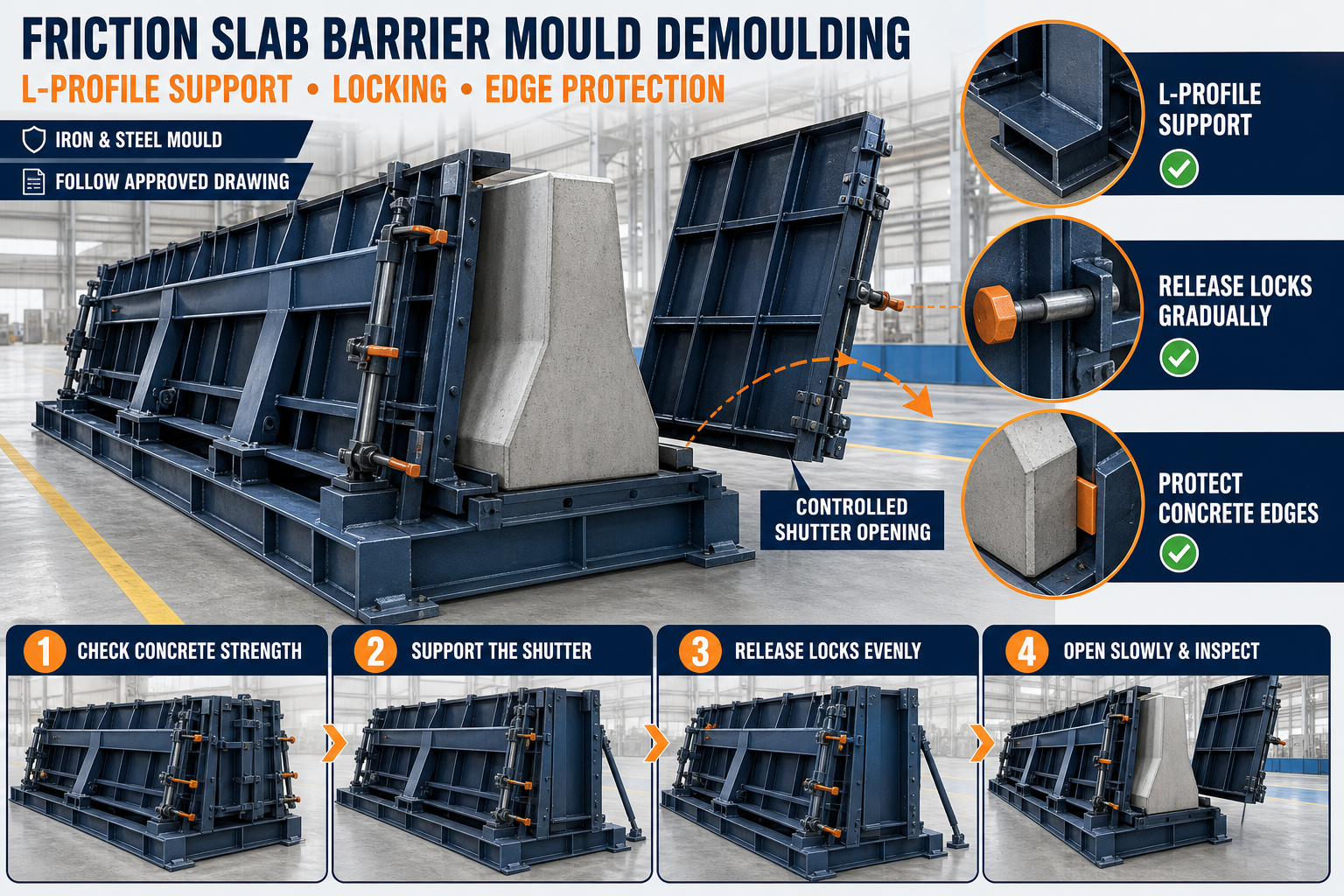
Friction Slab Barrier Mould Demoulding: L-Profile Support, Locking and Edge Protection Guide
Correct demoulding of a precast friction slab barrier depends on stable L-profile support, properly released locking points and careful edge protection. This guide explains a practical demoulding process that helps prevent concrete damage, protect the heavy-duty iron mould and maintain consistent production quality.
By Paras Steel Industries ·
Friction Slab Barrier Mould Demoulding: L-Profile Support, Locking and Edge Protection Guide
Friction Slab Barrier Mould Demoulding Guide
A friction slab barrier is a specialised precast concrete component used in road, bridge and infrastructure projects. Its profile may contain inclined faces, narrow corners and sensitive edges. If the mould is opened incorrectly, the concrete can suffer broken corners, surface marks, cracks or dimensional defects.
A properly manufactured heavy-duty iron mould uses strong supporting profiles, accurately aligned shutters and reliable locking points. However, even a well-designed mould must be opened in a planned sequence.
This guide explains the role of L-profile supports, mould locks and edge-protection practices during friction slab barrier demoulding.
What Is a Friction Slab Barrier Mould?
A friction slab barrier mould is an iron or structural-steel fabrication used to manufacture precast concrete friction slabs and barrier-related components. The exact shape, dimensions and reinforcement provisions depend on the approved project drawing.
A typical mould may include:
• Heavy-duty iron base frame • Fabricated side shutters • L-profile supporting members • Mechanical, bolted or pin-type locks • Reinforcement stiffeners • Hinged or removable shutters • Chamfer and edge-forming sections • Lifting points where required • Adjustable components for different production needs
The mould configuration must be selected according to the required concrete profile, casting method and production system.
Role of L-Profile Support
L-profile supports help maintain the position and rigidity of the shutter during concrete pouring and vibration. They reduce unwanted movement caused by fresh concrete pressure.
Correctly positioned L-profile supports help:
• Maintain the required barrier profile • Reduce shutter bending or deformation • Keep the casting surface properly aligned • Support controlled opening during demoulding • Improve dimensional consistency • Protect welded joints and locking brackets • Increase the working life of the iron mould
The thickness, size and spacing of L-profile supports should follow the approved mould design. These details should not be selected only through general assumptions because every barrier profile and mould length may create different loading conditions.
Check Concrete Before Demoulding
A precast barrier should not be demoulded only because a certain number of hours has passed. Concrete strength development depends on the mix design, cement type, ambient temperature, curing method, element size and production conditions.
Before beginning demoulding, confirm that:
• The required stripping strength has been achieved • The exposed concrete surface is sufficiently firm • Corners and edges do not appear soft • Lifting inserts are properly positioned • Curing requirements have been followed • Quality-control checks are complete • The production supervisor has approved demoulding
Opening the mould too early can cause corner breakage, cracking, surface damage and permanent deformation of the precast component.
Prepare the Demoulding Area
Before releasing any lock, prepare the complete working area.
The preparation process should include:
• Remove loose concrete and slurry from the mould • Clear unnecessary tools and materials • Inspect the shutter-supporting arrangement • Confirm that lifting equipment is available • Check that workers are outside the shutter movement zone • Inspect hydraulic or mechanical opening systems • Confirm that the mould base is level and stable
Heavy iron shutters can move unexpectedly after their final lock is released. Proper preparation is therefore essential for safe operation.
Correct Lock-Releasing Sequence
Mould locks should never be released randomly. Sudden or uneven release can place unnecessary pressure on the concrete edges and mould structure.
A practical demoulding sequence is:
1. Clean hardened slurry from bolts, pins and locking points. 2. Support the shutter before releasing the main locks. 3. Loosen the locks gradually from one end to the other. 4. Maintain a balanced release sequence on both sides. 5. Check that no bolt, wedge or pin remains engaged. 6. Open the shutter slowly using the designated mechanism. 7. Stop immediately if the concrete remains attached to the mould. 8. Identify the sticking point before continuing.
The actual opening sequence must follow the mould design and operating instructions supplied for the specific system.
Importance of Locking Alignment
Properly aligned locks hold the shutters securely during concrete casting and vibration. Misaligned locks may pull the shutter inward, create joint gaps or make opening difficult.
Before every casting cycle, inspect:
• Locking-pin alignment • Bolt condition • Thread movement • Wedges and clamps • Hinge operation • Locking brackets • Contact surfaces • Flange and joint alignment • Welded connections
Bent, cracked or heavily worn locking parts should be repaired or replaced before the next casting cycle.
Edge Protection During Demoulding
Edges and corners are among the most vulnerable areas of a precast friction slab barrier. They can break when the shutter is pulled away too quickly or when concrete sticks to the iron surface.
For better edge protection:
• Clean the mould surface before casting • Apply a suitable mould-release agent evenly • Use the specified chamfer strips • Avoid unnecessary vibration near sensitive edges • Release the shutters gradually • Use approved non-damaging separation tools • Never strike finished concrete edges with a steel hammer • Keep lifting and shutter movement slow • Use rubber, plastic or wooden protective pads at approved contact points
Do not force the shutter if the concrete has not separated. First inspect the locking points and identify the area causing resistance.
Correct Use of Mould-Release Agent
A mould-release agent creates a separation layer between the concrete and iron mould surface. Insufficient application may cause sticking, while excessive application may produce stains, pinholes or surface defects.
The release agent should be:
• Suitable for precast concrete production • Applied to a clean and dry mould surface • Spread in a thin and uniform layer • Prevented from collecting in corners • Kept away from reinforcement areas requiring concrete bond • Used according to the product manufacturer’s instructions
Diesel, used engine oil and other unsuitable materials should not be used as mould-release agents.
Safe Opening of Heavy Iron Shutters
Before opening a shutter, confirm that it is adequately supported. Workers must remain away from the shutter’s movement path.
Important safety practices include:
• Use only the designated opening system • Do not stand between the mould and moving shutter • Use lifting equipment rated for the actual load • Keep the mould base stable and level • Use mechanical stops or supports where provided • Do not pull shutters with uncontrolled construction equipment • Inspect hydraulic hoses and connections before operation • Open hydraulic shutters slowly and evenly
Hydraulic pressure should be released safely before maintenance or repair work begins.
Lifting the Finished Precast Barrier
The precast element should only be lifted after it has achieved the required handling strength. The lifting method and anchor positions must follow the approved lifting plan.
Before lifting:
• Inspect all lifting anchors • Check the concrete around each anchor • Confirm the actual component weight • Use properly rated lifting equipment • Connect all specified lifting points • Follow the approved lifting angle • Lift slowly to check whether the concrete is sticking • Use tag lines where required • Place the unit on level and adequately supported dunnage
Do not use mould locks, shutter brackets or L-profile supports as lifting points unless they have been specifically designed and approved for that purpose.
Common Demoulding Problems
Concrete Sticking to the Mould
Concrete may stick because of insufficient release agent, dirty casting surfaces, damaged mould surfaces or an incorrect opening sequence.
Broken Corners
Corner breakage can result from early demoulding, sudden shutter movement, poor concrete compaction or unsuitable handling practices.
Shutter Not Opening Evenly
Check for unreleased locks, bent hinges, hardened slurry, damaged brackets, poor lubrication or mould misalignment.
Slurry Around Locking Points
Cement slurry may enter bolts and pins through poorly sealed joints. Clean these areas after every casting cycle and inspect the mould joints before reuse.
Surface Scratches
Scratches can occur when the shutter moves sideways against the concrete. Open the shutter in the intended direction without dragging it across the finished surface.
Mould Inspection After Demoulding
After removing the precast component, inspect the complete iron mould before preparing the next casting cycle.
Check:
• Casting-surface condition • L-profile support alignment • Locking brackets and pins • Hinges and moving joints • Welded connections • Base-frame level • Joint sealing points • Rust or coating damage • Hardened concrete deposits • Shutter alignment
Damaged parts should be repaired before applying release agent and starting another casting cycle.
Maintenance of the Iron Mould
Regular maintenance helps improve mould life and keeps production quality consistent.
Recommended maintenance practices include:
• Clean the mould after every casting cycle • Lubricate pins, hinges and threaded locks • Remove hardened slurry carefully • Repair cracked welds through qualified personnel • Check mould alignment regularly • Protect unused moulds from rain and standing water • Apply corrosion protection to external iron surfaces • Store removable components in a dry location • Replace damaged sealing materials when required
Avoid uncontrolled heating, forceful hammering or unsuitable pulling methods because they can distort the mould.
Quality-Control Checklist
Before approving a demoulded friction slab barrier, inspect:
• Overall dimensions according to the approved drawing • Straightness and alignment • Edge and corner condition • Surface finish • Required openings and inserts • Position of embedded components • Visible cracks or honeycombing • Component identification • Production and curing records
Final acceptance must follow the project specifications and approved quality-control plan.
Conclusion
Successful friction slab barrier demoulding requires stable L-profile supports, correctly aligned locking points, proper mould-release agent application and controlled shutter movement. Following the correct sequence helps protect the concrete edges, improve surface finish and reduce unnecessary mould repairs.
Paras Steel Industries manufactures heavy-duty iron and structural-steel precast moulds according to customer requirements and approved project drawings. A properly designed mould combined with a planned demoulding process can support safer working, consistent quality and efficient precast production.