
Precast Mould Guide
Fencing Pole Mould Buying Guide: Sizes, Production Capacity and Iron Plate Thickness
Learn how to select a fencing pole mould based on pole dimensions, casting capacity, iron plate thickness, hole pattern and operating requirements.
By Paras Steel Industries ·
Fencing Pole Mould Buying Guide: Sizes, Production Capacity and Iron Plate Thickness
Fencing Pole Mould Buying Guide: Sizes, Production Capacity and Iron Plate Thickness
Precast concrete fencing poles are widely used for agricultural farms, industrial compounds, solar parks, railway boundaries and private properties.
Their strength, dimensional accuracy and surface quality depend on several factors, including the concrete mix, reinforcement, vibration, curing and mould construction.
A properly designed fencing pole mould helps manufacturers produce multiple RCC poles with uniform dimensions in every casting cycle. It can improve production speed, reduce manual finishing and support consistent product quality.
This buying guide explains the important sizes, production capacities, iron plate thicknesses, operating systems and selection factors buyers should evaluate before ordering a fencing pole mould.
What Is a Fencing Pole Mould?
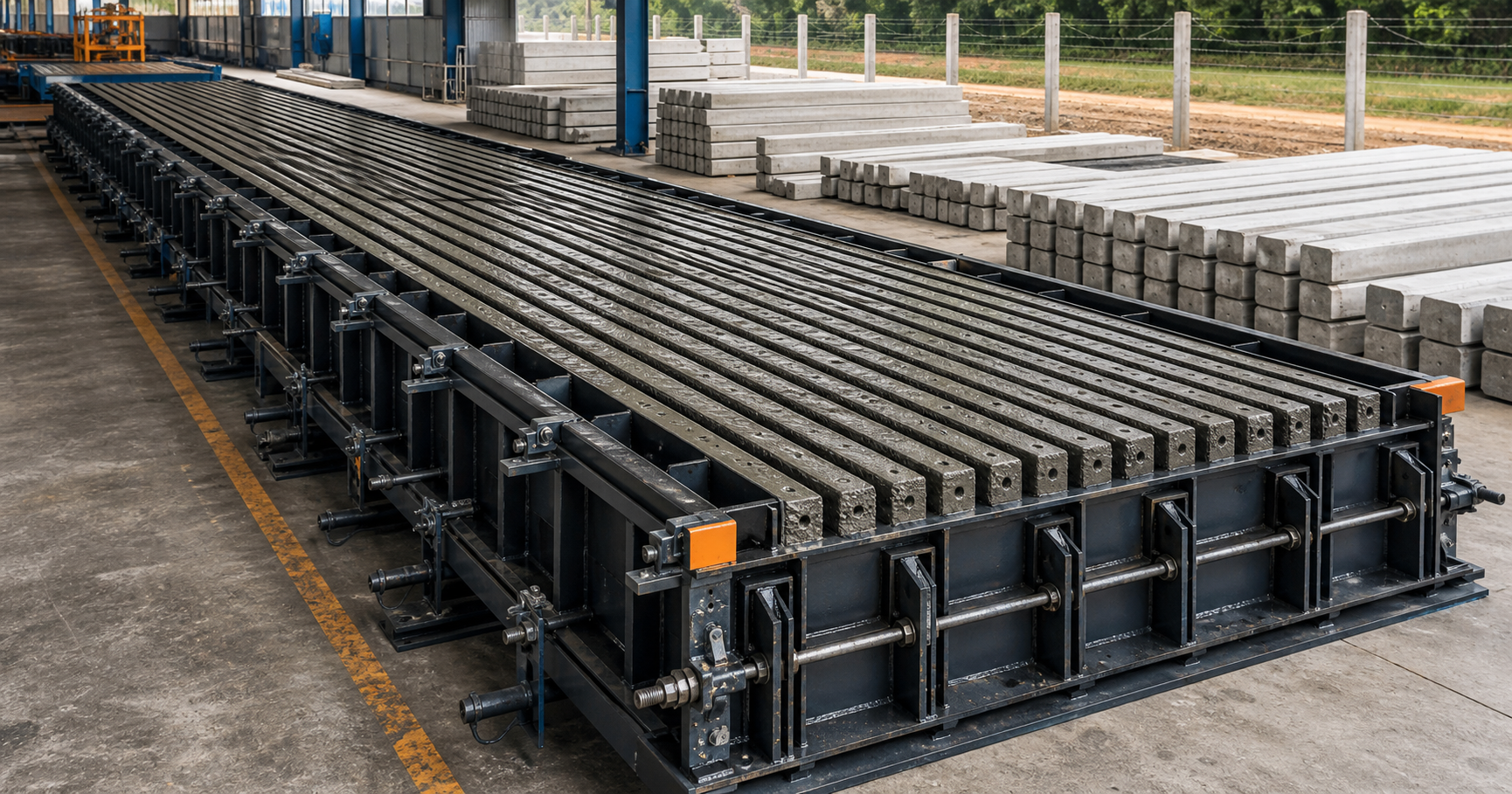
A fencing pole mould is a multi-cavity iron form used to manufacture precast concrete poles for boundary and security fencing.
Each cavity forms one concrete pole. Depending on its configuration, a production line can cast several poles in a single cycle.
The mould includes a heavy main frame, side plates, base plates, cavity dividers, alignment rods and locking arrangements. Custom provisions can also be provided for wire holes, grooves, tapers and reinforcement positioning.
After reinforcement and concrete are placed inside the cavities, vibration helps compact the mixture. The poles are demoulded after completing the required setting or curing period.
Why Mould Quality Matters
Concrete fencing poles are long and relatively narrow. Even a small alignment problem can produce bent, twisted or dimensionally inconsistent poles.
Weak or inadequately supported mould plates may bend under concrete pressure and vibration. Poorly fitted joints can allow cement slurry to leak, creating rough edges and honeycombing.
A well-fabricated heavy-duty iron mould helps maintain:
Consistent pole dimensions
Straight pole alignment
Uniform cross-sections
Correct hole positions
Cleaner concrete surfaces
Repeatable production output
Reduced rejection and repair work
Faster opening and demoulding
Standard Fencing Pole Mould Size
One commonly used fencing pole cross-section is:
4 x 4 inches
100 x 100 mm
This size is suitable for many agricultural, industrial and general boundary-fencing applications.
Pole length can be customised according to the required installation depth, above-ground fencing height and project specifications.
Before ordering a mould, buyers should confirm the exact finished-pole dimensions rather than relying only on common market terminology.
Important dimensions include:
Top cross-section
Bottom cross-section
Overall pole length
Taper requirement
Concrete cover
Reinforcement arrangement
Wire-hole diameter
Number of holes
Distance between holes
End distance of the first and last holes
Straight and Tapered Fencing Poles
Straight Poles
A straight fencing pole maintains the same cross-section throughout its length. For example, a straight 100 x 100 mm pole has approximately the same external dimensions from top to bottom.
Straight poles are simple to manufacture and are commonly used for farms, plots, factories and general boundary fencing.
Tapered Poles
A tapered fencing pole has a wider lower section and a comparatively narrow upper section.
This design can reduce concrete consumption while maintaining strength around the portion installed in the ground.
The taper must be accurately incorporated into the mould so that every pole follows the same profile.
Fencing Pole Mould Production Capacity
Production capacity refers to the number of concrete poles that a mould line can cast in one cycle.
Paras Steel Industries offers an industrial fencing pole mould line capable of producing up to 50 poles per casting cycle.
A 50-pole mould can help established precast manufacturers increase production volume without handling 50 separate individual moulds.
However, mould capacity alone does not determine actual daily output.
Factors that influence daily production include:
Concrete-mixing capacity
Reinforcement preparation
Availability of workers
Concrete transportation
Mould-filling time
Vibration arrangement
Demoulding process
Curing period
Weather conditions
Available factory space
If a 50-pole line completes one casting cycle per day, it can theoretically produce 50 poles daily. Actual output should be calculated according to the concrete mix, curing method and factory workflow.
Benefits of a 50-Pole Mould Line
Higher Batch Output
Producing multiple poles in one line can reduce the number of separate loading and demoulding operations.
Consistent Dimensions
All cavities are built into one aligned system, supporting more uniform pole dimensions across the batch.
Better Use of Factory Space
A planned multi-cavity layout can use production-floor space more efficiently than numerous separate moulds.
Simplified Production Planning
Workers can prepare reinforcement, concrete and demoulding activities around a defined 50-pole casting cycle.
Hydraulic Compatibility
The mould can be configured for compatibility with a hydraulic opening system, helping reduce manual effort and turnaround time.
Iron Plate Thickness
Iron plate thickness is an important factor when selecting a fencing pole mould.
Paras Steel Industries can manufacture the side and base portions using heavy-duty iron plates in approximately 4 mm to 6 mm thickness, depending on the mould design and production requirements.
The appropriate thickness depends on:
Pole length
Number of cavities
Concrete pressure
Vibration method
Support-frame design
Expected casting frequency
Opening mechanism
Required operational life
A thicker plate can provide greater resistance to bending, but plate thickness should not be considered separately from the supporting frame.
A correctly designed frame with properly positioned channels, angles and stiffeners is essential for maintaining mould alignment.
Main Support Frame
A multi-cavity fencing pole mould carries the weight of the iron plates, reinforcement and wet concrete.
A heavy 50 x 100 mm C-channel configuration can be used for the main support frame, depending on the final mould design.
The support frame helps:
Keep the mould line straight
Distribute the concrete load
Control vibration movement
Support the opening mechanism
Reduce plate deflection
Maintain cavity alignment
The exact channel and support arrangement should be selected according to the length and number of mould cavities.
Reinforcement and Alignment Structure
Structural iron angles can reinforce the cavity sections and side plates. A commonly used angle configuration may be approximately 50 x 50 x 6 mm, subject to final design requirements.
Heavy alignment rods and locking arrangements hold the shutters in position during pouring and vibration.
Properly placed locks help prevent the mould from opening under concrete pressure.
The rods, clamps and locking components should be easy for workers to inspect and operate.
Manual vs Hydraulic Fencing Pole Mould
Manual Operation
A manually operated mould uses mechanical clamps, rods and locking systems. Workers open and close the mould using the provided hardware.
Manual operation may suit smaller production units with controlled output requirements and sufficient labour.
Its benefits can include:
Simple operating system
Lower setup complexity
No hydraulic power pack requirement
Suitable for limited production
However, opening a large 50-pole line manually can require more labour and time.
Hydraulic-Compatible Operation
A hydraulic system helps open and close the mould shutters with reduced manual effort.
Hydraulic compatibility is useful for manufacturers who require regular high-volume production and faster turnaround between casting cycles.
Potential benefits include:
Faster shutter operation
Reduced labour dependency
More controlled opening
Convenient high-volume production
The hydraulic configuration should be planned according to the mould length, shutter weight and factory layout.
Wire-Hole Configuration
Precast fencing poles commonly include holes for passing fencing wire, barbed wire or other boundary materials.
The mould can be customised according to:
Number of holes
Hole diameter
Vertical spacing
Distance from pole ends
Straight or angled hole arrangement
Project-specific fencing system
Accurate hole positioning helps simplify installation and creates a uniform fence line.
Buyers should provide a drawing showing the complete hole pattern before mould manufacturing begins.
Applications of Concrete Fencing Poles
Agricultural Farms
Concrete poles are used to protect crops, divide farmland and create agricultural boundaries.
Livestock and Poultry Farms
Fencing poles support wire fencing around cattle areas, poultry farms and livestock enclosures.
Industrial Compounds
Factories, warehouses and storage yards use precast poles for perimeter security.
Solar Parks
Large solar-energy projects require extensive boundary fencing around panels, equipment and electrical installations.
Power and Utility Sites
Concrete poles can be used around substations, transformers and utility compounds.
Highways and Railways
Precast poles support boundary fencing along transport corridors and restricted infrastructure zones.
Open Plots and Real Estate Projects
Property owners and developers use RCC fencing poles to identify and protect plot boundaries.
How to Select the Right Fencing Pole Mould
Confirm the Finished Pole Size
Determine the required cross-section, total length and whether the pole should be straight or tapered.
Calculate Required Output
Estimate the number of poles required daily or monthly. Select the number of mould cavities according to realistic production demand.
Check Iron Plate Thickness
Confirm the proposed side and base plate thickness. It should be suitable for the concrete load, pole length and vibration system.
Inspect the Support Frame
Plate thickness alone does not guarantee mould strength. Review the main channels, angles, stiffeners and support spacing.
Confirm the Hole Pattern
Provide the exact number, diameter and position of wire holes. Avoid making assumptions based on another manufacturer’s pole design.
Select an Operating System
Choose manual or hydraulic-compatible operation according to output, labour availability and production budget.
Check the Locking Arrangement
Locks and alignment rods should hold the mould securely closed during concrete pouring and vibration.
Discuss Concrete Vibration
Confirm whether a vibrator table, shutter vibrator or another vibration method will be used. The mould must suit the planned production arrangement.
Evaluate Demoulding Convenience
The mould should open without damaging pole corners, edges or holes. Easy demoulding can reduce rejection and improve production speed.
Share the Technical Drawing
The buyer should share a complete pole drawing and production requirement before approving the mould configuration.
Factors Affecting Fencing Pole Mould Price
Number of Cavities
A 50-pole production line requires more material and fabrication than a smaller-capacity mould.
Pole Length and Cross-Section
Longer or larger poles require longer cavities, more iron and additional support.
Iron Plate Thickness
Increasing plate thickness affects mould weight, material requirement and price.
Support-Frame Construction
The quantity and size of channels, angles and stiffeners influence the overall cost.
Manual or Hydraulic Operation
A hydraulic-compatible mould requires a suitable opening configuration and may involve additional operating components.
Hole and Groove Provisions
Custom wire-hole patterns, grooves and reinforcement provisions increase fabrication complexity.
Straight or Tapered Profile
A custom taper may require additional precision during mould manufacturing.
Transportation
A 50-pole mould line is a large and heavy production system. Delivery distance and transport arrangements can affect the quotation.
Maintenance Tips for Longer Mould Life
Clean every cavity after completing the casting cycle. Concrete buildup can affect pole dimensions and surface quality.
Apply a suitable mould-release agent evenly before pouring concrete.
Inspect iron plates for concrete deposits, bending or surface damage.
Check alignment rods, clamps and locks before each batch.
Keep hinges and moving components clean and properly lubricated.
Inspect wire-hole pins for wear, bending and incorrect positioning.
Protect the mould from water and moisture when it is not being used.
Apply suitable anti-rust protection to exposed iron surfaces.
Place the mould on a level and adequately supported foundation.
Do not overload the cavities or use an unsuitable vibration method.
Frequently Asked Questions
What is the standard fencing pole size?
A commonly used cross-section is 4 x 4 inches or approximately 100 x 100 mm. Pole length and hole pattern can be customised.
How many poles can the mould produce?
The Paras Steel Industries fencing pole mould line can be configured to produce up to 50 poles per casting cycle.
Which material is used to manufacture the mould?
Paras Steel Industries manufactures fencing pole moulds using heavy-duty iron.
What iron plate thickness is used?
Side and base plates may use approximately 4 mm to 6 mm heavy-duty iron plates, depending on the mould configuration and production requirements.
Can the pole length be customised?
Yes. Pole length, taper and cross-section can be manufactured according to the customer’s drawing.
Can the hole pattern be customised?
Yes. The number, diameter and position of wire holes can be customised according to the fencing system.
Is hydraulic operation available?
The mould can be manufactured with compatibility for a hydraulic opening system, depending on production requirements.
How can I request a quotation?
Share the pole size, length, hole pattern, required cavity capacity, operating preference and delivery location with Paras Steel Industries.
Conclusion
A properly designed fencing pole mould helps manufacturers produce straight, uniform and accurately sized RCC fencing poles in large quantities.
Buyers should compare pole dimensions, number of cavities, iron plate thickness, support-frame strength, hole pattern and operating system before making a decision.
Paras Steel Industries manufactures heavy-duty iron fencing pole moulds with up to 50-pole casting capacity, custom pole lengths, project-specific hole patterns and hydraulic compatibility.
Contact Paras Steel Industries with your pole drawing and production requirements to discuss a suitable mould configuration and quotation.