
Precast Infrastructure Moulds
Retaining Wall Mould Manufacturer for Infrastructure Projects
Retaining wall moulds help precast manufacturers produce strong, uniform concrete wall units for roads, slopes, landscaping and infrastructure projects.
By Paras Steel Industries ·
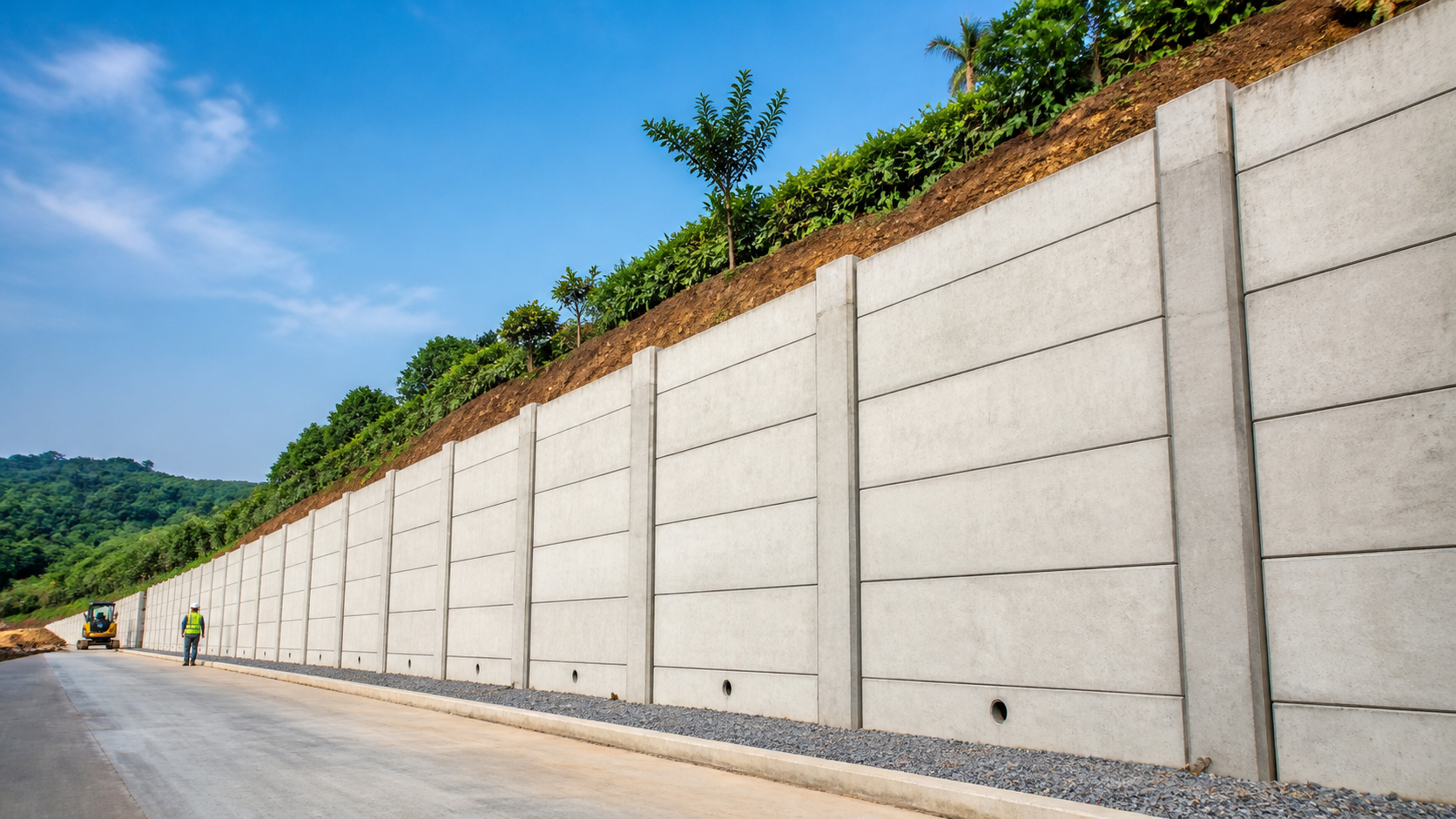
Retaining Wall Mould Manufacturer for Infrastructure Projects
Retaining walls are used to hold back soil, manage level differences and protect land around roads, buildings, industrial sites and landscaping projects. They are especially important where slopes, embankments, cuttings or raised ground need structural support.
Precast concrete retaining wall units are widely used because they offer faster installation, consistent quality and reduced on-site construction work. For precast manufacturers, a strong retaining wall mould is essential for producing accurately shaped concrete wall units that fit correctly during installation.
What is a retaining wall mould?
A retaining wall mould is a heavy-duty steel form used to manufacture precast concrete retaining wall panels or blocks. Concrete is poured into the mould with the required reinforcement, compacted properly and cured until the unit reaches sufficient strength.
After curing, the mould is opened and the finished precast unit is removed. The mould is cleaned, prepared with a release agent and reused for the next production cycle.
Retaining wall moulds can be made for many designs, including panel-type walls, L-shaped units, T-shaped units, counterfort sections, modular blocks and custom engineered profiles. The mould is fabricated according to the approved drawing, required dimensions and reinforcement provisions.
Why precast retaining walls are preferred
Precast retaining walls reduce the time required for site construction. Instead of casting every wall section at the location, concrete units can be manufactured in a controlled precast yard and transported to the project site for installation.
This allows construction work to continue with better planning and less dependency on weather conditions. Precast units also provide consistent dimensions, which helps achieve better alignment during installation.
Precast retaining wall systems are useful for road projects, railway works, industrial developments, housing layouts, drainage structures, bridge approaches and landscaped areas. The correct wall design and foundation should always be selected according to the site’s engineering and soil requirements.
Importance of high-quality retaining wall moulds
The quality of a retaining wall mould affects the accuracy, surface finish and structural form of every precast unit. A weak or poorly fabricated mould can lead to uneven dimensions, leakage, rough edges and distortion during casting.
A high-quality steel mould maintains its shape during concrete pouring, vibration and repeated demoulding. Heavy-duty steel plates, proper stiffeners and accurate welding help prevent mould movement and ensure consistent production.
Accurate mould dimensions are important because retaining wall units must fit correctly with adjacent units, foundations and drainage arrangements. A well-designed mould also helps place reinforcement correctly and remove the cured unit safely.
Key features to check before buying a retaining wall mould
Before choosing a retaining wall mould, confirm the required wall type, panel size, height, thickness, base details and reinforcement arrangement. The mould should match the approved engineering drawing exactly.
The steel structure should be strong enough to withstand concrete pressure and regular production cycles. Properly positioned stiffeners, reinforced side panels and strong locking systems help maintain the shape of the mould.
Easy demoulding is another important feature. Removable panels, clamps, bolts, hinges and lifting provisions help workers remove finished concrete units safely without damaging their edges.
If the retaining wall design requires grooves, keyways, connection slots, drainage holes, lifting hooks or decorative surfaces, these details should be included in the mould design. A custom mould manufacturer can provide these features according to the project requirement.
Applications of precast retaining wall units
Precast retaining wall units are used in road embankments, highway projects, railway corridors, bridge approaches, industrial sites, residential layouts and landscaping works.
They are also used to support soil around ramps, parking areas, warehouses, hill roads, water channels and site boundaries. Retaining walls can help create usable level areas where the natural ground has a slope or elevation difference.
The final retaining wall system should always be installed according to approved structural drawings. Proper foundation preparation, drainage design, reinforcement and backfilling are essential for safe long-term performance.
Benefits of custom retaining wall moulds
Custom retaining wall moulds allow precast manufacturers to produce units according to the specific design and load requirements of a project. A custom mould can include special panel dimensions, edge profiles, reinforcement arrangements, lifting points, connection features and surface patterns.
This is useful for infrastructure projects where standard retaining wall units do not match the required site condition. Custom moulds help ensure that each unit fits properly and reduces the need for site-level modifications.
For large projects requiring many similar retaining wall units, custom moulds support uniform production. Consistent units improve installation speed, wall alignment and the final appearance of the completed structure.
How to maintain steel retaining wall moulds
Regular cleaning and maintenance help increase the service life of a steel retaining wall mould. Concrete residue should be removed after every casting cycle before it hardens. Apply a suitable mould release agent before pouring concrete to make demoulding easier.
Inspect clamps, bolts, hinges, locking systems, lifting provisions and weld joints regularly. Repair any loose or damaged component before the next casting cycle to avoid mould movement or defects in the finished unit.
When the mould is not in use, store it in a dry area and protect exposed steel surfaces from moisture. Proper maintenance helps prevent rusting, reduces repair costs and supports reliable production.
Choose the right retaining wall mould manufacturer in India
A reliable retaining wall mould manufacturer should understand steel fabrication, precast concrete production and the practical requirements of infrastructure projects. The manufacturer should be able to provide accurate dimensions, durable steel construction, strong welding and custom design support.
Paras Steel Industries manufactures steel moulds for precast concrete and infrastructure applications. From retaining wall moulds and wall panel moulds to box culvert moulds, highway barrier moulds and custom precast solutions, the right mould design helps improve production quality, speed and long-term value.
If you need a retaining wall mould based on your required drawing, wall type or production capacity, contact Paras Steel Industries for a suitable precast concrete mould solution.