
Precast Mould Guide
Box Culvert vs U Drain: Which Precast Drainage Solution Should You Choose?
Box culverts and U drains both support effective water management, but they serve different site conditions. This guide helps you choose the right precast drainage solution.
By Paras Steel Industries ·
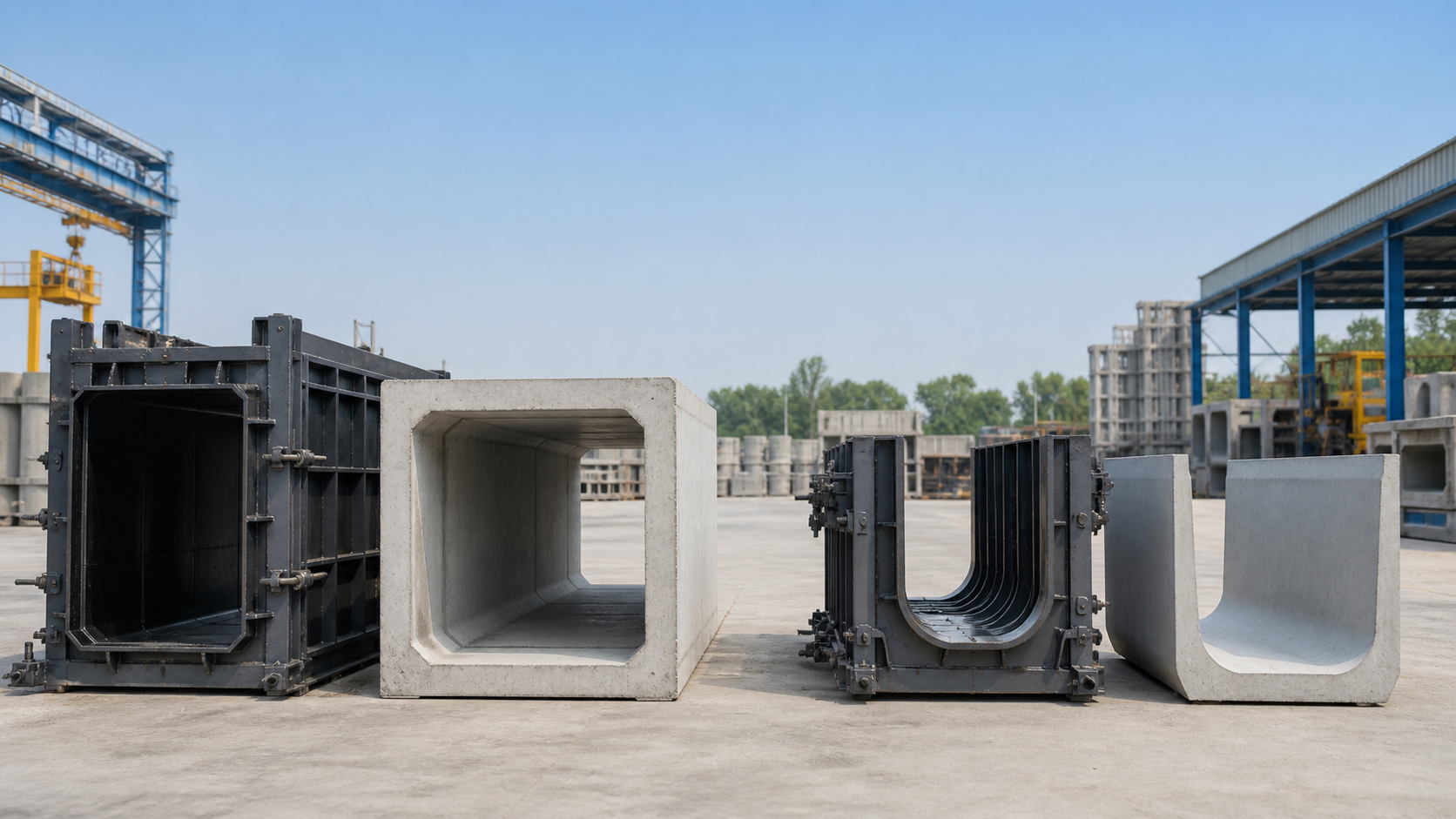
Box Culvert vs U Drain: Which Precast Drainage Solution Should You Choose?
Box Culvert vs U Drain: Which Precast Drainage Solution Should You Choose?
Precast drainage systems are widely used in roads, housing projects, industrial areas, municipal works, highways and infrastructure developments. Two common solutions are precast box culverts and precast U drains.
Both products help manage stormwater and drainage flow, but they are not interchangeable. The right choice depends on water flow, installation location, load condition, available space and project design.
This guide compares box culverts and U drains so that project owners, contractors and precast manufacturers can understand where each solution is suitable.
What Is a Precast Box Culvert?
A precast box culvert is a closed or box-shaped concrete structure used to carry water beneath roads, railways, embankments, access routes and other crossings.
It generally has a base, side walls and a top slab, creating a rectangular passage for water flow. Depending on the project requirement, box culverts may be manufactured in different internal sizes, wall thicknesses and lengths.
Precast box culverts are commonly used where drainage must pass under a road or where a protected enclosed channel is required.
What Is a Precast U Drain?
A precast U drain is an open-top concrete drainage channel shaped like the letter U. It is used to collect and carry surface water along roadsides, industrial plots, housing layouts, factory premises and open drainage routes.
U drains can be installed with an open top or with separate cover slabs, depending on the site requirement. They are useful where regular inspection and cleaning access is important.
Key Difference Between Box Culvert and U Drain
The main difference is the structure.
A box culvert forms a closed passage with a top section. It is commonly selected when drainage must cross beneath a road, access way or other load-bearing surface.
A U drain is open at the top unless a cover slab is added. It is generally selected for surface drainage along roads, plots, industrial areas and open channels.
Box Culvert Applications
Precast box culverts are commonly used for:
Drainage below roads Highway crossings Railway crossings Bridge approaches Access road crossings Industrial roads Large water flow routes Infrastructure projects
A box culvert can be a suitable option where the drainage line must continue below vehicle movement areas. Its design should be based on approved drawings, water flow calculation, soil condition and expected loading.
U Drain Applications
Precast U drains are commonly used for:
Roadside drainage Housing projects Factory premises Industrial plots Agricultural land Municipal drainage Commercial properties Open stormwater channels
U drains are useful where water needs to be collected from the surface and carried along a visible drainage route. Their open design can make inspection, cleaning and maintenance easier.
Consider Water Flow Requirement
Water flow is one of the first factors to consider.
For larger drainage crossings, high water flow or a channel that must pass below a road, a box culvert may be suitable.
For side drainage, surface runoff collection and open channel flow, a U drain may be more practical.
The final internal width and depth should always follow the approved drainage design. Do not select a product size only based on appearance or price.
Consider Site Load and Traffic Movement
Traffic load is an important difference between these two systems.
A box culvert may be designed for locations where vehicles will move above the drainage channel. Examples include roads, industrial yards, driveways and highway crossings.
A U drain is often installed beside roads or within plots. If it is placed in a vehicle movement area, it may require a suitable cover slab and supporting design.
The product size, wall thickness, reinforcement and cover arrangement should be decided by the project engineer according to actual load conditions.
Installation and Maintenance
U drains are generally easier to inspect because the channel is open. This can be useful for regular cleaning of soil, leaves and debris.
Box culverts provide an enclosed drainage route. They are useful where surface access is not possible or where the drain must pass below an obstruction.
Both products require correct jointing, level setting and proper site preparation to perform well.
Space Requirement
U drains can be a practical solution when there is enough open space along a road, property edge or industrial plot.
Box culverts are useful when the drainage line must pass under a road, driveway, embankment or access path.
Before selecting either option, check the site layout, road width, available depth, utility lines and outlet connection.
Precast Production Requirements
Both box culverts and U drains require accurately designed moulds for consistent production.
A Box Culvert Mould should be strong and rigid enough to produce accurate internal dimensions, wall thickness and joint details. Heavy-duty iron box culvert moulds are commonly used for repeated precast production.
A U Drain Mould should produce consistent channel width, depth and wall thickness. The mould should support easy casting, vibration and demoulding.
For both products, custom mould sizes can be manufactured according to approved project drawings.
Cost Considerations
The cost of a drainage solution depends on many factors, including size, concrete quantity, reinforcement, mould design, transport, site preparation and installation.
A U drain may be a practical choice for open surface drainage. A box culvert may involve more material and structural design because it is used for enclosed crossings and load-bearing locations.
The best choice is not always the lowest initial cost. Consider long-term performance, maintenance, installation speed and site condition.
How to Choose the Right Option
Choose a precast box culvert when:
Drainage must pass under a road or access route A protected enclosed passage is required Vehicle load is expected above the structure The approved drainage design requires a box section The project has a large crossing requirement
Choose a precast U drain when:
You need open surface drainage Regular cleaning access is important The drain runs along roads, plots or industrial areas The site has space for an open channel The approved design specifies U-shaped drainage channels
Conclusion
Box culverts and U drains are both valuable precast drainage solutions, but they are used for different purposes.
A box culvert is generally suitable for enclosed drainage crossings under roads and access routes. A U drain is generally suitable for open surface drainage along roads, plots, factories and housing projects.
Always choose the product based on the approved drainage drawing, water flow requirement, load condition and site layout.
Paras Steel Industries manufactures heavy-duty iron Box Culvert Moulds and U Drain Moulds in custom sizes for precast drainage and infrastructure projects across India.