
Precast Machinery Guide
Panel Shifting Trolley Wheel and Axle Maintenance: Load Distribution, Bearing Wear and Tracking
The wheels, bearings and axles of a panel shifting trolley carry heavy precast products across the plant. Uneven loading, worn bearings or incorrect wheel alignment can cause difficult movement, tyre wear and poor tracking. This guide explains safe inspection, lubrication and maintenance of an all-steel trolley system.
By Paras Steel Industries ·
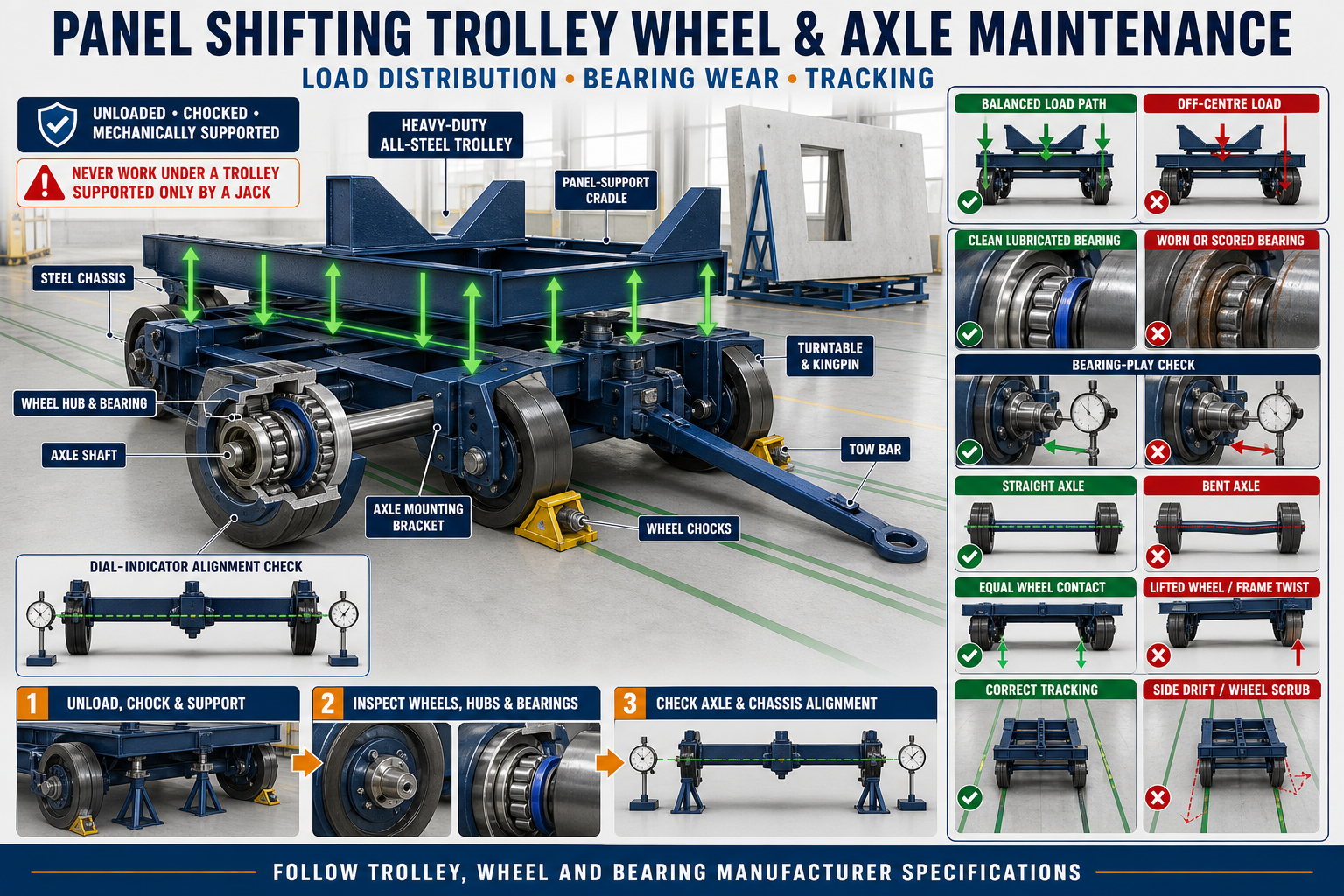
Panel Shifting Trolley Wheel and Axle Maintenance: Load Distribution, Bearing Wear and Tracking
Panel Shifting Trolley Wheel and Axle Maintenance: Load Distribution, Bearing Wear and Tracking
A panel shifting trolley transports precast wall panels, poles, slabs and other concrete components between casting, curing, storage and loading areas.
The trolley’s wheels, bearings and axles support the combined weight of the steel trolley and transported product. If these components are worn, misaligned or unevenly loaded, the trolley may pull toward one side, become difficult to move or place excessive stress on its frame.
Regular wheel and axle maintenance supports safer handling, smoother tracking and longer machinery life.
What Is a Panel Shifting Trolley?
A panel shifting trolley is an industrial material-handling platform designed to move precast concrete products inside a production plant.
Depending on the design, it may include:
• Heavy-duty steel chassis • Panel-support frame • Loading cradle • Turntable • Steering mechanism • Fixed or steering axles • Steel or industrial wheels • Bearings and hubs • Kingpin • Tow bar • Mechanical stops • Product restraints • Brake or parking arrangement where specified
The trolley should be used only within its approved design and plant handling procedure.
Functions of Wheels and Axles
The wheel-and-axle system helps:
• Support trolley and product weight • Distribute load into the floor • Allow smooth movement • Maintain the travel direction • Support steering • Reduce rolling resistance • Control wheel position • Keep the trolley frame stable
Failure of one wheel or bearing can affect the complete load path.
What Is Load Distribution?
Load distribution describes how the transported weight is shared across the trolley wheels and axles.
Balanced loading generally requires:
• Product centre of gravity positioned correctly • Support points arranged as designed • Trolley frame remaining level • Wheels maintaining floor contact • Axles carrying the intended share • Product restraints remaining secure
The approved trolley manufacturer should define the permitted loading arrangement.
Why Load Distribution Is Important
Poor load distribution can cause:
• One wheel carrying excessive load • Frame twist • Bearing overheating • Uneven wheel wear • Difficult steering • Trolley pulling to one side • Axle bending • Instability • Product movement • Floor damage • Reduced component life
A trolley should not be selected or loaded only by visual judgement.
Common Causes of Uneven Loading
Uneven load distribution may result from:
• Panel positioned off-centre • Different support heights • Damaged support pads • Uneven floor • Frame distortion • One tyre or wheel with different diameter • Worn bearing • Bent axle • Incorrect product orientation • Missing wheel contact • Product restraints pulling unevenly • Debris beneath a wheel
The load and trolley should both be inspected.
What Is Wheel Tracking?
Wheel tracking describes how accurately the trolley follows the intended direction of travel.
Correct tracking means:
• Wheels run in compatible directions • Trolley does not pull strongly to one side • Wheels do not scrub sideways • Steering returns predictably • Axles remain aligned with the chassis • All wheels rotate freely • Tyres or treads wear evenly
Poor tracking increases effort and component wear.
Symptoms of Poor Tracking
Possible signs include:
• Trolley drifts sideways • One wheel leaves a different track • Tyres scrub during straight movement • Steering requires excessive force • Trolley frame appears angled • Wheel wear is concentrated on one edge • Bearings become hot • Movement is jerky • Abnormal noise occurs • Tow bar does not remain centred
Tracking should be checked on a suitable level inspection path.
Common Causes of Tracking Problems
Tracking may be affected by:
• Bent axle • Misaligned axle mounts • Worn bearings • Loose wheel hubs • Kingpin wear • Turntable misalignment • Unequal wheel diameters • Damaged wheel tread • Frame twist • Incorrect toe relationship • Loose steering linkage • Uneven floor • Debris around wheel components
Do not adjust steering before checking the wheel and axle condition.
Types of Trolley Wheels
Panel shifting trolleys may use:
• Solid steel wheels • Fabricated steel wheels • Cast wheels • Industrial rubber-coated wheels • Polyurethane-coated wheels • Pneumatic tyres where specifically designed • Rail-guided wheels • Flanged wheels for track operation
The wheel type should suit the floor, track and load requirements.
Wheel Material and Floor Compatibility
Wheel selection can affect:
• Rolling resistance • Floor loading • Noise • Shock transfer • Traction • Wear • Steering effort • Track compatibility
Replacement wheels should match the approved trolley specification.
What Is Bearing Wear?
Bearings support wheel or hub rotation around the axle.
Wear may develop due to:
• Inadequate lubrication • Contamination • Water entry • Overloading • Misalignment • Damaged seals • Incorrect installation • Excessive shock • Corrosion • Loose adjustment • Long-term operation
Bearing wear generally increases noise, heat, play and rolling resistance.
Signs of Bearing Wear
Common warning signs include:
• Grinding noise • Rumbling sound • Wheel wobble • Excessive hub play • Rough rotation • Increased rolling effort • Bearing temperature rise • Grease leakage • Metallic particles • Damaged seal • Uneven wheel wear • Repeated loosening
A suspected bearing should be inspected before the trolley returns to service.
Axle-Related Problems
Axles can develop:
• Bending • Wear at bearing seats • Scoring • Cracks • Corrosion • Damaged threads • Loose mounting • Misalignment • Worn keyways • Distorted retaining components
An axle should not be straightened or repaired without an approved procedure.
Preparing the Trolley for Inspection
A trolley can move unexpectedly or fall from lifting equipment.
Before inspection:
• Unload the trolley • Park on a level surface • Isolate powered movement where fitted • Apply the parking arrangement • Chock the wheels • Prevent tow-bar movement • Use approved lifting points • Support the trolley mechanically • Establish an exclusion zone • Wear suitable protective equipment • Follow the manufacturer’s instructions
Never work beneath a trolley supported only by a jack or hydraulic system.
Keep the Trolley Unloaded
Wheel and bearing inspection should normally begin with the trolley empty.
This allows:
• Safer lifting • Easier wheel rotation • Better bearing-play checks • Accurate frame inspection • Clear load-path observation • Reduced stored energy
Loaded testing should be performed only under an approved controlled procedure.
Daily Visual Inspection
Before use, inspect:
• All wheels • Wheel tread or tyre surface • Wheel hubs • Axle ends • Retaining nuts and pins • Bearing covers • Grease leakage • Product-support frame • Tow bar • Steering components • Floor path
Report damage before loading a panel.
Checking Wheel Condition
Inspect each wheel for:
• Flat spots • Cracks • Chipping • Tread separation • Uneven wear • Local deformation • Embedded debris • Corrosion • Loose hub • Damaged flange • Different diameter from matching wheels
A damaged wheel may cause repeated impact and bearing wear.
Checking Wheel Diameter
Wheels on the same axle or corresponding positions should match the approved specification.
Unequal effective diameters can cause:
• Trolley lean • Uneven load sharing • Pulling • Wheel scrub • Frame twist • Different bearing loads
Measure wheels using an approved method after removing debris.
Checking Wheel Contact
On a level inspection surface, confirm that all designed wheels contact the floor or track correctly.
A wheel with incomplete contact may indicate:
• Frame twist • Unequal wheel diameter • Bent axle • Damaged suspension • Incorrect mounting • Uneven floor • Loose support • Bearing failure
Do not add random packing to force wheel contact.
Checking Wheel Rotation
With the trolley safely supported:
• Rotate each wheel by hand using an approved safe method • Listen for roughness • Feel for binding • Compare wheels • Check side-to-side movement • Observe hub runout • Confirm seals remain in place
Keep fingers away from pinch points.
Checking Bearing Play
Bearing play may be checked through approved movement or measurement methods.
Inspect for:
• Radial play • Axial play • Wheel wobble • Hub movement • Loose retaining hardware • Abnormal contact • Rough rotation
Acceptable play should follow the bearing and trolley manufacturer’s specifications.
Checking Bearing Temperature
Abnormally high bearing temperature may indicate:
• Inadequate lubrication • Excessive preload • Overloading • Misalignment • Internal damage • Contamination • Brake drag where fitted • Wheel rubbing
Temperature inspection should use an approved safe method and comparable operating conditions.
Lubrication Requirements
Correct lubrication helps reduce friction and wear.
Maintenance should follow specifications for:
• Grease type • Lubrication interval • Quantity • Grease-point cleaning • Bearing compatibility • Operating conditions • Seal design
Do not mix incompatible greases.
Avoid Over-Lubrication
Too much grease can:
• Damage seals • Cause heat • Attract contamination • Leak onto the floor • Hide bearing problems • Increase maintenance mess
Apply only the specified amount.
Inspecting Bearing Seals
Bearing seals help prevent dirt and water entry.
Check for:
• Cuts • Cracks • Displacement • Hardening • Missing sections • Grease leakage • Concrete slurry contamination • Damage during washing
A failed seal can shorten bearing life significantly.
Concrete Dust and Slurry Contamination
Precast plants contain cement dust, slurry and wash water.
Contamination can enter bearings through:
• Damaged seals • Open grease points • High-pressure washing • Loose covers • Incorrect cleaning • Standing water • Concrete buildup
Protect bearing areas during cleaning.
Inspecting the Axle
Check the axle for:
• Straightness • Mounting security • Wear • Cracks • Corrosion • Damaged retaining points • Loose fasteners • Movement marks • Alignment with the chassis • Bearing-seat condition
Any crack or severe deformation requires formal evaluation.
Checking Axle Straightness
A bent axle may cause:
• Wheel wobble • Uneven tyre wear • Bearing side load • Poor tracking • Hub runout • Frame vibration
Possible inspection methods include:
• Dial-indicator runout check • Alignment fixture • Straightedge • Laser measurement • Manufacturer-specified method
No generic axle-runout tolerance should be assumed.
Inspecting Axle Mounting Brackets
Check:
• Mounting bolts • Welds • Bracket straightness • Chassis contact • Cracks • Elongated holes • Loose plates • Corrosion • Previous repairs • Alignment marks
A correctly manufactured axle can still track poorly if its brackets are misaligned.
Wheel-Axle Alignment
The wheels and axles should follow the designed relationship with the chassis.
Check:
• Axle squareness to the frame • Corresponding wheel positions • Parallelism • Steering-centre position • Distance between reference points • Frame diagonals • Hub alignment • Turntable relationship where fitted
Use fixed chassis datums.
Checking Chassis Squareness
A twisted or out-of-square chassis can create apparent axle misalignment.
Inspect:
• Frame diagonals • Longitudinal members • Cross members • Welds • Support posts • Product cradle • Axle brackets • Turntable mounting
Correct the frame issue before adjusting the wheels.
Tracking Inspection on a Level Path
A general unloaded tracking check may include:
1. Select a Safe Level Route
Remove obstacles and personnel.
2. Mark the Trolley Centreline
Use approved reference points.
3. Position Steering Straight
Confirm the turntable and tow bar.
4. Move the Trolley Slowly
Use the approved towing method.
5. Observe Wheel Paths
Check for drift and scrub.
6. Stop and Inspect
Look for unusual heating or movement.
7. Compare Tracking Marks
Identify side displacement.
8. Record the Result
Note the wheel or axle involved.
Do not stand directly in the trolley’s travel path.
Rail-Guided Trolley Tracking
For rail-guided wheels, inspect:
• Rail gauge • Rail straightness • Rail level • Flange clearance • Wheel profile • Rail joints • Debris • Wheel-to-rail contact • End stops • Track foundation
Poor rail condition can imitate a wheel-alignment problem.
Turntable and Steering Relationship
A steering trolley may contain a turntable and kingpin.
Check:
• Turntable centreline • Bearing condition • Kingpin wear • Steering stops • Tow-bar alignment • Rotation freedom • Mounting bolts • Lubrication • Chassis relationship
Wheel tracking cannot be corrected reliably if the steering centre is loose.
Load-Support Arrangement
Precast products should rest on the trolley’s approved support points.
Check:
• Support spacing • Support height • Padding condition • Product centreline • Restraint points • Panel orientation • Cradle condition • Chassis load path
Temporary support blocks should not create unstable or concentrated loading.
Positioning the Product
Before movement:
• Identify the product centre of gravity • Use the approved lifting plan • Lower the product onto designed supports • Keep it centred or at the specified offset • Install approved restraints • Check trolley level • Confirm wheel contact • Remove lifting equipment safely
The trolley should not be moved while the product remains uncontrolled.
Signs of Uneven Load Distribution
Warning signs include:
• One side of the trolley sits lower • One wheel appears heavily compressed where applicable • Frame twists • Product support lifts • Steering becomes difficult • Bearing heats rapidly • Wheel scrubs • Tow bar pulls sideways • Product restraint becomes loose • Abnormal noise develops
Stop movement safely if instability is observed.
Checking Load Distribution Without Guessing
Where required, load distribution may be evaluated using:
• Engineered support layout • Verified load cells • Wheel-load scales • Manufacturer calculation • Approved lifting and handling plan • Frame-level inspection
Do not estimate wheel loads visually.
Wheel and Bearing Replacement
Before replacement:
• Identify the correct component • Confirm wheel material and diameter • Confirm bearing type • Verify axle fit • Check seals and retainers • Isolate and support the trolley • Use suitable removal tools • Keep parts clean • Inspect the axle seat • Follow installation specifications • Lubricate correctly • Conduct an unloaded functional test
Do not strike precision bearing surfaces with uncontrolled force.
Bearing Installation Mistakes
Common mistakes include:
• Applying force through the wrong bearing ring • Installing a contaminated bearing • Damaging the seal • Incorrect preload or clearance • Misaligned installation • Using unsuitable tools • Mixing old and new damaged components • Incorrect lubrication • Reusing defective retainers
Bearing installation should follow the component manufacturer’s procedure.
Replacing a Bent Axle
A bent or cracked axle should be evaluated according to the trolley manufacturer’s repair criteria.
Replacement should include checks of:
• Axle dimensions • Material specification • Bearing seats • Mounting brackets • Wheel alignment • Retaining arrangement • Chassis geometry • Welded connections where applicable
Do not substitute an unverified steel bar.
Fastener Inspection
Inspect wheel and axle fasteners for:
• Loosening • Damaged threads • Missing retainers • Corrosion • Incorrect washers • Elongated holes • Movement marks • Previous over-tightening
Tightening requirements should follow approved specifications.
Preventive Maintenance Schedule
The maintenance interval should consider:
• Trolley usage • Product weight range • Travel distance • Floor condition • Dust and slurry exposure • Steering frequency • Outdoor operation • Bearing type • Wheel material • Previous failure history
High-use trolleys may require more frequent inspection.
Daily Maintenance Checklist
Before operation:
• Inspect wheels visually • Check for flat spots and damage • Inspect hubs • Check grease leakage • Confirm axle retainers • Inspect tow bar and steering • Check product supports • Remove debris from the travel path • Confirm parking controls • Test unloaded movement where required
Do not use a trolley with a visibly damaged wheel or loose hub.
Periodic Maintenance Checklist
At scheduled intervals:
• Clean wheel assemblies • Check bearing play • Inspect bearing seals • Lubricate approved points • Check axle straightness • Inspect axle brackets • Measure wheel condition • Check wheel alignment • Inspect chassis diagonals • Check turntable and kingpin • Inspect tow-bar alignment • Conduct an unloaded tracking test • Record replaced components
Records help identify recurring overload or alignment problems.
Cleaning Wheel Assemblies
Remove:
• Concrete slurry • Cement dust • String or wire • Plastic wrapping • Aggregate • Grease mixed with debris • Rust flakes • Standing water
Avoid directing high-pressure water into bearing seals.
Common Maintenance Mistakes
Operating With a Noisy Bearing
Noise can indicate internal damage or contamination.
Adding Grease Without Inspection
Lubrication will not repair a damaged or misaligned bearing.
Replacing Only One Mismatched Wheel
Different effective diameters can cause uneven loading.
Adjusting Steering Before Checking Axles
A bent axle or loose hub can produce the same symptom.
Working Under an Unsupported Trolley
A jack is not a mechanical safety stand.
Ignoring Floor Condition
Potholes and debris can damage wheels and alter tracking.
Overloading One Side
Off-centre loading increases wheel, bearing and frame stress.
Using Unverified Replacement Parts
Incorrect wheel, bearing or axle components can create unsafe fit and performance.
Troubleshooting Common Problems
Problem: Trolley Pulls to One Side
Possible causes:
• Unequal wheel diameter • Bearing drag •