
Precast Mould Guide
What Is a U Drain Mould? Uses, Features and Benefits
A U drain mould is used to manufacture U-shaped precast concrete drainage channels. Explore how these moulds work, where the finished drains are used, and which features matter when selecting equipment for your precast production setup.
By Paras Steel Industries ·
What Is a U Drain Mould? Uses, Features and Benefits
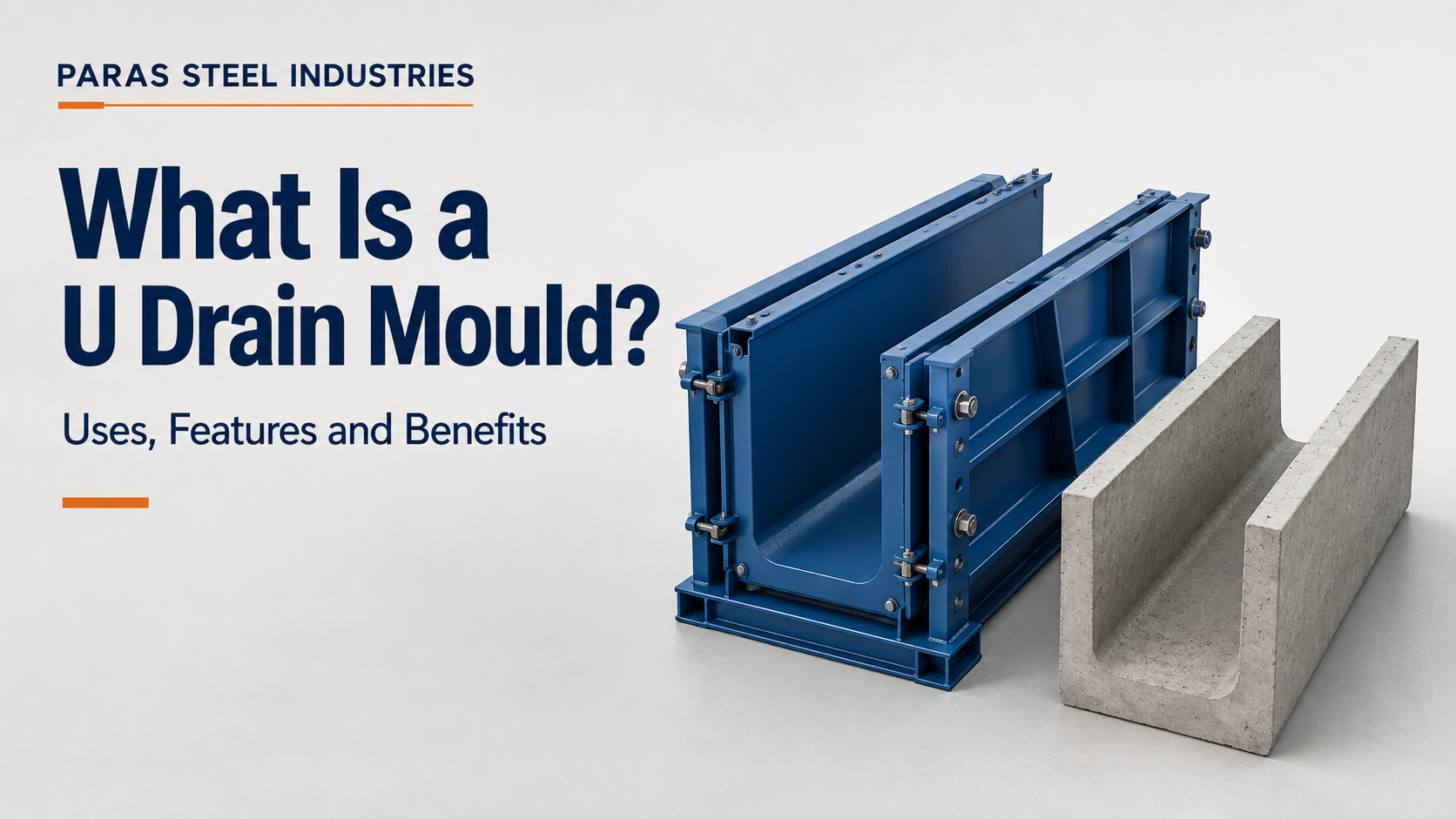
What Is a U Drain Mould? Uses, Features and Benefits Manufacturing precast concrete drainage channels starts with a clearly defined product design and a suitable mould. The mould determines the shape of the casting and supports the production team through assembly, concrete placement and demoulding. A U drain mould is designed to form U-shaped concrete drain sections. For precast manufacturers and infrastructure suppliers, choosing the right mould is an important part of establishing a consistent production process. Understanding how a concrete U drain mould works can help buyers prepare better specifications, compare equipment and plan their manufacturing operations. What Is a U Drain Mould? A U drain mould is a form used to cast concrete drainage channels with a base and two side walls, leaving the top open. Depending on the project design, the finished channel may remain open or accommodate a separate cover. The mould creates the internal channel profile and the external shape of the concrete component. For reinforced concrete drains, reinforcement is positioned within the assembled form according to the approved structural drawing. Steel and mild steel U drain moulds are offered for repeated precast production. Their configuration varies with the drain dimensions, joint details and method of removing the finished component. The terms “U drain mould,” “precast drain mould” and “U shaped drainage channel mould” may appear in supplier catalogues. Buyers should always check the actual drawing because product names alone do not define the complete shape or specification. How Does a U Drain Mould Work? The production process begins with inspecting, cleaning and assembling the mould. The team checks that the components are correctly aligned and applies a suitable release agent according to the relevant instructions. Where reinforcement is required, the reinforcement cage and spacers are positioned to achieve the specified concrete cover. Any inserts, openings or other cast-in details must also be checked before concrete placement. Concrete is then placed and compacted using the approved production procedure. The casting follows the specified curing process until it reaches the strength required for demoulding. The mould is opened or dismantled according to its design, and the finished drain is removed using the approved handling arrangement. After inspection and cleaning, the equipment can be prepared for another casting cycle. There is no single demoulding time that suits every product. Concrete mix, curing conditions, component design and release-strength requirements all need to be considered. Where Are Precast U Drains Used? The mould is production equipment; the finished concrete drain is the component installed on site. Potential applications depend on the project’s drainage and structural design. Roadside Drainage Precast U drains can form part of roadside systems that collect and convey surface water. Channel dimensions, alignment, gradient and discharge arrangements must suit the site. Residential and Commercial Developments Drainage channels may be used around housing developments, access roads, parking areas and commercial premises. Locations accessible to pedestrians or vehicles need appropriate cover and loading provisions where required. Industrial Sites Factory and warehouse developments may use concrete channels for surface-water drainage. Suitability for contaminated or chemically aggressive water requires a separate assessment of the concrete and any protective system. Water Conveyance Applications U-shaped precast channels may also be specified for suitable irrigation or water-conveyance works. Joint treatment and leakage requirements depend on the intended application. The mould itself does not establish the hydraulic capacity or load rating of the finished drain. Those requirements belong to the approved product and installation design. Key Features to Check in a U Drain Mould A useful specification should explain how the mould will support your actual production process. Clearly Defined Dimensions Confirm internal width, internal depth, unit length, wall thickness and base thickness. Identify whether quoted dimensions are internal, external or nominal. A size description without a drawing can lead to different interpretations between the buyer and supplier. Suitable Assembly and Opening Arrangement Review how operators will close, fasten and open the mould. The arrangement should suit the component geometry, handling equipment and available working space. Ask the supplier to demonstrate the sequence and explain any removable parts. Concrete-Contact Surface Condition Inspect the forming surfaces and joints against the agreed acceptance criteria. Their condition is one factor affecting the appearance of the casting, alongside concrete properties, release-agent application and compaction. Access for Routine Work Consider access for cleaning, reinforcement placement, inspection and fastening. The team should understand how routine tasks will be completed before the equipment enters production. Replaceable Parts and Documentation Request a supplied-parts list, operating instructions and maintenance guidance. Identify which components may require replacement and how they can be obtained. Benefits of a Suitable Precast U Drain Mould Supports Repeat Production A reusable mould provides a repeatable form for producing the same approved drain profile. This is useful when an order requires multiple matching precast units. Provides a Basis for Dimensional Checks The approved mould drawing gives production and inspection teams a reference for checking the assembled equipment. Finished castings still need verification under the quality plan. Helps Organise Production A defined assembly and opening procedure allows the factory to plan preparation, casting and handling activities. Actual output depends on the complete process, including concrete supply, curing, labour and lifting availability. Allows Project-Specific Features Where included in the design, a mould can accommodate specified end details, openings or cover supports. These features should be agreed before fabrication. Enables Reuse Across Suitable Orders A maintained mould may serve subsequent orders for the same product specification. Any changes to the drain design should be reviewed before the existing mould is reused. These benefits depend on suitable equipment, correct operation and consistent production control. A mould alone cannot guarantee concrete strength, surface quality or production output. How to Choose the Right U Drain Mould Start with the finished drain drawing and prepare a written enquiry. Include: - Internal and external dimensions. - Finished unit length. - Wall and base thickness. - Reinforcement and concrete-cover requirements. - End joints, openings and cover-support details. - Required mould quantity. - Expected production schedule. - Available handling equipment. - Delivery location. When comparing quotations, check that they cover the same components, accessories, inspection arrangements and services. Ask whether the proposed mould is dedicated to one size or supports specific adjustments. Do not assume that every U drain mould can manufacture multiple widths and depths. Basic Maintenance Considerations Follow the supplier’s cleaning, servicing and storage instructions. Inspect fastening components and forming surfaces regularly, and record any damage or alignment issues. Keep removable parts identified so they remain associated with the correct mould. Before restarting equipment after storage, complete the required inspection. A maintenance record can help the factory track repairs, plan spare parts and investigate recurring casting problems. Frequently Asked Questions What is the difference between a U drain and a U drain mould? A U drain is the finished concrete drainage channel. A U drain mould is the equipment used to form that channel during manufacturing. Can a U drain mould produce reinforced concrete drains? Yes, a suitable mould can be used for reinforced concrete drain production. The reinforcement arrangement, concrete cover and finished dimensions must follow the approved design. Can one mould produce different drain sizes? Some mould designs accommodate specified changes through adjustable or replaceable components. The supported sizes must be confirmed with the supplier; major changes may require another mould. Does a U drain mould determine the strength of the drain? No. Finished drain performance depends on factors including structural design, concrete properties, reinforcement, compaction and curing. The mould forms the component geometry. What information is needed for a quotation? Provide the drain drawing, dimensions, required mould quantity, special features and delivery location. Production and handling details also help define the enquiry. Discuss Your U Drain Mould Requirement Planning to manufacture precast concrete drainage channels? Contact Paras Steel Industries with your drain drawing, required dimensions, mould quantity and delivery location to discuss your U drain mould requirement.