
Precast Machinery Guide
Concrete Shifting Trolley Tray Maintenance: Slurry Buildup, Discharge Slope and Spill Prevention
Hardened slurry, a distorted tray or blocked discharge area can reduce the efficiency of a concrete shifting trolley and cause material spills. This guide explains safe cleaning, tray-slope checks, joint inspection and preventive maintenance.
By Paras Steel Industries ·
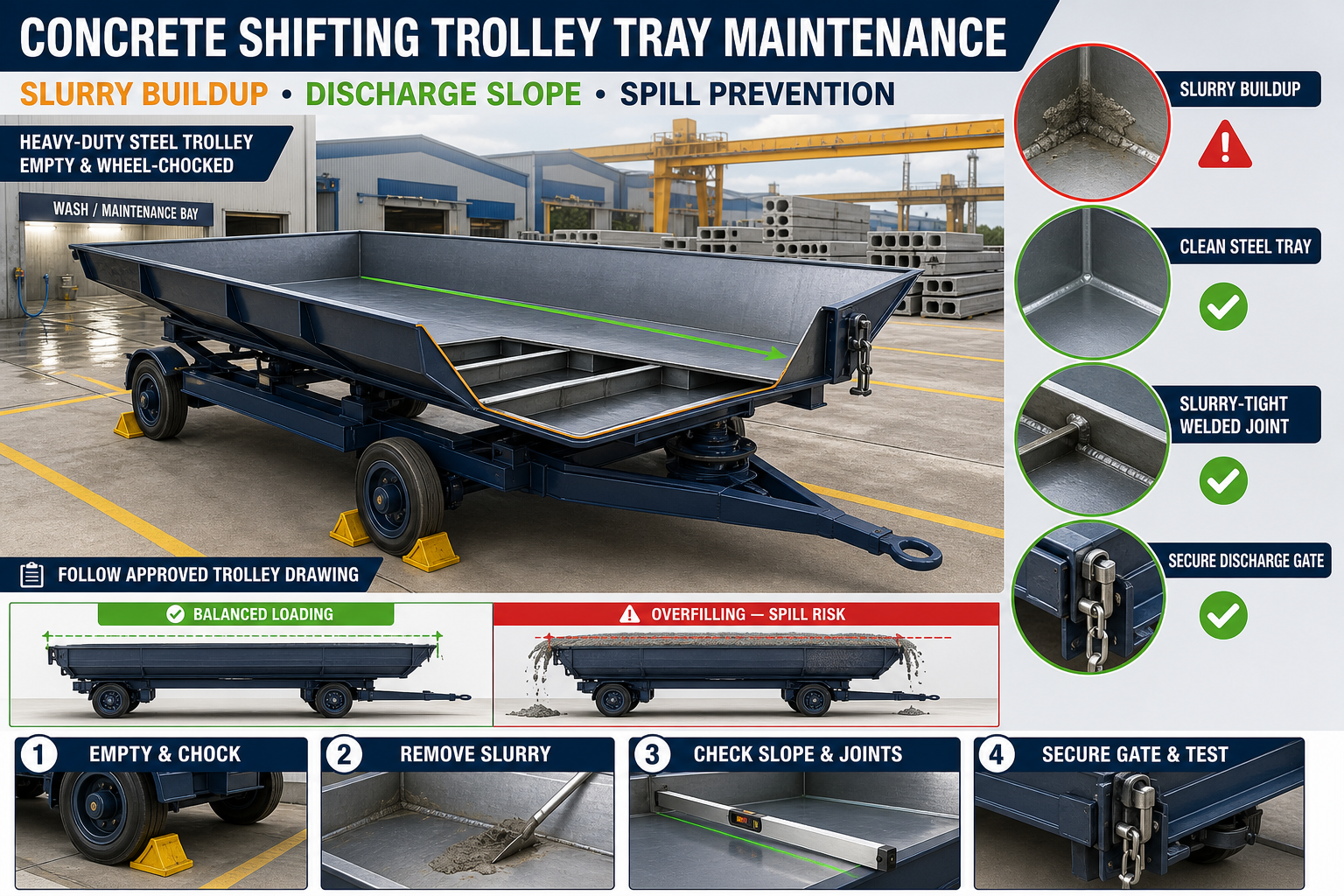
Concrete Shifting Trolley Tray Maintenance: Slurry Buildup, Discharge Slope and Spill Prevention
Concrete Shifting Trolley Tray Maintenance Guide
A concrete shifting trolley transports fresh concrete from the mixer to moulds and casting stations inside a precast plant. Its tray must contain the concrete securely and allow controlled discharge at the required location.
During regular production, cement slurry can collect in corners, around welded joints and near the discharge edge. If this material is not removed promptly, it can reduce tray capacity, change the discharge slope and create contamination in future batches.
Structural deformation, damaged joints and improper loading may also cause concrete to spill during transportation.
This guide explains concrete shifting trolley tray maintenance, including slurry removal, discharge-slope inspection, tray repair and spill prevention.
What Is a Concrete Shifting Trolley?
A concrete shifting trolley is a heavy-duty material-handling unit designed to transport fresh concrete within a production plant.
A typical trolley may include:
• Heavy structural-steel chassis • Fabricated steel tray • Flared or raised tray sides • Reinforcing ribs • Cross members • Discharge edge or gate • Turntable steering • Drawbar • Front and rear axles • Wheels and hubs • Towing connection • Tray-support brackets • Cleaning and access points
The tray shape and discharge arrangement depend on the approved trolley design.
Why Tray Maintenance Is Important
A clean and structurally sound tray helps:
• Maintain usable carrying volume • Support smoother concrete discharge • Reduce cross-contamination • Prevent hardened concrete buildup • Control spills • Protect welded joints • Reduce chassis overloading • Improve cleaning efficiency • Maintain trolley balance • Support consistent plant operation
Poor maintenance can increase manual cleaning time and place unnecessary load on the trolley.
Common Tray Problems
Typical maintenance problems include:
• Hardened concrete in corners • Cement slurry coating the tray floor • Blocked discharge edge • Reduced internal tray space • Bent tray side walls • Cracked welded joints • Slurry leakage • Distorted tray floor • Incorrect discharge slope • Concrete collecting at the rear • Damaged gate or latch • Corrosion beneath concrete deposits
These issues should be corrected before they affect regular production.
Safety Before Tray Maintenance
A trolley can move or tip if it is not parked and supported correctly.
Before inspection or cleaning:
1. Empty the tray completely. 2. Park the trolley on firm, level ground. 3. Disconnect it from the towing vehicle. 4. Chock the wheels in both directions. 5. Apply the parking or securing arrangement. 6. Isolate powered discharge systems where fitted. 7. Lower mechanical supports where provided. 8. Allow only trained personnel to enter or work around the tray. 9. Wear suitable personal protective equipment. 10. Follow the plant’s confined-access procedure if applicable.
Never work beneath a raised or tilted tray unless it is secured by an approved mechanical support.
Clean the Tray After Every Batch
Fresh concrete is easier to remove before it hardens.
A practical cleaning process includes:
1. Discharge the remaining concrete at the approved location. 2. Park and secure the trolley. 3. Remove loose concrete using approved tools. 4. Clean the tray corners and discharge edge. 5. Inspect the welded joints. 6. Collect wash water and slurry according to plant rules. 7. Prevent contaminated water from entering drains or soil. 8. Complete a visual inspection after cleaning.
Do not allow concrete residue to remain in the tray overnight.
Avoid Uncontrolled Hammering
Repeated hammering can dent the tray plate, crack welds and loosen its connection with the chassis.
Avoid:
• Heavy steel hammering on the tray floor • Striking welded joints • Using excavator buckets for cleaning • Uncontrolled chiselling • Bending tray sides to remove concrete • Flame heating hardened deposits
Use cleaning tools and methods approved for the steel tray.
Slurry Buildup Locations
Slurry commonly accumulates around:
• Tray corners • Welded seams • Reinforcing ribs • Discharge edge • Gate hinges • Gate seal • Bolt heads • Drain or cleaning openings • Low areas in a distorted floor • Tray-to-chassis connections
Inspect these areas carefully after every cleaning cycle.
How Slurry Buildup Affects the Trolley
Hardened slurry can:
• Increase the trolley’s empty weight • Reduce usable tray space • Change load distribution • Slow concrete discharge • Hide cracks and corrosion • Block gates and latches • Create sharp projections • Contaminate fresh concrete • Increase cleaning time • Trap water against the steel surface
Removing buildup early helps prevent more extensive repairs.
Inspect the Tray Floor
After cleaning, inspect the complete floor surface.
Look for:
• Dents • Local low points • Raised areas • Cracks • Corrosion • Worn plate sections • Damaged welds • Sharp edges • Concrete trapped beneath repairs • Previous patching
A distorted tray floor can retain concrete even when the overall trolley appears level.
What Is Discharge Slope?
The discharge slope is the designed inclination or internal profile that helps fresh concrete move toward the discharge end.
Depending on the trolley design, the slope may be provided by:
• The fabricated tray-floor angle • A tapered tray shape • A tilting mechanism • A discharge gate • A combination of tray geometry and controlled tipping
The required slope should follow the approved trolley drawing.
Why Discharge Slope Matters
A correctly maintained discharge slope helps:
• Reduce material remaining in the tray • Improve discharge control • Limit manual scraping • Prevent concrete accumulation • Maintain batch consistency • Reduce cleaning time • Keep weight distribution predictable
Too little effective slope may leave concrete behind, while an excessively steep or uncontrolled discharge can create spills.
Checking the Tray Slope
The trolley should be empty, clean and parked on a level reference surface.
A basic check may include:
1. Confirm the chassis is level. 2. Establish a fixed datum. 3. Clean the tray floor. 4. Check the floor profile along the centreline. 5. Check both side zones. 6. Inspect the discharge edge. 7. Identify local low points. 8. Compare the results with the approved drawing. 9. Record any change. 10. Correct structural problems before reuse.
Use a suitable level, straightedge, laser or survey method.
Check More Than One Line
Checking only the centreline may not reveal distortion near the sides.
Inspect:
• Tray centreline • Left side • Right side • Both diagonal references • Discharge edge • Rear retaining area • Areas between support ribs
The tray should not twist relative to the chassis.
Distorted Tray Floor
Possible causes include:
• Overloading • Impact from concrete buckets • Uneven chassis support • Inadequate structural ribs • Cracked welds • Hardened buildup • Improper lifting • Collision • Unapproved modifications • Excessive hammering during cleaning
The cause must be corrected before straightening or replacing the plate.
Inspect the Tray Side Walls
Side walls help contain fresh concrete during movement and turning.
Check for:
• Outward bulging • Cracked corners • Bent top edges • Damaged reinforcing ribs • Loose brackets • Corrosion • Leakage marks • Sharp projections • Previous repairs • Reduced side height from deformation
A bent side wall may allow concrete to spill during travel.
Check Welded Joints
Welded seams are common locations for slurry leakage.
Inspect:
• Floor-to-side joints • Corner joints • Discharge-edge welds • Reinforcing-rib connections • Tray-to-support brackets • Gate-hinge brackets • Previous repair welds • Chassis connections
Cracked welds should be repaired by qualified personnel using an approved procedure.
Slurry-Leak Detection
After cleaning, dried slurry trails may reveal the source of a leak.
Common leakage points include:
• Cracked welds • Open corner joints • Gate seals • Bolt penetrations • Damaged tray plates • Previous repair areas • Drain openings • Distorted discharge edges
Repair the source instead of repeatedly covering it with temporary material.
Do Not Use Unapproved Sealants
Temporary sealants may:
• Contaminate fresh concrete • Separate during transportation • Hide structural cracks • Interfere with welding • Block the discharge gate • Create cleaning difficulties
Use an approved repair or sealing method suitable for wet concrete contact.
Inspect the Discharge Edge
The discharge edge should remain straight and free from hardened buildup.
Check:
• Edge straightness • Plate wear • Sharp damage • Concrete deposits • Reinforcing support • Gate contact • Seal position • Welded joints • Unwanted deformation
A damaged discharge edge can redirect concrete outside the intended receiving area.
Discharge-Gate Maintenance
Where the trolley uses a gate, inspect:
• Hinges • Hinge pins • Bushes • Gate plate • Locking latch • Handle • Mechanical stops • Sealing surfaces • Retaining components • Welded brackets
The gate should open and close smoothly without uncontrolled release.
Gate Lock Inspection
The gate lock must remain secure during transportation.
Check:
• Full lock engagement • Pin condition • Retainer • Handle movement • Lock bracket • Wear • Concrete buildup • Accidental-opening protection
Never travel with a gate that cannot be locked securely.
Tray-to-Chassis Connection
The tray must remain firmly connected to the structural-steel chassis.
Inspect:
• Mounting brackets • Bolts • Welded joints • Cross members • Support ribs • Rubber pads where designed • Cracks • Loose components • Corrosion • Movement marks
A loose tray can shift during travel and change the trolley’s balance.
Inspect the Chassis
Tray distortion may originate from a damaged chassis.
Check:
• Main longitudinal members • Cross members • Axle mounts • Turntable mounting area • Drawbar connection • Welded joints • Chassis straightness • Corrosion • Impact damage • Previous repairs
Repair structural defects before adjusting the tray.
Spill Prevention Through Correct Loading
Concrete should be placed centrally and evenly in the tray.
Good loading practices include:
• Follow the approved trolley capacity • Distribute concrete evenly • Avoid loading one side first • Keep material below the safe tray boundary • Do not drop concrete from excessive height • Close the discharge gate before loading • Check the receiving path • Confirm the trolley is stable • Avoid loading while the trolley is moving
Uneven loading can cause spills and place excessive stress on the tray.
Do Not Overfill the Tray
Overfilling increases the risk of:
• Concrete spilling during turns • Material falling during braking • Chassis overloading • Axle and bearing damage • Unstable steering • Increased tray-wall pressure • Contaminated factory routes
The approved carrying limit should be followed for the actual concrete density and trolley design.
Spill Prevention During Transportation
Operators should:
• Use a designated route • Maintain a controlled speed • Avoid sudden acceleration • Avoid sharp turns • Brake gradually • Keep away from steep or uneven ground • Check wheel condition • Secure the discharge gate • Keep workers away from the moving trolley • Stop if material begins spilling
A maintained tray cannot compensate for unsafe towing.
Route Inspection
Before transportation, check the route for:
• Potholes • Loose aggregate • Excessive slopes • Sharp corners • Narrow passages • Pedestrian movement • Obstructions • Water or slurry • Poor lighting • Insufficient turning space
A smooth route reduces impact and material movement inside the tray.
Drawbar and Steering Inspection
Poor steering can contribute to spills during turning.
Inspect:
• Drawbar • Towing eye • Towing pin • Turntable steering • Kingpin • Retainers • Steering stops • Front axle • Wheel alignment
Stop using the trolley if steering becomes unpredictable.
Wheel and Hub Inspection
Check:
• Tyres • Wheel rims • Wheel nuts • Hub bearings • Spindles • Grease seals • Axle alignment • Overheating • Unusual noise • Uneven tyre wear
Wheel failure during concrete transportation can create a serious spill and handling hazard.
Cleaning-Water Control
Concrete wash water is alkaline and contains cement particles.
The plant should:
• Use a designated cleaning area • Collect slurry • Prevent discharge into storm drains • Recycle water where the approved system permits • Remove settled solids • Follow applicable environmental requirements • Keep cleaning areas away from traffic routes
Do not wash concrete residue onto open ground without an approved disposal system.
Corrosion Prevention
Concrete deposits can trap water against the steel tray and encourage corrosion.
To reduce corrosion:
• Clean the trolley regularly • Keep drainage points open • Repair damaged protective coatings • Store the trolley in a suitable area • Avoid standing water • Inspect welded joints • Remove rust before repair • Apply compatible protective coating externally
Coatings on concrete-contact surfaces should be suitable for the intended application.
Controlled Empty-Trolley Test
After maintenance:
1. Confirm that tools are removed. 2. Check the gate lock. 3. Remove wheel chocks through the approved process. 4. Connect the towing vehicle. 5. Clear the test route. 6. Move the trolley slowly. 7. Check steering and wheel tracking. 8. Test gradual turning and braking. 9. Operate the discharge gate safely. 10. Park and reinspect the tray and chassis. 11. Record the test result.
Complete the empty test before loading fresh concrete.
Common Problems and Corrective Actions
Concrete Remains in the Tray
Check hardened buildup, local low points, discharge slope, concrete workability and gate opening.
Slurry Leaks From a Corner
Inspect the corner weld, tray distortion, corrosion and previous repairs.
Concrete Spills During Turns
Check overfilling, side-wall condition, towing speed, turn radius, tray balance and steering.
Discharge Gate Does Not Open
Remove concrete buildup and inspect the hinge, pin, lock and plate alignment.
Gate Opens During Travel
Stop using the trolley and inspect the latch, retainer, wear and locking bracket.
Tray Leans to One Side
Check chassis distortion, axle condition, tyre size, wheel bearings and tray supports.
Hardened Concrete Returns Quickly
Review cleaning frequency, tray surface condition, discharge profile and concrete-handling procedure.
Repeated Weld Cracks
Investigate overloading, chassis movement, inadequate support, impact and vibration before completing another repair.
Preventive Maintenance Checklist
After Every Production Cycle
• Empty the tray completely • Clean fresh concrete residue • Inspect the discharge edge • Clean the gate and latch • Check for slurry leakage • Inspect visible tray damage
Daily or Pre-Use Checks
• Confirm the gate lock • Inspect the towing connection • Check tyres and wheels • Look for cracked welds • Check tray side walls • Verify that no large buildup remains
Scheduled Checks
• Check tray-floor profile • Verify discharge slope • Inspect structural ribs • Examine tray-to-chassis connections • Check chassis straightness • Service gate hinges and pins • Inspect turntable steering • Check wheel bearings • Repair damaged coatings • Record recurring leaks and defects
When Should the Trolley Be Stopped?
Stop using the concrete shifting trolley if you find:
• Cracked tray or chassis welds • Major slurry leakage • Severely distorted tray floor • Failed gate lock • Broken gate hinges • Loose tray supports • Damaged towing connection • Unpredictable steering • Loose wheels • Overheated bearings • Unstable chassis • Concrete spilling during controlled travel
Return the trolley to operation only after repair and a successful unloaded test.
Conclusion
Concrete shifting trolley tray maintenance requires prompt slurry removal, regular discharge-slope checks, joint inspection and correct loading practices.
Hardened buildup can reduce the usable tray space and hide cracks, while a distorted floor or damaged discharge edge may prevent complete emptying. Spill prevention also depends on balanced loading, secure gate locking, controlled towing and a well-maintained chassis.
Paras Steel Industries manufactures heavy-duty structural-steel concrete shifting trolleys according to customer requirements and approved drawings. Regular cleaning, inspection and preventive maintenance help support controlled concrete transport and cleaner precast plant operation.