
Precast Mould Guide
Iron Plate Thickness for Precast Moulds: 4 mm, 6 mm, 8 mm or 10 mm?
Selecting the correct iron plate thickness improves mould accuracy, durability and production quality. Compare 4 mm, 6 mm, 8 mm and 10 mm options for different precast products.
By Paras Steel Industries ·
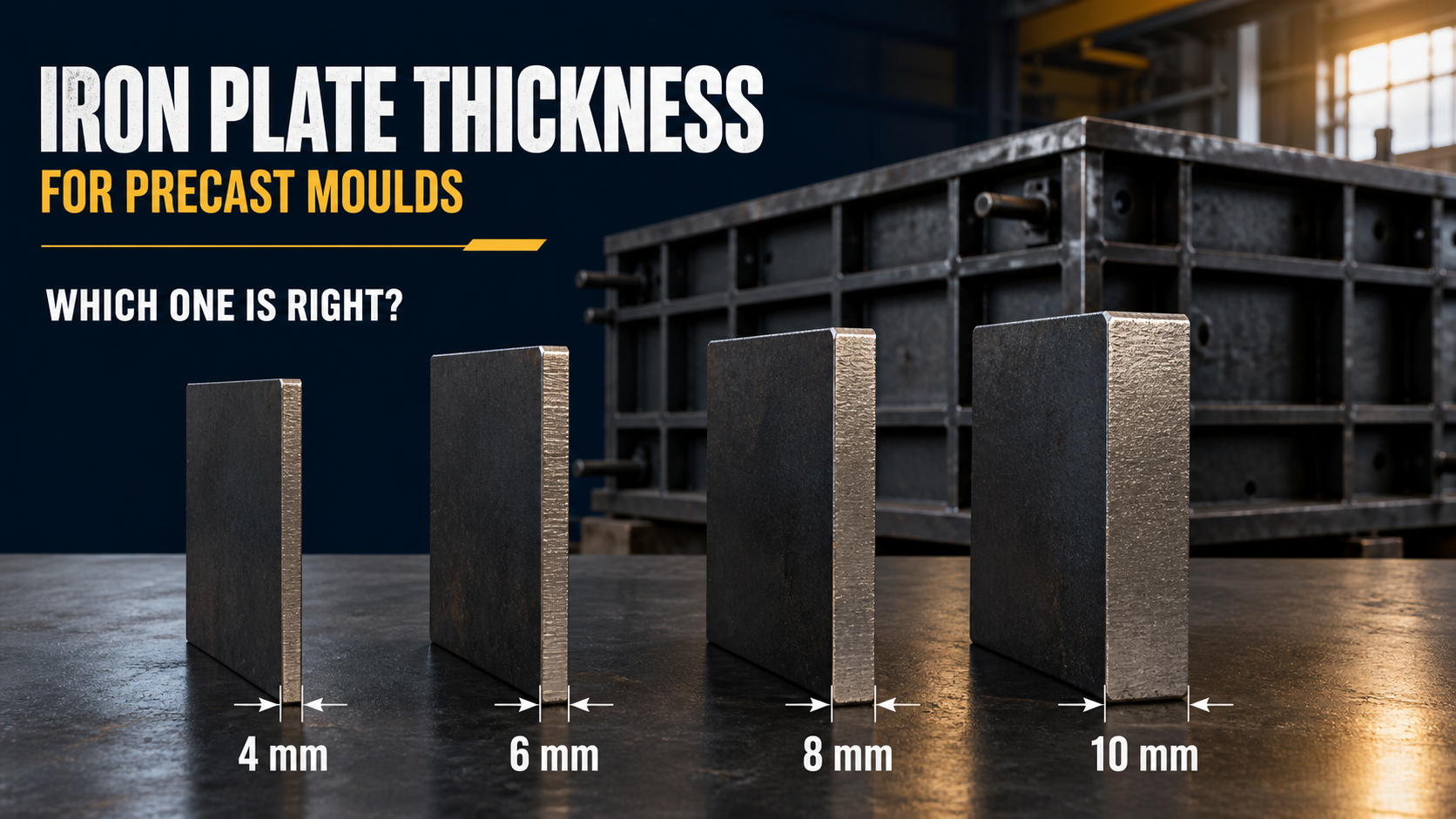
Iron Plate Thickness for Precast Moulds: 4 mm, 6 mm, 8 mm or 10 mm?
Iron Plate Thickness for Precast Moulds: 4 mm, 6 mm, 8 mm or 10 mm?
Iron plate thickness is one of the first specifications buyers ask about when purchasing a precast concrete mould.
Should the mould use a 4 mm, 6 mm, 8 mm or 10 mm iron plate?
The correct answer depends on the product size, concrete volume, casting orientation, vibration method, production frequency and mould-support structure.
A thicker plate can provide greater rigidity, but thickness alone does not determine mould quality. A properly engineered 6 mm mould with strong channels and closely spaced stiffeners may perform better than an unsupported 8 mm plate.
This guide explains how to select the correct iron plate thickness for precast moulds and why the complete structural design matters more than a single thickness figure.
Why Is Iron Plate Thickness Important?
Fresh concrete creates outward pressure on the mould surfaces. The pressure increases according to the depth of concrete, pouring speed and vibration intensity.
If the mould plate is too thin for the application, it may:
Bulge during concrete pouring
Deflect during vibration
Produce inconsistent dimensions
Create uneven concrete surfaces
Open at flange joints
Allow cement slurry leakage
Require frequent straightening
Develop cracks near welded joints
Lose alignment after repeated production
An unnecessarily thick plate can also create problems. It increases mould weight, fabrication cost, transportation expense and handling difficulty.
The objective is therefore not to select the thickest available plate. The objective is to select the correct combination of plate thickness, stiffeners, channels, flanges and locking points.
Common Iron Plate Thicknesses for Precast Moulds
The following plate thicknesses are commonly considered for different mould applications:
4 mm iron plate
6 mm iron plate
8 mm iron plate
10 mm iron plate
Some designs may use more than one thickness in the same mould. For example, a mould may use a 6 mm body plate with 8 mm or 10 mm end flanges and additional heavy channels.
This combination places stronger material in areas receiving concentrated pressure while controlling the mould’s total weight and cost.
4 mm Iron Plate for Precast Moulds
A 4 mm iron plate may be suitable for selected small and medium precast products with limited concrete depth.
Common applications may include:
Small fencing posts
Light boundary wall columns
Narrow pole moulds
Kerb stone moulds
Small cover moulds
Selected garden-product moulds
Light-duty wall-panel moulds
A 4 mm plate should only be used when the mould has an appropriate stiffener arrangement.
Advantages of 4 mm Iron Plate
Lower initial cost
Reduced mould weight
Easier manual handling
Suitable for smaller concrete products
Faster panel opening and closing
Lower transportation expense
Limitations of 4 mm Iron Plate
Greater risk of deformation in large moulds
Requires well-positioned stiffeners
May not suit high concrete depth
May be unsuitable for aggressive vibration
Can wear faster in intensive production
More sensitive to uncontrolled hammering
A 4 mm plate must not be selected only because the product appears narrow. Long pole and column moulds may still require substantial support because plate deflection increases across longer unsupported distances.
When Should You Consider a 4 mm Plate?
A 4 mm configuration may be considered when:
The precast product is relatively small.
Concrete depth is limited.
The mould contains sufficient external channels.
Stiffener spacing is close.
Casting frequency is moderate.
The vibration intensity is controlled.
The mould manufacturer has evaluated the complete design.
It should generally be avoided for large footings, box culverts, heavy barriers and other products that place high loads on the mould body.
6 mm Iron Plate for Precast Moulds
A 6 mm iron plate is a widely used option for many medium and heavy precast moulds.
It offers a practical balance between:
Rigidity
Mould weight
Manufacturing cost
Handling requirements
Repeated production performance
Common applications may include:
Column pole moulds
Boundary wall moulds
Medium-size wall panel moulds
U-drain moulds
Cable trench moulds
Footing moulds
Window and door frame moulds
Selected highway-product moulds
Advantages of 6 mm Iron Plate
Better resistance to concrete pressure than 4 mm plate
Suitable for many repeated-production applications
Improved dimensional stability
Supports mechanical vibration when properly reinforced
Provides a practical cost-to-strength balance
Can be combined with heavy channels and flanges
Limitations of 6 mm Iron Plate
May still require heavy stiffeners for large moulds
Can deflect across long unsupported areas
May not be sufficient for very deep concrete sections
Requires proper flange and locking design
Increased weight compared with 4 mm moulds
When Should You Consider a 6 mm Plate?
A 6 mm plate may be suitable when:
The product has medium dimensions.
The mould is used regularly.
Concrete pressure is moderate.
A vibrating table or external vibrator is used.
The body contains calculated stiffener spacing.
The mould requires a balance between strength and mobility.
Several mould designs use 6 mm plates for primary surfaces and heavier plates at end flanges, locking zones or high-pressure sections.
8 mm Iron Plate for Precast Moulds
An 8 mm iron plate is generally considered for large, deep or heavy-duty precast products.
Common applications may include:
Large wall panels
Highway barriers
Box culverts
Large U-drains
Bridge components
Heavy footings
Retaining-wall components
Large infrastructure moulds
Industrial foundation moulds
An 8 mm plate provides improved resistance to bending and local deformation, particularly when combined with a reinforced channel framework.
Advantages of 8 mm Iron Plate
High structural rigidity
Better resistance to heavy concrete pressure
Suitable for intensive production
Improved performance during vibration
Reduced risk of surface waviness
Better stability in large mould panels
Potentially longer working life with correct maintenance
Limitations of 8 mm Iron Plate
Higher mould cost
Increased mould weight
Greater crane or handling requirements
Higher transportation expense
More difficult manual demoulding
Still requires calculated structural support
When Should You Consider an 8 mm Plate?
An 8 mm plate may be considered when:
The concrete section is deep or heavy.
The mould has large surface areas.
High-frequency vibration is used.
Dimensional tolerance is critical.
The mould will operate continuously.
A crane-assisted production setup is available.
The product belongs to heavy infrastructure construction.
Even an 8 mm plate can bend if it spans a large area without sufficient channels or ribs. Heavy plate thickness must always be supported by an engineered framework.
10 mm Iron Plate for Precast Moulds
A 10 mm iron plate is used for selected high-load and special-purpose mould applications.
It may not be necessary across the entire mould. Manufacturers may use it specifically for:
Heavy end flanges
Mould base sections
High-pressure zones
Locking plates
Load-transfer brackets
Pivot supports
Large foundation moulds
Heavy infrastructure moulds
Custom high-volume production systems
Advantages of 10 mm Iron Plate
Very high local rigidity
Improved resistance at concentrated load points
Suitable for heavy locking and flange systems
Better support for large mould sections
Reduced risk of flange bending
Appropriate for specialised infrastructure products
Limitations of 10 mm Iron Plate
Significantly higher weight
Higher material and fabrication cost
Requires mechanical handling
Increased transportation cost
May make mould opening difficult
Can be unnecessary for light products
Does not replace external stiffening
When Should You Consider a 10 mm Plate?
A 10 mm plate may be appropriate when:
The product contains a very large concrete volume.
The mould experiences high local pressure.
Heavy flanges must remain straight.
The mould includes pivoting or hydraulic components.
The product dimensions are exceptionally large.
The production cycle is highly intensive.
The mould engineer recommends it after reviewing the drawing.
Using a 10 mm plate for every small mould does not automatically improve production. It may only make the mould unnecessarily expensive and difficult to handle.
Quick Thickness Comparison
4 mm Iron Plate
Best suited for:
Small and selected medium products
Limited concrete pressure
Light or moderate production
Manually handled moulds
Main consideration:
Requires close stiffener spacing and controlled vibration.
6 mm Iron Plate
Best suited for:
Medium-size precast products
Regular production
Moderate concrete pressure
Table or external vibration
Main consideration:
Offers a practical balance of rigidity, cost and weight.
8 mm Iron Plate
Best suited for:
Large and heavy products
Deep concrete sections
Infrastructure moulds
Intensive vibration and production
Main consideration:
Requires crane-assisted handling and strong support channels.
10 mm Iron Plate
Best suited for:
Special heavy-duty moulds
Base plates and end flanges
High-load foundation moulds
Concentrated-pressure sections
Main consideration:
Should be used only where the structural design requires it.
Factors That Determine the Required Plate Thickness
Precast Product Size
Larger products generally require stronger mould plates because they contain more concrete and create greater pressure.
Concrete Depth
Fresh-concrete pressure increases with vertical depth. A deep mould may require thicker plates and additional horizontal stiffeners.
Mould Orientation
Horizontal and vertical moulds experience concrete pressure differently.
A horizontal panel mould distributes concrete over a large base area, while a vertical mould experiences greater pressure toward its lower section.
Casting Length
Long pole and beam moulds may experience plate deflection across their length, even when the concrete cross-section is small.
Concrete Pouring Speed
Rapid filling can increase temporary pressure on the mould walls. Controlled layer-by-layer placement reduces sudden loading.
Vibration Method
The mould may be used with:
Poker vibrators
External shutter vibrators
Vibrating tables
Hydraulic vibration systems
Strong vibration places additional dynamic load on plates, joints and stiffeners.
Casting Frequency
A mould used occasionally has different durability requirements from one completing continuous daily production.
Required Casting Cycles
Buyers should consider the total quantity of products required throughout the project, not only daily production.
Stiffener Spacing
Closer stiffener spacing reduces the unsupported plate area and can improve resistance to deflection.
Channel and Angle Size
Heavy channels, angles and H-beams reinforce the plate and transfer loads into the mould frame.
Flange Thickness
Flanges may require thicker material than the main body because bolts and clamps create concentrated loads around the joints.
Locking System
The number and position of clamps, bolts, tie rods and wedge locks affect the mould’s ability to resist expansion.
Handling Method
A manually operated mould must remain manageable. A crane-operated mould can use heavier construction where required.
Dimensional Tolerance
Products requiring precise connections may need greater mould rigidity than general-purpose concrete products.
Why Plate Thickness Alone Is Not Enough
Buyers sometimes compare mould quotations only by asking whether the plate is 6 mm or 8 mm.
This comparison is incomplete.
Two moulds using the same plate thickness can perform very differently because of differences in:
Stiffener spacing
Channel size
Flange thickness
Welding quality
Mould alignment
Support foundation
Clamping arrangement
Plate flatness
Fabrication accuracy
Opening mechanism
For example, an 8 mm plate supported only at its outer edges may deflect more than a 6 mm plate reinforced with correctly spaced channels.
A mould should therefore be evaluated as a complete structural system.
Importance of Stiffener Design
Stiffeners reduce the unsupported area of the iron plate.
Common stiffener materials include:
Iron angles
C-channels
ISMC channels
H-beams
Flat ribs
Box-section supports
The required spacing depends on the mould size, concrete pressure and plate thickness.
Stiffeners that are too far apart may allow the plate to bulge between them. Excessive stiffeners can increase cost, weight and cleaning difficulty.
The best design uses enough reinforcement to control deflection without adding unnecessary material.
Plate Thickness for Different Mould Types
Column Pole Moulds
Column and pole moulds may use approximately 4 mm to 6 mm plates, depending on length, cross-section, groove design and vibration method.
Large Wall Panel Moulds
Large wall panels may require approximately 6 mm or 8 mm primary plates with heavy channels, beams and thicker end plates.
Footing Moulds
Footing moulds contain a high concrete volume. Selected sections may use approximately 6 mm to 8 mm plates with heavy external reinforcement.
Box Culvert Moulds
Box culvert moulds may use approximately 6 mm to 8 mm plates. Inner cores also require adequate stiffening to control dimensional changes.
Highway Barrier Moulds
Highway barrier moulds may use approximately 5 mm to 8 mm plate configurations with closely spaced stiffeners and reliable wedge locks.
U-Drain Moulds
Plate requirements depend on the drain width, depth and length. Larger drainage products may require heavier plate and framing arrangements.
Bridge Component Moulds
Large bridge-related products may require 8 mm or heavier plates in selected areas, subject to engineering calculations.
Window Frame Moulds
Smaller frame moulds may use lighter plate configurations, but dimensional accuracy and corner alignment remain important.
RE Wall Panel Moulds
Horizontal RE wall facing-panel moulds require a flat and adequately supported casting surface. The design depends on panel area, thickness and required finish.
How Plate Thickness Affects Mould Price
Increasing plate thickness raises the cost in several ways:
More raw material is required.
Mould weight increases.
Additional handling equipment may be needed.
Welding and fabrication time may increase.
Transportation becomes more expensive.
Heavier hinges and clamps may be required.
The supporting frame may also need reinforcement.
However, selecting an undersized plate can create a higher long-term cost through product rejection, mould repair and lost production time.
The correct mould offers the lowest total production cost rather than only the lowest purchase price.
How Plate Thickness Affects Mould Weight
Increasing an iron plate from 4 mm to 8 mm approximately doubles the plate’s weight when length and width remain unchanged.
Approximate plate weight can be calculated using:
Weight in kilograms = Length in metres × Width in metres × Thickness in millimetres × 7.85
For example, a plate measuring 2 metres × 1 metre may weigh approximately:
4 mm plate: 62.8 kg
6 mm plate: 94.2 kg
8 mm plate: 125.6 kg
10 mm plate: 157 kg
These figures represent only the flat plate. Channels, flanges, hinges and locks add further weight.
The production unit must ensure that cranes, trolleys and workers can handle the completed mould safely.
Signs That a Mould Plate Is Too Thin
Visible bulging during vibration
Finished products becoming wider than specified
Uneven concrete surfaces
Repeated slurry leakage
Panel joints opening under load
Difficulty matching components during installation
Frequent need for straightening
Cracks near stiffener welds
Permanent plate waviness
Locks becoming loose during casting
Production should be stopped and the mould inspected if deformation creates a safety or quality risk.
Can a Thin Mould Be Reinforced Later?
In some cases, additional channels or stiffeners can be installed on an existing mould.
However, reinforcement must be planned carefully. Uncontrolled welding can distort the casting surface and worsen dimensional problems.
Before reinforcement:
Measure the existing deformation.
Check plate straightness.
Inspect weld cracks.
Identify high-pressure areas.
Prepare a proper stiffener arrangement.
Support the casting surface during welding.
Check dimensions after fabrication.
Major modifications should be completed by an experienced mould manufacturer.
Questions to Ask Before Buying a Precast Mould
Which plate thickness is used in each mould section?
What is the spacing between stiffeners?
Which channels or angles reinforce the mould?
Are the end flanges thicker than the body plate?
How is plate deflection controlled?
Which vibration system can be used?
What is the approximate mould weight?
Is crane assistance required?
How many clamps or tie rods are provided?
Can the mould handle the planned concrete depth?
Is the design suitable for daily production?
Can the mould be customised according to my drawing?
Information to Share With the Manufacturer
Product drawing
Overall product dimensions
Concrete depth
Required product weight
Concrete grade
Reinforcement details
Vibration method
Daily production target
Total project quantity
Available crane capacity
Preferred demoulding method
Required dimensional tolerance
Factory floor and support conditions
The manufacturer can recommend a suitable plate and stiffener configuration only after understanding the complete product.
Maintenance Tips for Iron Mould Plates
Clean the casting surface after every cycle.
Remove concrete buildup from flange joints.
Apply mould-release oil uniformly.
Check plate straightness regularly.
Inspect welds and stiffeners.
Tighten clamps and tie rods.
Repair slurry leakage without delay.
Touch up damaged anti-rust coating.
Store moulds on level supports.
Avoid uncontrolled hammering during demoulding.
Do not lift the mould from unapproved points.
Common Buying Mistakes
Selecting Only by Plate Thickness
A mould is a complete structural system. Plate thickness must be evaluated together with channels and stiffeners.
Choosing the Thickest Plate Automatically
Unnecessary thickness increases cost and handling difficulty without always improving production.
Ignoring Mould Weight
A heavy mould may require a crane that is not available in the factory.
Not Sharing the Product Drawing
Without a drawing, the manufacturer cannot properly evaluate concrete pressure and mould geometry.
Ignoring Vibration Requirements
A mould designed for manual compaction may not be suitable for aggressive table vibration.
Comparing Only the Purchase Price
A cheaper mould that loses alignment can increase product rejection and long-term operating cost.
Final Recommendation
There is no single iron plate thickness suitable for every precast mould.
A general selection approach is:
4 mm for selected small and lighter products with sufficient stiffeners.
6 mm for many medium-size and regular-production moulds.
8 mm for large, deep and heavy infrastructure moulds.
10 mm for specialised high-load sections, bases, flanges and heavy custom moulds.
These are general guidelines rather than universal specifications. The correct thickness must be selected after reviewing product dimensions, concrete pressure, vibration, production cycles and handling requirements.
Paras Steel Industries manufactures heavy-duty iron precast moulds according to customer drawings and production requirements. Different plate thicknesses, channels, stiffeners and locking arrangements can be selected according to the mould application.
Frequently Asked Questions
Is a 4 mm iron plate sufficient for a precast mould?
It may be sufficient for selected small products when supported with suitable channels and closely spaced stiffeners.
Is a 6 mm plate suitable for regular production?
A 6 mm plate is commonly suitable for many medium-size moulds, subject to concrete depth, mould dimensions and reinforcement design.
When is an 8 mm iron plate required?
It may be required for large wall panels, heavy footings, box culverts, barriers and other infrastructure products with high concrete pressure.
Should every heavy mould use a 10 mm plate?
No. A 10 mm plate is generally used only where the load and structural design require it. It may be limited to bases, flanges or high-pressure sections.
Is an 8 mm mould always stronger than a 6 mm mould?
Not necessarily. A properly stiffened 6 mm mould can perform better than a poorly supported 8 mm mould.
Does vibration affect plate thickness selection?
Yes. Mechanical vibration creates additional dynamic forces, so the plate, channels, welds and locks must be designed accordingly.
Can different plate thicknesses be used in one mould?
Yes. The body, base, flanges, end plates and locking sections may use different thicknesses.
How can I get the correct recommendation?
Share the product drawing, dimensions, concrete depth, vibration method and required production quantity with the mould manufacturer.