
Precast Mould Guide
C-Channel vs Angle vs H-Beam Stiffeners for Heavy-Duty Precast Moulds
Choosing the correct stiffener is essential for manufacturing strong, accurate and durable iron precast moulds. This guide compares C-channel, angle and H-beam stiffeners based on strength, weight, cost and applications.
By Paras Steel Industries ·
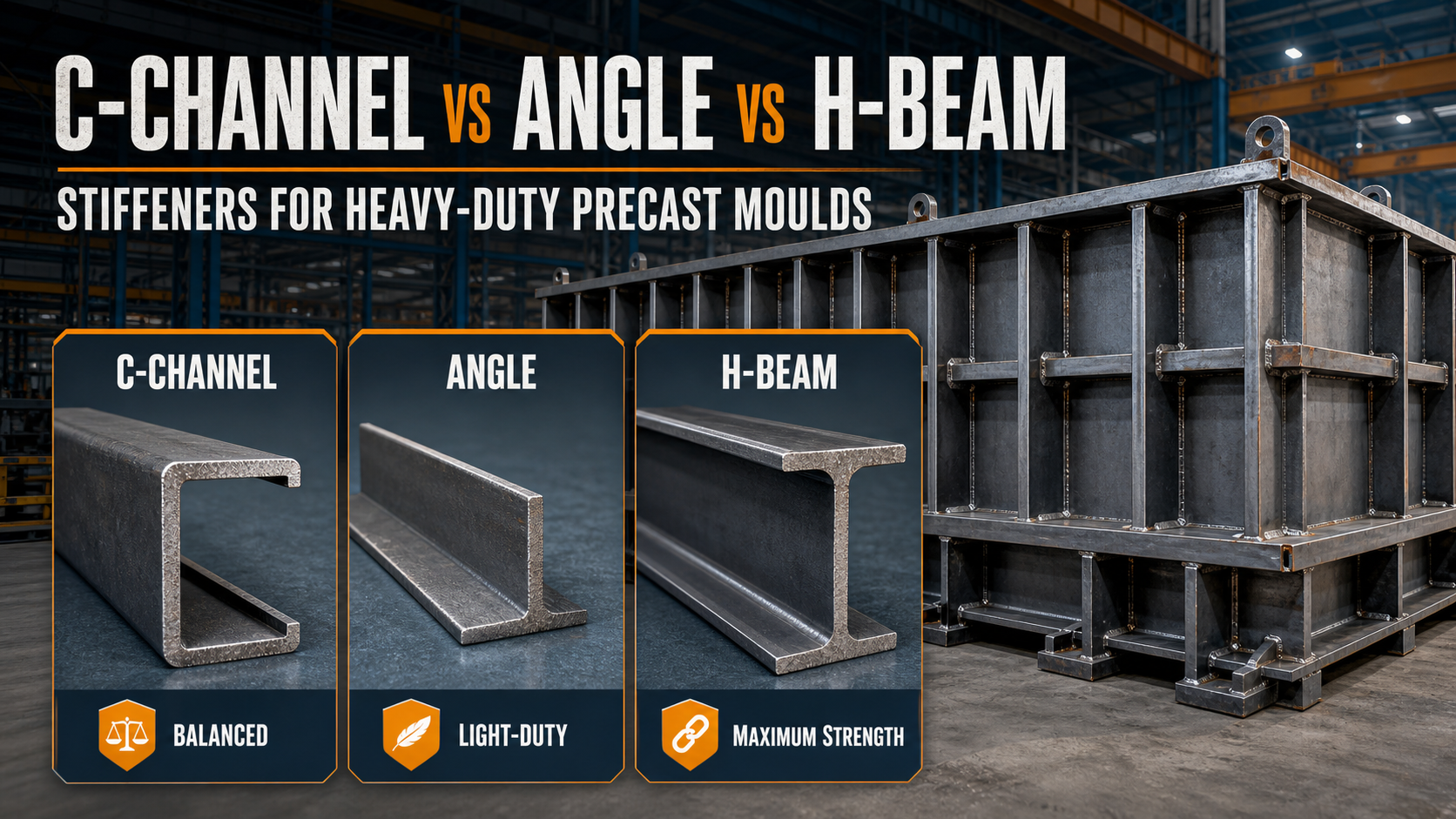
C-Channel vs Angle vs H-Beam Stiffeners for Heavy-Duty Precast Moulds
C-Channel vs Angle vs H-Beam Stiffeners for Heavy-Duty Precast Moulds
A heavy-duty precast mould must maintain its shape while carrying wet concrete pressure, vibration loads and repeated production cycles. Although iron plate thickness is important, plate thickness alone cannot provide sufficient structural strength.
Stiffeners are welded behind the mould plate to control bending, bulging and twisting. C-channels, angle sections and H-beams are commonly used for reinforcing heavy-duty iron precast moulds.
Each type of stiffener has different strength, weight, fabrication requirements and cost. The correct selection depends on the mould dimensions, concrete pressure, production frequency, vibration method and handling system.
Why Are Stiffeners Required in Precast Moulds?
Fresh concrete applies pressure against the mould surface. The pressure may increase due to concrete depth, rapid filling, vibration or the workability of the concrete mix.
Without sufficient reinforcement, the iron mould plate can bend or develop local bulges. This can affect the dimensions, straightness and surface finish of the finished precast product.
Stiffeners help a precast mould to:
• Maintain accurate product dimensions • Resist wet concrete pressure • Reduce mould plate bending and bulging • Control twisting during handling • Withstand repeated vibration • Support regular production cycles • Improve the service life of the mould • Produce consistent precast components
A reliable mould structure requires the correct combination of iron plate thickness, stiffener section, stiffener spacing, welding quality and supporting frame.
What Is an Angle Stiffener?
An angle stiffener is an L-shaped iron section welded behind the mould plate or along its edges. It is commonly used in small and medium-sized moulds where the structural load is moderate.
Angle sections are lightweight, economical and easy to cut, position and weld. They are especially useful for edge reinforcement, internal frames, removable shutters and smaller mould components.
Advantages of Angle Stiffeners
• Lower material cost • Lightweight construction • Easy cutting and fabrication • Suitable for edge reinforcement • Convenient for smaller mould sections • Easier handling and maintenance • Useful where installation space is limited
Limitations of Angle Stiffeners
An angle section is not symmetrical. Its resistance to bending and twisting depends heavily on its size and installation direction.
Light angle sections may not provide enough rigidity for large mould plates or deep casting sections. If the angles are undersized or placed too far apart, the mould plate may deform under concrete pressure.
Common Applications of Angle Stiffeners
Angle stiffeners can be used in:
• Small precast wall panel moulds • Fencing pole mould components • Window frame moulds • Garden product moulds • Edge frames • Supporting brackets • Removable shutters • Light-duty mould structures
What Is a C-Channel Stiffener?
A C-channel has a central web with two flanges. Its structural shape provides good resistance against bending and makes it suitable for reinforcing long mould plates.
C-channels are widely used in medium and heavy-duty iron precast moulds because they provide a practical balance between strength, weight and cost.
They can be positioned vertically, horizontally or as part of the main supporting frame according to the direction of concrete pressure.
Advantages of C-Channel Stiffeners
• Good resistance to plate bending • Better rigidity than light angle sections • Suitable for long mould surfaces • Practical strength-to-weight ratio • Easy integration into supporting frames • Suitable for regular production cycles • Economical for many heavy-duty applications
Limitations of C-Channel Stiffeners
A C-channel is an open structural section. It may twist if it is installed incorrectly or not connected properly to cross supports.
The welding sequence is also important because excessive welding heat can distort the iron mould plate.
For extremely large or deep moulds, ordinary C-channels may not provide sufficient support unless their size, thickness, spacing and connections are properly designed.
Common Applications of C-Channel Stiffeners
C-channel stiffeners are commonly used in:
• Boundary wall panel moulds • Big-size wall panel moulds • Column and pole moulds • RE wall panel moulds • Bridge component moulds • Industrial precast moulds • Medium and heavy-duty shutters
What Is an H-Beam Stiffener?
An H-beam consists of a central web and wide flanges on both sides. It provides high bending resistance and load-carrying capacity.
H-beams are generally used where a mould has large dimensions, a deep casting section or heavy concrete loads. They can also be used for constructing the main base frame of a large mould.
H-beams are heavier and more expensive than angle sections and C-channels. However, they provide the rigidity required for demanding industrial and infrastructure applications.
Advantages of H-Beam Stiffeners
• High load-carrying capacity • Excellent bending resistance • Suitable for large mould dimensions • Greater stability under heavy loads • Useful for long structural spans • Suitable for intensive production • Strong option for the main mould frame
Limitations of H-Beam Stiffeners
H-beams add considerable weight to the mould. A mould reinforced with heavy beams may require a crane, hydraulic system or shifting trolley for operation and transportation.
H-beams also involve higher material and fabrication costs. Using an H-beam where a C-channel is sufficient can make the mould unnecessarily heavy and expensive.
Common Applications of H-Beam Stiffeners
H-beam stiffeners may be used in:
• Big-size wall panel moulds • Heavy industrial moulds • Bridge and infrastructure moulds • Deep precast sections • Large foundation moulds • Long-span mould frames • High-capacity production systems
C-Channel vs Angle vs H-Beam Stiffeners
Angle Stiffener:
Strength: Light to moderate Weight: Low Cost: Economical Fabrication: Easy Bending resistance: Limited to moderate Best for: Small moulds, edges and supporting components
C-Channel Stiffener:
Strength: Moderate to high Weight: Medium Cost: Moderate Fabrication: Relatively easy Bending resistance: Good Best for: Medium and heavy-duty precast moulds
H-Beam Stiffener:
Strength: Very high Weight: High Cost: Higher Fabrication: Requires heavy fabrication arrangements Bending resistance: Excellent Best for: Large, deep and high-load precast moulds
This is a general comparison. Actual performance depends on the section dimensions, iron grade, orientation, spacing, connection design and overall mould structure.
Which Stiffener Is Best for a Precast Mould?
There is no single stiffener suitable for every precast mould.
Angle sections may be sufficient for small moulds, removable shutters and edge frames. C-channels generally provide a practical combination of rigidity, weight and cost for medium and heavy-duty moulds. H-beams may be necessary for large moulds carrying substantial concrete pressure.
Many heavy-duty moulds use a combination of structural sections. For example, angle sections can reinforce the edges, C-channels can support the mould plate and H-beams can form the main base frame.
The objective is not to use the heaviest section available. The objective is to achieve the required strength and dimensional accuracy without adding unnecessary weight or cost.
Important Factors When Selecting a Stiffener
1. Mould Dimensions
Long, wide and deep moulds generally require stronger reinforcement. As the unsupported plate area increases, the possibility of bending also increases.
2. Concrete Depth and Pressure
A deeper concrete pour applies greater pressure to the mould sides. Rapid filling, vibration and highly workable concrete can further increase the pressure on the mould shutters.
3. Iron Plate Thickness
Stiffener design must be considered together with the iron plate thickness. A thick plate with inadequate support may still deform.
The required plate thickness depends on the product dimensions, casting pressure, production frequency and mould structure.
4. Stiffener Spacing
A strong stiffener may not perform properly if the distance between supporting sections is excessive. Closer stiffener spacing reduces the unsupported area of the iron plate.
However, installing too many stiffeners can increase the weight, welding requirements and manufacturing cost. The spacing should therefore be selected according to structural requirements.
5. Daily Production Capacity
A mould used for continuous production experiences more vibration, opening, closing and handling cycles than a mould used occasionally.
Stiffeners, locks, hinges and welded joints should be designed according to the expected production frequency.
6. Vibration System
Shutter vibrators and vibrator tables transfer dynamic forces to the mould. The stiffeners and welded connections must withstand repeated vibration without loosening, cracking or distorting.
7. Opening and Closing System
Manual, mechanical and hydraulic moulds experience different operational forces. The stiffener arrangement should not interfere with hinges, locks, hydraulic cylinders or the demoulding process.
8. Mould Handling Method
Heavy moulds may require cranes, lifting hooks, shifting trolleys or hydraulic arrangements. The main frame and lifting points should safely support the complete mould weight.
Why More Iron Does Not Always Mean a Better Mould
Using larger and heavier structural sections everywhere can make a mould rigid, but it can also create operational problems.
An unnecessarily heavy mould may:
• Cost more to manufacture • Require expensive lifting equipment • Become difficult to transport • Consume additional factory space • Take longer to open and clean • Develop distortion due to excessive welding • Increase operating and maintenance costs
An efficiently designed mould uses structural material at the locations where it is genuinely required.
Importance of Welding Quality
The performance of a stiffener depends on how effectively it is connected to the mould plate and supporting frame.
Poor welding can result in joint cracking, local plate distortion or separation of the stiffener during vibration.
Important fabrication practices include:
• Cleaning surfaces before welding • Selecting a suitable welding process • Maintaining consistent weld quality • Following a balanced welding sequence • Avoiding excessive heat concentration • Checking mould alignment during fabrication • Inspecting critical welded joints regularly
Continuous welding may not be necessary at every location. The welding pattern should be selected according to the structural and sealing requirements of the mould.
How to Prevent Precast Mould Plate Distortion
The following practices can help control mould plate deformation:
• Select an appropriate iron plate thickness • Use properly sized stiffener sections • Maintain suitable stiffener spacing • Follow a controlled welding sequence • Use fabrication fixtures when required • Add cross-bracing to long mould frames • Install vibrators at suitable locations • Place the mould on a stable foundation • Check mould alignment regularly • Repair damaged locks and supports promptly
Common Stiffener Selection Mistakes
Choosing Only According to Price
The cheapest structural section may not provide sufficient rigidity. Repairing a distorted mould and rejecting inaccurate precast products can cost more than selecting a suitable stiffener initially.
Using the Same Design for Every Mould
A fencing pole mould and a big-size wall panel mould do not experience the same loads. Their stiffener requirements must be evaluated separately.
Ignoring Stiffener Orientation
The direction in which an angle or channel is installed affects its bending resistance. Incorrect orientation can significantly reduce its effectiveness.
Keeping Excessive Distance Between Stiffeners
Large gaps between stiffeners may allow the iron plate to bulge, even when strong structural sections are used.
Ignoring Vibration Loads
Stiffeners must resist concrete pressure as well as repeated vibration. Weak welded joints and unsupported attachments may fail prematurely.
Making the Mould Unnecessarily Heavy
Oversized sections increase the lifting, transportation and operating requirements without always providing a proportional production benefit.
Questions to Ask a Precast Mould Manufacturer
Before purchasing a heavy-duty iron precast mould, ask the manufacturer:
• Which structural section will be used for reinforcement? • What are the dimensions and thickness of the stiffeners? • What iron plate thickness will be used? • What will be the spacing between stiffeners? • Is the mould designed for the required product dimensions? • Can the mould withstand the selected vibration method? • Is it suitable for the expected daily production? • How will the mould be opened and shifted? • Are lifting points and locking systems included? • Can the mould specifications be customised?
Final Recommendation
Angle stiffeners are generally suitable for light-duty reinforcement, smaller mould components and edge frames.
C-channels offer a practical balance between strength, weight and cost for many medium and heavy-duty precast moulds.
H-beams are suitable for large moulds, heavy concrete loads, long supporting frames and demanding infrastructure applications.
The final selection should not be based only on the name of the section. Iron plate thickness, stiffener dimensions, spacing, orientation, welding quality, vibration system and mould-handling requirements must be considered together.
Paras Steel Industries manufactures customised heavy-duty iron precast moulds according to the required product dimensions, production capacity and project requirements. The mould structure can incorporate angle sections, C-channels, H-beams or a suitable combination to achieve strength, accuracy and dependable service life.
For customised specifications and pricing, contact Paras Steel Industries with your required precast product dimensions, daily production target and preferred operating system.