
Precast Mould Guide
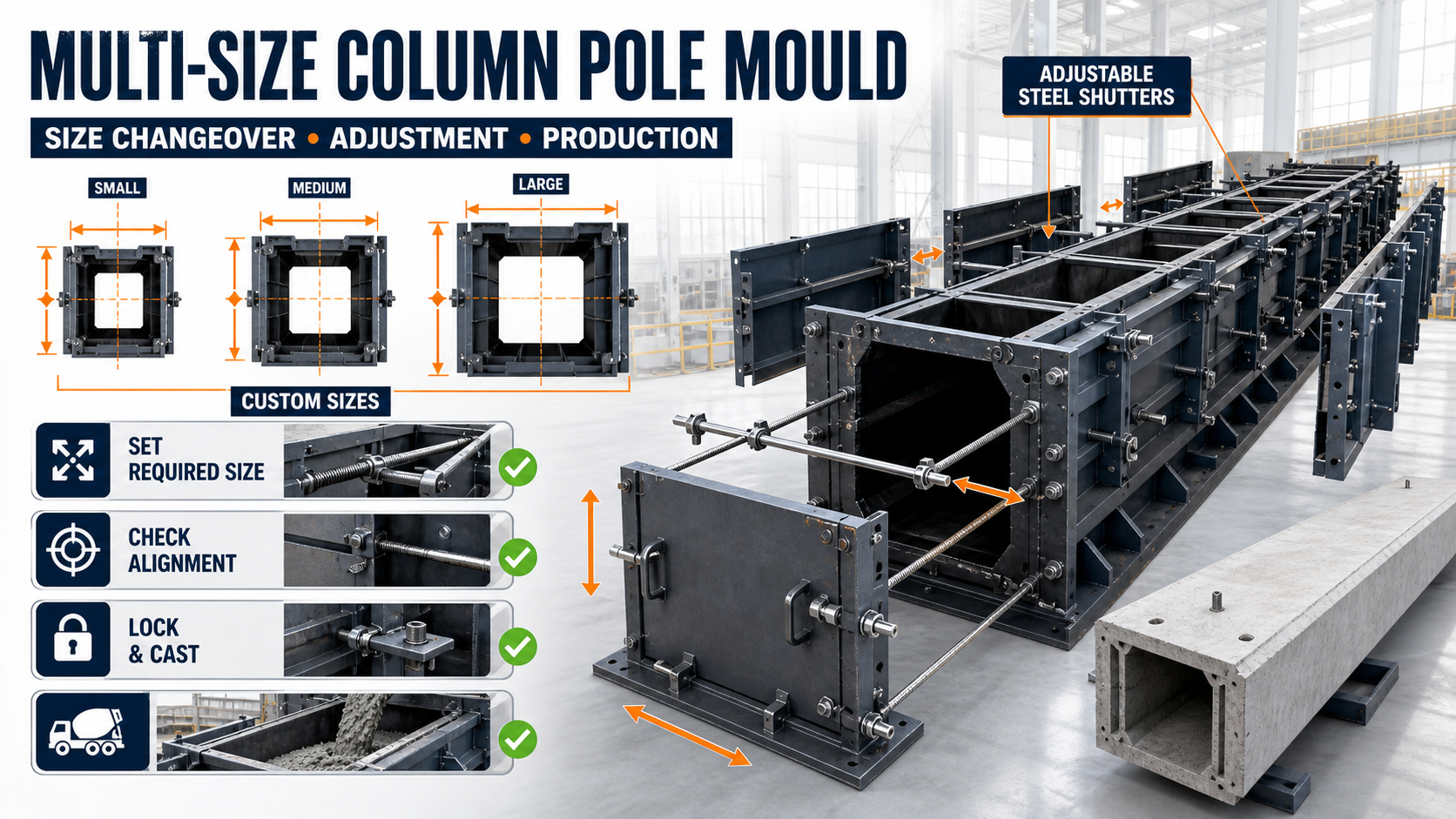
Multi-Size Column Pole Mould: Size Changeover, Adjustment and Production Guide
A multi-size column pole mould allows precast manufacturers to produce concrete columns or poles in different dimensions using one adjustable heavy-duty iron and steel mould system. This guide explains the size changeover process, adjustment methods, alignment checks, production planning and important buying considerations.
By Paras Steel Industries ·
Multi-Size Column Pole Mould: Size Changeover, Adjustment and Production Guide
Multi-Size Column Pole Mould: Size Changeover, Adjustment and Production Guide
Precast concrete plants frequently receive orders for column poles in different dimensions. Purchasing a separate mould for every product size can increase investment, consume factory space and complicate production planning.
A multi-size column pole mould provides a flexible solution. Its adjustable shutters, partitions and end plates allow manufacturers to produce different specified sizes from one properly designed mould system.
However, accurate size changeover is essential. Incorrect adjustment can affect the dimensions, straightness, squareness and surface quality of the finished precast product.
What Is a Multi-Size Column Pole Mould?
A multi-size column pole mould is an adjustable mould designed to manufacture precast concrete columns or poles in multiple specified dimensions.
The mould may contain movable side shutters, adjustable partitions, repositionable end plates and multiple locking points. These components are adjusted according to the required product drawing before concrete is poured.
Paras Steel Industries manufactures precast moulds using iron and heavy-duty steel components. The dimensions, plate thickness, reinforcement arrangement and adjustment system can be customized according to the customer’s production requirements.
Main Components of a Multi-Size Column Pole Mould
A multi-size column pole mould may include the following components:
• Heavy-duty iron or steel base frame • Adjustable side shutters • Movable end plates • Internal size-adjustment partitions • Alignment rods • Nuts, bolts, clamps or wedge locks • Reinforcing angles, channels or stiffeners • Vibration-compatible structural supports • Lifting and handling points
The final construction depends on the required product sizes, pole length, concrete pressure, operating system and production capacity.
How Does the Size Changeover Process Work?
Size changeover means adjusting the mould cavity from one specified product dimension to another.
The operator opens the locking system, repositions the adjustable shutters or partitions and sets them according to the required measurements. Every adjustment must be verified before casting begins.
A typical size changeover process includes:
1. Clean the mould completely after demoulding. 2. Remove hardened concrete from joints and adjustment slots. 3. Open the shutter locks, clamps or bolts. 4. Move the adjustable components to the required positions. 5. Measure every dimension from a fixed reference point. 6. Check the mould’s alignment and squareness. 7. Position and secure the end plates. 8. Tighten all locking points uniformly. 9. Apply a suitable mould-release agent. 10. Install the reinforcement cage correctly. 11. Recheck the mould before pouring concrete.
Operators should never depend only on visual estimation. Measuring tools must be used during every size changeover.
Important Measurements and Adjustment Checks
Internal Dimensions
Measure the internal cavity at the top, middle and bottom. The required dimensions should remain consistent throughout the casting length.
Straightness and Alignment
Use a string line, straightedge or suitable measuring instrument to check the alignment of the shutters. Poor alignment can result in bent or uneven concrete poles.
Squareness
Check the corners with an engineer’s square. Where applicable, measure both diagonals. Unequal diagonal measurements can indicate an out-of-square mould.
End-Plate Position
The end plates determine the finished product length. They must be positioned correctly and locked securely so that they do not move during concrete pouring or vibration.
Joint Closing
Inspect the joints between shutters, partitions and end plates. Open joints can cause cement slurry leakage and poor edge finishing.
Locking Pressure
Tighten all locking points uniformly. Loose locks can open during vibration, while excessive tightening at one location may distort the shutter.
Benefits of a Multi-Size Column Pole Mould
A properly designed multi-size mould can offer several benefits:
• Production of different specified sizes from one mould • Better utilization of factory floor space • Reduced need for multiple separate moulds • Greater flexibility for customized orders • Easier planning of mixed-size production • Consistent dimensional control • Reduced mould investment in suitable applications • Faster response to changing customer requirements
The actual benefits depend on the required adjustment range, mould construction and frequency of size changes.
Production Planning for Multiple Sizes
Production should be planned according to the quantity required for every column pole size. Producing several consecutive batches of the same size can reduce repeated changeover work.
Daily production capacity depends on several factors:
• Number of mould cavities • Concrete mixer capacity • Reinforcement preparation time • Number of available workers • Concrete filling time • Vibration arrangement • Demoulding time • Curing method • Frequency of size changeovers • Material-handling equipment
The mould alone does not determine production capacity. Mixing, reinforcement, casting, vibration, curing and handling must work together efficiently.
How to Prevent Size Changeover Mistakes
Prepare an approved setting chart for every product size. The chart should mention the required internal dimensions, shutter position, end-plate location and reinforcement details.
Validated adjustment points can also be marked on the mould. However, every setting must still be checked with proper measuring tools before casting.
Operators can use a checklist covering:
• Required product size • Internal cavity measurements • Diagonal measurements • Shutter alignment • End-plate position • Locking-point inspection • Joint leakage check • Reinforcement placement • Concrete-cover verification • Mould-release agent application
A standard checklist helps reduce dimensional errors, production delays and rejected products.
Reinforcement Cage Placement
The reinforcement cage must match the selected column pole size. After changing the mould dimensions, check that the cage remains centred inside the cavity.
Suitable spacers should be used to maintain the specified concrete cover. The cage must not touch the mould surface, adjustable shutters or end plates.
The reinforcement design and concrete cover should always follow the approved structural drawing for the product.
Cleaning and Maintenance
Adjustment channels, contact surfaces and locking components must remain clean. Hardened concrete can prevent the shutters from reaching the correct position.
After every production cycle:
• Remove concrete residue carefully. • Clean shutter joints and adjustment slots. • Inspect bolts, clamps, pins and locking points. • Check the shutters for bending or distortion. • Lubricate suitable moving components. • Inspect the frame and reinforcement members. • Repair damaged joints before the next casting. • Store removable parts in marked locations.
Avoid striking precision adjustment components unnecessarily with a heavy hammer. Improper handling can damage the locking or alignment system.
Manual and Hydraulic Adjustment Systems
Multi-size moulds can be designed with manual or hydraulic operating systems depending on their size, production target and operating requirements.
Manual systems may use bolts, clamps, screw arrangements or mechanical locks. They can be suitable for plants with moderate production and less frequent size changes.
Hydraulic systems may reduce manual effort and improve operating speed in suitable high-production applications. However, they require proper hydraulic maintenance, trained operators and a higher initial investment.
The best system depends on mould size, changeover frequency, manpower availability and production capacity.
Factors to Check Before Buying
Before ordering a multi-size column pole mould, provide the manufacturer with complete technical information:
• Minimum and maximum required product sizes • Length of every column pole • Cross-sectional shape • Required number of cavities • Reinforcement arrangement • Expected production capacity • Manual or hydraulic operating preference • Concrete vibration method • Available factory space • Crane or material-handling arrangement • Required dimensional tolerance • Frequency of size changes
The buyer should also discuss iron or steel plate thickness, frame reinforcement, shutter adjustment, locking arrangements and customization requirements.
Is a Multi-Size Mould Suitable for Every Plant?
A multi-size column pole mould can be suitable for plants that regularly manufacture several compatible product sizes and require production flexibility.
A dedicated fixed-size mould may be more efficient when one standard product is manufactured continuously in large quantities.
The correct selection depends on order variety, changeover frequency, production targets, required accuracy, available manpower and investment budget.
Conclusion
A multi-size column pole mould can help precast manufacturers produce different specified column or pole dimensions using one adjustable mould system.
Accurate measurement, proper alignment, uniform locking and regular maintenance are essential for achieving consistent product quality. Every size changeover should follow an approved setting chart and inspection checklist.
Paras Steel Industries manufactures iron and heavy-duty steel precast moulds according to customer drawings, required dimensions and production capacity. Buyers should share complete product specifications before requesting a technical proposal or quotation.