
Precast Infrastructure Moulds
Precast Column Pole Mould: Sizes, Production Capacity and Buying Guide
Learn about precast column pole mould sizes, production capacity, heavy-duty iron construction and key factors to check before buying a mould line.
By Paras Steel Industries ·
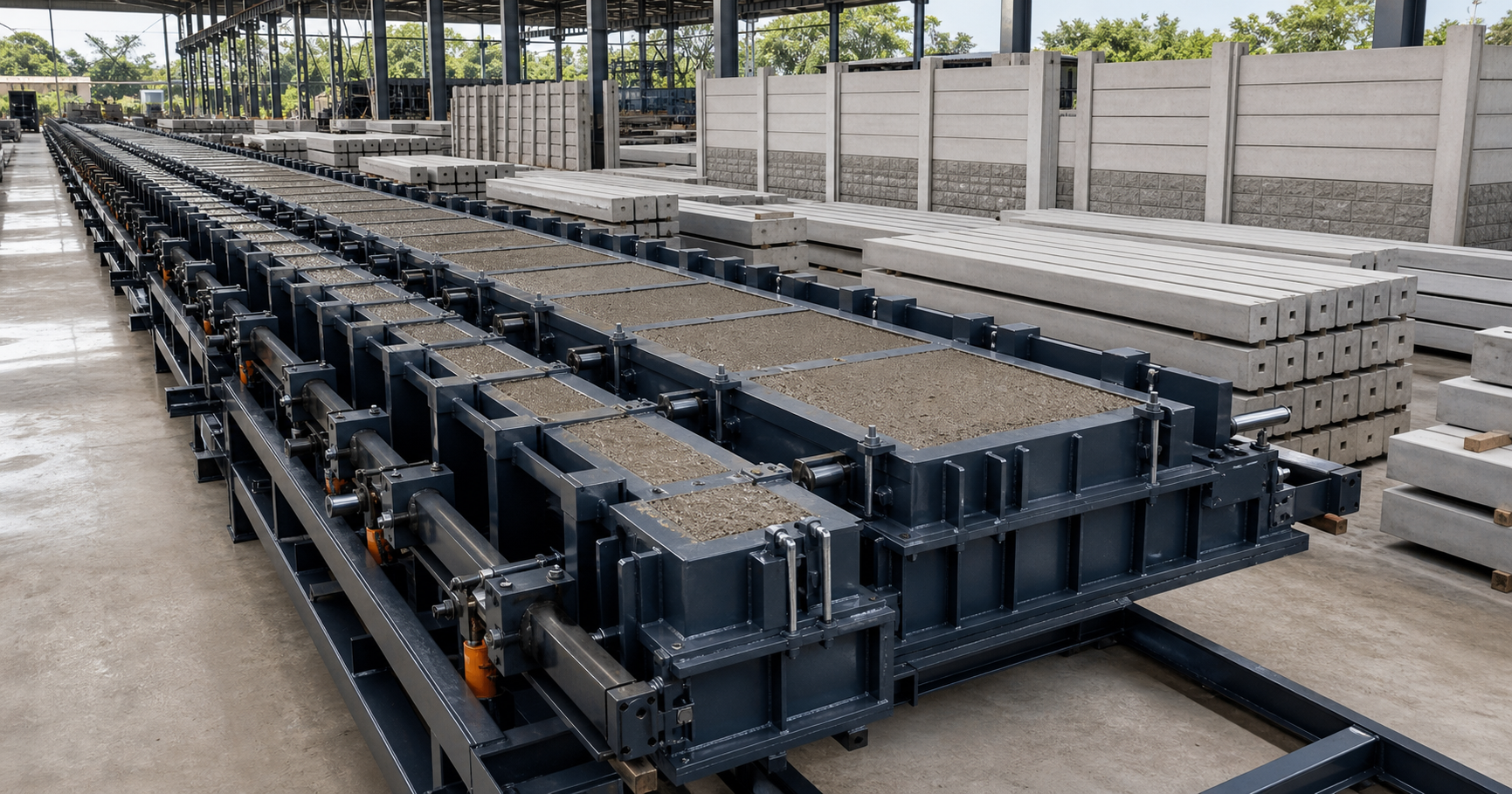
Precast Column Pole Mould: Sizes, Production Capacity and Buying Guide
Precast Column Pole Mould: Sizes, Production Capacity and Buying Guide
Precast concrete column poles are widely used in boundary walls, industrial compounds, agricultural properties and infrastructure projects.
Their dimensions, alignment and surface quality depend on the concrete mix, reinforcement, vibration, curing and accuracy of the mould used during production.
A precast column pole mould enables manufacturers to cast multiple RCC columns in uniform sizes during one production cycle.
A properly fabricated heavy-duty iron mould can help increase output, maintain consistent column dimensions and reduce finishing or rejection work.
This guide explains available column sizes, 26-pole production capacity, mould specifications, applications and important buying factors.
What Is a Precast Column Pole Mould?
A precast column pole mould is a heavy-duty iron form used to manufacture rectangular or square RCC columns and boundary wall posts.
The mould contains multiple long cavities arranged inside one production line. Reinforcement and concrete are placed inside these cavities according to the required column design.
After concrete pouring, vibration and initial curing, the shutters are opened and the finished poles are removed.
Depending on its configuration, the mould can produce columns with grooves, H-type profiles or plain external surfaces.
Difference Between Column Poles and Fencing Poles
Column poles and fencing poles may appear similar, but they are used for different requirements.
Fencing poles are usually smaller posts designed to support fencing wire, chain-link mesh or light boundary arrangements.
Column poles generally have larger cross-sections and can support precast wall panels or other project-specific components.
A column pole may also include:
Side grooves for wall panels
H-shaped profile
Custom reinforcement
Larger cross-section
Greater concrete weight
Project-specific length
The correct mould should be selected according to the intended product rather than only its external appearance.
Standard Column Pole Sizes
Paras Steel Industries offers multi-size column pole mould configurations suitable for three commonly required profiles.
150 x 150 mm Column Pole
The 150 x 150 mm profile is approximately equal to 6 x 6 inches.
It may be used for:
Standard boundary wall columns
Residential compounds
Agricultural properties
Light commercial fencing
Selected precast wall-panel systems
Its lower concrete volume can make it easier to handle than larger column sizes.
250 x 250 mm Column Pole
The 250 x 250 mm profile is approximately equal to 10 x 10 inches.
It can be suitable for:
Industrial boundary walls
Commercial compounds
Heavy precast wall panels
Institutional projects
Larger property boundaries
The reinforcement and lifting method should be planned according to the pole length and weight.
300 x 300 mm Column Pole
The 300 x 300 mm profile is approximately equal to 12 x 12 inches.
This larger column may be selected for:
Heavy industrial compounds
Infrastructure boundaries
High wall systems
Large commercial sites
Project-specific structural applications
Because of its concrete volume and weight, production requires adequate mixing, vibration and lifting equipment.
Custom Column Lengths
Column length can be customised according to:
Required wall height
Installation depth
Foundation arrangement
Panel dimensions
Groove configuration
Project drawing
Transportation restrictions
Lifting capacity
Buyers should confirm whether the required measurement represents the complete pole length or only the visible height above ground.
Plain, Grooved and H-Type Columns
Plain Column Pole
A plain column has flat external faces without panel grooves.
It may be used for fencing, structural support or custom installation arrangements.
Single-Groove Column
A single groove can hold a precast panel on one side of the column.
It may be used at the end of a wall section or around gate openings.
Double-Groove Column
A double-groove column holds panels on two opposite sides.
This profile is commonly used between consecutive boundary wall sections.
Corner Column
A corner column can include grooves positioned at approximately 90 degrees to receive panels from two directions.
H-Type Column Pole
An H-profile column contains two opposing grooves, creating an H-shaped cross-section.
The mould must reproduce these grooves accurately so the wall panels fit correctly during installation.
Production Capacity
The multi-size column pole mould line can be configured to manufacture up to 26 concrete column poles per casting cycle.
This high-output arrangement helps manufacturers produce multiple poles using one organised line instead of operating many individual moulds.
However, 26 poles per casting cycle does not automatically guarantee 26 saleable poles every day.
Actual output depends on:
Concrete-mixing capacity
Reinforcement preparation
Concrete transportation
Number of workers
Mould-filling time
Vibration arrangement
Initial setting time
Demoulding schedule
Curing method
Weather conditions
Lifting equipment
Storage space
A production plan should consider the complete factory workflow.
Benefits of a 26-Pole Mould Line
Higher Batch Output
Multiple columns can be cast during one organised production cycle.
Better Space Utilisation
A planned multi-cavity line can use production-floor space more efficiently than separate individual moulds.
Consistent Dimensions
Cavities fabricated within the same aligned system can produce more consistent pole profiles.
Simplified Concrete Planning
The production team can estimate the concrete requirement for one complete 26-pole batch.
Organised Reinforcement Placement
Reinforcement cages can be prepared and positioned according to a planned sequence.
Hydraulic Compatibility
The mould can be configured for compatibility with hydraulic clamping, opening or stripping arrangements.
Important Mould Specifications
Heavy-Duty Iron Construction
Paras Steel Industries manufactures column pole moulds using heavy-duty iron.
Strong iron plates, channels and angles help the mould withstand wet-concrete pressure and repeated vibration.
Iron Plate Thickness
Depending on the size and configuration, approximately 4 mm to 6 mm heavy-duty iron plates may be used for side and base-forming sections.
The correct thickness depends on:
Column cross-section
Pole length
Number of cavities
Concrete pressure
Vibration system
Frame design
Expected production frequency
Plate thickness should always be evaluated together with the complete support structure.
Main Base Frame
A heavy 50 x 100 mm C-channel arrangement may be used as part of the mould’s main frame.
The base frame helps:
Keep the production line straight
Support the concrete load
Control plate deflection
Distribute vibration forces
Maintain cavity alignment
Outer Support Structure
Heavy 50 x 50 x 6 mm iron angles can reinforce the side plates and cavity dividers.
Correct stiffener spacing helps prevent the mould from bulging during concrete pouring.
Alignment Rods and Locks
Heavy alignment rods and locking components keep the shutters securely closed.
They help maintain:
Correct column width
Straight cavity alignment
Tight mould joints
Uniform concrete pressure
Safe operation during vibration
Manual and Hydraulic Operation
Manual Mould Operation
A manual mould uses mechanical rods, clamps, bolts and locking systems.
It may be suitable for manufacturers with:
Controlled production output
Adequate labour
Limited hydraulic infrastructure
Straightforward mould configuration
Hydraulic-Compatible Operation
A hydraulic system can help open, close and strip mould shutters with reduced manual effort.
Potential benefits include:
Faster opening
Controlled shutter movement
Reduced labour dependency
Convenient high-volume operation
Shorter turnaround time
The required system depends on mould length, shutter weight and factory layout.
Complete Column Pole Manufacturing Process
Step 1: Confirm the Column Drawing
Before production, confirm:
Column cross-section
Complete pole length
Plain or grooved profile
Groove width and depth
Reinforcement arrangement
Concrete grade
Lifting provisions
Installation method
Step 2: Prepare the Mould
Clean the cavities, borders, corners and locking areas.
Remove hardened concrete without damaging the contact surfaces.
Step 3: Inspect Alignment
Check that the complete mould line is straight and level.
Inspect side plates, dividers, locks and support sections.
Step 4: Apply Release Agent
Apply a suitable mould-release agent evenly to all concrete-contact surfaces.
Avoid excessive application, which may affect the finished surface.
Step 5: Prepare Reinforcement
Cut, bend and assemble reinforcement according to the approved pole design.
Separate reinforcement cages may be required for different pole sizes.
Step 6: Position Reinforcement
Place the reinforcement inside each cavity using suitable concrete-cover spacers.
Confirm that the reinforcement does not touch the mould surface.
Step 7: Close and Lock the Mould
Close the shutters and tighten rods or clamps evenly.
Check the width, groove position and cavity alignment before pouring.
Step 8: Prepare the Concrete
Measure cement, sand, aggregates, water and approved admixtures accurately.
Use a suitable mixer to prepare a uniform concrete batch.
Step 9: Pour the Concrete
Fill the cavities gradually and evenly.
Avoid filling one area completely while leaving other cavities empty for an extended period.
Step 10: Compact the Concrete
Use a suitable vibration system to remove trapped air.
Pay special attention to:
Groove sections
Corners
Areas around reinforcement
Bottom surfaces
Narrow cavity locations
Step 11: Finish the Exposed Surface
Level and smooth the exposed concrete surface.
Remove excess material from cavity borders.
Step 12: Allow Initial Setting
Allow the columns to achieve sufficient strength before mould opening.
Demoulding time depends on concrete design, temperature and production conditions.
Step 13: Demould Carefully
Release the locks and open the shutters gradually.
Support long columns properly during lifting to avoid cracking or bending stress.
Step 14: Cure the Columns
Continue curing according to the approved process.
Proper curing supports strength, durability and crack resistance.
Step 15: Inspect the Finished Product
Check each column for:
Correct cross-section
Correct length
Straight alignment
Accurate groove dimensions
Smooth surface
Honeycombing
Cracks
Chipped corners
Reinforcement exposure
Step 16: Store Safely
Store columns on a level surface with supports at suitable intervals.
Do not stack long poles without adequate support.
Applications of Precast Column Poles
Industrial Boundary Walls
Large factories, warehouses and logistics hubs use precast columns to support concrete wall panels.
Commercial Properties
Shopping complexes, office campuses and open commercial plots require durable perimeter walls.
Residential Developments
Housing societies, villas and gated communities use precast boundary wall systems for faster installation.
Schools and Hospitals
Institutional compounds can use concrete columns and panels for secure boundaries.
Agricultural Properties
Large farms, estates and agricultural plots use precast posts for property demarcation.
Highway and Infrastructure Projects
Project-specific columns may support boundary panels, noise barriers and restricted-area fencing.
Utility Compounds
Electrical substations, water plants and utility sites require durable perimeter systems.
How to Select the Right Column Size
Begin with the approved wall or project drawing.
Consider:
Wall height
Panel weight
Distance between columns
Wind exposure
Installation depth
Foundation type
Groove dimensions
Required appearance
Handling equipment
Transportation method
Do not select a larger or smaller column only by comparing price. The profile should match the complete wall system.
Buying Guide: What to Check
Confirm the Required Product
Specify whether you need plain, grooved, corner or H-type columns.
Verify the Internal Dimensions
Check the actual concrete column size produced by the mould.
Review the Iron Plate Thickness
Confirm the side and base plate thickness proposed for your column size and mould length.
Inspect the Main Frame
Review the C-channels, iron angles, stiffeners and support spacing.
Check the Number of Cavities
Ensure the stated capacity matches your realistic concrete, labour and curing capacity.
Confirm the Operating System
Choose between manual and hydraulic-compatible operation according to output and available equipment.
Check the Locking Arrangement
The shutters should remain securely closed during pouring and vibration.
Confirm Groove Accuracy
Groove width and depth must match the precast panels used in the wall system.
Review Demoulding Access
The mould should open without applying damaging pressure to long concrete columns.
Plan Material Handling
Confirm that cranes, lifting clamps or other equipment can safely handle the finished products.
Share Complete Drawings
Provide the column profile, length, reinforcement and groove details before approving the mould.
Factors Affecting Column Pole Mould Price
Column Size
A 300 x 300 mm cavity requires more material than a 150 x 150 mm cavity.
Mould Length
Longer pole moulds require longer plates and additional support.
Number of Cavities
Increasing production capacity increases the mould’s total material and fabrication requirements.
Iron Plate Thickness
The selected 4 mm, 5 mm or 6 mm plate thickness affects mould weight and cost.
Frame Construction
The size and quantity of channels, angles and stiffeners influence the quotation.
Profile Complexity
H-type, grooved and corner columns require additional precision fabrication.
Manual or Hydraulic Configuration
Hydraulic compatibility can require additional operating and support arrangements.
Custom Features
Lifting points, adjustable sections and specialised locking systems affect the final price.
Transportation
A 26-pole line is a large and heavy mould system. Delivery distance and unloading requirements influence total cost.
Common Production Mistakes
Using an unlevel mould can produce bent or twisted columns.
Loose locks can allow the cavity width to change during vibration.
Insufficient release agent can make demoulding difficult.
Excessive release agent may affect surface quality.
Incorrect groove dimensions can create installation problems.
Poor reinforcement support can lead to inadequate concrete cover.
Insufficient vibration can cause honeycombing.
Early demoulding can damage corners and groove edges.
Unsupported storage can cause long columns to crack.
Maintenance Tips
Clean all cavities after every casting cycle.
Remove concrete from grooves, corners and locking points.
Inspect iron plates for bending and concrete buildup.
Check alignment rods, clamps and hinges regularly.
Apply release agent before every pour.
Inspect the complete line for straightness.
Protect exposed iron surfaces from moisture and rust.
Lubricate moving hardware without contaminating contact areas.
Support the mould on a level foundation.
Frequently Asked Questions
Which column sizes can the mould produce?
Available configurations include approximately 150 x 150 mm, 250 x 250 mm and 300 x 300 mm column profiles.
What is the production capacity?
The high-output mould line can produce up to 26 concrete column poles per casting cycle.
Which material is used to manufacture the mould?
Paras Steel Industries manufactures precast column pole moulds using heavy-duty iron.
Which iron plate thickness is used?
Depending on the configuration, approximately 4 mm to 6 mm heavy-duty iron plates may be used.
Can column length be customised?
Yes. Pole length can be manufactured according to the customer’s project drawing and production requirement.
Can the mould produce grooved columns?
Yes. Plain, H-type and custom groove arrangements can be discussed according to the required wall-panel system.
Is hydraulic operation available?
The mould can be configured for manual operation or hydraulic-system compatibility.
How can I request a quotation?
Share the column size, length, groove profile, required cavity capacity, operating preference and delivery location with Paras Steel Industries.
Conclusion
A precast column pole mould helps manufacturers produce accurately sized RCC columns for boundary walls, industrial compounds and infrastructure projects.
The correct mould should provide strong iron construction, adequate plate thickness, an aligned support frame and reliable locking arrangements.
Buyers should select mould size and capacity according to their actual production setup, handling equipment and project requirements.
Paras Steel Industries manufactures heavy-duty iron multi-size column pole mould lines for 150 x 150 mm, 250 x 250 mm and 300 x 300 mm columns, with capacity for up to 26 poles per casting cycle.
Contact Paras Steel Industries with your column drawing and production requirements to discuss a suitable mould configuration and quotation.