
Precast Production Guide
How Many Precast Moulds Do You Need? Daily Production Capacity Calculation Guide
Use a practical production-capacity formula to calculate the number of precast moulds required for wall panels, poles, drains and other concrete products.
By Paras Steel Industries ·
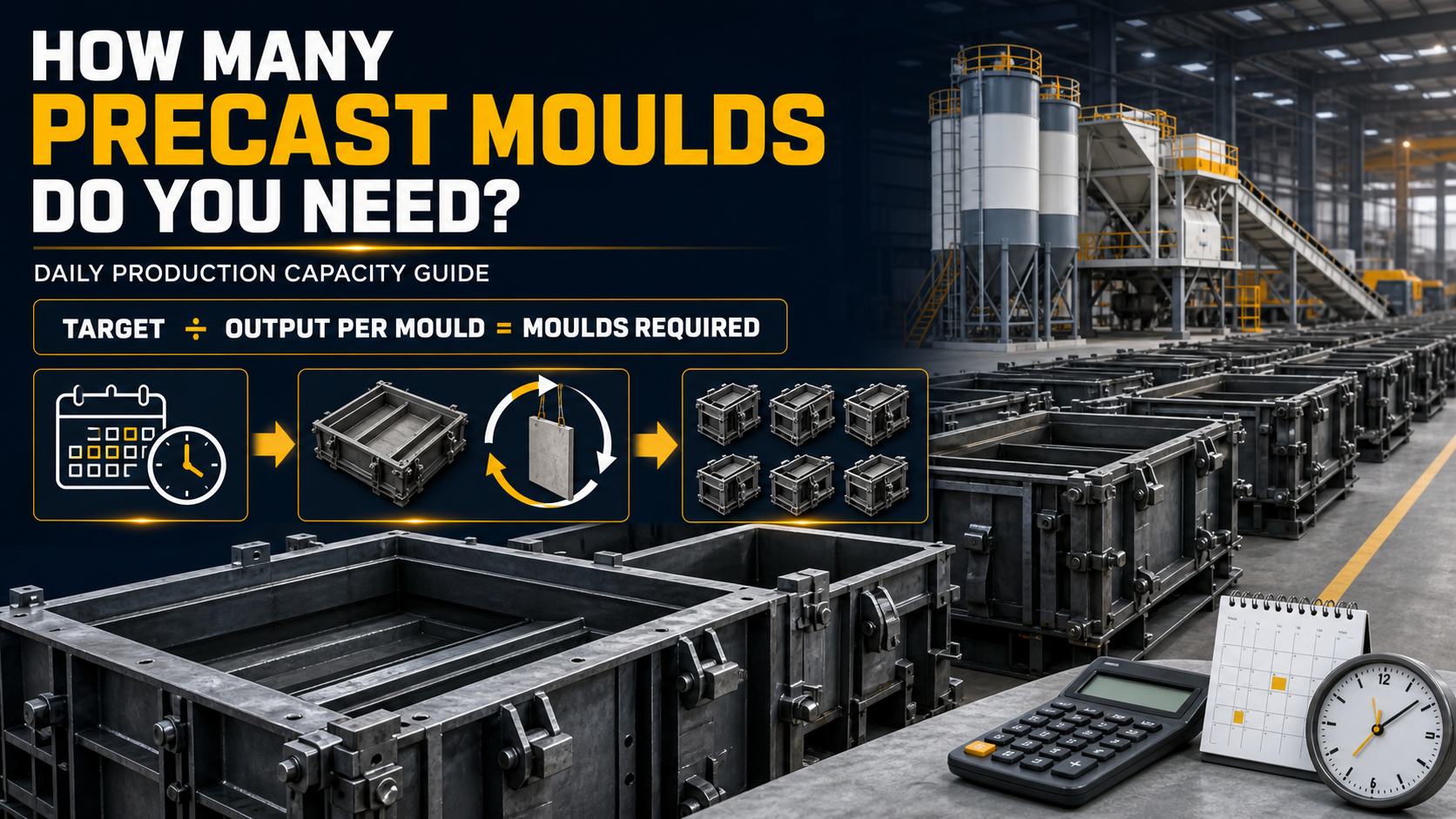
How Many Precast Moulds Do You Need? Daily Production Capacity Calculation Guide
How Many Precast Moulds Do You Need? Daily Production Capacity Calculation Guide
Purchasing too few precast moulds can delay orders and leave workers waiting for products to cure. Purchasing too many moulds can block factory space and increase investment without improving actual output.
The correct number depends on more than the required daily quantity.
A precast manufacturer must consider:
Number of cavities in each mould
Casting cycles completed per day
Concrete setting and curing time
Mould cleaning and preparation time
Expected rejection rate
Plant working shifts
Concrete batching capacity
Crane and trolley availability
Factory space
Maintenance and backup requirements
This guide provides a practical method for calculating the number of heavy-duty iron moulds required for wall panels, poles, columns, drains and other precast concrete products.
Why Mould Quantity Matters
Moulds are one of the main production assets in a precast factory. Each mould holds a product until the concrete achieves the required demoulding strength.
During this period, the mould cannot normally start another product.
The mould quantity therefore affects:
Daily production
Order-delivery time
Labour utilisation
Concrete consumption
Factory-floor space
Capital investment
Product consistency
Maintenance planning
Production flexibility
The objective is not to purchase the maximum possible number. It is to install enough mould capacity to meet production targets with a reasonable safety margin.
Basic Precast Mould Calculation Formula
A simple starting formula is:
Required working moulds = Daily production target ÷ Effective daily output per mould
Because a factory cannot normally purchase a fraction of a mould, always round the result up to the next whole number.
For example:
Daily target: 100 concrete poles
Effective output per mould: 1 pole per day
Required moulds: 100 ÷ 1 = 100 moulds
This basic calculation assumes every mould remains available and every casting is accepted. Real production requires a more detailed formula.
Detailed Production Capacity Formula
Effective output per mould can be calculated as:
Effective output per mould per day = Number of cavities × Casting cycles per day × Yield factor × Availability factor
Then calculate:
Required working moulds = Daily production target ÷ Effective output per mould per day
Finally:
Total recommended moulds = Required working moulds + Maintenance or contingency allowance
Definitions Used in the Formula
Daily Production Target
The number of accepted precast products that must be ready each production day.
Mould Cavities
The number of products a mould or mould line can cast during one cycle.
Casting Cycles per Day
The number of complete filling, curing, demoulding and preparation cycles completed in 24 hours or one production day.
Yield Factor
The percentage of cast products expected to pass quality inspection.
For example:
98% accepted production = 0.98 yield factor
95% accepted production = 0.95 yield factor
Availability Factor
The percentage of mould capacity expected to remain operational after cleaning, repairs, changeovers and delays.
For example:
95% mould availability = 0.95 availability factor
90% mould availability = 0.90 availability factor
Contingency Allowance
Additional mould capacity reserved for maintenance, urgent orders, variation and unexpected downtime.
Common planning allowances may range from approximately 5% to 15%, depending on production risk. The plant should determine its allowance using actual operating history.
Understanding Mould Cavities
A cavity is the section of a mould that produces one concrete component.
Single-Cavity Mould
One mould produces one component during each casting cycle.
Examples may include:
One column
One pole
One large footing
One box culvert
One large wall panel
Multi-Cavity Mould
One mould assembly produces multiple components during one casting cycle.
Examples may include:
Multiple wall panels
Several fencing poles
Multiple kerb stones
Several concrete covers
A 32-panel mould line can theoretically produce 32 wall panels during one casting cycle.
However, actual accepted output may be lower because of:
Rejected products
Cavity maintenance
Incomplete filling
Concrete defects
Operational downtime
Casting Cycles per Day
A casting cycle includes the complete sequence from mould preparation to readiness for the next pour.
Typical stages include:
Mould cleaning
Release-agent application
Panel assembly
Reinforcement placement
Insert installation
Concrete filling
Vibration
Surface finishing
Initial curing
Demoulding
Product removal
Final mould inspection
The cycle ends only when the mould is ready to receive the next batch.
Why Curing Time Controls Mould Quantity
Concrete must remain inside the mould until it achieves the specified demoulding strength.
A plant using normal curing may complete fewer mould cycles than a plant using an approved controlled or accelerated curing process.
Production managers should not assume two casting cycles per day without evidence.
Faster demoulding must be supported by:
Approved concrete mix
Verified early strength
Controlled curing
Representative strength testing
Safe lifting procedure
Suitable production temperature
An accelerated schedule that damages products will not improve effective output.
Calculating Cycles per Day
A simplified formula is:
Cycles per day = Available production hours ÷ Total mould cycle time
For example:
Available production time: 24 hours
Total cycle time: 20 hours
Theoretical cycles: 24 ÷ 20 = 1.2 cycles per day
A result of 1.2 does not mean every mould completes exactly 1.2 cycles each calendar day. It means that, over several days, average output may approach this figure if production runs continuously.
When planning conservatively, use verified factory data rather than theoretical maximum output.
Example 1: Single-Cavity Fencing Pole Moulds
Assume a factory requires:
Daily accepted output: 100 poles
Cavities per mould: 1
Verified casting cycles: 1 per day
Expected yield: 97%
Mould availability: 95%
Step 1: Calculate Effective Output per Mould
1 × 1 × 0.97 × 0.95 = 0.9215 pole per mould per day
Step 2: Calculate Working Mould Requirement
100 ÷ 0.9215 = 108.52
Round up:
109 working moulds
Step 3: Add Contingency Capacity
If the plant adds approximately 5% contingency:
109 × 1.05 = 114.45
Round up:
115 total moulds
Under these assumptions, the factory should plan approximately 115 moulds.
The actual number may change if the curing cycle, yield or daily target changes.
Example 2: Multi-Cavity Wall Panel Mould Line
Assume a manufacturer requires:
Daily accepted output: 300 wall panels
Cavities per mould line: 32
Casting cycles: 1 per day
Expected yield: 95%
Availability factor: 90%
Step 1: Calculate Effective Output per Line
32 × 1 × 0.95 × 0.90 = 27.36 accepted panels per line per day
Step 2: Calculate Working Lines
300 ÷ 27.36 = 10.96
Round up:
11 working mould lines
Step 3: Add Backup Capacity
If one additional line is maintained as backup:
12 total mould lines
Before investing in 12 production lines, the plant must also confirm that it can supply reinforcement, concrete, labour, curing space and lifting capacity for approximately 300 panels per day.
Example 3: Two-Cavity U-Drain Mould
Assume:
Daily accepted output: 40 U-drains
Cavities per mould: 2
Verified cycles: 1 per day
Yield factor: 96%
Availability factor: 92%
Effective output per mould:
2 × 1 × 0.96 × 0.92 = 1.7664 drains per day
Required working moulds:
40 ÷ 1.7664 = 22.64
Round up:
23 working moulds
With approximately 10% contingency:
23 × 1.10 = 25.3
Round up:
26 total moulds
Example 4: Large Footing Mould
Assume:
Daily accepted output: 12 footings
Cavities per mould: 1
Cycles per day: 0.8
Yield factor: 98%
Availability factor: 95%
Effective output:
1 × 0.8 × 0.98 × 0.95 = 0.7448 footing per day
Required working moulds:
12 ÷ 0.7448 = 16.11
Round up:
17 working moulds
With one standby mould:
18 total moulds
The 0.8-cycle figure accounts for a production cycle taking longer than one normal working day.
Example 5: Mixed-Length Column Production
A customer may require:
40 seven-foot columns
30 eight-foot columns
20 nine-foot columns
10 ten-foot columns
Total daily output: 100 columns
One common mistake is to calculate only 100 moulds without considering the size mix.
Separate the requirement:
Seven-foot mould requirement
Eight-foot mould requirement
Nine-foot mould requirement
Ten-foot mould requirement
Unless the mould has an approved adjustable-length arrangement, each column length may require dedicated mould capacity.
Calculate each product size separately using its demand, cycles, yield and availability.
Production Target: Cast Products vs Accepted Products
The customer order is normally based on accepted products, not total products cast.
If a factory needs to dispatch 500 panels and expects a 3% rejection rate, it must cast more than 500.
Required cast quantity can be estimated as:
Required cast quantity = Accepted target ÷ Expected yield factor
For example:
Accepted target: 500 panels
Yield factor: 0.97
500 ÷ 0.97 = 515.46
Round up:
At least 516 panels must be cast under these assumptions.
This calculation should be incorporated into mould planning.
Daily, Weekly and Monthly Targets
Factories often receive a project quantity and completion date instead of a daily target.
Daily Target Formula
Daily accepted output = Total order quantity ÷ Available production days
For example:
Order quantity: 12,000 panels
Available production days: 60 days
Daily target:
12,000 ÷ 60 = 200 panels per day
If the factory operates six days per week, do not calculate using all seven calendar days unless Sunday production is genuinely planned.
Allow for:
Public holidays
Preventive maintenance
Material delays
Rain or temperature effects
Power interruptions
Factory shutdowns
Product changeovers
Trial production
Dispatch interruptions
Available Production Days
A project may run for 90 calendar days but provide fewer actual production days.
For example:
Calendar duration: 90 days
Weekly holidays: 13 days
Planned maintenance: 3 days
Trial and setup: 2 days
Available production days:
90 - 13 - 3 - 2 = 72 days
Use 72 days—not 90 days—when calculating the required daily capacity.
Importance of Mould Availability
Mould availability measures how much installed mould capacity is actually ready for casting.
A mould may become unavailable because of:
Cleaning delays
Concrete buildup
Bent shutters
Worn clamps
Broken hinges
Slurry leakage
Welding repairs
Dimension correction
Product-size changeover
Release-agent problems
Availability can be calculated using:
Mould availability = Available mould operating time ÷ Planned operating time
A factory should use recorded data wherever possible.
New plants without historical records should use a conservative planning assumption and review it after trial production.
Rejection and Rework Rate
Common reasons for rejected precast products include:
Honeycombing
Cracking
Incorrect dimensions
Broken corners
Exposed reinforcement
Insufficient concrete cover
Misaligned grooves
Incorrect insert positions
Poor surface finish
Early demoulding
Handling damage
Calculate yield using:
Yield factor = Accepted products ÷ Total products cast
Example:
Products cast: 1,000
Accepted products: 960
Yield factor:
960 ÷ 1,000 = 0.96 or 96%
Reducing rejection can sometimes increase effective production more economically than purchasing additional moulds.
Plant Bottlenecks Beyond Mould Quantity
Installing more moulds does not guarantee more output.
The production system must support the additional capacity.
Concrete Mixer Capacity
Calculate whether the mixer can supply the total concrete required within the available pouring time.
Consider:
Concrete volume per product
Products per cycle
Mixer batch size
Mixing time
Loading and discharge time
Number of mixers
Concrete transportation
Reinforcement Capacity
The reinforcement team must prepare enough cages before mould filling begins.
A shortage of cages can leave expensive moulds empty.
Vibration Capacity
The factory may require:
Vibrator tables
Shutter vibrators
Poker vibrators
Sufficient electrical connections
Operating staff
If only one vibrator table is available, adding many moulds may create a waiting queue.
Crane and Handling Capacity
Large products require cranes, lifting beams, anchors, trolleys and trained operators.
The crane must complete:
Demoulding
Product shifting
Mould positioning
Stacking
Vehicle loading
One overloaded crane can become the main production bottleneck.
Curing Space
Products removed from moulds require sufficient curing and storage areas.
Increasing mould count without increasing curing space can create unsafe stacking and blocked factory routes.
Labour Availability
Calculate workers required for:
Cleaning
Release-agent application
Reinforcement
Mould assembly
Concrete placement
Vibration
Finishing
Demoulding
Product shifting
Quality inspection
Maintenance
Factory Floor Area
Each mould requires more than its physical footprint.
Allow space for:
Worker access
Shutter opening
Concrete trolley movement
Crane operation
Reinforcement placement
Vibration equipment
Product removal
Cleaning
Maintenance
Emergency routes
Installing moulds too close together reduces safety and productivity.
How to Calculate Concrete Requirement
Daily concrete volume can be estimated using:
Daily concrete volume = Concrete volume per product × Daily casting quantity
Add a controlled allowance for process wastage according to factory records.
For example:
Concrete per wall panel: 0.08 cubic metre
Daily casting quantity: 200 panels
Daily concrete requirement:
0.08 × 200 = 16 cubic metres
If the plant cannot batch and place approximately 16 cubic metres within the production schedule, purchasing mould capacity for 200 panels will not achieve the target.
Mould Utilisation Rate
Mould utilisation measures how effectively installed mould capacity is being used.
Utilisation rate can be calculated as:
Mould utilisation = Actual casting cycles ÷ Available casting cycles
For example:
Available mould cycles: 500 per month
Actual completed cycles: 400
Utilisation:
400 ÷ 500 = 80%
Low utilisation may indicate:
Insufficient orders
Concrete delays
Labour shortage
Reinforcement delays
Crane bottlenecks
Long cleaning times
Maintenance problems
Poor production planning
The plant should investigate low utilisation before purchasing more moulds.
Spare and Backup Mould Capacity
A contingency allowance helps protect production against unexpected downtime.
Backup capacity may be necessary when:
Delivery penalties are high.
The project schedule is tight.
Moulds operate continuously.
Replacement fabrication takes time.
Product sizes cannot be substituted.
The mould contains complex moving sections.
The plant is far from repair facilities.
A factory may maintain complete spare moulds or spare high-wear components such as:
Side shutters
End plates
Bolts
Clamps
Hinges
Alignment pins
Tie rods
Replaceable liners
Hydraulic seals, where applicable
Complete spare moulds are not always required if critical parts can be replaced quickly.
One Large Multi-Cavity Mould vs Multiple Small Moulds
One Large Multi-Cavity Mould
Advantages:
High output per casting cycle
Uniform product dimensions
Efficient floor-space use
Centralised concrete filling
Possible hydraulic compatibility
Limitations:
Large initial investment
Major production loss during maintenance
Higher crane requirement
Less flexibility between product sizes
Multiple Small Moulds
Advantages:
Flexible production planning
Individual moulds can be repaired without stopping the complete line
Different sizes can operate together
Lower investment per mould
Simpler expansion
Limitations:
More cleaning points
More individual locks and panels
Greater floor-space requirement
Higher manual labour
The correct configuration depends on order volume and product variety.
Fixed vs Adjustable Mould Capacity
An adjustable mould may manufacture selected product lengths or thicknesses through movable end plates or shutters.
Advantages may include:
Reduced number of dedicated moulds
Improved product flexibility
Better response to mixed orders
Limitations may include:
Longer setup time
Greater alignment requirements
Potential leakage at adjustment joints
Lower efficiency for continuous identical production
Do not assume one adjustable mould can produce all product sizes simultaneously. Capacity must be calculated according to the actual configuration used during each cycle.
Role of Mould Construction Quality
Heavy-duty iron mould construction supports stable production by reducing:
Panel deformation
Slurry leakage
Dimensional variation
Unplanned repairs
Locking problems
Surface inconsistency
Important mould-design factors include:
Iron plate thickness
Channel and angle stiffeners
Flange design
Locking system
Welding quality
Alignment pins
Opening mechanism
Surface protection
A cheap mould that frequently requires repairs may provide lower effective capacity than a well-engineered mould.
Production Planning for Multiple Products
A factory producing several product types should prepare a separate calculation for each one.
Example product mix:
Wall panels
Fencing poles
H-columns
Footings
Window frames
Garden benches
U-drains
Each product has different:
Mould capacity
Concrete volume
Cycle time
Reinforcement time
Demoulding requirement
Handling method
Storage requirement
After calculating each product, combine the results to check total demand on mixers, workers, cranes and factory space.
Seasonal Production Factors
Concrete strength development and production efficiency can vary with temperature and weather.
Possible seasonal effects include:
Slower strength development in cold conditions
Rapid workability loss in hot conditions
Rain affecting aggregate moisture
Outdoor mould-cleaning delays
Curing-water availability
Worker productivity
Include a seasonal margin when production must continue throughout the year.
Trial Production Before Bulk Investment
Before ordering a large number of identical moulds, consider running trial production using one or a small number of units.
The trial can verify:
Actual cycle time
Concrete consumption
Product finish
Demoulding process
Labour requirement
Vibration method
Mould leakage
Rejection rate
Handling time
Curing space
Use trial data to update the capacity calculation before full-scale expansion.
Precast Mould Requirement Checklist
Before finalising mould quantity, confirm:
Total order quantity
Project delivery date
Available production days
Daily accepted output
Number of mould cavities
Verified cycles per day
Concrete volume per product
Expected rejection rate
Mould availability
Maintenance allowance
Mixer output
Reinforcement capacity
Vibration equipment
Crane capacity
Curing space
Storage space
Available workers
Factory-floor area
Product-size variations
Required backup capacity
Questions to Ask the Mould Manufacturer
How many cavities does the mould include?
What is the expected operating cycle?
Is the mould manually or hydraulically operated?
What handling equipment is required?
Can the dimensions be adjusted?
What is the approximate mould weight?
How much floor space is required?
Which vibration method is compatible?
Which parts require regular maintenance?
Can high-wear components be replaced?
Can production be expanded using additional identical moulds?
What technical information is required for a quotation?
How to Request an Accurate Quotation
Share the following details with Paras Steel Industries:
Product drawing
Required dimensions
Total project quantity
Daily production target
Available production days
Required number of cavities
Concrete curing process
Factory working shifts
Available crane capacity
Vibration method
Factory layout
Required manual or hydraulic operation
The manufacturer can then discuss an appropriate mould configuration and quantity.
Final Calculation Method
Use the following sequence:
Step 1:
Calculate the required accepted products per day.
Step 2:
Identify the number of cavities in each mould.
Step 3:
Confirm the realistic casting cycles per day.
Step 4:
Apply the expected yield factor.
Step 5:
Apply the expected mould-availability factor.
Step 6:
Divide the daily target by effective output per mould.
Step 7:
Round the result up.
Step 8:
Add a suitable maintenance and contingency allowance.
Step 9:
Verify that the mixer, labour, vibration, crane, curing and storage systems can support the calculated output.
Final Formula
Effective output per mould per day:
Cavities × Cycles per day × Yield factor × Availability factor
Required working moulds:
Daily accepted production target ÷ Effective output per mould per day
Recommended total moulds:
Required working moulds + Contingency allowance
Conclusion
The correct number of precast moulds cannot be calculated from the daily target alone.
A reliable calculation includes:
Mould cavities
Casting cycles
Concrete curing time
Accepted-product yield
Mould availability
Maintenance allowance
Factory support capacity
More moulds improve production only when the complete plant can mix, reinforce, vibrate, demould, cure and shift the additional products.
Paras Steel Industries manufactures customised heavy-duty iron precast moulds according to product drawings and production targets. Customers can share their required daily output and factory details to discuss a suitable mould quantity and configuration.
Frequently Asked Questions
How do I calculate the required number of precast moulds?
Divide the daily accepted-production target by the effective daily output of one mould, then round up and add a maintenance allowance.
What is effective output per mould?
It is the number of cavities multiplied by cycles per day, yield factor and mould-availability factor.
Should I calculate using total cast or accepted products?
Use the required accepted-product quantity and include expected rejection in the yield factor.
How many cycles can one mould complete per day?
It depends on concrete strength development, curing, cleaning, preparation, demoulding and factory working hours.
Should I keep spare moulds?
A spare or contingency allowance may be useful for tight schedules, continuous production and moulds with long repair lead times.
Can a multi-cavity mould reduce the total number required?
Yes. One multi-cavity mould produces several components per cycle, but factory capacity and maintenance risk must also be evaluated.
Will more moulds automatically increase output?
No. The mixer, reinforcement, vibration, crane, curing area and labour must support the additional mould capacity.
How should adjustable moulds be calculated?
Calculate output according to the product size being produced during each cycle, not the mould’s total range of possible sizes.
Can Paras Steel manufacture moulds according to daily production requirements?
Yes. Customers can share product drawings, target output, dimensions and factory details for a customised heavy-duty iron mould configuration.