
Precast Machinery Guide
Panel Shifting Trolley Turntable Steering Maintenance: Kingpin, Bearing and Wheel Alignment Guide
A worn kingpin, loose turntable bearing or incorrect wheel alignment can make a panel shifting trolley difficult to steer and increase tyre or structural wear. This guide explains safe inspection, lubrication, steering adjustment and maintenance.
By Paras Steel Industries ·
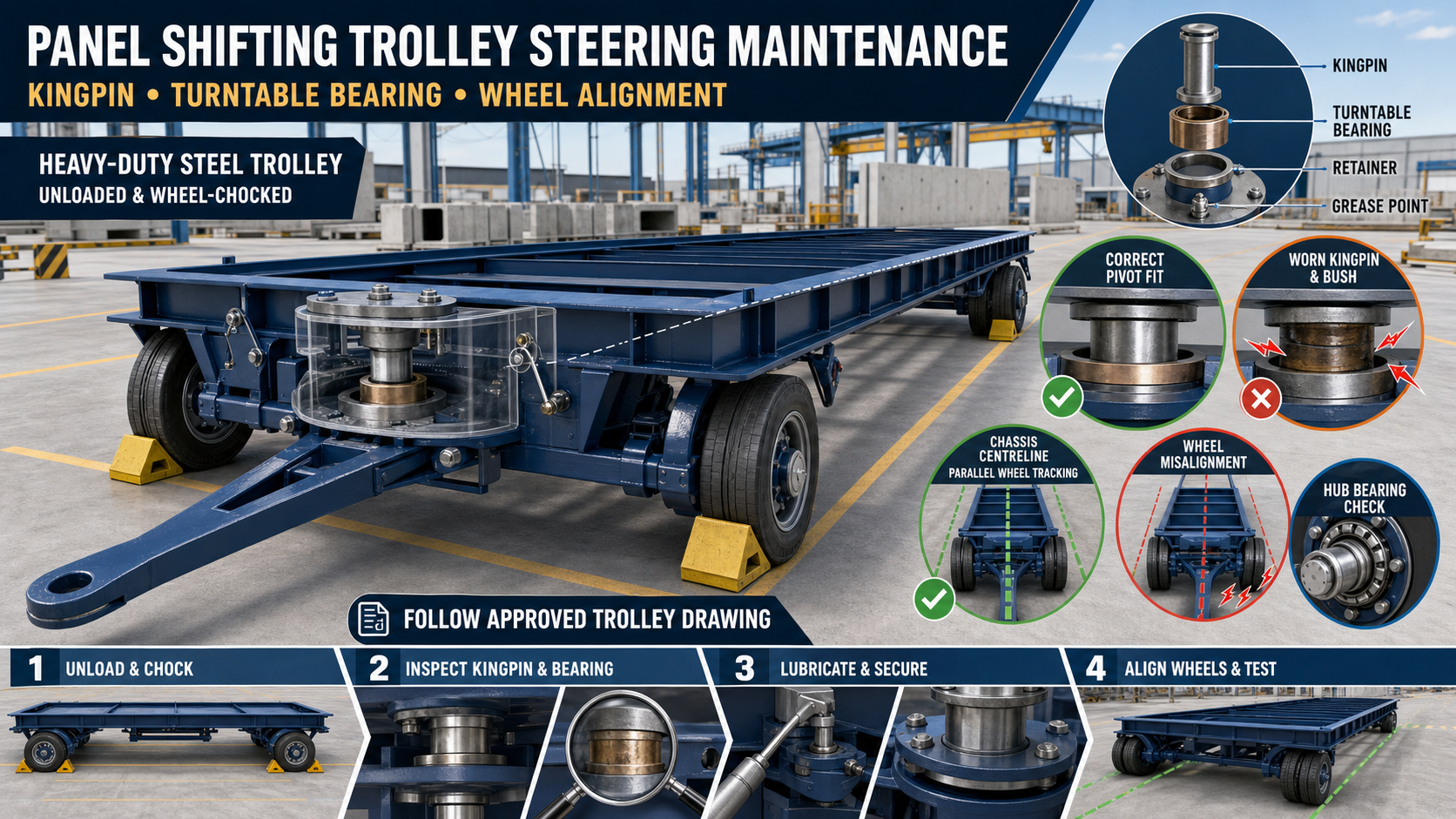
Panel Shifting Trolley Turntable Steering Maintenance: Kingpin, Bearing and Wheel Alignment Guide
Panel Shifting Trolley Turntable Steering Maintenance Guide
A panel shifting trolley is used in precast plants to move wall panels, mould components and other heavy materials between production, curing and storage areas.
Many heavy-duty trolleys use turntable steering at the front. This arrangement allows the complete front axle assembly to rotate around a central kingpin or pivot, helping the trolley follow the towing vehicle.
Regular maintenance is essential because kingpin wear, damaged bearings, loose steering connections or misaligned wheels can make the trolley unstable and difficult to control.
This guide explains panel shifting trolley steering maintenance, including kingpin inspection, turntable-bearing maintenance, lubrication and wheel-alignment checks.
What Is Turntable Steering?
Turntable steering is a mechanical arrangement in which the front axle rotates beneath the trolley chassis.
A typical system may include:
• Heavy structural-steel chassis • Rotating turntable plates • Central kingpin or pivot pin • Turntable bearing or wear ring • Front axle • Drawbar • Tie rods or steering links • Wheel hubs • Bearings • Wheels and tyres • Mechanical steering stops • Retaining plates • Grease points
The exact steering arrangement depends on the trolley design and approved load requirement.
Function of the Kingpin
The kingpin forms the main pivot between the turntable and trolley chassis. It helps maintain the centre of rotation while allowing the front axle to change direction.
A correctly maintained kingpin helps:
• Keep the steering axis stable • Reduce unwanted axle movement • Maintain drawbar alignment • Support controlled turning • Reduce turntable wear • Maintain wheel tracking • Protect mounting brackets • Improve steering response
A worn kingpin can allow excessive movement between the front axle and chassis.
Why Steering Maintenance Is Important
A poorly maintained trolley may:
• Pull toward one side • Wander during towing • Require excessive turning force • Produce knocking sounds • Wear tyres unevenly • Damage wheel bearings • Place side loads on the drawbar • Stress the chassis • Become unstable during turns • Increase handling risk around stored panels
Steering problems should be corrected before transporting precast components.
Safety Before Maintenance
A panel trolley can move unexpectedly if it is not secured correctly.
Before inspection:
1. Remove all precast panels and materials. 2. Park the trolley on firm, level ground. 3. Disconnect it from the towing vehicle. 4. Apply the parking or securing procedure. 5. Chock the wheels in both directions. 6. Lower stabilising supports where provided. 7. Isolate powered systems if fitted. 8. Use rated lifting and supporting equipment. 9. Keep personnel away from unsupported components. 10. Wear suitable personal protective equipment.
Never work underneath a trolley supported only by a hydraulic jack.
Clean the Steering Assembly
Concrete slurry, cement dust and aggregate particles can hide wear and block grease passages.
Clean:
• Turntable plates • Kingpin area • Grease points • Drawbar connection • Steering links • Mechanical stops • Wheel hubs • Bearing covers • Axle brackets • Chassis mounting points
Remove contamination before taking measurements or applying fresh grease.
Initial Visual Inspection
Before dismantling the steering system, inspect:
• Chassis level • Turntable position • Kingpin retainers • Drawbar alignment • Steering-link condition • Wheel position • Tyre wear • Hub movement • Missing bolts • Cracked welds • Bent brackets • Grease leakage • Rust • Previous repairs
Record any abnormal movement or damaged area.
Common Signs of Turntable Steering Problems
Operators may notice:
• Knocking while starting or stopping • Front axle shifting sideways • Steering becomes heavy • Turntable does not return smoothly • Trolley pulls toward one side • Drawbar sits off-centre • Wheels appear non-parallel • Uneven tyre wear • Wheel hubs become hot • Steering links become loose • Grease contains metal particles • Chassis moves excessively during turning
Stop using the trolley if steering becomes unpredictable.
Inspect the Kingpin
After safely supporting the trolley, inspect the kingpin according to the approved maintenance procedure.
Check for:
• Diameter wear • Flat spots • Grooves • Scoring • Bending • Cracks • Corrosion • Damaged threads • Worn retaining grooves • Hammer damage • Uneven polishing • Insufficient lubrication
A damaged kingpin should not be reused without qualified assessment.
Check Kingpin Straightness
A bent kingpin can cause the turntable to bind and wear unevenly.
Use an approved flat reference or measurement setup to inspect straightness. Do not attempt to straighten the pin using uncontrolled heating or hammering.
Kingpin Bush or Bearing Inspection
Depending on the design, the kingpin may operate inside a bush, bearing or machined pivot housing.
Inspect for:
• Oval wear • Cracks • Excessive clearance • Rotation inside the wrong component • Loose fit in the housing • Scoring • Corrosion • Damaged edges • Blocked grease passages • Metal particles
Replacing only the kingpin may not correct steering movement if the bush or housing is also worn.
Checking Kingpin Movement
With the unloaded trolley safely supported, check for unwanted movement at the turntable pivot.
Observe:
• Vertical movement • Sideways movement • Front-to-rear movement • Movement during steering reversal • Movement at the retaining plate • Movement between the kingpin and bush
Use a suitable measuring method and compare the result with the approved maintenance limit.
Inspect Kingpin Retainers
The kingpin retaining system prevents the pin from moving out of position.
Check:
• Retaining nut • Lock plate • Split pin • Circlip • Keeper plate • Retaining bolts • Welded stop • Washer and spacer condition
Missing or damaged retaining parts must be replaced before operation.
What Is the Turntable Bearing?
The turntable bearing or wear plate allows the front axle assembly to rotate beneath the trolley chassis while supporting vertical and steering loads.
The system may use:
• A dedicated turntable bearing • Steel wear plates • A circular thrust bearing • Rollers • Bush-supported pivot plates • A lubricated sliding surface
The correct maintenance procedure depends on the original trolley design.
Inspect the Turntable Bearing or Wear Ring
Check for:
• Uneven wear • Cracks • Scoring • Flat spots • Loose mounting bolts • Distortion • Missing rollers • Damaged seals • Rust • Grease contamination • Excessive movement • Contact with surrounding parts
The front axle should rotate smoothly without severe binding or loose movement.
Turntable Plate Inspection
Inspect the upper and lower turntable plates for:
• Flatness • Cracked welds • Local bending • Elongated holes • Loose fasteners • Uneven contact pattern • Corrosion • Dirt between plates • Excessive edge wear
A distorted plate can make the turntable bind even when the bearing is in good condition.
Lubricating the Kingpin and Turntable
Correct lubrication helps reduce friction and wear.
Good lubrication practices include:
• Clean grease fittings first • Use the specified lubricant • Confirm grease passages are open • Apply a controlled amount • Rotate the steering slowly after lubrication • Check that lubricant reaches the intended surfaces • Wipe away excess grease • Keep dust and slurry away • Record the maintenance activity
Do not mix incompatible lubricants.
Problems Caused by Insufficient Lubrication
Insufficient lubrication may cause:
• Heavy steering • Grinding or squeaking • Kingpin scoring • Bush wear • Turntable overheating • Corrosion • Jerky axle rotation • Accelerated bearing failure
Frequent dry operation can damage several steering components.
Problems Caused by Excessive Lubrication
Excess grease can:
• Attract cement dust • Create an abrasive paste • Hide cracks • Contaminate the floor • Damage some sealing arrangements • Make inspection difficult
Apply only the amount required by the approved maintenance procedure.
Inspect the Drawbar
The drawbar transfers towing and steering force from the tractor or towing vehicle to the turntable.
Inspect:
• Straightness • Towing eye • Pin hole • Welded joints • Reinforcement plates • Pivot connection • Safety-chain points • Locking pin • Retainers • Corrosion • Impact damage
A bent drawbar can make the trolley pull toward one side.
Inspect the Towing Eye and Pin
Check the towing connection for:
• Oval hole wear • Pin wear • Cracks • Missing retainers • Excessive clearance • Incorrect pin size • Poor lubrication • Bent components
Only approved towing pins and retaining arrangements should be used.
Steering-Link and Tie-Rod Inspection
Where the trolley uses steering links or tie rods, inspect:
• Rod straightness • Thread condition • Locknuts • Ball joints • Clevis pins • Bushes • Welded brackets • Retaining components • Left and right adjustment • Contact with the chassis
Loose steering links can allow the wheels to point in different directions.
Check Mechanical Steering Stops
Steering stops limit the turntable angle and prevent wheels, drawbar or links from striking the chassis.
Inspect:
• Stop position • Weld condition • Contact surfaces • Deformation • Missing stop bolts • Equal contact on both sides • Drawbar clearance • Tyre-to-chassis clearance
Do not remove or modify the steering stops without approval.
Wheel Alignment
Correct wheel alignment helps the trolley track straight and reduces tyre wear.
Check:
• Wheel parallelism • Front axle squareness • Left and right wheel position • Hub alignment • Axle straightness • Tyre condition • Steering-link length • Turntable centre position
The required alignment should follow the trolley drawing.
Establish a Fixed Datum
Use the chassis centreline or another approved fixed reference when checking wheel positions.
Measure:
• Kingpin centre relative to the chassis • Axle position • Left wheel position • Right wheel position • Drawbar centreline • Front-to-rear wheel tracking
Do not align one wheel only from the position of the other without confirming the chassis datum.
Toe Alignment Check
Some steering systems require the wheels to remain parallel or use a specified toe setting.
The correct requirement depends on the trolley design. Use an approved measuring gauge and follow the manufacturer’s specification rather than applying a general vehicle value.
Signs of Incorrect Wheel Alignment
Incorrect alignment may cause:
• Trolley pulling to one side • Tyres scrubbing during travel • Uneven tread wear • Steering links under stress • Heavy turning • Wheel-hub heating • Drawbar side loading • Instability during reversing
Correct alignment only after checking kingpin, bearing and axle condition.
Inspect the Axle
A bent axle can create permanent wheel misalignment.
Check:
• Axle straightness • Welded brackets • Spring or suspension mounts where fitted • Hub spindle condition • Chassis connection • Corrosion • Impact damage • Previous repairs
Do not compensate for a bent axle only by changing steering-link adjustment.
Wheel-Hub Bearing Inspection
Wheel bearings support the trolley and allow the wheels to rotate.
Check for:
• Excessive movement • Rough rotation • Noise • Heat • Damaged seals • Grease leakage • Water or dust contamination • Corrosion • Loose retaining nuts • Damaged spindle
Bearing inspection and adjustment should follow the approved hub procedure.
Tyre and Wheel Inspection
Inspect:
• Tyre tread • Sidewall condition • Cuts • Uneven wear • Correct inflation where pneumatic tyres are used • Wheel-rim damage • Loose wheel nuts • Missing fasteners • Corrosion • Contact with trolley components
Different tyre sizes or uneven tyre condition can affect trolley tracking.
Wheel-Fastener Check
Wheel nuts and bolts should be tightened using the approved sequence and specified torque.
Do not use assumed torque values. Inspect threads, contact surfaces and locking arrangements before tightening.
Chassis Inspection
Steering alignment depends on a straight and rigid chassis.
Inspect:
• Main longitudinal members • Cross members • Turntable mounting area • Drawbar support • Welded joints • Cracks • Twisting • Corrosion • Impact damage • Previous repairs
A distorted chassis can cause recurring steering misalignment.
Controlled Steering Test
After completing maintenance:
1. Confirm that all tools are removed. 2. Install all guards and retainers. 3. Lower the trolley onto level ground. 4. Keep the trolley unloaded. 5. Connect the approved towing vehicle. 6. Clear the test area. 7. Move forward slowly. 8. Perform gradual left and right turns. 9. Check tracking and noise. 10. Reverse slowly where permitted. 11. Stop and reinspect the components. 12. Record the test results.
Do not begin with a loaded high-speed test.
Common Steering Problems and Causes
Trolley Pulls Toward One Side
Check wheel alignment, tyre condition, axle straightness, drawbar alignment and kingpin wear.
Knocking During Direction Changes
Possible causes include kingpin clearance, worn bushes, loose turntable bolts or towing-eye wear.
Steering Is Heavy
Inspect lubrication, turntable-bearing condition, kingpin alignment, tyre condition and mechanical interference.
Front Axle Moves Sideways
Check the kingpin, retaining system, turntable bearing, wear plates and chassis mounting.
Tyres Wear Unevenly
Possible causes include incorrect alignment, bent axle, worn wheel bearings or unequal tyre condition.
Wheel Hub Becomes Hot
Stop the trolley and inspect the hub bearing, lubrication, brake drag where fitted and spindle condition.
Turntable Does Not Rotate Smoothly
Check contamination, damaged bearings, distorted plates, insufficient lubrication and overtightened components.
Drawbar Does Not Remain Centred
Inspect the drawbar, kingpin, steering links, mechanical stops and chassis alignment.
Preventive Maintenance Checklist
Daily or Pre-Use Checks
• Inspect the towing eye and pin • Check tyres and wheels • Look for loose fasteners • Observe turntable movement • Check for grease leakage • Inspect visible chassis damage • Test steering at low speed
Scheduled Checks
• Inspect the kingpin • Check kingpin bush or bearing wear • Lubricate the turntable • Inspect retaining components • Check drawbar alignment • Examine steering links • Verify wheel alignment • Inspect hub bearings • Check axle straightness • Inspect structural welds • Record repairs and replaced parts
When Should the Trolley Be Stopped?
Stop using the panel shifting trolley if you find:
• Cracked kingpin or steering brackets • Missing kingpin retainers • Excessive turntable movement • Failed turntable bearing • Bent drawbar • Broken steering links • Loose wheels • Overheated hubs • Severely damaged tyres • Cracked chassis members • Unpredictable steering • Unsafe towing connection
Return the trolley to service only after repair and a successful unloaded steering test.
Loading and Operating Precautions
Even a correctly maintained trolley can become unstable if loaded improperly.
Operators should:
• Follow the approved trolley capacity • Position panels according to the loading plan • Keep the load balanced • Secure panels using approved supports • Avoid sudden turns • Maintain a controlled towing speed • Use level routes where possible • Keep personnel away from the moving trolley • Follow the plant’s traffic-management plan • Never transport workers on the trolley
Maintenance does not replace safe loading and towing practices.
Conclusion
Panel shifting trolley turntable steering maintenance requires regular inspection of the kingpin, pivot bush, turntable bearing, drawbar, steering links, axle and wheel hubs.
Kingpin wear or a loose turntable can create unwanted axle movement, while incorrect wheel alignment can cause tyre wear and poor tracking. All repairs should be completed before the trolley transports heavy precast panels.
Paras Steel Industries manufactures heavy-duty structural-steel panel shifting trolleys according to customer requirements and approved drawings. Planned steering inspection, lubrication and wheel-alignment checks help support reliable material movement and safer precast plant operation.