
Precast Mould Guide
Custom Precast Moulds: When Standard Sizes Are Not Enough
Standard precast moulds work for common products, but many infrastructure and construction projects need specific sizes, shapes and technical details. Custom precast moulds help manufacturers produce accurate products with less waste and better site fitting.
By Paras Steel Industries ·
Custom Precast Moulds: When Standard Sizes Are Not Enough
Custom Precast Moulds: When Standard Sizes Are Not Enough
Precast concrete manufacturing is becoming more specialized across India. Construction companies, infrastructure contractors and precast units often require products that match exact drawings, site conditions and project specifications.
Standard mould sizes are useful for regular production of common products. However, they may not be suitable when a project needs special dimensions, unique shapes, different wall thicknesses, custom openings, lifting arrangements or specific reinforcement positions.
This is where custom precast moulds become important.
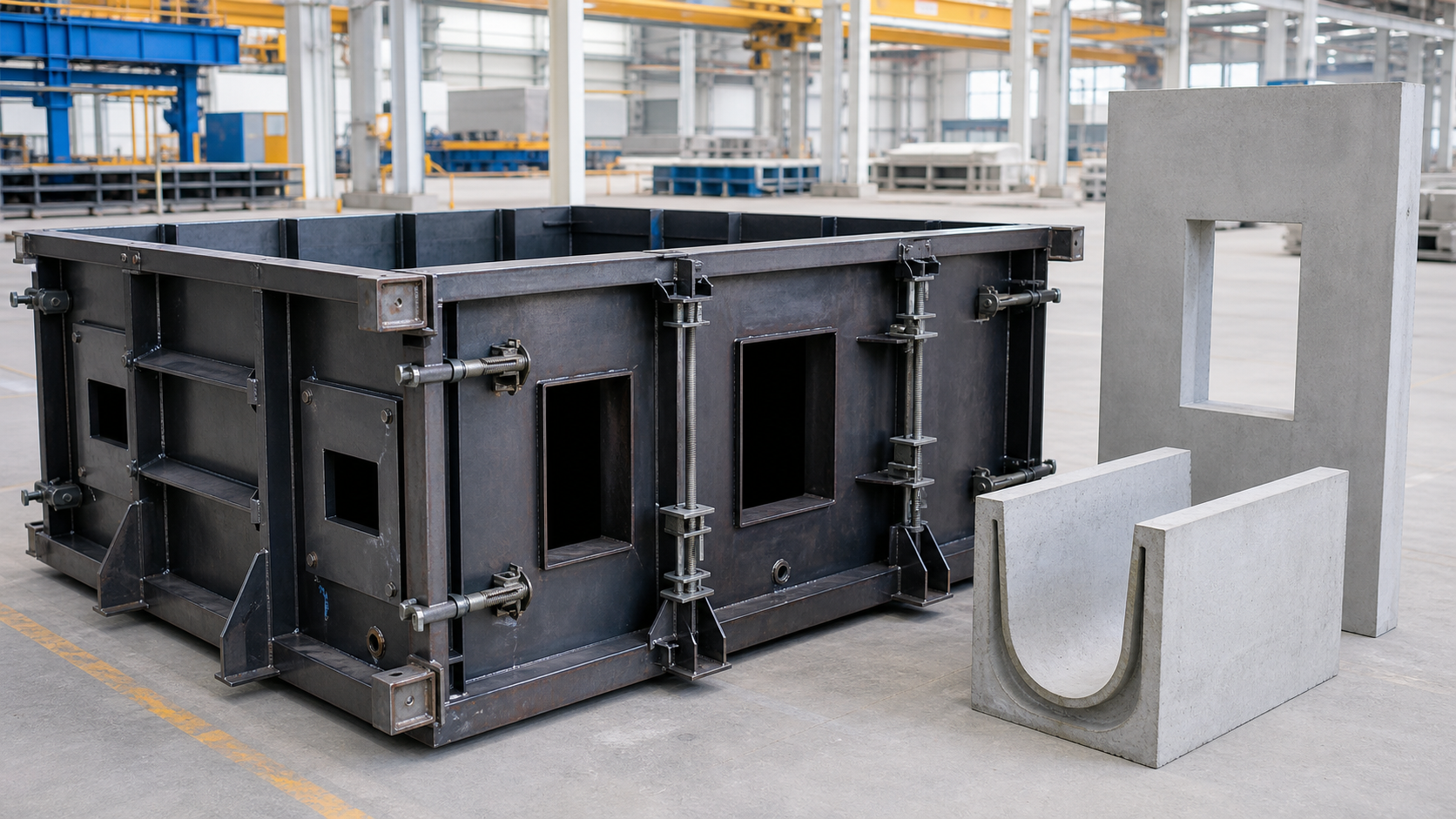
A custom precast mould is manufactured according to the required product drawing, size and production method. It helps precast manufacturers produce concrete components with accurate dimensions, reliable quality and better installation compatibility.
What Are Custom Precast Moulds?
Custom precast moulds are specially designed moulds made for a particular precast concrete product or project requirement. Instead of using a fixed standard size, the mould is fabricated based on approved dimensions and technical details.
Custom moulds can be made for products such as:
Precast boundary wall panels Compound wall panels and poles U drains Box culverts Cable trenches Retaining wall panels Precast door frames Window frames Concrete poles Manhole covers Highway barriers Bridge components Footings and columns Decorative wall panels Garden furniture products
Heavy-duty iron is commonly used for custom mould fabrication because it provides strength, stability and long production life.
When Are Standard Mould Sizes Not Enough?
Standard moulds are not always the best option. A custom mould should be considered when the required product cannot be manufactured accurately with an available standard mould.
Here are common situations where custom moulds are useful.
1. Your Project Requires Special Dimensions
Many infrastructure projects have unique size requirements. For example, a U drain may need a specific width, depth or wall thickness to match the drainage design. A box culvert may need a special internal opening for water flow, utilities or site clearance.
Using an incorrect size can create installation problems and may require expensive modification at the site.
A custom mould helps produce the exact required dimensions from the first casting cycle.
2. You Need a Unique Product Shape
Some precast products have special shapes that cannot be created with a standard rectangular mould. Examples include Y-shape poles, curved drainage channels, special retaining wall sections, decorative wall panels and customized bridge components.
Custom mould fabrication allows the mould design to match the intended concrete product shape. This improves the appearance, functionality and site compatibility of the finished product.
3. Your Product Needs Specific Openings or Inserts
Precast products may require openings, grooves, utility holes, lifting hooks, embedded plates or fixing arrangements. These details must be positioned accurately so the product can be installed easily at the project site.
Custom moulds can include provision for:
Pipe openings Utility cable openings Drainage outlets Lifting hook locations Connection points Grooves and joints Embedded plates Reinforcement guides
These features reduce manual cutting, drilling and modification after casting.
4. You Need Accurate Panel and Pole Matching
Boundary wall systems, compound walls and precast panel systems require accurate matching between panels, poles and connection slots. Even a small dimensional difference can affect installation speed and alignment.
Custom moulds help maintain uniform length, width, thickness and edge profiles. This makes precast components easier to install and improves the final appearance of the project.
5. You Want to Reduce Concrete Waste and Rework
When standard moulds do not match the required dimensions, manufacturers may try to adjust products after casting. This can create waste, increase labour cost and reduce product quality.
A custom mould produces the correct size directly. This reduces unnecessary concrete use, cutting work, repairs and rejection.
6. Your Project Has High Volume Production Requirements
Custom moulds are especially valuable for large projects where the same special component will be produced repeatedly. Once the mould is fabricated correctly, the manufacturer can produce consistent units across many casting cycles.
This improves production planning, quality control and delivery speed.
For high-volume production, moulds can also be designed with faster locking systems, easy opening arrangements and suitable handling points.
7. You Need Better Surface Finish or Decorative Details
Architectural precast products often need a better surface finish or unique design pattern. Decorative boundary wall panels, embossed wall panels and customized garden furniture may require detailed mould surfaces.
Custom moulds can be designed to create:
Embossed patterns Textured finishes Decorative borders Special edge profiles Custom branding areas Architectural grooves
The mould quality directly affects the surface quality of the final concrete product.
Benefits of Custom Iron Precast Moulds
Custom iron moulds provide practical advantages for precast manufacturers and construction projects.
Accurate product dimensions
The mould is fabricated according to the required drawing, which helps maintain proper size, shape and thickness.
Better site installation
Precast units fit more easily when they are manufactured for the exact project requirement. This can reduce delays during installation.
Reduced rework and waste
Producing the correct product size from the beginning reduces cutting, patching, rejection and material wastage.
Higher production consistency
A durable custom mould helps produce similar units repeatedly with consistent dimensions and finish.
Long production life
Heavy-duty iron moulds are suitable for repeated casting cycles when properly maintained.
Improved productivity
Moulds can be designed for easy assembly, faster demoulding, proper vibration support and convenient handling.
Custom features for project needs
Openings, inserts, lifting arrangements and reinforcement guides can be included in the mould design.
How Custom Precast Moulds Are Designed
Custom mould manufacturing should begin with clear project information. The more accurate the input drawing and requirement, the better the final mould result.
The typical process includes:
Reviewing the approved product drawing Confirming length, width, height and thickness Checking required openings, grooves and connections Planning reinforcement location and cover requirements Selecting suitable mould plate thickness and stiffeners Designing locking and opening arrangements Adding lifting or handling provisions where required Fabricating and assembling the iron mould Checking dimensions before production use Conducting trial casting if needed
Before final fabrication, all structural and product details should be confirmed with the project engineer or customer.
Important Things to Check Before Ordering a Custom Mould
Before placing an order for a custom precast mould, prepare the following details.
Product drawing or sketch Required product dimensions Concrete thickness Expected production quantity Required surface finish Reinforcement details Required openings or inserts Lifting and handling method Available vibration method Required delivery date
Providing complete information helps the mould manufacturer design a practical and durable solution.
Why Mould Strength Matters in Custom Production
A custom mould must remain stable during concrete pouring, vibration and demoulding. If the mould bends, leaks or loses alignment, the final product may have dimensional variation, poor edges or surface defects.
A strong iron mould should have:
Proper plate thickness Adequate stiffeners Secure bolts, clamps or locking systems Accurate joints Smooth internal surfaces Reliable opening arrangement Stable base support Proper lifting points where required
Mould strength is especially important for large wall panels, box culverts, retaining wall sections and other heavy precast products.
Custom Mould Maintenance for Long Life
Custom moulds should be maintained carefully because they are made for specific products and project requirements.
Clean the mould after every casting cycle. Remove concrete residue from joints and corners. Apply mould release oil evenly before casting. Check bolts, clamps and hinges regularly. Inspect for rust, bending or damaged surfaces. Store the mould in a dry area when not in use. Repair damaged parts before they affect product quality. Check critical dimensions periodically.
Proper maintenance helps custom moulds deliver accurate results for many production cycles.
Choose the Right Custom Precast Mould Manufacturer
A custom mould should not be selected only on price. It should be designed for the actual production process, concrete load, vibration method and required output quality.
Choose a manufacturer who can understand your drawing, recommend suitable mould construction and fabricate the mould with accurate dimensions.
Paras Steel Industries manufactures heavy-duty custom iron precast concrete moulds for infrastructure, boundary wall, drainage and construction applications across India.
We manufacture custom moulds for U drains, box culverts, wall panels, compound walls, poles, cable trenches, retaining walls, door frames, manhole covers and other precast concrete products.
Share your approved drawing, required dimensions and production requirement with our team to get a custom precast mould solution for your project.