
Precast Building Solutions
Precast Window Frame Mould Slot Design: Grill Fixing, Glass Track and Tapered Core Guide
Accurate grill-fixing slots, glass-track grooves and tapered core design improve the fit and finish of precast concrete window frames. This guide explains slot positioning, mould alignment, casting, demoulding and quality checks.
By Paras Steel Industries ·
Precast Window Frame Mould Slot Design: Grill Fixing, Glass Track and Tapered Core Guide
Precast Window Frame Mould Slot Design: Grill Fixing, Glass Track and Tapered Core Guide
Precast concrete window frames, also known as RCC khidki chaukhat, provide durable and dimensionally consistent openings for residential, commercial and infrastructure projects.
A window frame may need to accommodate a security grill, glass shutters, mesh shutters or other project-specific fittings. These components cannot be installed accurately unless the required slots and grooves are positioned correctly during casting.
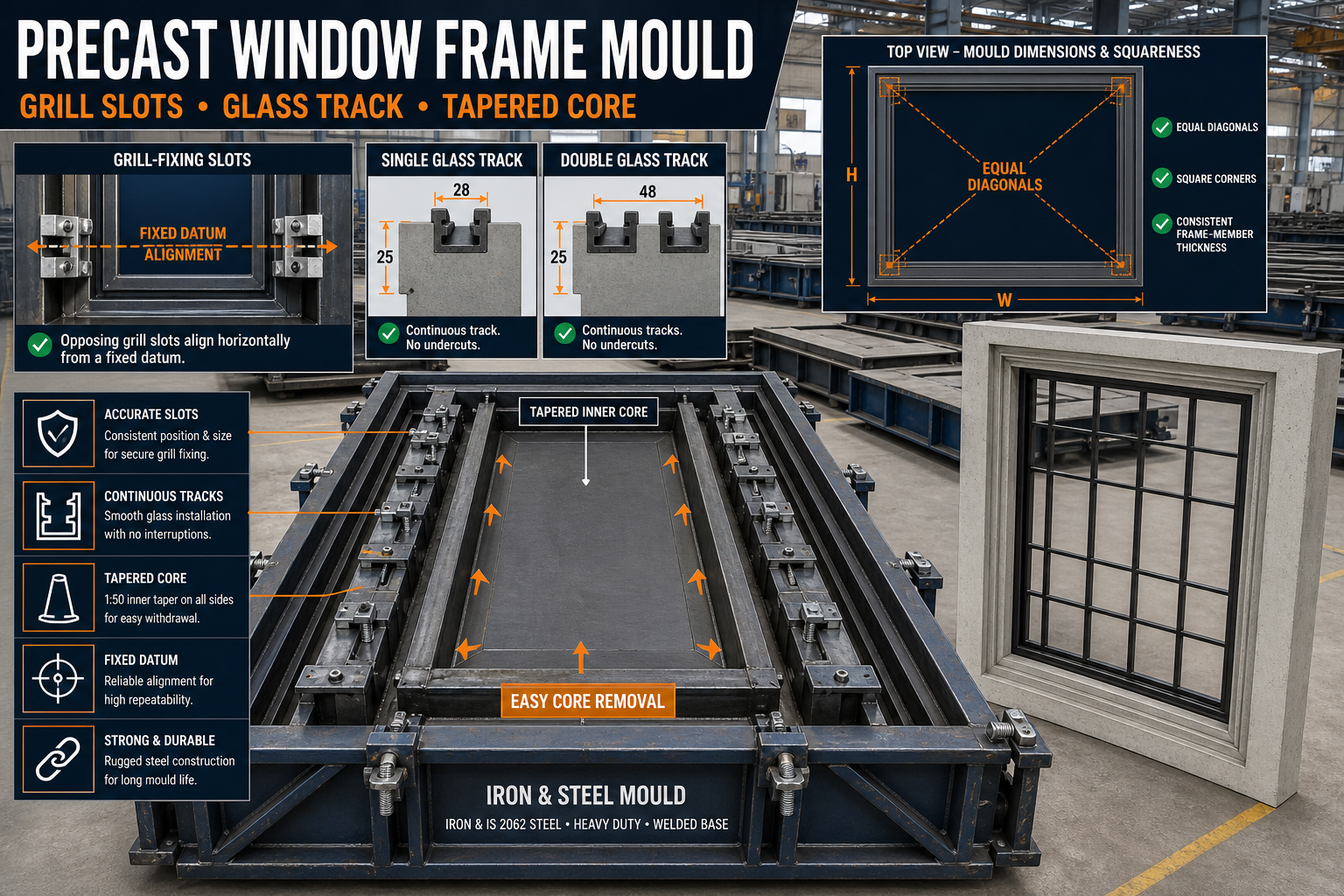
A well-designed iron and steel window frame mould can form grill-fixing slots, glass-track grooves and hardware recesses directly in the concrete. A tapered inner core also helps release the cured frame without damaging its internal corners.
Paras Steel Industries manufactures high-precision IS 2062 steel precast window frame moulds with grill and glass-track slot arrangements, structural reinforcement and tapered cores for easier demoulding.
What Is a Precast Window Frame Mould?
A precast window frame mould is an iron or steel formwork system used to manufacture reinforced concrete window frames.
A typical mould may contain:
• Heavy-duty iron or steel casting base • Outer profile shutters • Tapered inner core • Removable end shutters • Grill-fixing slot formers • Glass-track groove formers • Mesh or shutter-track provisions • Hardware insert fixtures • Diagonal corner braces • Angle stiffeners • Quick-release clamps • Reinforcement-positioning guides
The complete arrangement should match the approved window-frame drawing.
What Are Grill-Fixing Slots?
Grill-fixing slots are recesses or prepared fixing positions formed in the concrete window frame for installing a security grill.
The slots may accommodate:
• Grill anchor bars • Steel fixing plates • Embedded fasteners • Project-specific fixing inserts • Removable installation hardware
Casting these provisions directly into the frame can reduce post-production drilling and help maintain consistent grill positioning.
The slot shape and fixing method should follow the approved architectural and structural design.
Importance of Grill-Slot Alignment
Grill slots on opposite sides of the window frame must align with one another. If the slots are positioned at different heights, the grill may sit unevenly or require modification during installation.
Before casting, check:
• Number of grill slots • Vertical spacing • Horizontal alignment • Slot width and depth • Distance from the frame corners • Position relative to the glass track • Insert orientation • Fixing security • Relationship with reinforcement
All measurements should be taken from one fixed datum point.
Measuring every slot from the previous slot can create cumulative positioning errors.
What Is a Glass Track?
A glass track is a groove or channel formed in the concrete window frame for positioning a glass shutter or compatible sliding component.
Depending on the approved design, the frame may contain:
• Single glass track • Double glass track • Glass and mesh-track combination • Glass and grill arrangement • Project-specific shutter grooves
The mould profile must reproduce the track continuously and accurately.
Glass-Track Design Considerations
Track Width
The groove must suit the approved shutter or glass-frame system. An excessively narrow track can prevent installation, while excessive clearance may cause loose fitting.
Track Depth
The groove should provide the required seating without unnecessarily weakening the concrete edge.
Track Continuity
The track should remain consistent around the required sides of the frame. Sudden changes in depth or width can interfere with shutter movement.
Corner Formation
Track corners should be clean and accurately formed. Concrete residue or damaged mould corners can alter the finished profile.
Drainage
Where required by the approved design, the lower track should include an appropriate drainage arrangement.
Demoulding Direction
The groove profile should not create an undercut that locks the concrete onto the mould.
Single Track vs Double Track
Single-Track Window Frame
A single-track frame contains one primary groove for one compatible window shutter or panel.
It may be suitable for:
• Basic fixed-glass arrangements • Single sliding-shutter systems • Simple residential openings • Project-specific single-panel designs
Double-Track Window Frame
A double-track design provides two parallel grooves.
It may be used for:
• Two sliding shutters • Glass and mesh arrangements • Compatible multi-panel systems • Project-specific ventilation systems
The required number of tracks must be confirmed from the approved window-system drawing.
Relationship Between Grill Slots and Glass Track
Grill-fixing slots and glass tracks must be coordinated before mould fabrication.
The grill should not obstruct shutter movement, while the track former should not interfere with embedded grill components.
Check:
• Distance between grill and glass position • Required cleaning space • Shutter movement clearance • Insert embedment • Reinforcement clearance • Frame-edge thickness • Installation sequence
The complete window assembly should be studied, not only the concrete frame profile.
What Is a Tapered Inner Core?
The inner core forms the clear opening and internal profile of the precast window frame.
A tapered core contains a small calculated draft that creates clearance during demoulding. After the concrete gains sufficient strength and the mould is released, the tapered core can be removed more easily than a completely straight core.
The taper should be controlled carefully. It should assist demoulding without changing the frame beyond its approved dimensional tolerance.
Benefits of a Tapered Core
A correctly designed tapered inner core can provide:
• Easier mould release • Reduced friction against concrete • Lower risk of damaged internal corners • Less dependence on hammering • Faster production cycles • Better concrete edge protection • Reduced wear on mould surfaces • More consistent internal dimensions
A taper cannot compensate for premature demoulding, poor cleaning or insufficient release agent.
Tapered Core Alignment
The core must remain centred and square inside the outer shutters.
Before casting, verify:
• Internal clear width • Internal clear height • Equal diagonal measurements • Corner squareness • Core centreline • Distance from all external shutters • Track-former position • Grill-slot position • Locking-point security
An off-centre core can produce unequal frame-member thickness.
Why Is Window Frame Squareness Important?
A precast window frame must fit correctly inside the building opening and accept the specified grill or shutter assembly.
An out-of-square frame may cause:
• Unequal diagonal dimensions • Difficult grill installation • Jammed sliding shutters • Uneven gaps • Glass-fitting problems • Poor site alignment • Cracked corners during installation • Unacceptable visual appearance
Use diagonal braces and angle stiffeners to maintain exact geometry during concrete pouring and vibration.
Alignment Checks Before Casting
Overall Length and Width
Measure the complete external frame dimensions.
Clear Opening
Check the inner-core dimensions at several points.
Diagonals
Measure both internal diagonals. Equal diagonals help confirm squareness.
Frame-Member Thickness
Verify the distance between the inner core and outer shutters on every side.
Track Alignment
Check that each glass-track former remains parallel and continuous.
Grill-Slot Centreline
Verify corresponding slots using fixed reference lines.
Corner Angle
Inspect each corner with a suitable square.
Mould Level
Ensure the flat casting bed is supported and levelled correctly.
Window Frame Mould Setup Process
A typical setup process includes:
1. Clean the iron or steel mould completely. 2. Remove concrete residue from track-forming grooves. 3. Inspect the tapered inner core. 4. Position the outer shutters. 5. Centre and lock the inner core. 6. Install the required glass-track formers. 7. Position the grill-slot formers. 8. Install any approved hardware inserts. 9. Check overall dimensions. 10. Measure both diagonals. 11. Secure the diagonal braces and clamps. 12. Apply a suitable mould-release agent. 13. Position the reinforcement cage. 14. Complete the final pre-pour inspection.
The mould should be rechecked after locking because clamp pressure may affect its dimensions.
Reinforcement Placement
The reinforcement cage must follow the approved structural drawing.
Important checks include:
• Bar or wire diameter • Reinforcement spacing • Concrete cover • Corner reinforcement • Cage position • Clearance from the inner core • Clearance around grill slots • Clearance around glass tracks • Reinforcement around fixing inserts
Suitable spacers should prevent the reinforcement from touching the mould surface.
Concrete Filling and Compaction
Concrete should be placed gradually and uniformly around the complete window frame.
Particular attention is required around:
• Grill-fixing slots • Narrow glass-track grooves • Internal corners • Embedded inserts • Dense reinforcement areas • Lower frame member
A vibrator table or compatible shutter vibrator may improve concrete compaction.
Too little vibration may leave air pockets and incomplete grooves. Excessive vibration may cause segregation or move the embedded inserts.
Demoulding Process
Demoulding should begin only after the concrete has achieved sufficient handling strength.
A typical sequence includes:
1. Open the external locking components. 2. Remove detachable slot formers where required. 3. Release the outer shutters gradually. 4. Retract or remove the tapered inner core in its designed direction. 5. Avoid striking track edges and corners. 6. Lift the frame using the approved handling method. 7. Support the frame to prevent twisting. 8. Inspect all slots and grooves immediately.
Do not apply uncontrolled hammering to precision mould surfaces.
Common Production Problems
Misaligned Grill Slots
Possible causes include measurement from different reference points, loose slot formers or movement during vibration.
Incomplete Glass Track
Trapped air, thick release agent or concrete residue can prevent the track from forming properly.
Unequal Frame Thickness
This may result from an off-centre inner core or loose outer shutters.
Broken Internal Corners
Premature demoulding, insufficient core taper or inadequate release agent can damage the corners.
Out-of-Square Frame
Incorrect diagonal adjustment, weak corner bracing or an uneven casting bed can distort the frame.
Core Sticks to Concrete
Possible causes include inadequate cleaning, insufficient release agent, low demoulding strength or damaged taper surfaces.
Slurry Leakage
Loose shutter joints can produce concrete fins, poor edges and dimensional variation.
Quality-Control Checklist
After demoulding, inspect:
• Overall external dimensions • Internal clear opening • Diagonal measurements • Corner squareness • Frame-member thickness • Grill-slot position • Grill-slot depth and size • Glass-track width and depth • Track continuity • Hardware-insert position • Concrete surface finish • Honeycombing • Cracks • Damaged edges • Reinforcement cover
Where possible, conduct a trial fitting using the intended grill and shutter components.
Cleaning and Maintenance
After every casting cycle:
• Remove concrete residue. • Clean all glass-track grooves. • Clean grill-slot formers. • Inspect the tapered inner core. • Check outer shutters for bending. • Inspect diagonal corner braces. • Examine clamps, bolts and locking points. • Check structural angles and welds. • Lubricate approved moving components. • Repair slurry-leakage joints. • Verify mould dimensions periodically. • Apply anti-rust protection where required.
Avoid cleaning tools that scratch or deform precision track surfaces.
Factors to Check Before Buying
Before ordering a precast window frame mould, provide:
• Approved window-frame drawing • Overall external dimensions • Clear opening dimensions • Frame cross-section • Single or double glass-track requirement • Track width and depth • Grill-fixing method • Grill-slot dimensions and spacing • Mesh or shutter details • Hardware-insert positions • Reinforcement drawing • Required number of moulds • Expected production target • Vibration method • Required dimensional tolerance
The buyer should also discuss iron or steel plate thickness, tapered core design, bracing system and customization requirements.
Conclusion
Grill-fixing slots, glass-track grooves and tapered inner-core design are important features of a high-quality precast concrete window frame mould.
Correct slot positioning simplifies grill installation, while an accurate glass track supports proper shutter fitting and movement. A well-aligned tapered core makes demoulding easier and helps protect the internal corners of the concrete frame.
Paras Steel Industries manufactures heavy-duty IS 2062 iron and steel precast window frame moulds with customizable grill slots, glass-track provisions and tapered cores. Complete architectural, hardware and reinforcement drawings should be provided before mould manufacturing begins.