
Precast Mould Guide
Box Culvert Mould Shrinkable Inner Core: Working Process and Maintenance Guide
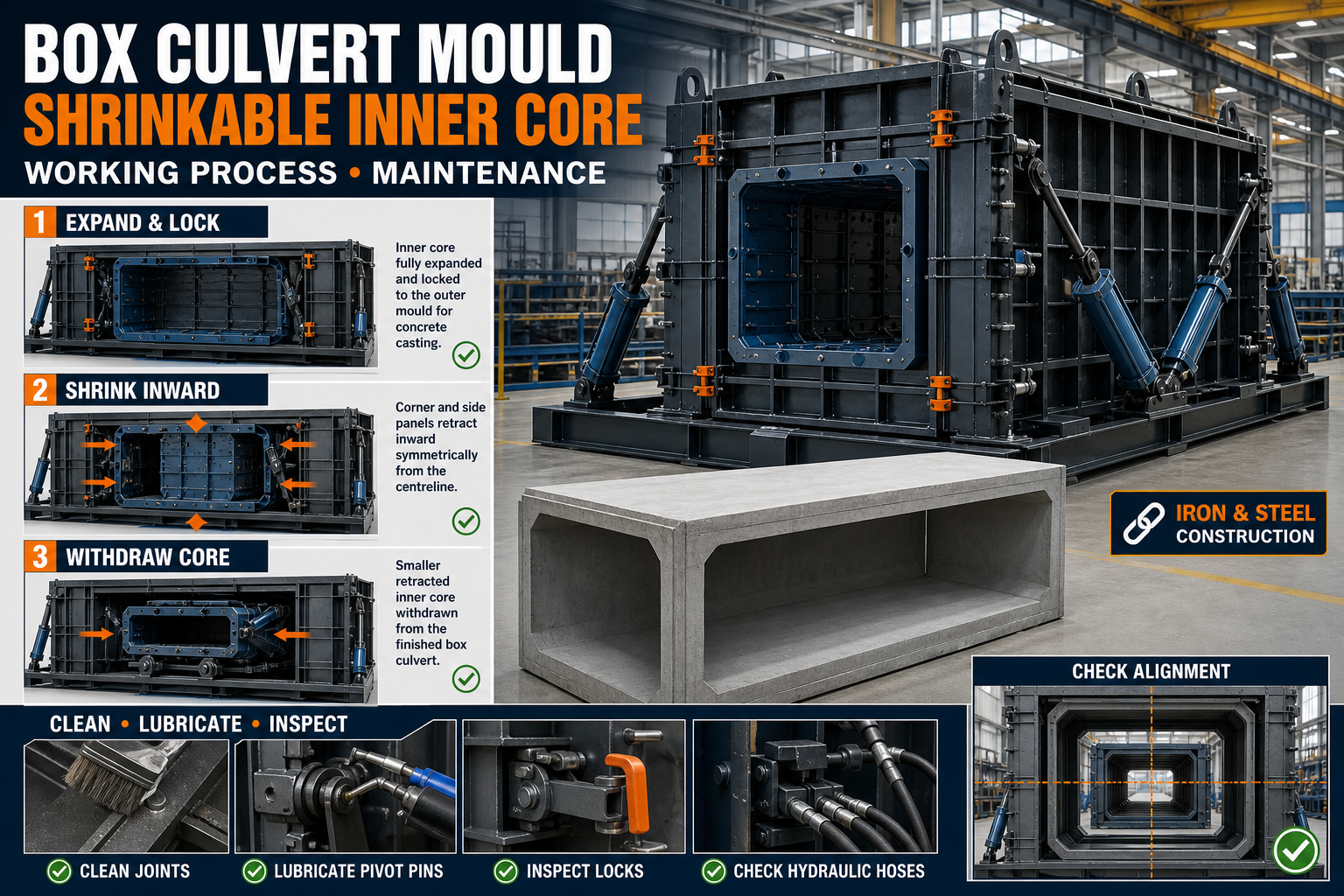
A shrinkable inner core creates sufficient clearance for removing the internal shutter from a precast box culvert. This guide explains its working process, locking sequence, alignment, safe demoulding and maintenance requirements.
By Paras Steel Industries ·
Box Culvert Mould Shrinkable Inner Core: Working Process and Maintenance Guide
Box Culvert Mould Shrinkable Inner Core: Working Process and Maintenance Guide
Precast box culverts are used for drainage, stormwater management, road crossings, utility passages and infrastructure projects. Their hollow rectangular profile requires an internal mould that can be removed without damaging the freshly cast concrete.
A shrinkable inner core solves this challenge by retracting its steel shutter sections inward before demoulding. This reduces the effective size of the core and creates clearance between the mould surface and concrete.
Paras Steel Industries manufactures precast moulds using iron and heavy-duty steel components. Box culvert dimensions, plate thickness, locking systems and inner-core mechanisms can be customized according to the customer’s product drawing and production requirements.
What Is a Shrinkable Inner Core?
A shrinkable inner core is a collapsible internal mould used to form the hollow opening of a precast box culvert.
During casting, its shutter sections remain fully expanded and locked in their production position. After the concrete gains sufficient strength, the locks are released and the shutters retract inward.
The retracted core becomes smaller than the culvert opening, allowing it to be removed with reduced risk of damaging the internal concrete surface and edges.
Main Components of the Inner Core
A box culvert shrinkable core may contain:
• Heavy-duty iron and steel frame • Top shutter • Side shutters • Corner folding sections • Hinges and pivot points • Mechanical linkages • Screw-adjustment arrangements • Hydraulic cylinders where required • Locking pins and wedge locks • Alignment guides • Supporting wheels or rollers • Pulling or removal arrangement • Structural angles and channels
The exact design depends on the box culvert dimensions, concrete pressure, product weight and selected operating system.
How Does the Shrinkable Inner Core Work?
The inner core operates in two main positions: expanded casting position and retracted demoulding position.
In the expanded position, all shutter sections are correctly aligned and locked. This creates the required internal dimensions of the box culvert.
During demoulding, the locking mechanism is released in the specified sequence. The shutter panels then move inward through mechanical linkages, screw mechanisms or hydraulic cylinders.
This movement creates clearance around the core so it can be withdrawn safely.
Typical Working Process
A normal production sequence may include:
1. Clean the external mould and inner core. 2. Inspect hinges, locks and moving components. 3. Expand the inner core into its casting position. 4. Check its internal dimensions and alignment. 5. Engage every locking point completely. 6. Apply a suitable mould-release agent. 7. Position the reinforcement cage correctly. 8. Assemble the external shutters and end plates. 9. Pour and vibrate the concrete uniformly. 10. Allow the concrete to gain sufficient demoulding strength. 11. Open the external shutters where required. 12. Release the inner-core locks in the approved sequence. 13. Retract the core panels slowly and evenly. 14. Withdraw the retracted core from the culvert. 15. Lift or shift the finished product safely. 16. Clean and inspect the mould for the next cycle.
Operators should always follow the manufacturer’s operating instructions.
Why Must the Inner Core Shrink Before Removal?
Freshly demoulded concrete remains vulnerable to edge damage and surface marks. Attempting to pull out a fully expanded core can create excessive friction against the internal concrete surfaces.
Retracting the core can provide:
• Clearance between steel and concrete • Reduced friction during removal • Lower risk of corner damage • Reduced demoulding force • Faster mould operation • Less dependence on hammering • Better internal surface finish • Easier handling of large box culvert moulds • Reduced stress on the mould structure
The benefits depend on correct core alignment, proper release-agent application and adequate concrete strength.
Importance of the Locking System
The locking system holds every core panel in its exact casting position. It must resist fresh concrete pressure and vibration without allowing shutter movement.
Loose or incomplete locks may cause:
• Incorrect internal dimensions • Unequal wall thickness • Poor corner formation • Bulging or misalignment • Cement slurry leakage • Difficulty during demoulding • Damage to moving components
Before casting, inspect all pins, wedges, clamps, bolts and hydraulic locks. Every locking point should be engaged completely and tightened uniformly.
Inner-Core Alignment Checks
Core alignment should be checked before every casting cycle.
Centreline Position
The inner core should be positioned correctly within the external mould. Incorrect centring can produce unequal wall thickness.
Horizontal Level
Check the core with an appropriate level. An incorrectly levelled core may affect the top and bottom slab thickness.
Vertical Alignment
Both sides of the core should remain vertical unless the approved product drawing specifies a different profile.
Diagonal Measurements
Measure the diagonals of the expanded core. Unequal measurements may indicate that it is out of square.
Clearance and Wall Thickness
Measure the space between the inner core and external shutters at several locations. The spacing should match the approved box culvert drawing.
End Alignment
Confirm that the inner core is correctly positioned against the end shutters and joint-sealing surfaces.
Manual vs Hydraulic Shrinkable Core
Manual System
A manual shrinkable core may use screw arrangements, levers or mechanical linkages.
Possible advantages include:
• Simpler operation • Lower initial investment • Easier maintenance • Suitability for moderate production
Manual systems may require more labour and operating time, particularly for large inner cores.
Hydraulic System
A hydraulic shrinkable core uses cylinders to retract and expand the shutter sections.
Possible advantages include:
• Faster operation • Controlled shutter movement • Reduced manual effort • Better suitability for heavy inner cores • Improved productivity in suitable plants
Hydraulic systems require regular inspection of oil levels, hoses, seals, fittings, cylinders and operating pressure.
Concrete Pressure and Structural Strength
Fresh concrete exerts considerable pressure on the box culvert mould. Vibration may increase the forces acting on the shutters, locks and core frame.
The mould must include suitable iron or steel plates, structural channels, angles and stiffeners. Plate thickness and frame design should be selected according to the product dimensions and expected casting pressure.
One standard plate thickness should not be assumed for every box culvert mould. Larger products may require a different structural design than smaller units.
When Should the Box Culvert Be Demoulded?
The inner core should be retracted only after the concrete has achieved sufficient demoulding strength.
The required time depends on:
• Approved concrete mix design • Cement type • Water-cement ratio • Product dimensions • Reinforcement arrangement • Ambient temperature • Curing method • Approved admixtures • Required handling strength
A fixed demoulding time cannot be applied to every product, mix and weather condition. The manufacturer should establish demoulding strength through proper testing and quality control.
Safe Inner-Core Removal
Before starting core removal:
• Confirm that the concrete has achieved sufficient strength. • Clear workers from the core-removal path. • Check that all lifting and pulling equipment is suitable. • Release the locks in the specified sequence. • Retract each shutter gradually. • Confirm that sufficient clearance has been created. • Withdraw the core slowly and evenly. • Stop immediately if the core becomes jammed. • Never use uncontrolled force or excessive hammering. • Keep workers away from pinch points and moving components.
No worker should stand beneath suspended mould parts or precast products.
Common Operating Problems
Inner Core Does Not Retract
Possible causes include hardened concrete inside the joints, damaged linkages, bent pins, insufficient lubrication or hydraulic failure.
Core Becomes Jammed
This may result from inadequate retraction, incorrect alignment, concrete slurry entering the mechanism or premature demoulding.
Unequal Wall Thickness
Possible causes include incorrect core centring, loose locks, shutter movement or incorrect reinforcement placement.
Damaged Internal Corners
This can occur because of insufficient concrete strength, sudden core movement, inadequate clearance or poor release-agent application.
Cement Slurry Leakage
Leakage may enter the hinges and moving joints when shutter connections are damaged or improperly closed.
Maintenance of the Shrinkable Inner Core
Regular maintenance is essential because the mechanism contains several moving and locking components.
After every casting cycle:
• Remove concrete residue from all core surfaces. • Clean hinges, joints and folding sections. • Inspect locks, pins, wedges and clamps. • Check mechanical linkages for bending. • Lubricate approved pivot and sliding points. • Inspect hydraulic cylinders and hoses where installed. • Check shutter plates for distortion. • Examine welds, channels and stiffeners. • Repair slurry-leakage points. • Confirm that the core expands to the correct dimensions. • Replace worn bushes, seals and locking components.
Concrete residue should not be allowed to accumulate inside moving joints.
Preventive Maintenance Schedule
Daily Checks
• Clean the core after every production cycle. • Inspect locking points and visible damage. • Check for concrete residue inside joints. • Confirm smooth expansion and retraction.
Weekly Checks
• Inspect hinges, pins and mechanical linkages. • Check fasteners and structural connections. • Lubricate approved moving components. • Examine hydraulic hoses for leakage.
Periodic Checks
• Verify dimensions and squareness. • Inspect shutter plates for bending. • Check the core frame and welds. • Replace worn pins, bushes and seals. • Test the complete mechanism without concrete.
The inspection frequency should be adjusted according to production volume and operating conditions.
Factors to Check Before Buying
Before ordering a box culvert mould with a shrinkable inner core, provide:
• Complete product drawing • Internal and external dimensions • Culvert length • Wall, top and bottom slab thickness • Reinforcement details • Required number of cavities • Expected daily production • Manual or hydraulic operating preference • Concrete-filling method • Vibration arrangement • Core-removal direction • Available crane or pulling system • Factory space and layout • Required dimensional tolerance
The buyer should also discuss iron or steel plate thickness, structural stiffeners, locking mechanisms, corner design and maintenance access.
Conclusion
A shrinkable inner core makes precast box culvert demoulding more controlled by creating clearance between the steel shutters and concrete.
Correct alignment, complete locking, sufficient concrete strength and gradual retraction are essential for producing dimensionally accurate box culverts. Regular cleaning and preventive maintenance also help keep the mechanism operating smoothly.
Paras Steel Industries manufactures iron and heavy-duty steel precast moulds according to customer drawings, required dimensions and production targets. Complete technical specifications should be shared before mould design and manufacturing begin.