
Precast Mould Guide
Manual vs Hydraulic Precast Mould: Which System Is Better for Your Plant?
Manual and hydraulic precast moulds differ in operating speed, labour, investment and maintenance. Compare both systems to select the right solution for your production plant.
By Paras Steel Industries ·
Manual vs Hydraulic Precast Mould: Which System Is Better for Your Plant?
Manual vs Hydraulic Precast Mould: Which System Is Better for Your Plant?
Selecting the correct mould operating system can significantly affect production speed, labour requirements and manufacturing costs in a precast concrete plant.
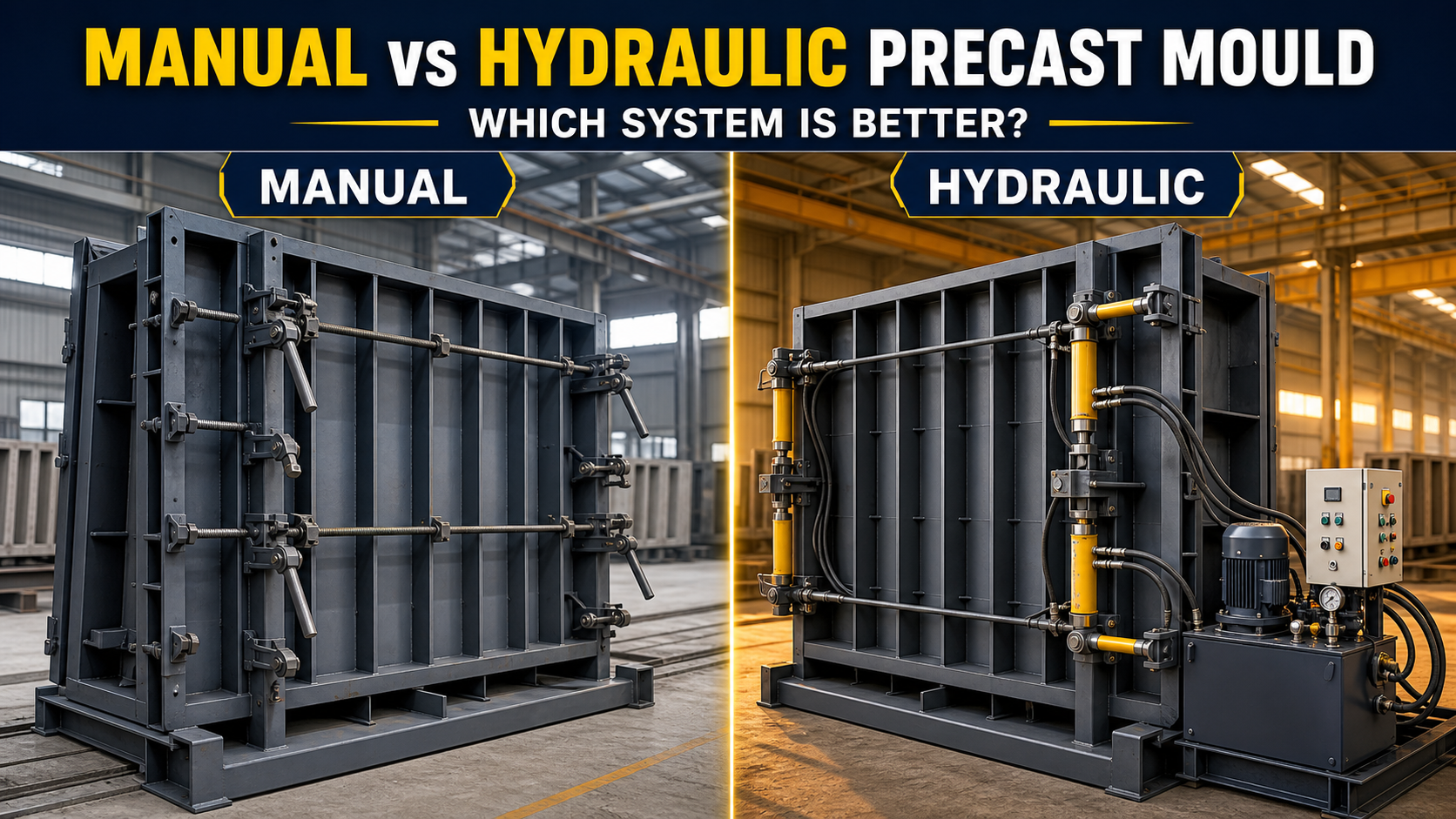
Manual precast moulds use bolts, clamps, wedges, tie rods, screw arrangements or manually operated shutters. Hydraulic moulds use cylinders and a hydraulic power pack to open, close, clamp or release selected mould sections.
Both systems can produce accurate concrete products when the mould is designed and operated correctly.
A small plant producing limited quantities may achieve better financial results with a manual mould. A large factory operating multiple moulds and continuous production shifts may benefit from hydraulic automation.
This guide compares manual and hydraulic precast moulds by investment, production capacity, labour, safety, maintenance and suitable applications.
What Is a Manual Precast Mould?
A manual precast mould is opened, closed and locked using worker-operated mechanical components.
Common manual operating components include:
Nut-bolt locks
Quick-release clamps
Wedge locks
Tie rods
Screw jacks
Hinged shutters
Detachable side panels
Manual lever systems
The main body of the mould is manufactured using heavy-duty iron plates, channels, angles, stiffeners and flanges. Workers assemble and lock these parts before casting.
After the concrete develops sufficient strength, workers release the locks and open the shutters manually or with crane assistance.
Manual does not necessarily mean lightweight. Large highway, drainage, wall-panel and foundation moulds may use manual locking while still requiring a crane for panel handling.
How Does a Manual Precast Mould Work?
A typical manual production cycle includes:
Cleaning the mould
Applying release oil
Closing the side shutters
Installing bolts, wedges or clamps
Checking mould alignment
Positioning reinforcement
Pouring and vibrating concrete
Allowing the concrete to set
Releasing all locks manually
Opening or removing the shutters
Lifting the finished product
The speed of this process depends on the number of locking points, mould size and worker experience.
Advantages of Manual Precast Moulds
Lower Initial Investment
Manual moulds do not require a hydraulic power pack, cylinders, control valves or electrical control system.
This makes them suitable for new businesses and plants operating with a limited equipment budget.
Simple Operation
Workers can understand mechanical clamps, bolts and wedges with basic training.
Easy Maintenance
Most manual components can be inspected and repaired using standard workshop tools.
Lower Dependence on Electricity
The locking and opening systems can operate without continuous electrical power.
Suitable for Low-Volume Production
When only a few products are cast daily, hydraulic automation may not provide enough savings to recover its additional cost.
Easy to Relocate
Manual moulds can be easier to shift between project sites when they do not include permanently connected hydraulic equipment.
Lower Technical Complexity
There are fewer pumps, hoses, seals, cylinders and control components that can stop production.
Suitable for Multiple Custom Products
Manual moulds can be practical when the plant frequently changes product dimensions and produces small batches.
Limitations of Manual Precast Moulds
Higher Labour Requirement
Workers must open and close multiple bolts, clamps or wedges during every production cycle.
Longer Cycle Time
A large multi-cavity mould may contain many locking points. Releasing each point manually increases demoulding time.
Dependence on Worker Skill
Unevenly tightened locks can cause mould expansion, slurry leakage or dimensional variation.
Greater Physical Effort
Large shutters and locking components can be difficult to handle manually.
Inconsistent Clamping
Different workers may apply different tightening force. This can affect joint pressure and alignment.
Safety Risks From Improper Handling
Workers may place their hands near closing shutters or use uncontrolled hammering to release wedges.
What Is a Hydraulic Precast Mould?
A hydraulic precast mould uses hydraulic cylinders to operate one or more mould functions.
Possible hydraulic functions include:
Opening side shutters
Closing mould panels
Applying clamping pressure
Contracting an inner core
Expanding an inner core
Tilting the mould
Lifting selected sections
Ejecting the concrete product
Releasing multi-cavity panels
The mould body remains manufactured using heavy-duty iron plates, channels and stiffeners. Hydraulic components are added to automate or assist mechanical movement.
A hydraulic system normally contains:
Hydraulic power pack
Electric motor
Hydraulic pump
Oil tank
Control valves
Pressure gauge
Hydraulic cylinders
High-pressure hoses
Pipe fittings
Flow-control valves
Electrical control panel
Limit switches or sensors, where required
How Does a Hydraulic Precast Mould Work?
The operating sequence depends on the product and mould design.
A typical hydraulic process may include:
Clean and prepare the mould.
Activate the hydraulic system to close the shutters.
Engage the hydraulic clamping arrangement.
Check mould alignment and safety locks.
Install reinforcement and inserts.
Pour and compact the concrete.
Allow the product to reach demoulding strength.
Release the hydraulic pressure.
Open the side shutters using cylinders.
Contract the inner core, where applicable.
Lift or remove the finished concrete product.
Close the mould for the next cycle.
Hydraulic pressure, cylinder stroke and operating sequence must be set according to the engineered mould design.
Advantages of Hydraulic Precast Moulds
Faster Opening and Closing
Several shutters or mould sections can be moved in a controlled sequence within a shorter time.
Reduced Manual Labour
Hydraulic cylinders perform heavy movement that would otherwise require multiple workers.
Consistent Clamping Pressure
A properly designed system applies repeatable force during every production cycle.
Improved Production Capacity
Reduced setup and demoulding time can support more efficient high-volume production.
Suitable for Multi-Cavity Moulds
Hydraulics can improve the operation of long production lines containing multiple wall-panel cavities.
Controlled Heavy Movement
Large shutters and cores can move gradually without uncontrolled dropping or manual pulling.
Reduced Worker Fatigue
Workers do not need to repeatedly handle heavy bolts or shutters throughout the shift.
Better Automation Potential
Hydraulic systems can be integrated with control panels, sensors, timers and sequential operation.
Suitable for Complex Inner Cores
Box culverts, drains and hollow products may use hydraulic contraction or expansion systems for demoulding.
Limitations of Hydraulic Precast Moulds
Higher Initial Investment
The system requires cylinders, power pack, valves, hoses, controls and additional engineering.
More Maintenance
Hydraulic oil, seals, filters, hoses and fittings require periodic inspection and replacement.
Requires Skilled Technicians
Troubleshooting pressure loss, cylinder leakage and control problems may require specialised knowledge.
Dependence on Power
Most hydraulic power packs require a reliable electrical supply.
Risk of Oil Leakage
Damaged hoses or seals can release hydraulic oil into the production area.
Production Stops During Major Failure
A failed cylinder or power pack may stop operation until the problem is repaired.
Requires Safety Controls
Large hydraulic forces can damage mould components or injure workers if the system is operated incorrectly.
Manual vs Hydraulic Mould: Quick Comparison
Initial Investment
Manual system: Lower
Hydraulic system: Higher
Operating Speed
Manual system: Slower for large or multi-cavity moulds
Hydraulic system: Faster when correctly designed
Labour Requirement
Manual system: Higher
Hydraulic system: Lower
Maintenance Complexity
Manual system: Low to moderate
Hydraulic system: Moderate to high
Power Requirement
Manual system: Minimal
Hydraulic system: Requires electricity or another power source
Clamping Consistency
Manual system: Depends on worker operation
Hydraulic system: More consistent with correct pressure control
Suitability for Small Production
Manual system: Usually more economical
Hydraulic system: May be unnecessarily expensive
Suitability for High Production
Manual system: Possible but labour-intensive
Hydraulic system: Generally more efficient
Repair Availability
Manual system: Standard fabrication and mechanical repair
Hydraulic system: Requires hydraulic components and technical support
Automation Potential
Manual system: Limited
Hydraulic system: High
Production Capacity Comparison
The mould’s cavity count and concrete curing time often determine maximum production capacity. Hydraulics cannot reduce the time concrete requires to develop demoulding strength.
However, hydraulics can reduce non-casting time, including:
Shutter opening
Shutter closing
Core contraction
Core expansion
Mechanical locking
Product release
Mould resetting
For example, a 32-panel wall mould line may produce 32 panels during one casting cycle in either manual or hydraulic configuration.
The hydraulic system does not automatically increase the number of cavities. It helps workers prepare and release those cavities faster and with less physical effort.
Production capacity should be calculated using the complete cycle:
Cleaning time
Reinforcement placement
Closing time
Concrete pouring
Vibration
Setting and curing
Opening time
Product lifting
Mould resetting
If curing is the main production bottleneck, hydraulic operation alone may not significantly increase daily output.
Labour Cost Comparison
Manual moulds require workers to operate each locking point and shutter.
Labour requirements increase with:
Number of cavities
Number of clamps
Length of the mould
Shutter weight
Number of daily cycles
Distance between operating points
Hydraulic systems reduce repetitive mechanical work but still require trained operators for:
Mould cleaning
Release-oil application
Reinforcement placement
Concrete pouring
Quality checks
Product handling
Hydraulic inspection
Automation reduces selected tasks; it does not eliminate the need for workers.
Investment and Return on Investment
A hydraulic mould costs more initially, so buyers should calculate whether labour and time savings justify the additional investment.
Consider:
Daily number of products
Number of production shifts
Workers required for a manual system
Local labour cost
Time saved per cycle
Annual operating days
Hydraulic maintenance cost
Electricity cost
Expected project duration
Value of faster delivery
A hydraulic system may provide a strong return when the same mould completes continuous production for several years.
A manual mould may offer a better return when production quantities are limited or project demand is uncertain.
Mould Types Suitable for Manual Operation
Manual systems are often practical for:
Fencing pole moulds
Column pole moulds
Window frame moulds
Garden bench moulds
Small footing moulds
Kerb stone moulds
Manhole cover moulds
Small wall-panel moulds
Short production runs
Custom low-volume components
Larger moulds may also use manual locks with crane-assisted shutter handling.
Mould Types Suitable for Hydraulic Operation
Hydraulics can be beneficial for:
Multi-cavity compound wall mould lines
Large wall-panel moulds
Box culvert moulds
Large U-drain moulds
Heavy barrier moulds
Long column mould lines
Complex inner-core moulds
Tilting-table systems
High-volume industrial production
Moulds with heavy side shutters
The decision depends on operating weight and production volume rather than only the product name.
Manual-Hydraulic Hybrid Moulds
A hybrid mould combines manual locking with hydraulic assistance.
Examples include:
Hydraulic shutter opening with manual safety locks
Hydraulic inner-core contraction with manual side panels
Hydraulic lifting with wedge clamping
Manual dimensional adjustment with hydraulic operation
Hydraulic positioning with mechanical lock pins
Hybrid systems can reduce investment while automating the most labour-intensive operation.
They also provide mechanical safety locks that prevent unwanted mould movement if hydraulic pressure drops.
Importance of Iron Mould Construction
Whether the operating system is manual or hydraulic, the mould body must remain rigid during concrete pouring and vibration.
Heavy-duty iron construction may include:
Iron body plates
Supporting channels
Angle stiffeners
Heavy flanges
Tie rods
Base frames
Alignment pins
End shutters
The required iron plate thickness depends on product dimensions, concrete depth and vibration intensity.
Hydraulics cannot compensate for a weak mould body. Excessive cylinder force applied to an under-reinforced mould can bend shutters or damage welded joints.
The iron structure and hydraulic force must therefore be engineered together.
Hydraulic Cylinder Selection
Hydraulic cylinder capacity should be based on actual operating resistance.
Important specifications include:
Required pushing or pulling force
Cylinder bore diameter
Rod diameter
Stroke length
Operating pressure
Mounting arrangement
Movement speed
Number of cylinders
Expected working cycles
Environmental conditions
An oversized cylinder can apply excessive force and damage the mould. An undersized cylinder may fail to open a concrete-loaded or misaligned shutter.
The system should include pressure control to prevent overloading.
Hydraulic Power-Pack Requirements
The power pack supplies oil flow and pressure to the cylinders.
Selection factors include:
Number of cylinders
Required operating pressure
Required opening speed
Simultaneous or sequential movement
Motor power
Oil-tank capacity
Duty cycle
Control-valve configuration
Available electrical supply
The fastest possible cylinder speed is not always the safest. Heavy shutters should move at a controlled rate.
Safety Comparison
Manual Mould Safety
Manual systems avoid high-pressure hydraulic movement but still create risks from heavy shutters, pinch points and uncontrolled tool use.
Important precautions include:
Use proper handles and lifting points.
Do not strike locks aggressively.
Support heavy shutters before removal.
Tighten locks uniformly.
Keep hands away from closing joints.
Inspect bolts, wedges and clamps.
Hydraulic Mould Safety
Hydraulic systems apply considerable force and require additional controls.
Important precautions include:
Install mechanical safety locks.
Provide emergency-stop controls.
Use pressure-relief valves.
Protect hoses from concrete and sharp edges.
Keep workers outside moving-panel zones.
Release stored pressure before maintenance.
Inspect cylinders and fittings regularly.
Never repair a pressurised hose.
A hydraulic system must not rely only on oil pressure to support a heavy raised shutter. Mechanical locking or blocking should be provided.
Maintenance Comparison
Manual Mould Maintenance
Clean bolts and clamps.
Lubricate hinges and screw mechanisms.
Replace damaged fasteners.
Check flange alignment.
Inspect handles and lifting points.
Repair worn wedge locks.
Hydraulic Mould Maintenance
Inspect hydraulic oil level.
Replace filters according to schedule.
Check hoses for cracks and abrasion.
Inspect cylinder rods.
Check seals for leakage.
Monitor operating pressure.
Inspect electrical controls.
Tighten hydraulic fittings correctly.
Test emergency and safety controls.
Both systems require regular inspection of iron plates, channels, welds and alignment.
Effects on Product Quality
Either system can produce high-quality precast products.
Product quality depends primarily on:
Mould dimensional accuracy
Iron plate rigidity
Joint sealing
Correct reinforcement placement
Concrete quality
Controlled vibration
Curing
Demoulding method
Hydraulic clamping can provide more consistent joint pressure in high-volume production. However, an incorrectly adjusted hydraulic system may push the mould out of alignment.
Manual moulds can also maintain excellent accuracy when locks are positioned correctly and workers follow a standard tightening sequence.
When Is a Manual Mould Better?
A manual precast mould may be the better choice when:
You are starting a new precast business.
Daily production volume is limited.
Labour is readily available.
Product designs change frequently.
The project duration is short.
Electricity supply is unreliable.
Maintenance technicians are not easily available.
The mould has few shutters and locks.
The products are small or medium-sized.
Initial investment must remain low.
When Is a Hydraulic Mould Better?
A hydraulic system may be more suitable when:
The plant produces high volumes continuously.
The mould contains many cavities.
Shutters are extremely heavy.
Opening and closing consume significant production time.
Labour availability is limited.
The same product will be manufactured for several years.
The plant operates multiple shifts.
Consistent clamping pressure is required.
The product uses a complex inner core.
Technical maintenance support is available.
Questions to Ask Before Selecting a System
How many products are required per day?
How many casting cycles will run per shift?
How many workers operate the manual mould?
How much time is spent opening and closing?
What is the total mould-shutter weight?
Is crane assistance available?
Is the power supply reliable?
Are hydraulic technicians available locally?
What is the project duration?
How many cavities are required?
Does the product need a collapsible inner core?
Can a hybrid arrangement provide sufficient automation?
What safety-locking system is included?
Information to Share With the Manufacturer
Product drawing
Mould dimensions
Required cavity count
Daily production target
Number of factory shifts
Available workers
Available crane capacity
Factory electrical supply
Preferred opening system
Concrete vibration method
Required automation level
Factory layout
Maintenance capability
Budget range
The manufacturer can then recommend a manual, hydraulic or hybrid configuration.
Common Buying Mistakes
Choosing Hydraulics Only for Marketing Value
Hydraulic automation should solve a measurable production problem. It should not be selected only because it appears more advanced.
Ignoring Maintenance Availability
A hydraulic mould can remain idle if replacement seals, hoses or technicians are unavailable.
Underestimating Manual Labour
A low-cost manual mould can become expensive when many workers are required during every cycle.
Ignoring Curing Time
Hydraulics reduce handling time but cannot eliminate concrete setting and curing requirements.
Removing Mechanical Safety Locks
Hydraulic pressure should not be the only system holding heavy mould sections in position.
Using Excessive Cylinder Force
Too much pressure can bend shutters, damage clamps or affect alignment.
Purchasing Without a Production Study
The decision should be based on daily output, labour and cycle-time calculations.
Can a Manual Mould Be Converted to Hydraulic?
Some manual moulds can be modified for hydraulic operation, but conversion is not always simple.
Before conversion, the manufacturer must inspect:
Main iron frame strength
Shutter rigidity
Hinge position
Cylinder mounting points
Required cylinder stroke
Expected hydraulic force
Base-frame stability
Opening clearance
Mechanical safety locks
Factory power supply
Adding cylinders to a mould that was not designed for hydraulic loads can damage the structure.
If future automation is planned, it is better to mention this before the mould is manufactured. Hydraulic-compatible mounting and structural provisions can then be included.
Final Decision: Which System Is Better?
Neither system is universally better.
Choose a manual mould when you need:
Lower initial investment
Simple maintenance
Flexible small-batch production
Limited daily output
Minimal power dependence
Choose a hydraulic mould when you need:
High-volume continuous production
Reduced shutter-handling time
Lower repetitive labour
Controlled heavy movement
Automation compatibility
Choose a hybrid system when you need:
Hydraulic assistance for heavy operations
Manual dimensional adjustment
Mechanical safety locking
Moderate automation investment
The best system is the one that provides the lowest cost per acceptable precast product over the mould’s full working life.
Paras Steel Industries manufactures heavy-duty iron precast moulds in manual and hydraulic-compatible configurations. Customers can share their product drawing, daily output, cavity requirement and preferred operating system to discuss a suitable mould design.
Frequently Asked Questions
What is the main difference between manual and hydraulic moulds?
A manual mould uses worker-operated bolts, wedges and clamps. A hydraulic mould uses cylinders and a power pack to operate selected shutters, clamps or cores.
Is a hydraulic mould always faster?
It usually reduces opening and closing time, but total production capacity also depends on concrete pouring, curing and product handling.
Which system is cheaper?
Manual moulds generally have a lower initial cost. Hydraulic systems may reduce long-term labour and cycle costs in high-volume production.
Can a manual mould produce accurate products?
Yes. A properly fabricated and uniformly locked manual mould can provide excellent dimensional accuracy.
Does a hydraulic mould require workers?
Yes. Workers are still required for cleaning, reinforcement, concrete placement, inspection and product handling.
Which system needs more maintenance?
Hydraulic moulds require additional maintenance for oil, hoses, seals, cylinders, valves and electrical controls.
Can a manual mould be converted to hydraulic?
Conversion may be possible if the iron frame and shutters can withstand hydraulic forces. The manufacturer must inspect the complete design.
What is a hybrid precast mould?
It combines manual and hydraulic operations, such as hydraulic shutter opening with manual mechanical safety locks.
Which system is best for a small plant?
A manual system is generally more economical for limited production, provided labour and handling requirements remain manageable.
Which system is best for a 32-panel mould line?
A manual system can operate the line, but hydraulic-compatible opening and clamping can reduce labour and cycle time during continuous high-volume production.