
Precast Machinery Guide
Panel Shifting Trolley for Precast Plants: Capacity, Design and Safety Guide
Learn how to select and safely operate a panel shifting trolley for transporting concrete panels, poles, slabs and other products inside a precast plant.
By Paras Steel Industries ·
Panel Shifting Trolley for Precast Plants: Capacity, Design and Safety Guide
Panel Shifting Trolley for Precast Plants: Capacity, Design and Safety Guide
Moving cured concrete products is one of the most demanding material-handling activities inside a precast manufacturing plant.
Boundary wall panels, columns, fencing poles, slabs, beams and culvert sections are heavy and can be damaged if they are handled using unsuitable equipment.
A panel shifting trolley provides a stable mobile platform for transporting precast products between casting beds, curing areas, storage bays and loading zones.
Selecting the correct trolley requires careful consideration of load capacity, platform dimensions, chassis strength, steering system, tyres and operating conditions.
This guide explains the available capacities, design features, applications and essential safety practices for precast panel shifting trolleys.
What Is a Panel Shifting Trolley?
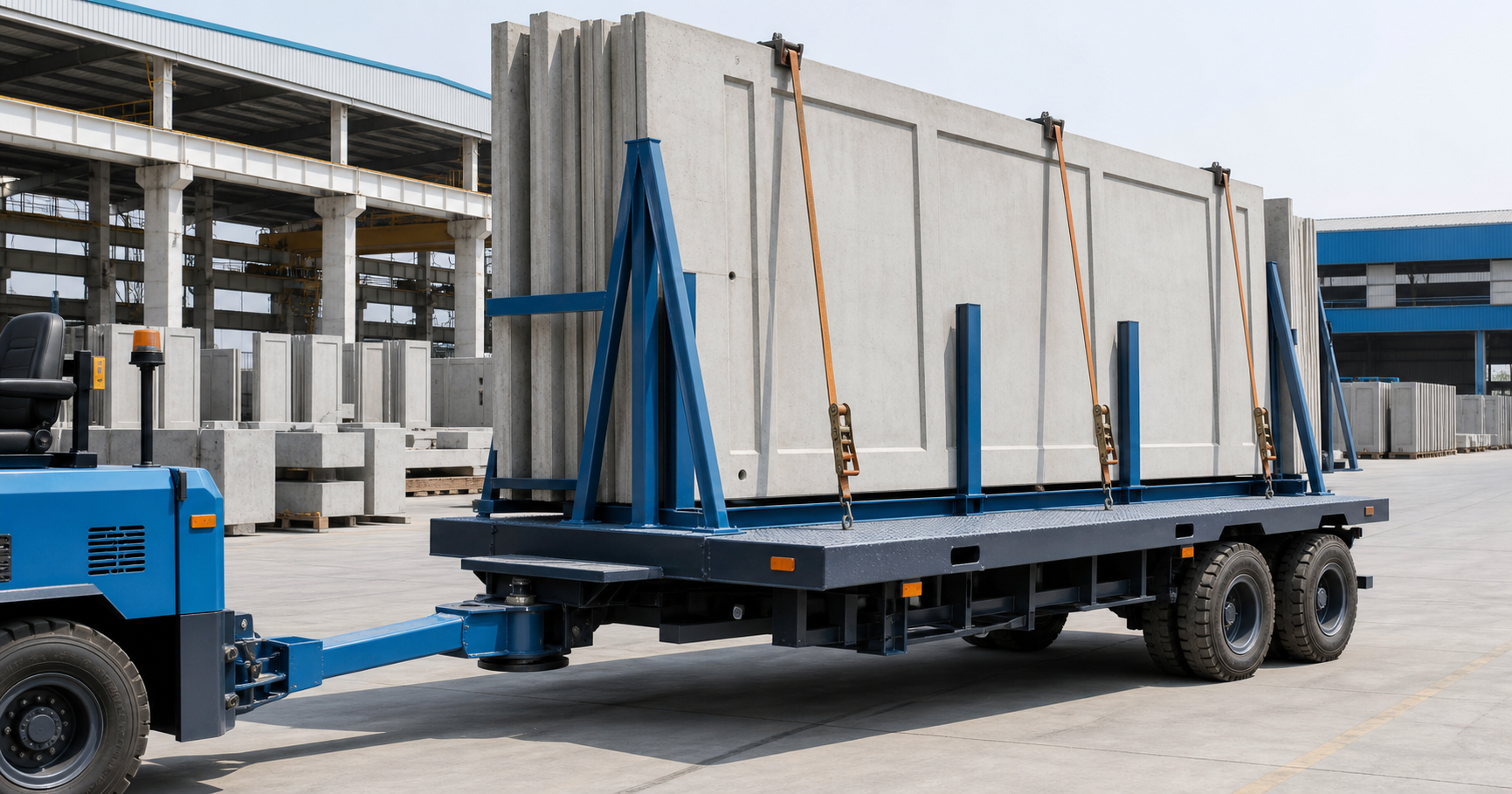
A panel shifting trolley is a heavy-duty flatbed yard trailer designed to transport precast concrete products and other heavy materials within a factory or construction site.
The trolley can be connected to a suitable tractor, forklift, loader or yard utility vehicle using a heavy towing hitch.
Unlike a standard road trailer, a precast yard trolley is designed for low-speed movement across factory aisles, casting yards and storage areas.
Its reinforced chassis and high-capacity wheels allow it to handle concentrated loads from heavy concrete products.
Applications in a Precast Plant
Boundary Wall Panels
The trolley can transport cured wall panels from the casting area to the storage or assembly section.
Fencing Poles and Columns
Long concrete poles and columns can be shifted using a suitably sized platform and secure supports.
Precast Slabs and Beams
Heavy slabs, beams and structural products can be moved between production, curing and dispatch areas.
Box Culvert Sections
High-capacity trolley models can transport heavy culvert segments within the yard, subject to the rated capacity.
Footings and Structural Components
Precast foundations, pier components and other heavy units can be shifted using a trolley configured for their weight and dimensions.
Mould and Equipment Movement
The trolley can also transport empty iron moulds, reinforcement cages and selected production equipment.
Factory Logistics
It can move products from casting beds to stacking bays and from storage areas to vehicle-loading zones.
Panel Shifting Trolley Capacity Options
Compact Yard Model
A compact trolley may have:
Load capacity: approximately 2 to 3 tons
Platform size: approximately 5 x 3 feet
Wheel arrangement: four pneumatic or solid wheels
Towing options: suitable tractor, forklift or appropriate tow system
This model is useful for smaller products and narrow factory aisles.
Standard Yard Model
A standard precast trolley may have:
Load capacity: approximately 3 to 5 tons
Platform size: approximately 4 x 8 feet or 5 x 10 feet
Tyres: approximately 7.50-16 pneumatic tyres
Towing system: tractor or forklift-compatible tow bar
This configuration can handle common wall panels, poles and medium-sized components.
Heavy Precast Yard Model
A heavy-duty model may provide:
Load capacity: approximately 5 to 8 tons
Platform size: approximately 5 x 12 feet or 6 x 12 feet
Tyres: heavy-duty pneumatic tyres
Steering: reinforced double-bearing turntable
This type is suitable for large panels, beams, footings and other heavy precast products.
Extra-Heavy Industrial Model
An extra-heavy trolley may provide:
Load capacity: approximately 10 to 15 tons or more
Platform size: approximately 6 x 14 feet or a custom modular deck
Tyres: heavy truck or solid industrial tyres
Axle arrangement: dual heavy-duty axles
The final capacity must be confirmed according to the chassis, axle, bearing, tyre and towing-system design.
Understanding Rated Load Capacity
The trolley’s rated capacity represents the maximum approved load under specified operating conditions.
Buyers should not select a trolley by comparing only the total product weight. They must also consider how that weight is distributed across the platform.
A concentrated load placed at one point can create more stress than an evenly distributed load of the same total weight.
Important factors include:
Total product weight
Number of products per trip
Position of the load
Centre of gravity
Deck span
Axle capacity
Tyre load rating
Bearing capacity
Yard surface
Turning conditions
Towing vehicle capacity
A suitable safety margin should be maintained rather than operating continuously at the maximum limit.
Platform Size and Deck Design
The platform must provide adequate support for the complete product.
Common platform dimensions include:
5 x 3 feet
4 x 8 feet
5 x 10 feet
5 x 12 feet
6 x 12 feet
6 x 14 feet
Custom lengths and widths can also be manufactured.
The correct platform size depends on the precast product’s length, width, stacking arrangement and support locations.
Deck Plate Options
The top platform may use a smooth or chequered plate.
Common deck thickness options can include approximately:
5 mm
6 mm
8 mm
Custom heavy configurations may use thicker plates according to the rated load and chassis design.
A chequered plate can improve surface grip, while a smooth deck may simplify certain loading arrangements.
Deck thickness should be evaluated together with the underlying channel grid and cross-support spacing.
Heavy-Duty Chassis Design
The chassis forms the structural foundation of the trolley.
Heavy structural channels may be used for the main longitudinal rails and cross-members.
Common channel depths can include approximately:
125 mm
150 mm
200 mm
The exact channel size depends on platform length, rated load and expected load distribution.
Cross-stiffeners help reduce:
Platform sagging
Chassis twisting
Local deck deformation
Movement under concentrated loads
Uneven weight transfer
A well-reinforced chassis is particularly important when the trolley carries stacked panels or heavy structural components.
Turntable Steering System
A front turntable or kingpin assembly allows the front wheel set to rotate during towing.
This system helps the trolley navigate factory corners and storage aisles.
Benefits may include:
Reduced turning radius
Improved yard manoeuvrability
Better tracking behind the towing vehicle
Convenient movement in confined spaces
The turntable, kingpin, bearings and stops should be inspected regularly.
A damaged or loose steering assembly can cause unstable tracking and uneven tyre wear.
Axle and Bearing Design
The axles transfer the load from the chassis to the wheels.
Heavy-duty solid square or round axles can be used with high-capacity bearings.
The complete axle system should be selected according to:
Rated trolley capacity
Number of wheels
Tyre size
Platform dimensions
Operating surface
Expected travel frequency
Concentrated load conditions
Axle capacity should not be considered separately from the chassis, wheels and bearings.
Tyre Options
Pneumatic Tyres
Pneumatic truck or tractor tyres can absorb some vibration and move across uneven factory surfaces.
Common sizes may include:
7.50-16
8.25-16
9.00-20
Actual tyre selection depends on the trolley’s rated capacity and wheel configuration.
Solid Rubber Tyres
Solid tyres eliminate puncture risk and may suit factories with relatively smooth, level floors.
However, they provide less cushioning than pneumatic tyres and can transfer greater shock to the load and chassis.
The best tyre depends on:
Floor condition
Gravel or soil movement
Puncture risk
Load capacity
Travel distance
Operating speed
Maintenance preference
Towing Hitch Design
A heavy-duty tow bar connects the trolley to an appropriate towing vehicle.
Depending on the trolley configuration, it may connect to:
Yard tractor
Forklift with approved towing attachment
Loader
Suitable utility vehicle
The hitch pin, tow eye, locking arrangement and connection height should match the towing vehicle.
Improvised towing connections should never be used.
Optional Custom Features
Removable Side Poles
Side poles can help create controlled support points for selected panel configurations.
A-Frame Panel Rack
An A-frame can support panels in a near-vertical position when designed for the specific product and load.
Hydraulic Tipping
A tipping arrangement may help with selected unloading operations. It requires appropriate hydraulic and stability design.
Custom Deck Size
The bed dimensions can be matched to the length and width of the products manufactured at the plant.
Custom Plate Thickness
Deck thickness can be selected according to rated capacity and structural calculations.
Lifting Points
Approved lifting provisions can help reposition or maintain the empty trolley.
Wheel Guards
Suitable guards may reduce accidental contact with rotating wheels in selected factory layouts.
How to Select the Right Trolley
Calculate the Maximum Load
Determine the heaviest load expected during normal production.
Include:
Weight of each panel
Number of panels per trip
Support racks
Packing blocks
Securing equipment
Other accessories
Select a trolley with adequate rated capacity and operating margin.
Measure the Products
Record the length, width, height and support requirements of the largest products.
The deck should support the load without unsafe overhang.
Study the Yard Layout
Measure aisle widths, turning spaces, gateways and storage-bay access.
A very large trolley may carry more products but can be difficult to manoeuvre in a compact yard.
Check Floor Conditions
Identify whether the trolley will operate on:
Smooth concrete
Uneven concrete
Compacted soil
Gravel
Outdoor yard surfaces
Ramps or slopes
The operating surface affects tyre, suspension, steering and towing requirements.
Select the Towing Vehicle
Confirm the towing and braking capability of the tractor, forklift or loader.
The towing vehicle must control the loaded trolley safely under actual yard conditions.
Plan the Loading Method
Determine whether products will be loaded using:
Overhead crane
Gantry crane
Hydra crane
Forklift
Loader
Other approved lifting equipment
The platform height and support arrangement should suit the loading method.
Consider Product Orientation
Confirm whether panels will be carried flat, stacked horizontally or supported using a designed A-frame.
The chosen orientation affects stability and the centre of gravity.
Verify the Complete Capacity
Ask for the capacity of the complete trolley system, including chassis, axles, bearings, tyres, hitch and steering assembly.
Essential Safety Guidelines
Follow the Rated Capacity
Never load the trolley beyond its approved limit.
Inspect Before Every Shift
Check the tyres, wheel nuts, axles, bearings, turntable, tow bar and platform before use.
Use a Suitable Towing Vehicle
The vehicle must have sufficient towing and control capacity for the loaded trolley.
Operate at Low Speed
Panel shifting trolleys are intended for controlled yard movement, not high-speed road transport.
Secure the Load
Use suitable supports, restraints, chocks or approved frames to prevent panels from sliding or tipping.
Distribute Weight Correctly
Place the load according to the trolley’s designed support and axle arrangement.
Avoid Sudden Turns
Sharp steering and sudden direction changes can destabilise tall or stacked loads.
Keep Workers Clear
No worker should stand between the towing vehicle and trolley or beside an unstable load during movement.
Do Not Carry Passengers
The trolley should not be used to transport workers.
Use a Trained Operator
Only trained personnel should operate the towing vehicle and coordinate panel movement.
Use a Spotter
A spotter should guide movement in congested factory areas or locations with limited visibility.
Maintain Clear Routes
Remove obstacles, loose material and unnecessary workers from the transport route.
Avoid Unsafe Slopes
Do not operate on excessive gradients unless the complete system is designed and approved for that condition.
Never Stand Under Suspended Loads
Workers must remain outside the lifting danger zone during loading and unloading.
Park Safely
Park the trolley on a level surface and use suitable wheel chocks when required.
Daily Inspection Checklist
Before operation, check:
Tyre pressure and visible damage
Wheel nuts
Axles and bearings
Turntable and kingpin
Tow bar and hitch pin
Safety locking arrangement
Chassis cracks or bending
Deck plate condition
Side poles or A-frame supports
Load restraints
Warning markers
Towing-vehicle connection
Unusual movement or noise
Any damaged component should be repaired before the trolley returns to service.
Maintenance Tips
Clean concrete and debris from the deck after every shift.
Inspect channel sections and welded joints for cracking or deformation.
Lubricate bearings, turntable components and other specified moving parts.
Maintain pneumatic tyres at the recommended pressure.
Replace damaged tyres and worn bearings promptly.
Inspect the tow eye, hitch pin and locking system regularly.
Protect exposed metal surfaces from corrosion.
Check the deck for bending caused by concentrated loads.
Store the empty trolley on a firm and level surface.
Keep a written maintenance and inspection record.
Factors Affecting Trolley Price
Rated Load Capacity
A 15-ton trolley requires heavier chassis, axles, bearings and tyres than a 3-ton model.
Platform Dimensions
Longer and wider platforms require more structural material and reinforcement.
Deck Plate Thickness
Increasing deck thickness affects material use, weight and cost.
Tyre Selection
Truck tyres, tractor tyres and solid industrial wheels have different costs and capacities.
Axle Configuration
Single, dual and custom axle arrangements influence the final price.
Turntable Design
Heavy-duty bearing and kingpin systems vary according to the rated load.
Optional Features
A-frames, removable poles, hydraulic tipping and custom supports add to the cost.
Transportation
Large trolleys may require special dispatch and transportation arrangements.
Frequently Asked Questions
What capacity options are available?
Panel shifting trolleys can be configured from approximately 2 tons to 15 tons or more, depending on the required design.
What platform sizes are available?
Common sizes range from approximately 5 x 3 feet to 6 x 14 feet. Custom dimensions can also be discussed.
Which steering system is used?
A front turntable or kingpin swivel-steering assembly can provide convenient yard manoeuvrability.
Can the trolley carry wall panels and columns?
Yes. The appropriate platform and support arrangement can transport wall panels, poles, columns and other precast components.
Can an A-frame be added?
A suitable A-frame panel-support rack can be provided according to product dimensions and transport requirements.
Which tyre type is suitable?
Pneumatic tyres suit uneven yard surfaces, while solid tyres may suit smooth factory floors. Final selection depends on load and operating conditions.
Can a forklift tow the trolley?
A forklift may tow a suitable trolley only when it has an approved towing attachment and adequate manufacturer-rated towing capacity.
How can I request a quotation?
Share the required load capacity, platform dimensions, product type, tyre preference, towing vehicle and delivery location with Paras Steel Industries.
Conclusion
A panel shifting trolley helps precast manufacturers move heavy concrete products more efficiently between production, curing, storage and dispatch areas.
The correct trolley should be selected according to load weight, product dimensions, yard layout, floor conditions and towing equipment.
Buyers should evaluate the complete system, including the chassis, deck, axles, tyres, bearings, steering and hitch.
Paras Steel Industries manufactures custom panel shifting trolleys with capacities ranging from compact yard models to extra-heavy industrial configurations of 15 tons or more.
Contact Paras Steel Industries with your product dimensions, required capacity and yard conditions to discuss a suitable trolley configuration and quotation.