
Precast Production Guide
Precast Concrete Demoulding Time: When Is a Panel, Pole or Drain Ready?
Correct demoulding time protects precast panels, poles and drains from cracks, broken edges and deformation. This guide explains the factors and checks required before opening a heavy-duty iron precast mould.
By Paras Steel Industries ·
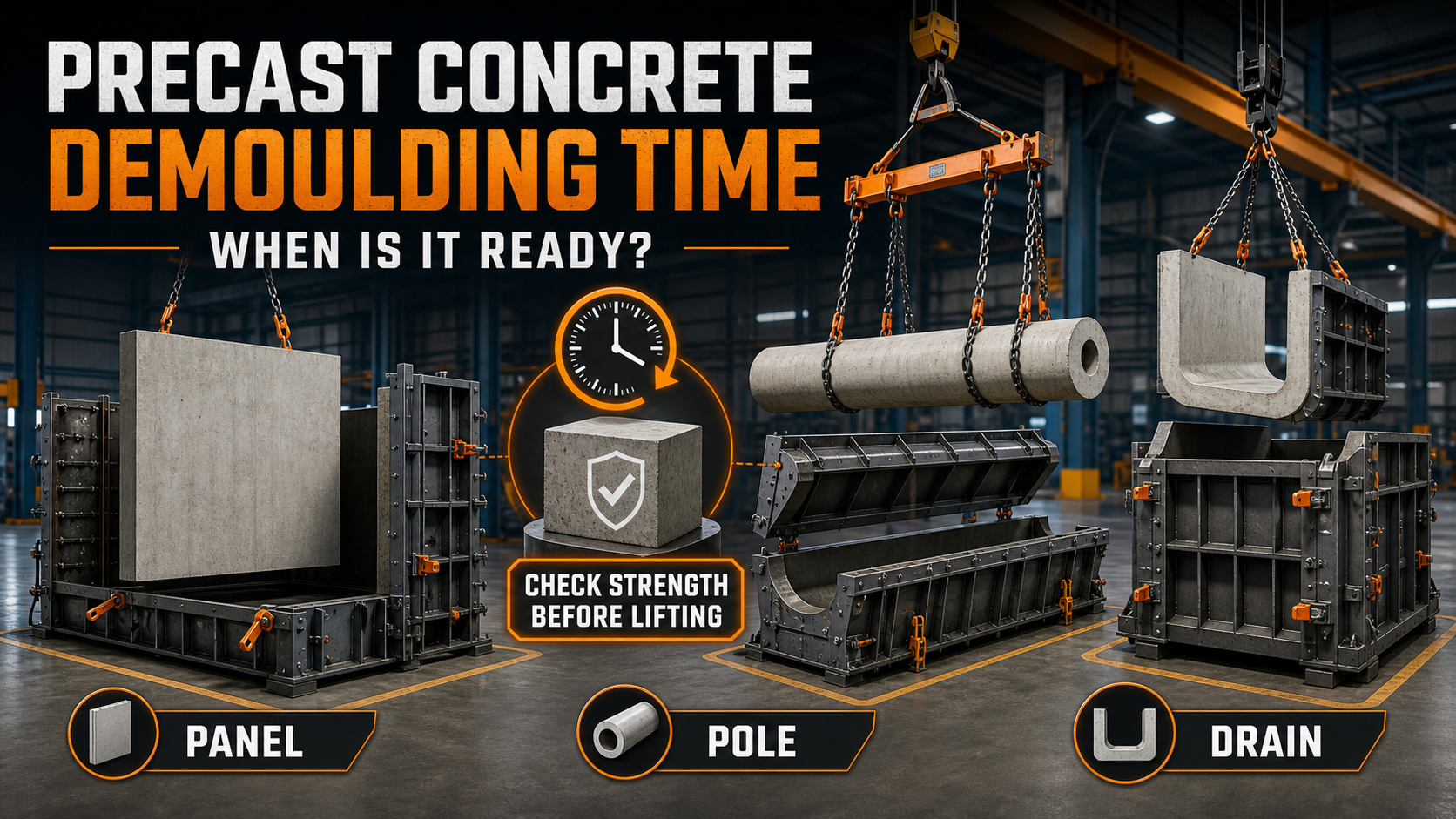
Precast Concrete Demoulding Time: When Is a Panel, Pole or Drain Ready?
Precast Concrete Demoulding Time: When Is a Panel, Pole or Drain Ready?
Demoulding is one of the most critical stages in precast concrete production. Opening a mould too early can cause cracks, broken corners, surface damage and permanent deformation. Waiting unnecessarily long can reduce daily production capacity and increase the number of moulds required.
The correct demoulding time cannot be decided only by counting hours after casting. A precast product should be removed when the concrete has achieved the approved stripping or demoulding strength and can safely resist handling forces.
Concrete mix design, product shape, curing method, weather conditions, lifting system and mould design all influence when a panel, pole or drain is ready.
What Is Precast Concrete Demoulding Time?
Demoulding time is the period between concrete casting and the safe opening or removal of the mould.
It does not necessarily mean that the concrete has achieved its final design strength. It means the product has developed sufficient early strength to:
• Maintain its intended shape • Resist cracking during mould opening • Protect corners and edges • Carry its own weight • Withstand approved lifting forces • Move safely to the curing or storage area • Avoid unacceptable deformation
The required stripping strength should be defined by the project engineer, approved mix design or production quality plan.
Demoulding Time Is Not the Same as Final Curing Time
Demoulding and curing are two different stages.
Demoulding allows the product to be removed from the iron mould. Concrete strength development must continue after demoulding through an approved curing method.
A product that can be safely demoulded may still be unsuitable for transportation, stacking or installation.
The production team should separately define:
• Mould-opening strength • Lifting strength • Stacking strength • Transportation strength • Installation strength • Final design strength
Why Early Demoulding Is Dangerous
Concrete may appear hard on the surface while remaining weak internally. Opening the mould based only on surface appearance can damage the product.
Early demoulding may cause:
• Broken corners • Chipped edges • Surface peeling • Hairline cracks • Structural cracks • Bending of long products • Damage around lifting anchors • Collapse of thin sections • Distorted openings • Excessive deflection • Honeycombing becoming exposed • Complete rejection of the product
Long products such as poles and slender panels are particularly sensitive to bending during lifting.
Problems Caused by Excessively Late Demoulding
Waiting longer than necessary may not damage the concrete, but it can reduce production efficiency.
Possible disadvantages include:
• Lower mould utilisation • Reduced daily production • More moulds required for the same target • Delayed cleaning and preparation • Increased production-cycle time • Higher manufacturing cost • Difficulty removing some inserts • Stronger adhesion where release agent was inadequate
The objective is to demould as soon as the approved stripping strength and safe handling conditions are achieved.
Factors That Affect Precast Demoulding Time
1. Concrete Mix Design
Concrete with suitable early-strength development may become ready sooner than a slower-strength mix.
Important mix-related factors include:
• Cement type • Cement content • Water-cement ratio • Aggregate grading • Chemical admixtures • Supplementary cementitious materials • Concrete workability • Initial concrete temperature
Any change in material source or mix proportions may affect early strength.
2. Required Demoulding Strength
The most reliable demoulding decision is based on verified concrete strength rather than a fixed number of hours.
The required strength depends on:
• Product shape • Product weight • Reinforcement arrangement • Lifting method • Lifting-point location • Unsupported length • Expected handling forces • Project specification • Engineer’s approval
The required value should not be assumed or copied from an unrelated product.
3. Ambient Temperature
Concrete generally develops early strength more slowly in cold conditions and faster in warm conditions.
Low temperatures may significantly delay demoulding. Very high temperatures can also create problems by causing rapid moisture loss and uneven curing.
Temperature should be monitored and recorded during production.
4. Curing Method
Proper curing maintains the moisture and temperature required for cement hydration.
Common precast curing methods include:
• Moist curing • Covered curing • Curing compounds • Controlled chamber curing • Steam or heat-assisted curing • Insulated mould arrangements
Accelerated curing should follow an approved procedure. Uncontrolled heating can cause thermal cracking, surface damage or uneven strength development.
5. Product Size and Shape
Thin, small and compact products may behave differently from long, deep or irregular components.
Products with the following features may require special attention:
• Long unsupported spans • Thin edges • Deep sections • Sharp corners • Large openings • Complex profiles • Heavy embedded components • Uneven thickness • Slender geometry
6. Reinforcement and Lifting Arrangement
Reinforcement helps control cracking, but it does not automatically make weak concrete safe to lift.
Lifting anchors, loops and inserts must be properly positioned and designed for the actual handling load.
The concrete surrounding the lifting point must have sufficient strength before lifting begins.
7. Mould Release Agent
A suitable release agent reduces adhesion between the concrete and the heavy-duty iron mould.
Too little release agent can make demoulding difficult. Excessive or uneven application can cause staining, surface defects and other quality problems.
The release agent should be compatible with the mould, concrete finish and subsequent coating requirements.
8. Mould Opening System
Manual, mechanical and hydraulic moulds apply different forces during opening.
A well-designed iron mould should release the product gradually without pulling, twisting or striking the concrete.
Hinges, locks, wedges and hydraulic systems must operate smoothly.
9. Vibration and Compaction
Correct vibration produces dense concrete and consistent strength.
Insufficient vibration can cause honeycombing and weak edges. Excessive vibration may cause segregation or slurry leakage.
Both conditions can affect the safety and quality of demoulding.
10. Mould Condition and Cleanliness
Hardened concrete, rust, damaged plates and rough joints can hold the product inside the mould.
Before casting, the mould should be:
• Properly cleaned • Correctly aligned • Free from hardened concrete • Uniformly coated with release agent • Securely locked • Checked for damaged surfaces
How to Confirm That Concrete Is Ready for Demoulding
Concrete should not be released based only on colour, surface dryness or operator experience.
A proper verification process may include:
• Testing representative concrete specimens • Using maturity monitoring where approved • Reviewing curing time and temperature • Confirming the specified stripping strength • Inspecting exposed concrete surfaces • Checking lifting-anchor areas • Reviewing the approved production procedure • Obtaining quality-control clearance
Test specimens should represent the concrete used in the product and should be cured under comparable conditions whenever required by the quality plan.
Precast Wall Panel Demoulding
Wall panels can have large surface areas with relatively thin sections. Their edges, lifting points and openings may remain vulnerable during early handling.
Before demoulding a wall panel, confirm:
• Required stripping strength has been achieved • Panel thickness is correct • Lifting anchors are secure • Mould shutters can open freely • Panel edges are not locked by concrete buildup • Lifting equipment is ready • Approved lifting points will be used • The panel will receive uniform support • The storage rack is prepared
The shutters should be opened gradually. Sudden pulling or impact can damage the panel corners.
Large panels should not be lifted from unapproved points. Incorrect lifting can cause bending or cracking even when the concrete has achieved the required demoulding strength.
Precast Concrete Pole Demoulding
Concrete poles are long and slender, making them sensitive to bending and uneven lifting forces.
Before demoulding a pole, check:
• Concrete stripping strength • Pole length and section • Reinforcement position • Lifting-point locations • Condition of lifting inserts • Mould-opening sequence • Crane and lifting-beam capacity • Number and spacing of lifting points • Prepared supporting blocks
The pole should be lifted and supported according to the approved handling procedure.
Dragging a pole from the mould or lifting it from one end can create excessive stress and cracking.
A flip-over column pole mould or mechanically operated system should move smoothly and under controlled conditions.
Precast Drain Demoulding
Precast drains, U-drains and drainage channels may have thin walls, corners and open sections that are vulnerable during demoulding.
Before opening a drain mould, verify:
• Concrete has achieved the approved strength • Internal core can be released safely • Side shutters are completely unlocked • Concrete is not attached to damaged mould surfaces • Edges and corners appear sound • Suitable lifting or turning equipment is available • The drain will receive proper support after removal
The internal core and side shutters should be removed in the designed sequence. Forcing a core out of weak concrete can crack the walls or damage the inner surface.
Recommended Demoulding Sequence
A general demoulding process may follow these steps:
1. Review casting and curing records. 2. Confirm the required concrete strength. 3. Inspect the visible product surface. 4. Prepare the lifting equipment and storage area. 5. Remove non-structural inserts where specified. 6. Release locks and clamps gradually. 7. Open shutters in the designed sequence. 8. Check that the product has separated from the mould. 9. Attach lifting equipment to approved points. 10. Apply the lifting load gradually. 11. Move the product without impact or sudden rotation. 12. Place it on suitable supports. 13. Inspect and record its condition. 14. Continue the approved curing process. 15. Clean and inspect the iron mould.
The exact sequence should follow the mould design and product-specific method statement.
Common Demoulding Mistakes
Using a Fixed Time for Every Product
A small drain and a long concrete pole do not have identical strength and handling requirements.
Demoulding According to Surface Hardness
A hard-looking surface does not confirm sufficient internal concrete strength.
Forcing the Mould Open
Using hammers, bars or excessive hydraulic force can damage the product and iron mould.
Incorrect Lifting Points
Lifting from unapproved positions can create cracking, bending or anchor failure.
Stopping Curing After Demoulding
Concrete must continue to receive the required curing after removal from the mould.
Using Too Much Release Agent
Excessive release agent can cause staining, surface defects and poor adhesion of future coatings.
Ignoring Cold Weather
A production cycle that works in warm conditions may be unsafe during colder weather because strength develops more slowly.
Poor Storage Support
Incorrectly positioned supports can crack or permanently deform a recently demoulded product.
How Iron Mould Design Improves Safe Demoulding
A properly designed heavy-duty iron precast mould supports safe and efficient product release.
Useful mould features include:
• Smooth casting plates • Suitable iron plate thickness • Adequate structural stiffeners • Accurately aligned shutters • Strong hinges • Adjustable locking systems • Removable side shutters • Controlled taper where required • Properly positioned lifting points • Hydraulic or mechanical opening options • Replaceable wear components • Easy-to-clean joints
The mould should open without forcing the concrete product to bend, twist or carry unnecessary load.
Role of Maintenance in Demoulding
Poor mould maintenance increases adhesion and creates unpredictable opening forces.
After every production cycle:
• Remove concrete residue • Clean mould corners and joints • Inspect casting surfaces • Check locks and hinges • Repair damaged welds • Check plate alignment • Inspect structural stiffeners • Apply lubricant to suitable moving parts • Store the mould correctly • Record recurring defects
Damaged or misaligned mould components should be repaired before the next casting cycle.
Demoulding Quality Checklist
Before Opening the Mould:
• Approved stripping strength confirmed • Curing record checked • Product drawing identified • Lifting equipment inspected • Storage area prepared • Locks and shutters accessible • Safety area controlled
During Demoulding:
• Locks released gradually • Shutters opened in sequence • No excessive force applied • Product supported correctly • Approved lifting points used • Lifting load applied smoothly • Product protected from impact
After Demoulding:
• Edges and corners inspected • Surface condition checked • Cracks or defects recorded • Product dimensions checked • Product placed on correct supports • Required curing continued • Mould cleaned and inspected
Final Conclusion
The correct precast concrete demoulding time depends on verified early strength, curing conditions, product geometry, lifting requirements and mould design.
A panel, pole or drain should not be removed only because a particular number of hours has passed. It should be demoulded after achieving the approved stripping strength and meeting all safe-handling requirements.
Panels require careful support because of their large surface area. Poles require controlled lifting because of their long and slender shape. Drains require the correct shutter and core-removal sequence to protect their walls and corners.
Paras Steel Industries manufactures customised heavy-duty iron precast moulds with suitable plate thickness, structural stiffeners, locking systems and opening arrangements for safe and efficient production.
For customised mould specifications and pricing, share your precast product drawing, dimensions, daily production capacity and preferred opening system with Paras Steel Industries.