
Precast Production Guide
Mould Release Agent for Precast Concrete: Selection, Application and Common Mistakes
The correct mould release agent simplifies demoulding, improves concrete finish and protects heavy-duty iron moulds. Learn its types, application process and common mistakes.
By Paras Steel Industries ·
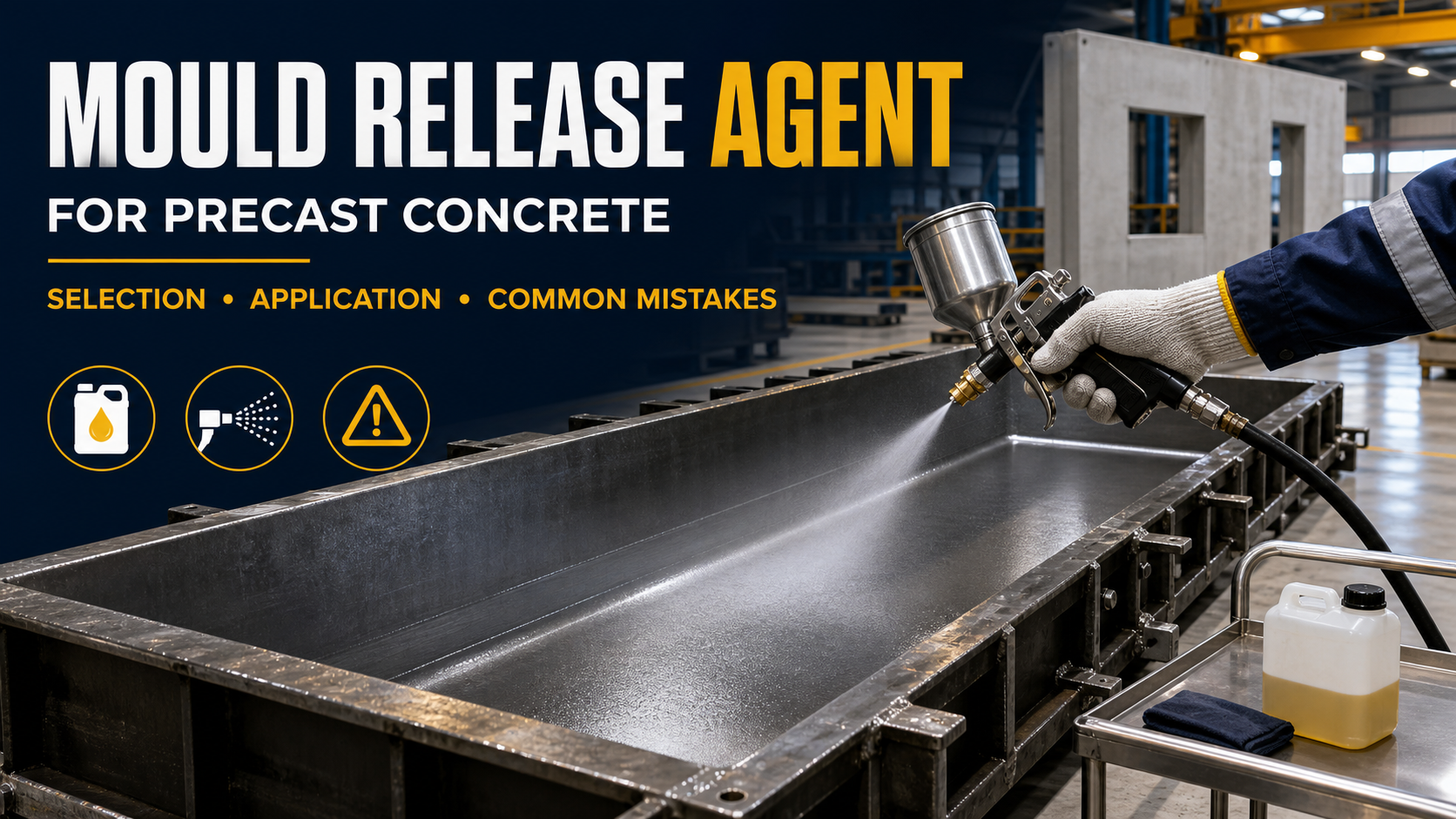
Mould Release Agent for Precast Concrete: Selection, Application and Common Mistakes
Mould Release Agent for Precast Concrete: Selection, Application and Common Mistakes
A mould release agent may appear to be a minor production material, but it directly affects concrete finish, demoulding time, mould cleanliness and product rejection.
Without an appropriate release agent, concrete can stick to the mould surface. Workers may then use hammers, crowbars or excessive force during demoulding, potentially damaging both the finished product and the heavy-duty iron mould.
Applying too much release agent can also create problems. Excess material may cause stains, surface pores, discolouration and difficulty with painting or coating.
The best result comes from selecting a release agent compatible with the concrete, iron mould, production temperature and required surface finish—and then applying it as a thin, uniform film.
This guide explains the types of precast mould release agents, selection factors, application methods, safety requirements and common mistakes to avoid.
What Is a Mould Release Agent?
A mould release agent is a chemical or formulated liquid applied to the internal surface of a concrete mould before casting.
It creates a controlled separation layer between the concrete and mould surface. This layer helps the hardened concrete component release without sticking.
A suitable release agent can provide:
Easier demoulding
Reduced concrete edge damage
Cleaner mould surfaces
Improved product appearance
Reduced manual cleaning
Lower mould wear
Faster production cycles
Reduced use of hammers and pry bars
More consistent concrete finishes
The product is also commonly called mould oil, shuttering oil, form-release oil or demoulding agent. However, these terms can cover products with different formulations and performance levels.
How Does a Concrete Release Agent Work?
Release agents generally work through one or both of the following principles.
Physical Barrier Release
The product creates a thin physical film between the iron mould and concrete. This film prevents direct bonding.
Chemically Reactive Release
The active ingredients react with compounds at the concrete surface, creating a separation layer that supports clean demoulding.
Some commercial products combine barrier and reactive properties.
The release mechanism should be effective without creating an excessively thick or oily coating on the concrete.
Why Release Agent Is Important for Iron Moulds
Heavy-duty iron moulds are designed for repeated production, dimensional accuracy and long operational life. Correct release-agent use supports this performance.
Benefits for iron moulds include:
Reduced concrete adhesion
Easier cleaning after casting
Less aggressive scraping
Reduced hammer damage
Protection against moisture exposure, depending on product formulation
Cleaner flange and corner areas
Reduced buildup in fine details
Faster mould preparation
A release agent is not a replacement for anti-rust coating, correct storage or regular mould maintenance. Its primary function is safe and consistent concrete release.
Types of Mould Release Agents
Mineral Oil-Based Release Agents
These products use an oil-based carrier and are commonly applied to iron shuttering and precast moulds.
Advantages may include:
Easy application
Good water resistance
Suitability for iron surfaces
Useful performance in general precast production
Limitations may include:
Oily concrete surfaces if overapplied
Dust attraction
Potential staining
Possible interference with paint or coatings
Product suitability depends on the specific formulation rather than only the presence of mineral oil.
Water-Based Release Agents
Water-based products contain active release ingredients dispersed or emulsified in water.
Advantages may include:
Lower oily residue
Cleaner working conditions
Easy spray application
Suitability for products requiring a clean finish
Potentially lower solvent exposure, depending on formulation
Limitations may include:
Sensitivity to freezing or extreme storage conditions
Need for correct mixing if supplied as concentrate
Possible separation during long storage
Risk of corrosion if an unsuitable product is used on iron moulds
Before using a water-based release agent on heavy-duty iron moulds, confirm that the product contains appropriate corrosion protection and is approved by its manufacturer for ferrous mould surfaces.
Chemically Reactive Release Agents
Reactive agents form a controlled separation layer through a chemical reaction at the concrete interface.
Advantages may include:
Clean concrete finish
Thin-film performance
Reduced surface staining
Good release with correct application
Limitations may include:
Application rate must be controlled
Performance depends on formulation and concrete mix
May be more expensive than basic shuttering oils
The user should follow the technical data sheet for the specific product.
Vegetable Oil-Based Release Agents
Some products use vegetable-derived components or esters.
Potential advantages include:
Reduced dependence on conventional mineral oils
Good release performance in suitable formulations
Possibly lower odour
Potential limitations include:
Product stability varies
Improperly formulated oils may become sticky
Storage life must be checked
Performance can vary with temperature
Raw cooking oil should not be assumed to perform like a professionally formulated concrete release agent.
Solvent-Based Release Agents
Solvent-carried products can create a thin film and may dry quickly.
Advantages may include:
Fast film formation
Low application thickness
Suitability for selected architectural finishes
Limitations may include:
Flammability concerns
Higher ventilation requirements
Potentially higher VOC emissions
Additional worker-protection requirements
Always review the manufacturer’s safety data sheet before using a solvent-based product.
Wax or Paste Release Agents
Wax and paste formulations may be used for special mould details or selected production applications.
They may provide a durable barrier but require careful manual application.
Excess paste can accumulate in corners and change the finished concrete profile.
Which Release Agent Is Best for Precast Concrete?
There is no single product suitable for every mould and concrete component.
The correct release agent depends on:
Mould material
Concrete mix
Required surface finish
Casting temperature
Curing method
Application equipment
Production cycle
Product shape
Painting requirements
Workplace regulations
Storage conditions
For Paras Steel heavy-duty iron moulds, the release agent should be specifically approved for iron or ferrous concrete formwork.
Do not use a product only because it is labelled as oil. It should be formulated for concrete mould-release applications.
Selection Factors
Compatibility With Iron Moulds
Confirm that the product is suitable for heavy-duty iron mould surfaces.
An incompatible water-based product may contribute to surface corrosion. An unsuitable oil may leave excessive residue.
Concrete Surface Finish
Products requiring an exposed architectural finish need a release agent that minimises staining and surface variation.
For ordinary infrastructure products, finish requirements may be less demanding, but consistency remains important.
Painting and Coating Requirements
If the finished concrete will be painted, plastered, coated, tiled or bonded, select a release agent that does not prevent adhesion.
Confirm compatibility with the coating supplier and release-agent manufacturer.
Concrete Mix Design
The release agent should work with the cement type, supplementary cementitious materials and admixtures in the concrete.
A trial casting is recommended when the mix changes significantly.
Curing Method
Steam curing, heated moulds and high-temperature production may require a release agent formulated for those conditions.
Production Temperature
Some oils become thick at low temperatures, while some products evaporate or become less effective at high temperatures.
Application Method
Select a formulation suitable for the available spray gun, roller, cloth or brush.
Worker Safety
Check odour, flammability, ventilation needs, skin-contact precautions and safety-data-sheet requirements.
Environmental Requirements
Consider VOC restrictions, spill management, waste disposal and local workplace rules.
Coverage and Cost Per Casting
The cheapest product per litre may not be the most economical.
Compare:
Recommended coverage
Application time
Demoulding performance
Cleaning time
Product rejection
Mould maintenance
Cost per casting cycle provides a more useful comparison than container price alone.
How Much Release Agent Should Be Applied?
Release agent should generally form a thin, continuous and uniform film.
The correct application rate varies by product. Always follow the technical data sheet.
Applying more than the recommended quantity does not improve release. It can cause:
Concrete staining
Surface pores
Discolouration
Oily patches
Dust accumulation
Loss of sharp detail
Difficulty with painting
Concrete surface softness in severe cases
Release agent should not collect in puddles, corners, grooves or flange joints.
Correct Application Process
Step 1: Clean the Iron Mould
Remove concrete deposits, dust, rust particles and old sticky release material.
Release agent should be applied to a clean and dry surface unless the product instructions state otherwise.
Step 2: Inspect the Mould
Check the iron plates, joints, corners, flanges, groove formers and decorative liners.
Repair damaged surfaces before application.
Step 3: Read the Product Instructions
Review:
Recommended dilution
Application rate
Required drying time
Suitable mould materials
Temperature limits
Safety precautions
Storage instructions
Some products are ready to use. Others are concentrates that require controlled dilution.
Step 4: Mix or Agitate if Required
Water-based emulsions and concentrates may require mixing before use.
Do not add water or solvent unless the manufacturer permits it.
Step 5: Select the Application Equipment
Common methods include:
Low-pressure spray gun
Airless sprayer
Hand-pressure sprayer
Roller
Brush
Clean cloth or mop
Spraying generally provides a more uniform thin film when the nozzle and pressure are correctly adjusted.
Step 6: Apply a Thin Coat
Hold the spray nozzle at a consistent distance and move it evenly across the mould.
Use overlapping passes to prevent dry areas.
Step 7: Remove Excess Material
Use a clean cloth, rubber wiper or suitable tool to remove puddles and runs.
Pay particular attention to:
Corners
Grooves
Embossed details
Bolt recesses
Horizontal base areas
Low points
Step 8: Allow the Film to Stabilise
Some release agents require evaporation or drying time before concrete placement.
Follow the stated waiting period.
Step 9: Check the Surface
The mould should have a thin and consistent film rather than a visibly wet layer.
Step 10: Cast the Concrete
Position reinforcement carefully to avoid scraping the release film away from the mould surface.
Best Application Methods
Spray Application
Spraying is usually effective for large iron moulds and repeated factory production.
Advantages:
Fast coverage
Thin film
Reduced material usage
Access to corners and vertical surfaces
Requirements:
Correct nozzle
Controlled pressure
Regular nozzle cleaning
Suitable worker protection
Brush Application
Brushes can be useful for small moulds and complex details.
Limitations include uneven coating and greater risk of excessive application.
Roller Application
A roller provides practical coverage on large flat surfaces but may leave heavy material at edges if overloaded.
Cloth Application
A clean cloth can spread a very thin film on small iron moulds or remove excess product after spraying.
Automatic Spray System
Large production plants may install fixed or mobile automatic spraying systems.
Benefits can include:
Consistent application rate
Reduced labour
Faster mould preparation
Lower release-agent consumption
The system must prevent nozzle blockage and overspray.
Common Mould Release Agent Mistakes
Using Waste Engine Oil
Used engine oil is not a properly formulated concrete release agent.
It may contain contaminants, metal particles and combustion residues. It can create staining, worker-safety concerns and inconsistent concrete surfaces.
Applying Too Much Product
A thick oily layer is one of the most common mistakes.
It can affect concrete colour, surface texture and coating adhesion.
Applying Too Little Product
Dry areas may cause concrete to stick to the iron mould, particularly at corners and grooves.
Uneven Application
Heavy and light areas create inconsistent concrete appearance and release performance.
Applying Over Concrete Buildup
Release agent cannot correct an unclean mould surface. Existing deposits may transfer their shape to the next product.
Ignoring Low Points
Excess material collects in horizontal corners and recesses, producing dark stains or surface defects.
Using the Wrong Dilution
Over-dilution can reduce release performance. Under-dilution can leave excessive residue.
Mix only according to the manufacturer’s instructions.
Mixing Different Products
Different release agents may not be chemically compatible. Mixing can create separation, gel formation or unpredictable performance.
Using an Unsuitable Sprayer
Some products damage seals or block nozzles in incompatible spraying equipment.
Allowing Dust to Settle
A mould coated too early may collect factory dust before casting.
Ignoring Paint Compatibility
Some oily residues can prevent coatings from bonding correctly to the finished concrete.
Poor Storage
Release agents may deteriorate when exposed to heat, freezing, water contamination or direct sunlight.
Not Conducting Trial Castings
A full production run should not be the first test of a new release agent.
Conducting a Trial Casting
Before changing products, complete a controlled trial.
Use one clean mould and record:
Release-agent name
Dilution ratio
Application method
Quantity used
Ambient temperature
Concrete mix
Waiting time
Demoulding time
Release effort
Surface finish
Presence of stains
Mould cleanliness
Coating adhesion, if required
Compare the trial against the existing production result.
Surface Defects Related to Release Agent
Dark or Oily Stains
Possible causes:
Excess release agent
Product pooling
Incompatible formulation
Insufficient drying time
Pinholes and Surface Voids
Possible causes:
Overapplication
Air trapped against an oily film
Incorrect concrete compaction
Surface Softness
Possible causes:
Extremely heavy application
Contaminated release product
Chemical incompatibility
Uneven Colour
Possible causes:
Uneven spraying
Mixed release products
Different drying periods
Dust contamination
Concrete Sticking
Possible causes:
Insufficient coverage
Dry areas
Poor mould cleaning
Unsuitable product
Film removed during reinforcement placement
Not every surface defect is caused by release agent. Concrete mix, vibration, curing and mould condition must also be inspected.
Impact on Concrete Painting and Coating
Release-agent residue can affect:
Paint
Protective coating
Plaster
Tile adhesive
Repair mortar
Waterproofing
Sealants
If the concrete requires a secondary coating, select a compatible release agent and complete adhesion trials.
The concrete surface may require cleaning or preparation according to the coating manufacturer’s instructions.
Do not assume that a surface looking clean is automatically free of bond-breaking residue.
Release Agent for Decorative Moulds
Embossed and textured moulds require special attention because release agent can collect inside small recesses.
Best practices include:
Use fine spray equipment.
Apply the thinnest effective film.
Remove puddles from deep details.
Inspect corners under good lighting.
Clean texture liners regularly.
Complete a finish trial before bulk production.
Too much product can reduce pattern sharpness and create dark areas.
Release Agent for Large Wall-Panel Moulds
Large horizontal moulds require consistent coverage across a broad area.
The operator should follow an organised spraying pattern, such as moving from one end to the other in overlapping passes.
Important points include:
Maintain consistent nozzle distance.
Avoid walking over treated areas.
Inspect against reflected light.
Remove pooling near side shutters.
Apply shortly before casting where practical.
Prevent factory dust from settling.
Release Agent for Column and Pole Moulds
Long pole moulds can develop dry spots along their length.
Workers should inspect:
Groove formers
Narrow corners
End plates
Flange joints
Long vertical surfaces
Areas behind reinforcement spacers
Spray lances or suitable extension nozzles may help reach difficult sections.
Release Agent for Box Culvert and Drain Moulds
Inner cores and deep side shutters require uniform application because concrete can grip multiple surfaces during demoulding.
Pay attention to:
Internal corners
Core edges
Hinged joints
Contracting sections
Tapered surfaces
Release agent alone cannot compensate for insufficient demoulding taper or a damaged inner core.
Effect on Mould Life
Correct release-agent use can extend useful mould life indirectly by reducing:
Concrete adhesion
Aggressive scraping
Hammer impact
Corner damage
Cleaning time
Wear on decorative details
However, release agent cannot prevent structural damage caused by:
Excessive concrete pressure
Incorrect lifting
Weak stiffeners
Poor welding
Over-vibration
Misaligned clamps
Long-Term Mould Cleaning
Over time, some release agents can create sticky deposits if they are overapplied or incompatible.
A maintenance schedule should include:
Daily removal of fresh concrete
Periodic degreasing, where appropriate
Inspection for carbonised or sticky film
Cleaning of spray nozzles
Removal of buildup from corners
Inspection of iron surfaces for corrosion
Use cleaning products compatible with the release agent and mould coating.
Worker Safety
Release agents are industrial chemicals and should be handled according to their label and safety data sheet.
General precautions include:
Wear suitable gloves.
Use eye protection.
Provide ventilation.
Avoid breathing spray mist.
Keep flammable products away from ignition sources.
Clean spills immediately.
Store containers closed and labelled.
Do not transfer products into unmarked bottles.
Provide worker training.
Use respiratory protection only where required by the product instructions and workplace risk assessment.
Storage Requirements
Keep release agent:
In its original labelled container
Away from direct sunlight
Within the recommended temperature range
Protected from water contamination
Away from incompatible chemicals
Inside a controlled storage area
Use stock rotation and check the expiry or recommended storage life.
How to Compare Release-Agent Cost
Calculate the total production cost using:
Purchase price per litre
Actual coverage per litre
Number of moulds coated
Application labour
Cleaning labour
Concrete rejection rate
Mould-repair cost
Time saved during demoulding
A more expensive, high-coverage product may cost less per finished component than a cheap oil requiring heavy application.
Selection Checklist
Before purchasing a release agent, confirm:
It is designed for concrete moulds.
It is suitable for heavy-duty iron surfaces.
It matches the required concrete finish.
It is compatible with subsequent coatings.
It suits the curing temperature.
It can be applied with available equipment.
The technical data sheet is available.
The safety data sheet is available.
Workers can follow the safety requirements.
A trial casting has been successful.
Questions to Ask the Supplier
Is the product suitable for iron precast moulds?
Is it ready to use or concentrated?
What is the recommended dilution?
What is the recommended coverage?
How should it be applied?
Does it require drying time?
Is it compatible with steam curing?
Will it affect concrete paint or coating adhesion?
What storage temperature is required?
Which safety precautions are necessary?
How should equipment be cleaned?
Does it contain corrosion inhibitors for iron surfaces?
Final Recommendation
The best mould release agent is not the one that creates the thickest oily film. It is the product that provides consistent demoulding with the thinnest effective and uniform application.
For dependable precast production:
Select a product approved for heavy-duty iron moulds.
Follow the technical data sheet.
Keep the mould clean.
Apply a thin, even film.
Remove excess material.
Complete a trial casting.
Monitor the finished concrete surface.
Train workers to use one standard process.
Correct selection and application can improve product finish, reduce cleaning time and protect the mould from unnecessary mechanical damage.
Paras Steel Industries manufactures heavy-duty iron moulds for wall panels, columns, poles, drains, barriers, foundations and other precast products. Proper mould cleaning, release-agent application and maintenance support reliable long-term production.
Frequently Asked Questions
What is a mould release agent?
It is a formulated product applied between the iron mould and concrete to simplify demoulding and reduce sticking.
Can ordinary oil be used as a release agent?
A properly formulated concrete release agent is recommended. Ordinary or used oils may cause staining, inconsistent release and safety concerns.
How much release agent should be applied?
Apply only the thin, uniform quantity specified in the product’s technical data sheet. The mould should not contain puddles.
Can release agent damage concrete paint?
Some products or excessive residue can affect coating adhesion. Check compatibility and conduct an adhesion trial.
Is a water-based agent suitable for iron moulds?
It can be suitable if specifically formulated and approved for ferrous mould surfaces with appropriate corrosion protection.
Should release agent be applied before every casting?
Follow the product instructions and inspect the mould before each cycle. Most production processes require controlled application before casting.
What causes concrete to stick to the mould?
Possible causes include insufficient coverage, dry spots, dirty mould surfaces, an unsuitable product or premature demoulding.
Can too much release oil create pinholes?
Excessive or uneven application can contribute to surface pores and other defects, although concrete mix and vibration should also be checked.
Which application method is best?
Low-pressure spraying commonly provides a thin and uniform coat. The best method depends on the product formulation and mould design.
How should a new product be tested?
Apply it to one clean mould, complete a controlled casting and evaluate demoulding, surface finish, mould cleanliness and coating compatibility.