
Precast Business Guide
Precast Garden Bench Mould: Manufacturing Process, Designs and Business Opportunity
Explore precast garden bench mould designs, sizes and the complete manufacturing process for starting or expanding an outdoor concrete furniture business.
By Paras Steel Industries ·
Precast Garden Bench Mould: Manufacturing Process, Designs and Business Opportunity
Precast Garden Bench Mould: Manufacturing Process, Designs and Business Opportunity
Precast concrete benches are widely installed in public parks, gardens, housing societies, schools, hospitals, railway stations and commercial landscaping projects.
They provide durable outdoor seating with comparatively low maintenance. Unlike wooden furniture, concrete benches are not affected by termites or rotting and can withstand outdoor weather conditions when manufactured correctly.
A precast garden bench mould helps manufacturers produce uniform bench legs, seat planks and backrests in repeatable dimensions.
The business can complement an existing precast unit because manufacturers may already have concrete-mixing, vibration, curing and material-handling facilities.
This guide explains garden bench mould designs, sizes, manufacturing steps, required machinery, cost factors and business opportunities.
What Is a Precast Garden Bench Mould?
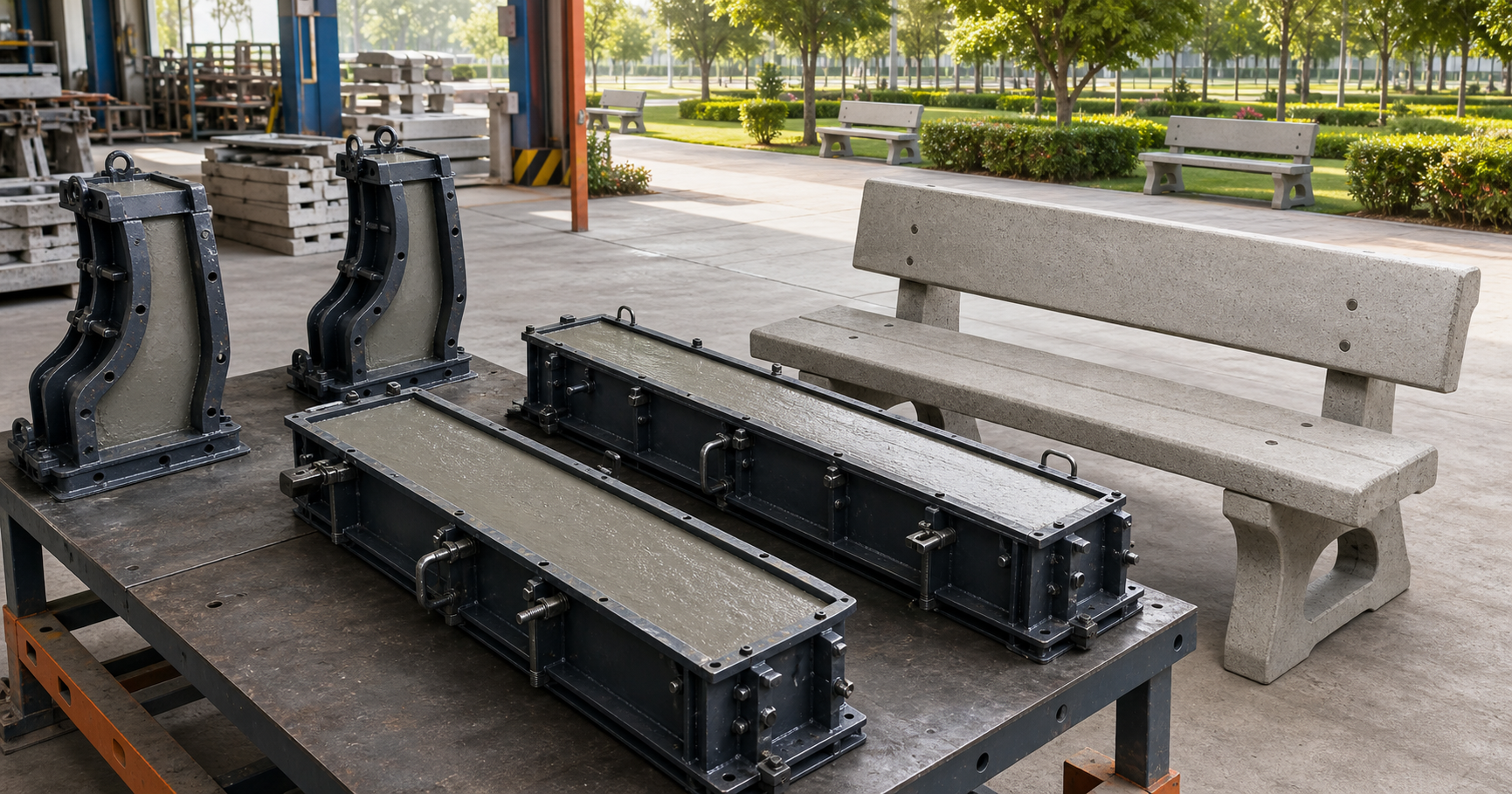
A precast garden bench mould is a heavy-duty iron form used to manufacture the individual concrete components required to assemble an outdoor bench.
A complete mould set generally includes dedicated moulds for:
Two side legs or support frames
One concrete seat plank
One concrete backrest plank
Nut and bolt inserts
Alignment and fixing provisions
The components are normally cast separately, cured and then connected using suitable bolts and fixing hardware.
A modular design makes transportation, handling and replacement easier than moving a completely assembled concrete bench.
Benefits of Concrete Garden Benches
Outdoor Durability
Properly manufactured concrete benches can tolerate sun, rain and regular public use.
Termite and Rot Resistance
Concrete does not suffer from termite attacks or timber decay.
Low Maintenance
The benches can be cleaned, repainted or sealed without extensive maintenance.
Suitable for Public Spaces
Their weight and robust construction make them suitable for parks, campuses and other high-traffic locations.
Custom Appearance
Manufacturers can offer different colours, surface patterns, support profiles and decorative finishes.
Repeat Production
A precision-made heavy-duty iron mould supports the production of uniform components across repeated casting cycles.
Main Components of a Bench Mould Set
Side-Leg Moulds
The side legs support the seat and backrest. A complete bench normally requires two matching support components.
The leg profile may be straight, curved, angled or decorative. It can also include fixing provisions for the seat and backrest planks.
Seat-Plank Mould
The seat-plank mould produces the horizontal seating surface.
The plank should provide sufficient width, thickness and structural reinforcement for the intended span and usage.
Backrest-Plank Mould
The backrest improves user comfort and helps create the final bench design.
It may be a single broad panel or multiple narrow slats, depending on the model.
Insert and Bolt Holders
Pre-positioned nut holders, dowel pins or bolt inserts help align the components during final assembly.
Accurate positioning reduces drilling and adjustment work after curing.
Popular Garden Bench Designs
Standard Straight Bench
A standard bench uses straight seat and backrest planks with two side supports.
It is practical for public parks, schools, housing societies and institutional projects.
Curved-Support Bench
Curved or ergonomically shaped side legs can improve appearance and sitting comfort.
The mould requires accurate profiling to ensure both supports have identical geometry.
Bench Without Backrest
A backless bench uses a seat plank fixed to two or more support legs.
This compact design is suitable for walking tracks, bus stops, sports grounds and spaces where seating access is required from both sides.
Slatted Concrete Bench
A slatted design uses several narrow concrete planks instead of one broad seat or backrest.
Individual slats can simplify replacement but require more inserts and assembly hardware.
Decorative Garden Bench
Decorative supports may include curved edges, geometric profiles or architectural surface patterns.
These models are suitable for landscaped gardens, resorts and premium residential projects.
Heavy-Duty Public Bench
A heavy-duty design uses thicker seat and backrest components for busy public spaces such as stations, plazas and transport facilities.
Custom Logo or Name Bench
Project names, municipal markings or approved logos can be incorporated using removable inserts or surface designs.
Any text or branding should be confirmed before mould production begins.
Standard Garden Bench Sizes
Two-Seater Bench
A typical two-seater park bench may have:
Plank length: approximately 1200 mm or 4 feet
Total height: approximately 750 to 800 mm
Seat height: approximately 400 to 450 mm
Seat depth: approximately 400 to 450 mm
Three-Seater Bench
A typical three-seater garden bench may have:
Plank length: approximately 1500 mm or 5 feet
Total height: approximately 800 mm
Seat height: approximately 450 mm
Plank thickness: approximately 50 to 60 mm
Four-Seater Bench
A heavy-duty four-seater public bench may have:
Plank length: approximately 1800 mm or 6 feet
Total height: approximately 800 to 850 mm
Plank thickness: approximately 60 to 75 mm
These dimensions are indicative. Final sizes should follow the required bench design, reinforcement calculation and customer specifications.
Important Mould Features
Heavy-Duty Iron Construction
Paras Steel Industries manufactures garden bench moulds using heavy-duty iron.
Approximately 4 mm to 6 mm iron plates may be used depending on the mould component, dimensions and expected production requirements.
Strong iron construction helps the mould resist concrete pressure and vibration.
Reinforced Frame
Heavy flat bars, iron angles and tubular stiffeners support the mould profile.
Correct reinforcement helps maintain straight planks and identical side-leg components.
Precision-Cut Profiles
Accurately cut side profiles support smooth contours, correct seating geometry and consistent component dimensions.
Integrated Insert Holders
Built-in nut, bolt and dowel positions help maintain alignment during final bench assembly.
Smooth Contact Surfaces
Clean and accurately finished mould surfaces can reduce concrete imperfections and additional plastering work.
Easy Manual Demoulding
Removable borders and convenient lifting handles allow workers to release cured components without damaging their edges.
Vibrator Compatibility
The mould set can be used with a suitable vibrator table or portable formwork vibrator, depending on the production setup.
Garden Bench Manufacturing Process
Step 1: Select the Bench Design
Confirm the required seating capacity, total length, seat height, backrest angle and support profile.
Prepare drawings for every individual component.
Step 2: Inspect and Clean the Mould
Remove hardened concrete, dust and residue from all mould surfaces.
Inspect the borders, insert holders, locks and lifting handles.
Step 3: Apply Release Agent
Apply a suitable concrete mould-release agent evenly across all contact surfaces.
Avoid excessive application because it may affect the finished surface.
Step 4: Prepare the Reinforcement
Cut, bend and assemble the reinforcement according to the approved component design.
Seat planks, backrests and supporting legs may require different reinforcement arrangements.
Step 5: Position Inserts
Install threaded nuts, fixing inserts or dowel provisions in the exact mould locations.
Secure them to prevent movement during concrete pouring and vibration.
Step 6: Position the Reinforcement
Place the reinforcement inside each mould component using suitable spacers.
Maintain the specified concrete cover on all sides.
Step 7: Prepare the Concrete
Measure cement, sand, aggregates, water and approved admixtures accurately.
Use a concrete mixer machine to prepare a uniform batch according to the required mix design.
Avoid adding excessive water solely to simplify pouring.
Step 8: Pour the Concrete
Place concrete gradually into the leg, seat and backrest moulds.
Ensure that narrow areas and insert locations receive sufficient concrete.
Step 9: Compact the Concrete
Use a suitable vibrator table or formwork vibrator to remove trapped air.
Proper vibration helps create denser concrete and cleaner surfaces.
Avoid excessive vibration that may cause aggregate segregation or insert movement.
Step 10: Finish Exposed Surfaces
Level and smooth exposed surfaces after vibration.
Remove excess concrete from mould edges and insert points.
Step 11: Cure the Components
Allow the components to set before demoulding.
Continue curing after removal according to the approved concrete process. Proper curing is essential for strength and crack resistance.
Step 12: Demould Carefully
Open the mould borders and lift the components using the designed handling points.
Do not force the concrete legs or planks out of the mould.
Step 13: Inspect the Components
Check every part for:
Correct dimensions
Straight alignment
Smooth surface
Cracks or chipped edges
Correct insert locations
Uniform colour and finish
Step 14: Assemble the Bench
Align the seat plank and backrest with the side supports.
Use suitable corrosion-resistant bolts and washers. Tighten them evenly without damaging the concrete.
Step 15: Apply the Final Finish
Depending on the product range, the finished bench may receive:
Concrete sealer
Exterior paint
Stone-effect coating
Smooth natural finish
Decorative colour finish
Project-specific branding
Step 16: Store and Transport Safely
Store assembled benches or separate components on level supports.
Use protective padding during transportation to prevent edge damage.
Machinery and Equipment Required
A basic garden bench production setup may require:
Concrete mixer machine
Garden bench mould set
Vibrator table or suitable vibrator
Reinforcement cutting tools
Reinforcement bending tools
Material weighing equipment
Water-measuring system
Concrete transportation trolley
Lifting and handling equipment
Curing area or water arrangement
Assembly tools
Finished-product storage space
Existing precast manufacturers may already own much of this equipment.
Raw Materials Required
Typical raw materials include:
Cement
Fine aggregate
Coarse aggregate
Water
Approved admixtures
Reinforcement bars or wire
Threaded inserts
Nuts, bolts and washers
Release agent
Exterior paint or sealer
The exact material specification should follow the required concrete strength and product design.
Garden Bench Business Opportunity
Municipal Park Development
Municipal bodies and landscape contractors purchase outdoor benches for public parks, walking tracks, gardens and urban plazas.
Housing Societies
Apartment complexes and gated communities require seating around gardens, clubhouses and walking areas.
Schools and Colleges
Educational institutions use concrete benches in playgrounds, courtyards, corridors and campus gardens.
Hospitals
Hospitals and healthcare campuses require durable outdoor seating for patients and visitors.
Railway and Bus Facilities
Transport locations use heavy-duty seating around platforms, waiting areas and rest stops.
Resorts and Hotels
Hospitality projects require decorative outdoor benches for gardens, pathways and recreational spaces.
Industrial Campuses
Factories, warehouses and office campuses install benches in rest areas and landscaped sections.
Real Estate Projects
Developers use precast benches as part of residential and commercial landscape packages.
Religious and Community Spaces
Temples, community halls and public gathering areas often require weather-resistant outdoor seating.
How to Estimate Production Cost
Calculate the cost of each bench using the following components:
Cement and aggregate cost
Reinforcement cost
Insert and hardware cost
Paint or surface-finish cost
Electricity or fuel
Worker wages
Demoulding and assembly labour
Curing and water expense
Packing and loading
Transportation cost
Mould depreciation
Product rejection allowance
Administrative and marketing expenses
Do not calculate profit only from the raw concrete cost. Heavy concrete benches can involve significant handling and transportation expenses.
Factors Affecting Selling Price
Bench Size
A six-foot bench requires more concrete, reinforcement and handling than a four-foot model.
Design Complexity
Curved supports, multiple slats and decorative patterns require additional moulding and assembly work.
Surface Finish
Coloured, textured, polished or branded benches may command a higher price than basic grey products.
Order Quantity
Large project orders may reduce per-unit production and transportation costs.
Delivery Distance
Concrete benches are heavy. Transportation can significantly affect the final delivered price.
Installation Requirement
Some customers may require unloading, assembly, anchoring or complete site installation.
Sales and Marketing Strategies
Create a Product Catalogue
Show different bench sizes, designs, finishes and applications using clear photographs.
Display Sample Benches
Install sample benches outside the factory or at a visible dealer location.
Contact Landscape Contractors
Landscape contractors regularly work with parks, housing projects and institutional customers.
Connect with Builders
Builders and real-estate developers may purchase benches as part of complete site-development packages.
Approach Government Contractors
Registered contractors handling municipal and institutional projects can become recurring buyers.
Offer Custom Finishes
Provide colour, surface-pattern and project-name options where commercially practical.
Use Local SEO
Create location-based pages and listings targeting searches such as precast garden bench manufacturer, concrete park bench supplier and RCC bench mould manufacturer.
Maintenance Tips for the Mould
Clean every mould component immediately after use.
Remove concrete from corners and insert holders.
Apply release agent before each casting cycle.
Inspect iron plates for bending or surface damage.
Check handles, locks and removable borders.
Protect exposed iron surfaces from rust and moisture.
Store all mould components on a level platform.
Keep matching insert pins and hardware organised.
Frequently Asked Questions
Which material is used to manufacture the mould?
Paras Steel Industries manufactures garden bench moulds using heavy-duty iron.
Which components are included in a bench mould set?
A complete set may include moulds for two support legs, a seat plank and a backrest, along with fixing-insert provisions.
What sizes are available?
Common bench lengths include approximately 4 feet, 5 feet and 6 feet. Custom sizes can also be discussed.
Which iron plate thickness is used?
Depending on the component and design, approximately 4 mm to 6 mm heavy-duty iron plates may be used.
Can custom bench designs be manufactured?
Yes. Side-support profiles, plank sizes, surface patterns and insert positions can be customised according to the drawing.
Which vibration system is suitable?
The mould can be used with a suitable vibrator table or portable formwork vibrator.
Is this product suitable for an existing precast unit?
Yes. Manufacturers already producing concrete products may be able to use their existing mixing, vibration, curing and handling equipment.
How can I request a quotation?
Share the bench design, dimensions, required mould components, expected output and delivery location with Paras Steel Industries.
Conclusion
A precast garden bench mould enables manufacturers to produce durable outdoor seating for public, residential, institutional and commercial projects.
The right mould set should provide accurate component dimensions, strong iron construction, convenient demoulding and correctly positioned assembly inserts.
The business opportunity depends on local demand, product design, production efficiency, selling price and transportation planning.
Paras Steel Industries manufactures heavy-duty iron mould sets for two-seater, three-seater, four-seater and custom concrete garden benches.
Contact Paras Steel Industries with your bench design and production requirements to discuss a suitable mould set and quotation.