
Precast Infrastructure Moulds
RE Wall Panel Mould: Types, Sizes, Price Factors and Applications
Learn how to select the right RE wall panel mould by comparing panel shapes, standard sizes, steel construction, price factors and infrastructure applications.
By Paras Steel Industries ·
RE Wall Panel Mould: Types, Sizes, Price Factors and Applications
RE Wall Panel Mould: Types, Sizes, Price Factors and Applications
Reinforced earth walls are widely used in highways, bridges, flyovers and large infrastructure projects. These structures require accurately manufactured concrete facing panels that can withstand soil pressure, structural loads and demanding site conditions.
An RE wall panel mould helps precast manufacturers produce these facing panels with consistent dimensions, smooth surfaces and correctly positioned connection provisions. Choosing the right mould is essential for maintaining panel quality, improving production speed and reducing rejection during installation.
This guide explains the main types of RE wall panel moulds, commonly used sizes, important price factors and their applications in infrastructure construction.
What Is an RE Wall Panel Mould?
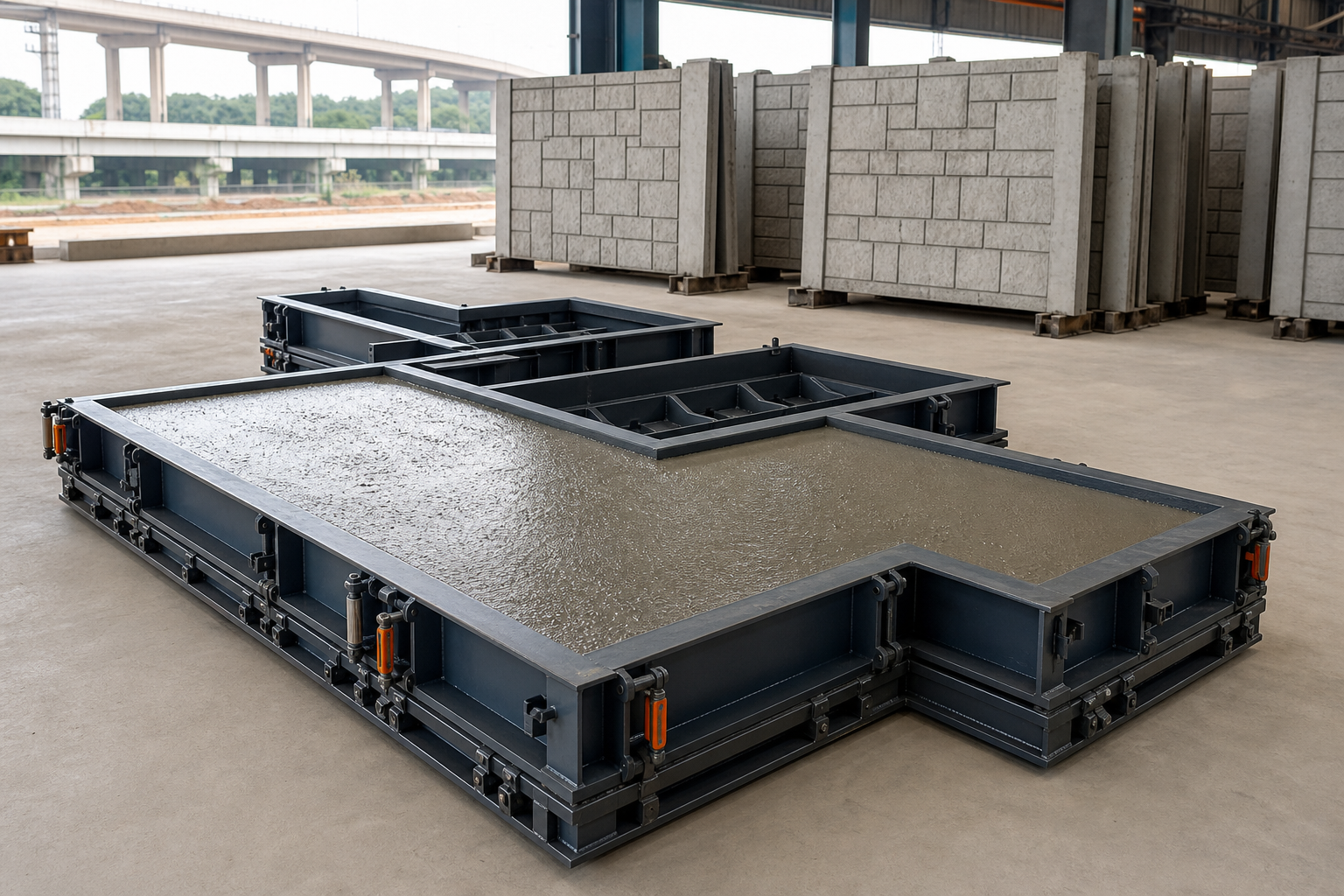
An RE wall panel mould is a specially engineered steel form used to manufacture precast concrete facing panels for reinforced earth retaining wall systems.
The panels form the visible outer face of the retaining wall. They are connected to steel strips, polymeric reinforcement or geogrid systems extending into the compacted soil behind the wall.
Because individual panels must fit together accurately, the mould needs to maintain precise dimensions, clean edges and correctly positioned connector slots throughout repeated casting cycles.
RE wall moulds are generally designed as horizontal casting tables. Concrete is poured over the base surface, compacted and cured before the hinged or removable borders are opened for demoulding.
Major Types of RE Wall Panel Moulds
RE wall panels are manufactured in different shapes according to structural drawings, project specifications and architectural requirements.
Cruciform RE Wall Panel Mould
Cruciform or plus-shaped panels are commonly used in reinforced earth wall construction. Their interlocking profile helps create an organised facing pattern while supporting accurate panel alignment.
Typical cruciform panel sizes include:
1500 x 1500 x 180 mm
1500 x 1500 x 220 mm
1800 x 1500 x 200 mm
The exact size and thickness depend on wall height, loading conditions and the approved structural design.
Square RE Wall Panel Mould
Square panels provide a simple and uniform facing arrangement. They are suitable for highway retaining walls, flyover approaches, bridge structures and land development projects.
A commonly used square panel size is 1500 x 1500 mm, with thickness generally ranging from 180 mm to 220 mm.
Rectangular RE Wall Panel Mould
Rectangular panels are selected when the wall design requires longer facing units or a specific installation pattern.
Common rectangular panel dimensions include:
2000 x 1000 x 200 mm
2000 x 1500 x 220 mm
Custom dimensions can also be manufactured according to the contractor’s technical drawing.
Hexagonal and Custom Interlocking Panel Moulds
Hexagonal and custom interlocking panels are used for specialised structural or architectural requirements. These panels can provide a distinctive wall appearance while satisfying the engineering requirements of the project.
Typical dimensions may include:
1200 x 1200 x 180 mm
1500 x 1500 x 200 mm
Custom moulds can be developed when standard shapes or dimensions are unsuitable for the approved wall design.
Important Features of a Quality RE Wall Panel Mould
The performance of an RE panel mould depends on its material, fabrication accuracy, locking arrangement and base support system.
Heavy-Duty Steel Construction
Industrial RE wall panel moulds are commonly manufactured using high-grade mild steel or IS 2062 structural steel. Strong steel construction helps the mould resist deformation under the weight of wet concrete.
Base plates may be manufactured using 6 mm, 8 mm or 10 mm heavy-duty MS sheets. The required thickness depends on the panel size, concrete load, mould design and expected production cycles.
Anti-Deflection Support
Heavy C-channels, ISMC sections and structural angles support the mould base. This reinforcement helps prevent bending or sagging, which could otherwise affect the thickness and surface level of the finished panel.
Quick-Release Side Borders
Hinged or removable side borders allow the mould to open smoothly after curing. A properly designed release system reduces demoulding time and helps protect the edges and corners of the concrete panel.
Interchangeable Surface Liners
Different projects may require plain, ribbed, corrugated or custom-patterned panel surfaces. Interchangeable liner plates allow manufacturers to produce multiple finishes using a suitable mould configuration.
Connector Positioning Slots
RE panels require provisions for steel strips, polymeric loops or geogrid connectors. Pre-engineered slots and inserts hold these components in the correct position during concrete pouring and vibration.
Accurate positioning is important because misplaced connectors can create problems during wall installation.
Slurry-Tight Sealing
Rubber gaskets, heavy clamps and properly fitted joints help prevent cement slurry leakage. Leak-proof borders produce cleaner edges and reduce finishing or repair work after demoulding.
Common RE Wall Panel Mould Sizes
There is no single size suitable for every reinforced earth wall project. Panel dimensions are selected according to structural drawings, wall height, soil conditions and reinforcement design.
Frequently used panel dimensions include:
1500 x 1500 x 180 mm
1500 x 1500 x 200 mm
1500 x 1500 x 220 mm
1800 x 1500 x 200 mm
2000 x 1000 x 200 mm
2000 x 1500 x 220 mm
The standard panel thickness generally ranges from 180 mm to 220 mm. However, customised dimensions and thicknesses may be required for particular infrastructure projects.
Before ordering a mould, the buyer should share the approved panel drawing, connector details, surface pattern and expected production capacity with the mould manufacturer.
Factors Affecting RE Wall Panel Mould Price
The price of an RE wall panel mould cannot be determined only by its external dimensions. Several technical and production-related factors influence the final quotation.
Panel Size and Shape
A large or complex panel requires more steel, additional structural support and greater fabrication work. Cruciform, hexagonal and special interlocking shapes may require more precision manufacturing than basic square panels.
Steel Grade and Plate Thickness
The grade and thickness of the steel directly affect mould strength, weight, service life and price. Moulds using thicker base plates and heavier structural channels generally cost more but provide better resistance to deflection.
Number of Cavities
A single mould may produce one panel per casting cycle, while a customised setup can be designed for higher output. Increasing the number of casting positions affects the total steel requirement and mould cost.
Surface Finish and Design Liners
Plain panels usually require a simpler base surface. Ribbed, corrugated or customised architectural finishes may need specially fabricated or interchangeable liner plates.
Connector and Insert Provisions
The type and number of provisions required for steel strips, geogrid loops or polymeric connectors influence the mould design. Precision inserts and positioning systems can add to the fabrication cost.
Locking and Opening Mechanism
Quick-release wedges, heavy clamps, T-bolts and hinged side frames improve daily operation. The design and quality of this hardware also influence the total mould price.
Custom Engineering Requirements
Projects may require unique panel dimensions, connection layouts or surface patterns. Manufacturing a mould according to a new technical drawing involves design, material planning and precision fabrication.
Transportation and Installation
Large moulds are heavy and may require special transportation arrangements. Delivery location, packing and on-site installation requirements should be considered while requesting a quotation.
For an accurate price, buyers should provide the panel drawing, required quantity, expected daily output and project location.
Applications of RE Wall Panel Moulds
RE wall panel moulds are mainly used for projects that require strong and reliable soil-retaining structures.
Highways and Road Widening
Reinforced earth walls are used along highway embankments, approach roads and road-widening projects where land availability is limited.
Flyover Approach Roads
RE wall panels provide stable retaining faces on elevated flyover approaches. Accurate panel dimensions help maintain alignment during installation.
Bridge Abutments and Wing Walls
Precast RE panels are used around bridge abutments, wing walls and overpass retaining structures. These projects often demand project-specific sizes and connector arrangements.
Underpasses and Grade Separators
Urban road projects use reinforced earth systems around underpasses and grade separators to manage level differences within restricted spaces.
Metro and Railway Infrastructure
RE wall systems may be used for elevated approaches, embankments and retaining structures in metro and railway development projects.
Land Development and Industrial Projects
The panels can also support retaining walls for industrial sites, commercial developments and large land-levelling works.
How to Select the Right RE Wall Panel Mould
Start with the approved structural drawing rather than selecting a mould only from a standard size list.
Confirm the required panel shape, length, width and thickness. Check the type and position of reinforcement connectors. Specify whether the concrete face should be smooth, ribbed, corrugated or custom patterned.
Buyers should also consider the expected daily output, available casting area, lifting arrangement and vibration method.
The mould should have adequate base support, reliable locking hardware, leak-proof joints and an easy demoulding system. Precision fabrication is especially important because dimensional variation can make panel installation difficult at the project site.
Why Dimensional Accuracy Matters
RE wall panels are installed as part of an interconnected facing system. Even small variations in panel size, thickness or connector position can create alignment problems.
An accurately fabricated steel mould helps maintain repeatable dimensions during every production cycle. It also contributes to uniform joints, consistent surface appearance and smoother site installation.
Proper mould maintenance is equally important. The mould should be cleaned after every casting cycle, inspected for loose hardware and protected from rust when not in use.
Custom RE Wall Panel Moulds from Paras Steel Industries
Paras Steel Industries manufactures precast concrete RE wall facing panel moulds for highway, bridge and infrastructure projects.
The moulds can support cruciform, square, rectangular, hexagonal and custom panel shapes. Available features include heavy IS 2062 steel construction, 6 mm to 10 mm base plates, quick-release side borders, interchangeable design liners and integrated connector positioning slots.
Dimensions and mould configuration can be developed according to the customer’s technical drawing, production requirement and project specifications.
Frequently Asked Questions
What is the standard thickness of an RE wall panel?
The commonly used panel thickness ranges from 180 mm to 220 mm. The final thickness must follow the structural design and project loading requirements.
Can an RE wall panel mould be manufactured in a custom size?
Yes. Custom moulds can be manufactured according to the approved panel drawing, required shape, dimensions, connector positions and surface finish.
Which steel is used for an RE wall panel mould?
Heavy-duty moulds are commonly manufactured from high-grade mild steel or IS 2062 structural steel. Plate thickness and support sections depend on the panel size and concrete load.
Which panel shapes can be produced?
Depending on the mould design, manufacturers can produce cruciform, square, rectangular, hexagonal and custom interlocking RE wall panels.
What information is required for a price quotation?
Share the panel drawing, dimensions, thickness, surface pattern, connector details, mould quantity, expected output and delivery location to receive an accurate quotation.
How can I order an RE wall panel mould?
Contact Paras Steel Industries with your technical drawing and production requirements. The team can discuss a suitable mould configuration and provide a requirement-based quotation.
Conclusion
A well-designed RE wall panel mould helps precast manufacturers achieve accurate dimensions, clean finishes and dependable production performance.
The right mould should be selected according to the panel shape, approved size, steel construction, connector arrangement and expected production capacity. Instead of comparing only the initial price, buyers should also consider fabrication accuracy, operational convenience and long-term mould durability.
For custom RE wall panel mould sizes, technical specifications and pricing, contact Paras Steel Industries and share your project drawing and production requirements.