
Precast Infrastructure Moulds
Precast Concrete Bridge Mould: Complete Guide for Bridge and Infrastructure Projects
Explore the types, dimensions, working features and applications of heavy-duty iron precast concrete bridge moulds for major infrastructure projects.
By Paras Steel Industries ·
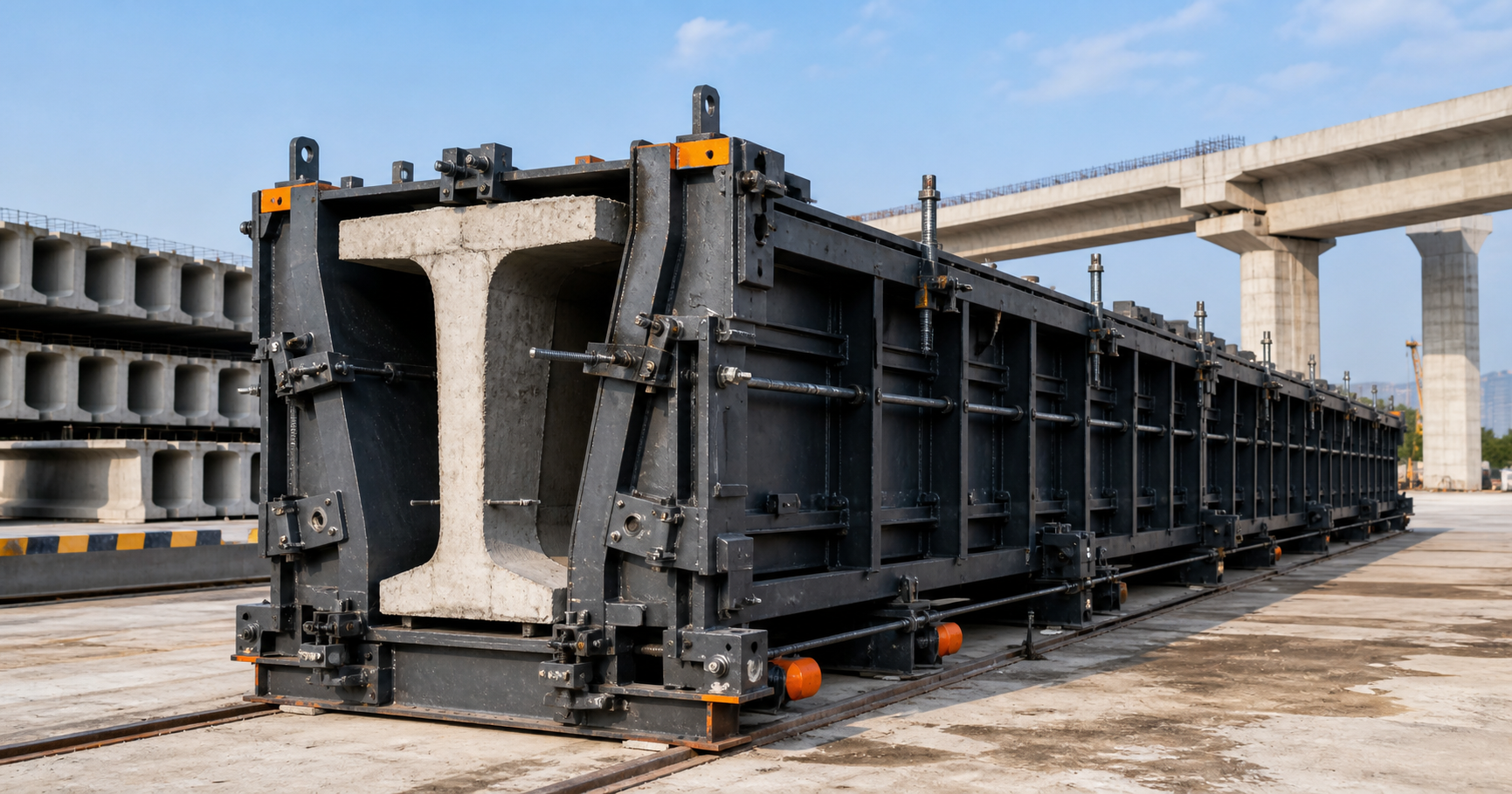
Precast Concrete Bridge Mould: Complete Guide for Bridge and Infrastructure Projects
Precast Concrete Bridge Mould: Complete Guide for Bridge and Infrastructure Projects
Modern bridge and infrastructure projects require concrete components with high structural strength, dimensional accuracy and consistent finishing. Producing these components directly at the construction site can be time-consuming and difficult to control.
Precast concrete bridge moulds help manufacturers produce bridge girders, deck slabs, pier caps, culverts and other structural components under controlled production conditions.
A properly fabricated heavy-duty iron mould improves dimensional consistency, supports faster production and reduces finishing work. It can also be customised according to the technical drawings and production requirements of a specific project.
This guide explains the major types, features, dimensions, benefits and applications of precast concrete bridge moulds.
What Is a Precast Concrete Bridge Mould?
A precast concrete bridge mould is a heavy-duty iron formwork system used to manufacture concrete components for bridges, flyovers, highways, railways and other civil infrastructure projects.
Concrete and reinforcement are placed inside the mould according to the approved structural design. After pouring, vibration and curing, the side shutters are opened and the finished component is removed.
Bridge components are usually large and heavy. Therefore, their moulds require strong iron plates, reinforced support frames, accurate flange joints and dependable opening mechanisms.
The mould must withstand the pressure of fresh concrete without bending, leaking or losing its original dimensions.
Major Types of Precast Bridge Moulds
Different bridge components require moulds with different shapes, opening systems and structural configurations.
I-Girder Mould
An I-girder mould is designed to produce precast concrete girders with an I-shaped cross-section. These girders are commonly used to support bridge decks over long spans.
The mould usually consists of a strong base and two side shutters. Hydraulic cylinders, mechanical jacks or quick-release locking arrangements may be used to open the shutters after curing.
I-girder moulds can be manufactured in modular sections to support different girder lengths.
Box Girder Mould
Box girders have a hollow box-shaped cross-section that provides high structural strength with controlled component weight.
A box girder mould generally includes an outer mould and an accurately positioned inner core. Both parts must maintain proper alignment during reinforcement placement, concrete pouring and vibration.
The inner core should also be designed for safe and convenient removal after the concrete reaches the required strength.
U-Girder Mould
U-girders are widely used in metro rail, railway viaduct and elevated transit projects. Their U-shaped design can support tracks or deck arrangements depending on the engineering requirements.
A U-girder mould needs heavy support framing and an accurate side profile to maintain the required structural geometry.
Box Culvert Mould
Box culvert moulds produce hollow concrete sections used beneath roads, railways and embankments. They help provide a passage for drainage water, utilities or limited-access crossings.
The mould normally includes an external body and a removable or shrinkable inner core. Strong joints and slurry-tight seals are important for producing clean corners and uniform wall thickness.
Bridge Deck Slab Mould
Bridge deck slab moulds produce flat structural panels used to form the upper surface of a bridge.
Depending on the project, the mould may include provisions for reinforcement, lifting points, utility openings and connection details. Deck slab moulds can be manufactured in standard or custom widths and thicknesses.
Pier Cap Mould
Pier caps transfer loads from the bridge superstructure to the supporting piers. A pier cap mould must follow the approved structural profile and provide sufficient support for the heavy concrete load.
Custom moulds may be required because pier cap dimensions can vary considerably between projects.
Important Features of a Bridge Mould
A bridge mould is a long-term production asset. Its performance depends on the quality of its iron construction, support system, joints and operating mechanism.
Heavy-Duty Iron Construction
Paras Steel Industries manufactures moulds using heavy-duty iron. Thick iron plates and reinforced structural sections help the mould withstand heavy concrete pressure and repeated casting cycles.
Plate thickness is selected according to the component size, concrete load, mould length and required service life.
Anti-Sag Support Frame
Bridge girders and culvert sections may be several metres long. Without proper support, the mould base can sag or deflect under the concrete load.
Heavy channels, beams and bracing sections strengthen the base and side shutters. Correct support placement helps maintain the required line, level and dimensions.
Hydraulic or Mechanical Opening
Large side shutters are difficult to operate manually. A hydraulic or mechanical quick-release mechanism makes opening and closing easier and reduces labour requirements.
The selected mechanism should suit the mould size, production frequency, available power supply and factory setup.
Modular Sectional Design
A modular bridge mould can be manufactured in precisely matched bolted segments. Individual sections may be added or removed to achieve different component lengths.
Modules commonly range from approximately 3 metres to 6 metres, depending on the mould and project requirements.
Modular construction can provide greater production flexibility when a manufacturer handles components of different lengths.
Pre-Stressing Compatibility
Certain bridge girders are manufactured using pre-stressed concrete. Their moulds must accommodate strand positioning and the forces created during the pre-stressing process.
The exact mould and support arrangement should always follow the approved structural and production design.
Slurry-Tight Joints
Cement slurry leakage can create rough surfaces, honeycombing and defective edges. Precisely matched flange joints and heavy rubber gaskets help prevent leakage.
Quick-locking clamps and strong bolts also help keep the shutters securely closed during pouring and vibration.
Vibrator Compatibility
Proper vibration removes trapped air and improves concrete density. Bridge moulds can include mounting provisions for external electric or pneumatic formwork vibrators.
The quantity and position of the vibrators depend on the component shape, concrete mix and mould length.
Suitable for Different Curing Methods
Bridge components may be cured under natural ambient conditions or through an accelerated curing process.
The mould configuration should be selected according to the curing method used at the production facility.
Common Sizes and Dimensions
Bridge mould dimensions are normally customised according to approved project drawings. However, some commonly required production ranges include the following.
Bridge I-Girder Moulds
Girder height: approximately 900 mm to 2400 mm
Modular span length: approximately 12 metres to 35 metres
Web thickness: approximately 150 mm to 300 mm
Precast Box Culvert Moulds
Clear opening: 1.5 x 1.5 metres
Clear opening: 3.0 x 2.0 metres
Clear opening: 3.0 x 3.0 metres
Wall or slab thickness: approximately 150 mm to 300 mm
Segment length: approximately 1.0 metre to 2.5 metres
Bridge Deck Slab Moulds
Deck thickness: approximately 150 mm to 250 mm
Panel width: approximately 1.2 metres to 2.5 metres
Length: manufactured according to the required modular span
These dimensions are indicative production ranges. Buyers should always provide approved drawings before mould manufacturing begins.
Benefits of Using Precast Concrete Bridge Moulds
Consistent Component Dimensions
A precision-fabricated iron mould helps manufacturers repeat the required length, width, height and profile during every casting cycle.
Better Concrete Finish
Smooth mould surfaces and slurry-tight joints reduce leakage and support a cleaner concrete finish. This can minimise patching and repair work.
Faster Project Execution
Precast components can be manufactured while foundation and site work continue. Once ready, the components are transported and installed according to the project schedule.
Controlled Factory Production
Concrete mixing, reinforcement placement, vibration and curing can be monitored more effectively inside a precast production facility.
Reduced On-Site Formwork
Using precast components reduces the amount of formwork assembly and concrete casting required at the bridge site.
Repeat Production
A durable heavy-duty iron mould can support repeated production when it is operated, cleaned and maintained correctly.
Applications of Precast Bridge Moulds
Highway Bridges
Precast girders, culverts and deck components are widely used in national highway and expressway development projects.
Flyovers and Elevated Corridors
Urban flyovers and elevated road corridors require accurately manufactured structural components that can be installed within planned traffic-blocking periods.
Railway Viaducts
Precast moulds can be used to manufacture girders and structural segments for railway viaducts and elevated railway projects.
Metro Rail Projects
U-girders, deck components and other precast elements are used in elevated metro rail corridors and station-related infrastructure.
River and Canal Crossings
Bridge components manufactured with heavy-duty moulds can be used for river bridges, canal crossings and waterway infrastructure projects.
Box Culverts and Drainage Crossings
Precast box culverts provide drainage passages beneath roads, railway tracks and embankments.
Ports and Coastal Infrastructure
Custom bridge moulds may also be required for marine jetties, port structures and coastal infrastructure components.
How to Select the Right Bridge Mould
Begin with the approved structural drawing and production method. Avoid selecting a mould based only on general dimensions or initial price.
Confirm the exact component type, length, height, width and concrete thickness. The reinforcement and pre-stressing requirements should also be discussed with the mould manufacturer.
Consider the following points before ordering:
Component dimensions and total concrete weight
Required daily or monthly production capacity
Hydraulic or mechanical opening preference
Number and length of modular sections
Pre-stressing requirements
Vibration method
Curing system
Lifting and handling arrangement
Available factory space
Transportation limitations
The mould manufacturer should receive complete technical drawings before finalising the design and quotation.
Factors Affecting Bridge Mould Price
Component Type and Size
A long girder mould requires more iron, structural support and fabrication work than a smaller deck slab mould.
Iron Plate Thickness
Thicker iron plates increase mould strength and weight. Plate thickness should be selected according to the expected concrete pressure and component size.
Support Frame Design
The number and size of channels, beams, stiffeners and braces affect both mould performance and manufacturing cost.
Opening Mechanism
Hydraulic opening systems generally require additional cylinders and operating components. Mechanical systems may use heavy jacks, clamps or other opening arrangements.
Modular Configuration
A mould with interchangeable or extendable sections requires precisely matched flanges, additional hardware and accurate fabrication.
Inner Core Requirement
Box girder and box culvert moulds require an internal core. The core design, shrinking mechanism and removal arrangement influence the total mould price.
Custom Profiles and Inserts
Special shapes, openings, chamfers, lifting provisions and reinforcement inserts require additional engineering and fabrication work.
Order Quantity and Delivery Location
The total number of moulds, transportation distance and installation requirements can also influence the final quotation.
Maintenance Tips for Longer Mould Life
Clean the mould immediately after each casting cycle. Hardened concrete deposits can affect shutter alignment and the quality of future components.
Apply a suitable release agent evenly before every concrete pour. Excessive release agent should be avoided because it can affect the finished surface.
Inspect clamps, bolts, hinges, jacks and hydraulic components regularly. Loose hardware should be tightened before the next casting cycle.
Check flange joints and rubber gaskets for wear or damage. Replace damaged seals to prevent slurry leakage.
Protect exposed iron surfaces from moisture and rust during extended periods of storage.
Support long mould sections correctly when moving or storing them. Improper handling can affect alignment.
Why Choose Paras Steel Industries?
Paras Steel Industries manufactures heavy-duty iron precast moulds for bridge and infrastructure projects.
Available configurations include I-girder, box girder, U-girder, box culvert, deck slab and custom structural component moulds.
Mould dimensions, plate thickness, opening system, modular length and production features can be discussed according to the customer’s technical drawing and manufacturing requirements.
Frequently Asked Questions
Which material is used to manufacture bridge moulds?
Paras Steel Industries manufactures bridge moulds using heavy-duty iron. The plate thickness and supporting sections are selected according to the mould size and concrete load.
Can bridge moulds be manufactured in custom sizes?
Yes. Mould dimensions and configurations can be customised according to approved technical drawings and production requirements.
Can the mould have a hydraulic opening system?
Yes. Depending on the mould design and operational requirements, hydraulic or mechanical opening arrangements can be provided.
Are bridge moulds suitable for pre-stressed girders?
A suitable mould can be configured for pre-stressing requirements. The buyer should share the complete girder and production drawings before manufacturing.
What details are required for a quotation?
Share the component drawing, dimensions, mould quantity, opening mechanism, production capacity, delivery location and other project requirements.
How can I order a precast concrete bridge mould?
Contact Paras Steel Industries with your approved drawing and production requirements. The team can discuss a suitable mould configuration and provide a requirement-based quotation.
Conclusion
A heavy-duty precast concrete bridge mould helps manufacturers produce strong, accurate and uniform structural components for major infrastructure projects.
The right mould should be selected according to the component type, dimensions, concrete load, opening mechanism and required production capacity.
For custom bridge girder, box culvert, U-girder, deck slab or pier cap mould requirements, contact Paras Steel Industries and share your technical drawings for a suitable configuration and quotation.