
Precast Mould Guide
Precast Concrete Mould Maintenance Checklist for Long Production Life
Heavy-duty iron precast moulds can deliver reliable production for many casting cycles, but only when they are cleaned, inspected and maintained properly. A simple maintenance routine reduces mould damage, product rejection and avoidable repair cost.
By Paras Steel Industries ·
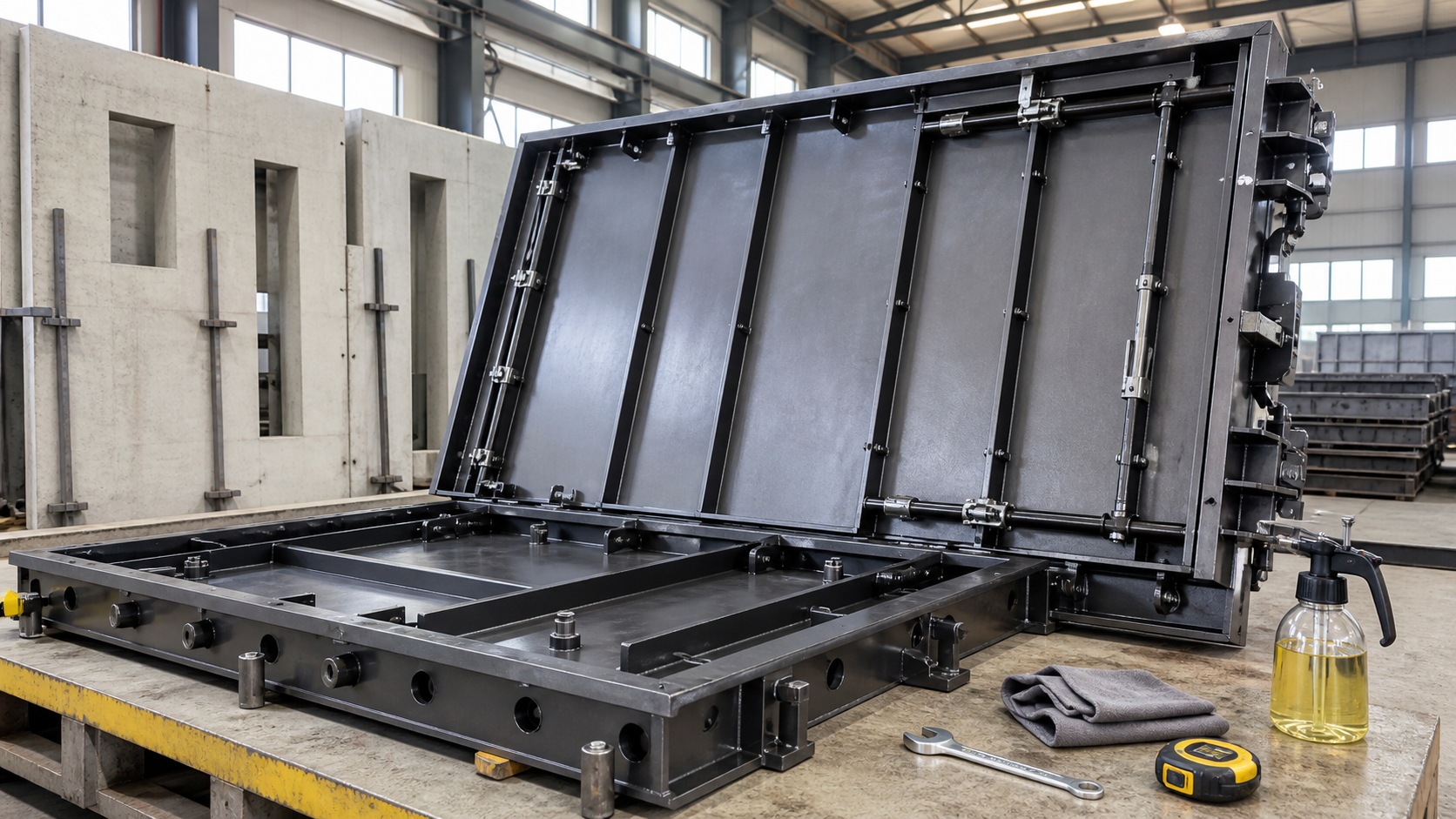
Precast Concrete Mould Maintenance Checklist for Long Production Life
Precast Concrete Mould Maintenance Checklist for Long Production Life
A precast concrete mould is a major investment for every precast manufacturing unit. Whether you manufacture boundary wall panels, poles, U drains, box culverts, cable trenches, retaining walls, door frames or other precast products, the condition of your mould directly affects product quality and production speed.
Heavy-duty iron moulds are built for repeated casting cycles. However, without regular cleaning and inspection, even a strong mould can develop rust, concrete buildup, leakage points, loose clamps and dimensional variation.
Proper mould maintenance helps you produce smooth, accurate and consistent precast concrete products while extending the working life of the mould.
This practical checklist explains how to maintain precast concrete moulds before, during and after every production cycle.
Why Precast Mould Maintenance Is Important
Mould maintenance is not only about keeping the mould clean. It protects the complete production process.
A well-maintained mould helps provide:
Smooth concrete surface finish Accurate product dimensions Reduced concrete leakage Easy mould assembly and demoulding Lower product rejection Less repair work Longer mould service life Improved production speed Safer handling for operators Better return on mould investment
Ignoring small issues can lead to bigger problems. For example, a loose bolt may cause slurry leakage, while a damaged corner can create repeated product edge defects.
Daily Precast Mould Maintenance Checklist
The following checks should be completed before and after each casting cycle.
1. Clean the Mould Surface
Remove all old concrete residue from internal surfaces, corners, joints and edges. Hardened concrete buildup can create rough surfaces and incorrect product dimensions.
Use suitable hand tools carefully. Avoid damaging the mould surface while removing concrete residue.
Pay special attention to:
Inner mould faces Corners and edge profiles Bolt holes Hinges and moving parts Locking areas Drainage or opening provisions Reinforcement guide locations
A clean mould produces a cleaner concrete surface.
2. Check for Concrete Buildup in Joints
Concrete slurry often collects near joints, clamps and locking points. If this buildup is not removed, mould parts may not close properly.
Improper closing can lead to leakage, rough joint lines and dimensional variation in the finished product.
Clean the joints after every demoulding cycle and check whether the mould faces fit correctly before the next pour.
3. Apply Mould Release Oil Properly
Release oil helps the precast product separate from the mould after curing. It should be applied evenly in a thin layer before casting.
Too little release oil may cause concrete to stick to the mould. Too much oil can create surface marks and affect the finish.
Use a clean brush, spray system or cloth to apply release oil evenly across all contact surfaces.
Do not forget corners, edge profiles and detailed mould sections.
4. Inspect Bolts, Clamps and Locking Systems
Bolts, clamps, pins and locks keep the mould stable during concrete pouring and vibration. Loose or damaged locking parts can cause mould movement, slurry leakage and incorrect product shape.
Before casting, check that:
All bolts are present and tightened correctly Clamps are properly secured Hinges open and close smoothly Locking pins are not bent or damaged Side plates are aligned No connection point is loose
Replace damaged locking accessories before they cause production problems.
5. Check for Rust and Corrosion
Iron moulds can develop rust when exposed to moisture, rain or poor storage conditions. Rust can damage the mould surface and affect the concrete finish.
Inspect the mould regularly for early signs of corrosion. Clean rusted areas and apply suitable protective coating or touch-up paint where required.
Store moulds in a dry area whenever they are not in use. Avoid keeping moulds directly on wet ground.
6. Inspect Mould Surface for Damage
Check the internal and external mould surface for dents, bending, cracks, welding damage or worn-out edges.
Damaged surfaces can create visible defects in the precast product. Even a small dent can affect the finish of a wall panel, U drain or other visible concrete component.
Repair damaged sections as early as possible to avoid repeated quality issues.
7. Verify Mould Alignment
Mould alignment is important for accurate dimensions and clean edges. Check that side plates, base plates, end plates and closing arrangements are sitting in the correct position.
If the mould is not aligned properly, the product may become twisted, uneven or difficult to install.
For critical products such as box culverts, wall panels, poles and door frames, check key dimensions periodically with measuring tools.
8. Inspect Welds and Stiffeners
Iron moulds experience concrete pressure, vibration and repeated opening and closing. Over time, weld joints and stiffeners may develop damage or weakness.
Inspect structural supports, welded joints and stiffeners for cracks or bending. Repair the mould only through qualified fabrication work so that its original strength is maintained.
Strong stiffeners help the mould maintain shape during repeated casting cycles.
9. Maintain Hinges and Moving Parts
Mould hinges, sliding sections and opening mechanisms should move smoothly. If they become tight or damaged, demoulding becomes slower and may damage the precast product.
Clean moving parts regularly and use suitable lubrication where required. Do not allow concrete slurry to remain in hinge areas after production.
10. Check Mould Base Support
The mould should stand on a stable and level surface during casting and vibration. Uneven base support can create product thickness variation, poor alignment and mould stress.
Check that the casting platform or base support is level and strong enough for the mould and fresh concrete load.
For large products, use appropriate support arrangements according to the mould design.
Maintenance During Concrete Casting
Mould maintenance also continues while production is running.
During casting, check for slurry leakage at joints. If leakage is visible, stop and inspect the locking system or joint alignment before it becomes a larger issue.
During vibration, observe whether the mould remains stable. Excessive movement may indicate loose clamps, weak supports or an uneven base.
Avoid striking moulds with hammers or heavy objects unless it is part of the correct operating procedure. Rough handling can damage edges, locking points and surface finish.
Maintenance After Demoulding
After demoulding, do not leave the mould dirty until the next shift. Immediate cleaning saves time and prevents concrete from becoming hard and difficult to remove.
Follow this after-demoulding routine:
Remove remaining concrete residue. Clean all joints and corners. Inspect the finished product for repeated defects. Check whether defects may be linked to the mould. Inspect bolts, clamps and hinges. Apply rust protection if required. Store the mould safely or prepare it for the next cycle.
If the same defect appears repeatedly, inspect the mould instead of only repairing the concrete product.
Weekly Precast Mould Maintenance Checklist
In addition to daily checks, perform a deeper inspection every week.
Check all key mould dimensions. Inspect welds, stiffeners and base plates. Tighten bolts and clamps. Lubricate hinges and moving parts. Clean hard-to-reach corners and joints. Remove any rust spots. Check surface smoothness. Inspect mould storage conditions. Check lifting hooks or handling points. Record mould repair requirements.
A simple maintenance record helps identify moulds that need attention before major breakdown occurs.
Monthly Precast Mould Maintenance Checklist
Once every month, review the overall condition of each high-use mould.
Check whether the mould is producing consistent dimensions. Inspect for bending or deformation. Review product rejection and repair records. Repair damaged plates, edges or locking points. Repaint external rusted areas if required. Check the condition of mould release oil and cleaning tools. Review worker feedback about difficult mould opening or assembly. Plan refurbishment for moulds showing repeated quality issues.
This monthly review helps protect long-term mould investment.
Common Mould Maintenance Mistakes to Avoid
Some mistakes reduce mould life and increase production cost.
Do not leave wet concrete residue on the mould. Do not store iron moulds in rain or standing water. Do not use excessive release oil. Do not ignore loose clamps or damaged bolts. Do not continue production with bent or cracked mould parts. Do not use rough demoulding methods. Do not skip dimension checks for critical products. Do not delay small repairs until the mould fails completely.
How Good Maintenance Improves Precast Product Quality
A clean and accurate mould helps prevent many common casting defects, including:
Honeycombing near corners Slurry leakage marks Broken concrete edges Rough concrete surfaces Dimensional variation Poor alignment Concrete sticking to mould surfaces Uneven product thickness
Mould maintenance, proper concrete mix, correct vibration and controlled curing work together to produce better precast products.
Choose Durable Moulds for Reliable Production
The best maintenance routine starts with a strong mould. Heavy-duty iron moulds with proper stiffeners, accurate joints and reliable locking systems are easier to maintain and provide consistent performance over repeated casting cycles.
Paras Steel Industries manufactures heavy-duty iron precast concrete moulds for compound walls, boundary wall panels, poles, U drains, box culverts, cable trenches, retaining walls, door frames, manhole covers and customized precast products.
Our moulds are designed for accurate dimensions, long production life and practical factory use. We also manufacture custom precast moulds according to approved drawings and project requirements.
Contact Paras Steel Industries to discuss your precast mould requirement and get a quotation for durable iron moulds and precast production machinery.