
Precast Production Guide
Water Curing vs Steam Curing for Precast Concrete: Time, Cost and Strength Comparison
Water curing and steam curing can both produce durable precast concrete when properly controlled. This guide compares their curing time, cost, early strength, equipment and suitability for different production requirements.
By Paras Steel Industries ·
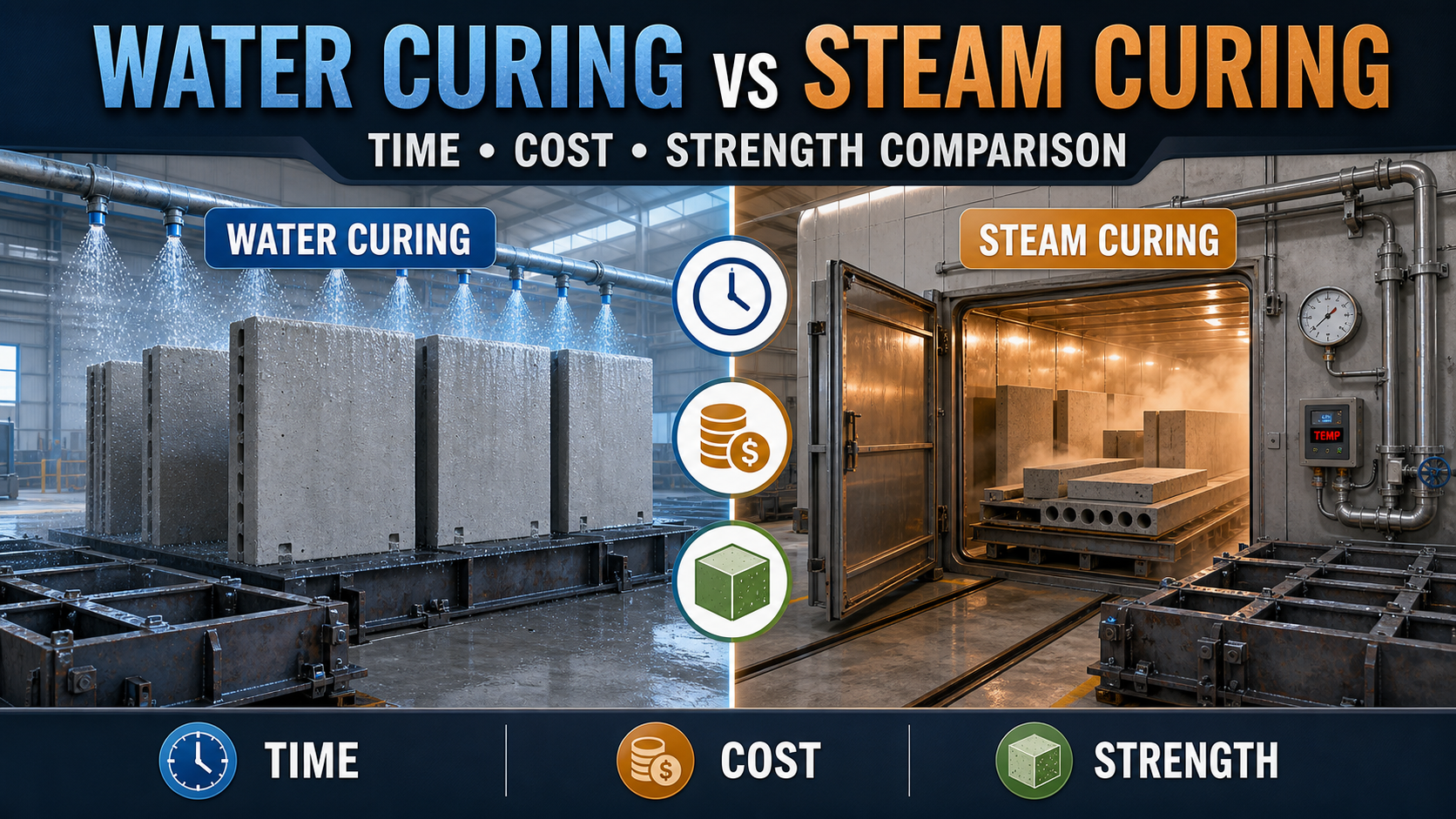
Water Curing vs Steam Curing for Precast Concrete: Time, Cost and Strength Comparison
Water Curing vs Steam Curing for Precast Concrete: Time, Cost and Strength Comparison
Proper curing is essential for producing strong and durable precast concrete components. It maintains the moisture and temperature conditions required for cement hydration and concrete strength development.
Water curing is comparatively simple and economical, while steam curing can accelerate early-strength development and shorten the production cycle. However, neither method is automatically better for every precast plant.
The correct curing system depends on the concrete mix, required demoulding strength, daily production target, product dimensions, climate, factory infrastructure and quality-control capabilities.
What Is Concrete Curing?
Concrete curing is the process of maintaining suitable moisture and temperature conditions after casting.
Correct curing helps concrete to:
• Develop the required strength • Reduce early moisture loss • Control surface cracking • Improve durability • Produce a dense concrete surface • Protect edges and corners • Improve resistance to weather exposure • Achieve consistent production quality
Curing begins soon after the concrete has been placed and finished. The timing and method should follow the approved mix design, project specification and production procedure.
Why Curing Is Important in Precast Production
Precast plants often follow repeated production cycles. The mould must be opened, cleaned and prepared for the next casting as efficiently as possible.
If concrete strength develops too slowly, the product may occupy the heavy-duty iron mould for longer. This can reduce daily production capacity or increase the number of moulds required.
If curing is accelerated incorrectly, the product may develop surface defects, thermal cracks, non-uniform strength or durability problems.
A suitable curing system must therefore balance:
• Safe demoulding time • Early concrete strength • Long-term strength • Product quality • Energy consumption • Labour requirements • Production capacity • Operating cost
What Is Water Curing?
Water curing maintains moisture around the concrete surface so that cement hydration can continue.
Depending on the product and factory arrangement, water curing may include:
• Water spraying • Wet coverings • Fogging or misting • Ponding where suitable • Immersion for small products • Moist curing chambers • Continuous damp-sheet curing
The curing method should keep the concrete adequately moist without damaging its surface or causing contamination.
Advantages of Water Curing
Lower Initial Investment
Water curing generally requires less specialised equipment than a complete steam-curing system.
Depending on the selected method, a plant may require water lines, spraying equipment, curing tanks, wet coverings or a moist-curing area.
Simple Operation
The process can be comparatively easy to understand and operate.
It may be suitable for small and medium-sized precast plants that do not require highly accelerated production.
Good Long-Term Strength Development
Proper moisture curing supports continued cement hydration and long-term concrete strength.
It can produce durable precast components when the mix design, curing duration and handling procedures are correctly controlled.
Lower Energy Requirement
Water curing usually consumes less thermal energy than steam curing.
However, pumping, water treatment, storage and recycling may still add to the operating cost.
Suitable for Many Precast Products
Water curing can be used for products such as:
• Boundary wall panels • Fencing poles • Paving products • Garden products • Drainage components • Concrete blocks • Kerbs • Columns • Other precast products with suitable production cycles
Limitations of Water Curing
Slower Early-Strength Development
Compared with properly controlled steam curing, water curing may require more time for concrete to reach its approved demoulding strength.
The exact duration depends on the mix design and environmental conditions.
Higher Mould Requirement
If each product remains in its iron mould for longer, additional moulds may be required to achieve a high daily production target.
Water Consumption
A poorly managed curing system can consume significant quantities of water.
Recirculation, collection and treatment systems may be necessary where water availability is limited.
Temperature Sensitivity
Concrete gains strength more slowly in colder conditions. Water curing alone may not provide sufficient temperature control during cold weather.
Space Requirement
Some water-curing methods require tanks, curing areas, racks or drainage arrangements, which can occupy considerable factory space.
What Is Steam Curing?
Steam curing uses controlled heat and humidity to accelerate cement hydration and early-strength development.
Precast components may be covered or placed inside a controlled curing enclosure. Steam or heated moisture is then introduced according to an approved curing cycle.
A proper steam-curing cycle generally includes:
• Initial delay period • Controlled temperature increase • Holding period • Controlled cooling period • Strength verification
The concrete should not receive uncontrolled steam immediately after casting.
Advantages of Steam Curing
Faster Early-Strength Development
Steam curing can help concrete achieve the required stripping strength sooner when the mix and curing cycle are properly designed.
This can support earlier demoulding and faster mould reuse.
Higher Daily Production Capacity
Shorter production cycles allow a precast plant to manufacture more components from the same number of iron moulds.
This can be beneficial for large projects with strict delivery schedules.
Better Temperature Control
A controlled enclosure protects early-age concrete from cold weather and sudden environmental changes.
Consistent Production Cycle
Automatic temperature and humidity monitoring can improve repeatability across production batches.
Suitable for High-Volume Production
Steam curing is commonly considered where continuous production and rapid mould turnover are important.
Limitations of Steam Curing
Higher Initial Cost
A steam-curing system may require:
• Boiler or steam generator • Insulated curing enclosure • Steam distribution pipes • Temperature sensors • Control system • Water-treatment equipment • Safety arrangements • Regular maintenance
Higher Energy Cost
Steam generation requires fuel or electricity. The operating cost depends on energy prices, equipment efficiency and plant utilisation.
Requires Skilled Control
Incorrect heating and cooling can affect concrete quality.
The curing cycle must be developed according to the concrete mix, product geometry and applicable technical requirements.
Risk of Thermal Cracking
Rapid temperature rise or cooling can create thermal stress within the concrete.
Large or thick products may require additional monitoring because their internal temperature can differ from their surface temperature.
Possible Long-Term Performance Concerns
Excessive curing temperature or an unsuitable cycle may affect later-age strength and durability.
Steam curing must therefore be controlled instead of being used simply at the highest possible temperature.
Water Curing vs Steam Curing: Quick Comparison
Water Curing:
Initial cost: Low to moderate Operating complexity: Relatively simple Energy consumption: Lower Water requirement: Moderate to high Early-strength development: Generally slower Mould turnover: Slower Temperature control: Limited Best suited for: Small to medium production and flexible schedules Quality requirement: Continuous moisture management
Steam Curing:
Initial cost: Higher Operating complexity: Higher Energy consumption: Higher Water requirement: Depends on the system Early-strength development: Faster when properly controlled Mould turnover: Faster Temperature control: Better Best suited for: High-volume and time-sensitive production Quality requirement: Controlled heating, holding and cooling cycle
This is a general comparison. Actual results depend on the concrete mix, curing procedure, climate, product and factory arrangement.
Which Method Provides Faster Demoulding?
Steam curing generally provides faster early-strength development than conventional water curing when the system is properly designed and controlled.
However, demoulding should never be based only on elapsed time.
Before opening an iron mould, confirm that the concrete has achieved the approved stripping strength. Strength may be verified using representative specimens, maturity monitoring or another approved quality-control method.
A faster curing method does not permit unsafe lifting or early mould opening without strength confirmation.
Which Method Produces Better Strength?
Both water curing and steam curing can produce strong precast concrete.
Water curing supports gradual hydration and can provide excellent long-term strength when moisture is maintained properly.
Steam curing can provide higher early strength, but excessive temperature or an unsuitable heating cycle may affect later-age performance.
Strength depends on the complete production system, including:
• Concrete mix design • Water-cement ratio • Cement and supplementary materials • Aggregate quality • Compaction • Curing temperature • Moisture availability • Curing duration • Temperature rise and cooling rate • Post-demoulding curing
The best method is the one that consistently achieves the specified early and final strength without damaging durability.
Cost Comparison
Water Curing Costs
Possible expenses include:
• Water supply • Pumps and spray systems • Storage tanks • Wet coverings • Labour • Drainage • Water collection • Treatment and recycling • Additional iron moulds for longer production cycles
Water curing has a lower equipment cost in many cases, but its slower mould turnover may increase the number of moulds required.
Steam Curing Costs
Possible expenses include:
• Boiler or steam generator • Curing enclosure • Insulation • Pipework • Sensors and controls • Fuel or electricity • Water treatment • Maintenance • Operator training • Safety inspection
Steam curing has a higher setup and energy cost, but faster mould reuse can improve output from the same production area.
The correct cost comparison should consider the cost per acceptable precast product, not only the curing equipment price.
Effect on Daily Production Capacity
Suppose a plant has a limited number of heavy-duty iron moulds.
If water curing keeps each product in its mould for a longer period, fewer casting cycles may be completed within the available production time.
If steam curing safely accelerates strength development, the same mould may be cleaned and reused sooner.
Before investing in steam curing, compare:
• Required daily production • Number of available moulds • Demoulding-strength requirement • Concrete material cost • Energy cost • Labour cost • Factory space • Project duration • Additional mould cost • Equipment maintenance cost
For some plants, purchasing more iron moulds may be more economical than installing a steam-curing system. For high-volume plants, accelerated curing may provide greater long-term value.
Water Curing Quality-Control Requirements
A reliable water-curing system should include:
• Timely start of curing • Continuous moisture availability • Uniform water distribution • Clean curing water • Suitable drainage • Protection from direct sunlight and wind • Cold-weather precautions • Regular inspection • Curing records • Strength testing
Intermittent wetting followed by complete drying can reduce curing effectiveness.
Steam Curing Quality-Control Requirements
A controlled steam-curing system should monitor:
• Time of concrete casting • Initial delay period • Steam-start time • Temperature-rise rate • Maximum approved temperature • Holding duration • Concrete or enclosure temperature • Humidity • Cooling rate • Demoulding strength • Equipment condition
Temperature sensors and recording systems should be checked regularly.
Steam Curing Cycle
A controlled steam-curing cycle commonly includes four stages.
1. Initial Delay
Concrete is allowed to begin setting before significant heating starts.
Applying steam too early can damage the concrete surface or internal structure.
2. Controlled Heating
The temperature is increased gradually according to the approved procedure.
Rapid heating should be avoided.
3. Holding Period
The required temperature and moisture conditions are maintained for the specified period.
The objective is to achieve the required early strength, not simply to maintain the highest possible temperature.
4. Controlled Cooling
The product is cooled gradually before exposure to the factory environment.
A large temperature difference between the concrete and surrounding air can increase the risk of thermal cracking.
The actual curing cycle must be established by qualified technical personnel through testing and production trials.
Can Water and Steam Curing Be Combined?
Yes. Some precast plants use a combined approach.
For example, a product may receive controlled heat-assisted curing to achieve safe demoulding strength and then continue with moist curing after removal from the mould.
A combined method can support early mould turnover while maintaining moisture for continued strength development.
The complete procedure should be tested and approved for the concrete mix and product.
Product Suitability
Water Curing May Be Suitable For:
• Plants with moderate production targets • Products with flexible delivery schedules • Small and medium precast components • Locations with reliable water availability • Products that do not require rapid demoulding • Plants seeking lower initial investment
Steam Curing May Be Suitable For:
• High-volume precast production • Projects with short delivery schedules • Cold-weather production • Plants with limited mould availability • Products requiring controlled early strength • Automated or continuous production systems
The product type alone should not determine the curing method. Production economics and concrete performance must also be evaluated.
Common Water-Curing Mistakes
• Starting curing too late • Allowing the concrete surface to dry • Using insufficient water • Wetting only selected areas • Using dirty or contaminated water • Ignoring cold weather • Stopping curing immediately after demoulding • Failing to maintain curing records
Common Steam-Curing Mistakes
• Applying steam immediately after casting • Increasing temperature too rapidly • Using excessive temperature • Heating products unevenly • Failing to monitor concrete temperature • Cooling the product too quickly • Opening the enclosure suddenly • Demoulding without strength verification • Ignoring equipment maintenance • Using one curing cycle for every concrete mix
Role of Heavy-Duty Iron Moulds
A strong iron precast mould must maintain its dimensions during concrete casting, heating, curing and demoulding.
For steam-curing applications, the mould design should consider:
• Temperature changes • Thermal expansion • Plate thickness • Structural stiffeners • Welded joints • Locking arrangements • Gaskets and seals • Opening mechanism • Condensation and corrosion protection • Safe lifting and shifting
The mould should also allow efficient heat transfer without losing alignment.
Final Selection Checklist
Choose the curing method after reviewing:
• Required early strength • Final strength and durability • Daily production target • Available iron moulds • Product dimensions • Project duration • Local climate • Water availability • Energy availability and price • Factory space • Equipment investment • Maintenance capability • Operator skills • Environmental requirements • Approved technical specification
Final Conclusion
Water curing offers simpler operation, lower initial investment and dependable long-term strength development when moisture is maintained correctly.
Steam curing provides faster early-strength development, improved temperature control and quicker mould turnover, but requires higher investment, energy and technical control.
The most economical option depends on the complete production cycle. A plant should compare curing cost, mould utilisation, labour, energy and daily output before selecting a system.
Regardless of the curing method, concrete should be demoulded only after achieving the approved stripping strength.
Paras Steel Industries manufactures customised heavy-duty iron precast moulds for panels, poles, drains and other precast products. Moulds can be designed according to product dimensions, production capacity, curing method and preferred opening system.
For customised mould specifications and pricing, share your precast product drawing, required daily output and curing process with Paras Steel Industries.