
Precast Machinery Guide
Concrete Mixer Machine for Precast Products: Capacity, Motor and Selection Guide
Compare concrete mixer machine capacity, motor options, mixing features and applications to select the right machine for your precast production unit.
By Paras Steel Industries ·
Concrete Mixer Machine for Precast Products: Capacity, Motor and Selection Guide
Concrete Mixer Machine for Precast Products: Capacity, Motor and Selection Guide
Consistent concrete quality is essential for manufacturing strong and accurately finished precast products. Even a high-quality mould cannot deliver reliable results if the concrete mix is uneven, poorly proportioned or inadequately blended.
A concrete mixer machine combines cement, sand, aggregates, water and required admixtures into a uniform batch. It helps precast manufacturers maintain consistent concrete quality while reducing manual labour and mixing time.
Selecting the right mixer requires more than comparing its purchase price. Manufacturers should evaluate batch capacity, motor power, drive system, drum construction, production requirement and available electricity.
This guide explains how to select a suitable concrete mixer machine for a precast concrete manufacturing unit.
Why Is a Concrete Mixer Important for Precast Products?
Precast manufacturing requires repeatable concrete quality across multiple casting cycles. Every batch should have a consistent mix proportion, moisture level and aggregate distribution.
Manual mixing can produce variation between batches. Some portions may contain excess cement or water, while other portions may not contain enough binding material.
A properly designed mixer rotates the ingredients through internally positioned mixing blades. This movement distributes the materials more evenly and reduces the possibility of dry pockets or aggregate segregation.
Uniform mixing can contribute to:
Consistent product strength
Better concrete compaction
Cleaner surface finishing
Reduced honeycombing
Lower product rejection
Faster batch preparation
Improved production planning
A mixer should be used together with accurate material measurement, controlled water addition, proper vibration and suitable curing.
What Is a One-Bag Concrete Mixer Machine?
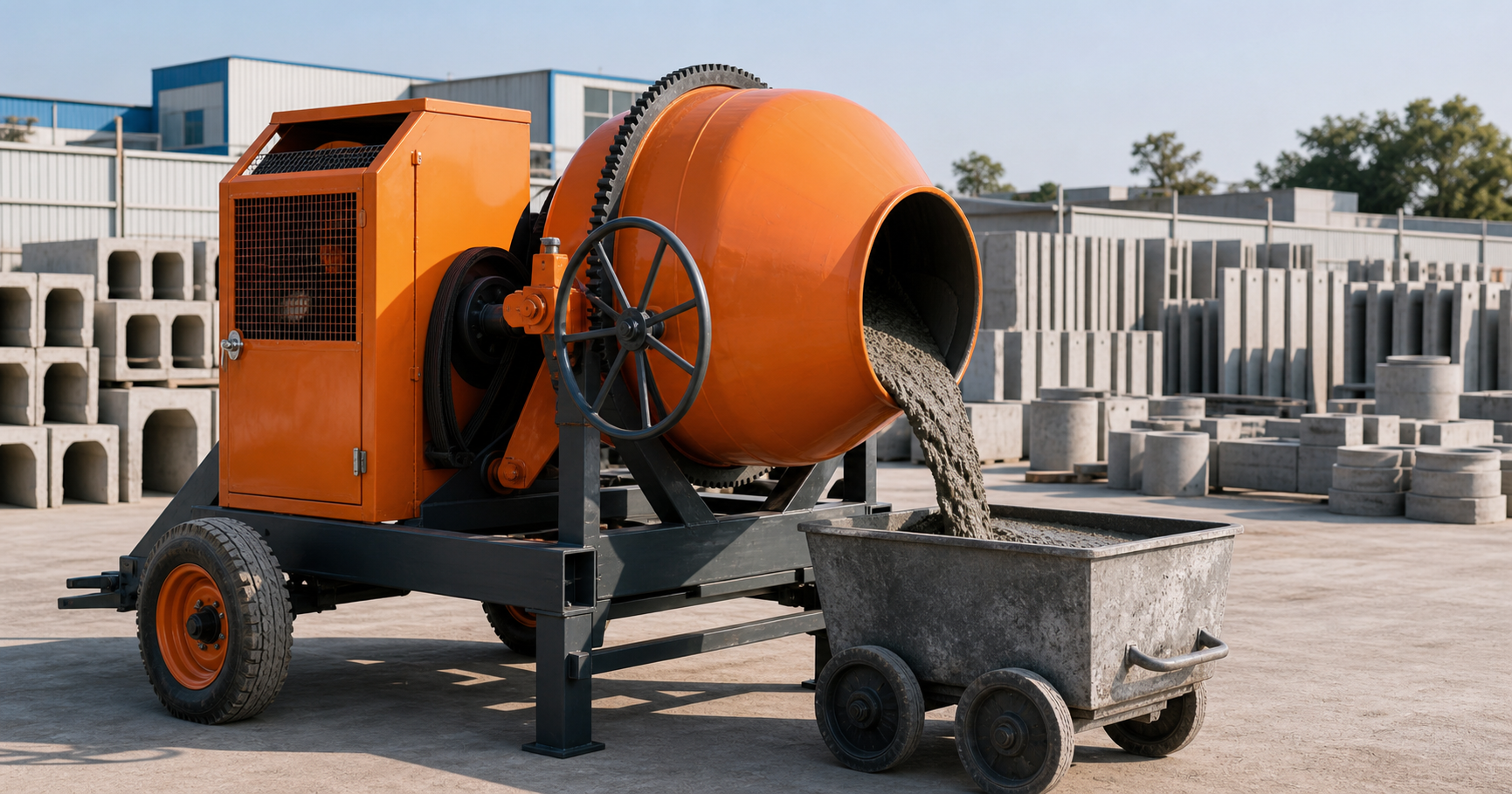
A one-bag concrete mixer is designed to process one complete 50 kg cement bag along with the required sand, aggregates and water in each batch.
The machine commonly uses a tilting drum. Materials are loaded into the drum, mixed for the required duration and discharged by tilting the drum using a handwheel.
A one-bag mixer is suitable for small and medium precast production units, civil construction sites and infrastructure works requiring repeated concrete batches.
It provides a useful balance between production output, operating cost and machine size.
Concrete Mixer Capacity Explained
Mixer capacity can be described using cement-bag capacity, gross drum volume or wet-concrete output. Buyers should understand the difference between these measurements.
Cement Batch Capacity
The machine can process one 50 kg cement bag per batch with the required quantities of aggregates and sand.
This does not mean that the total batch weight is only 50 kg. The final mixture also includes sand, coarse aggregate, water and other approved materials.
Gross Drum Volume
The drum has a total volume of approximately 10 cubic feet or 300 to 350 litres.
The gross drum volume indicates the physical internal capacity of the drum. The entire drum should not be filled with compacted wet concrete because sufficient space is required for the materials to move and mix.
Wet-Concrete Output
A one-bag mixer can produce approximately 200 to 250 litres of mixed wet concrete per batch.
Actual output depends on the approved concrete mix ratio, aggregate size, water content and loading method.
Estimating the Required Production Capacity
Before selecting a mixer, calculate the volume of concrete required during one production shift.
Start with the concrete volume of one precast product. Multiply it by the number of products planned per day. Add a reasonable allowance for handling loss, testing and minor production variation.
For example, if a production unit requires approximately 2,000 litres of concrete per shift and the mixer provides 200 litres of usable output per batch, it may require around ten batches.
The total production time will also depend on:
Material loading time
Mixing duration
Discharge time
Transport time to the mould
Cleaning time
Worker availability
The mixer should provide enough output to keep the mould-filling process moving without creating unnecessary waiting time.
Electric Motor Options
An electric concrete mixer is suitable for factories and precast yards with a dependable three-phase power supply.
Common electric options include:
3 HP three-phase motor
5 HP three-phase motor
415V power supply
Approximately 1440 RPM motor speed
A 3 HP motor may be suitable for regular one-bag mixing under controlled operating conditions. A 5 HP motor provides additional power for demanding production environments and repeated operation.
The appropriate motor should be selected according to drum load, operating frequency, local voltage conditions and manufacturer recommendations.
Benefits of an Electric Concrete Mixer
Electric mixers generally provide smooth and consistent operation. They are suitable for fixed production facilities where electrical power is continuously available.
Major benefits include:
Convenient starting and stopping
Lower operating noise
No diesel fuel storage requirement
Reduced direct exhaust emissions
Suitable for indoor or covered production yards
Simpler daily operation
The electrical installation should include suitable wiring, earthing, switches and overload protection. Installation must be completed by a qualified electrician.
Diesel Engine Options
A diesel concrete mixer is suitable for remote construction locations or production yards where three-phase electricity is unavailable or unreliable.
Common diesel options include:
5 HP air-cooled diesel engine
6.5 HP air-cooled diesel engine
A diesel-powered mixer provides greater location flexibility but requires fuel, regular engine maintenance and sufficient ventilation.
Benefits of a Diesel Concrete Mixer
A diesel mixer can operate independently of the electrical grid. It is useful for roadwork, drainage projects, bridge works and developing industrial sites.
Important benefits include:
Suitable for power-limited locations
Convenient for outdoor construction sites
No dependence on three-phase electricity
Useful for temporary or mobile production setups
The engine should be protected from concrete dust, water spray and unauthorised access. A lockable protective cabin can help protect the operating components.
Electric Motor vs Diesel Engine: Which Should You Choose?
Choose an electric mixer when the machine will operate at a fixed precast factory with reliable three-phase power.
An electric drive is generally more convenient for regular daily production, particularly in a covered manufacturing unit.
Choose a diesel mixer when the machine must operate at remote or temporary sites where electrical supply is unavailable or frequently interrupted.
The selection should be based on actual site conditions rather than only the initial machine price.
Important Features of a Concrete Mixer Machine
Heavy-Duty Mixing Drum
The drum must withstand the movement of cement, sand and coarse aggregates during repeated batches.
Its shape should allow materials to circulate correctly while providing adequate space for mixing.
Internal Mixing Blades
Angled internal blades lift and turn the ingredients as the drum rotates. Correct blade positioning supports uniform mixing and reduces material segregation.
Worn or damaged blades can increase mixing time and reduce batch consistency.
Cast-Iron Ring Gear and Pinion Drive
The ring gear transfers power to the mixing drum. A machined cast-iron ring gear and correctly aligned pinion support dependable drum rotation.
The gear should be inspected and lubricated according to the machine manufacturer’s instructions.
V-Belt Drive System
A V-belt and pulley arrangement transfers power from the motor or engine to the drum mechanism.
Correct belt tension is important. A loose belt may slip, while excessive tension can increase load on the bearings.
Handwheel Tilting Mechanism
A large cast-iron handwheel allows the operator to tilt the drum and control concrete discharge.
A multi-position locking latch helps hold the drum during loading, mixing and unloading.
Rigid Channel Chassis
A heavy channel frame supports the drum, drive system and power unit. A strong chassis absorbs operating vibration and helps keep the machine stable during full-batch mixing.
Protective Motor or Engine Cabin
A lockable enclosure protects the electric motor or diesel engine from concrete dust, water spray, weather and accidental contact.
The enclosure should still allow appropriate ventilation and maintenance access.
Applications in Precast Manufacturing
Boundary Wall Panels
A mixer can prepare repeatable concrete batches for precast boundary wall panels, columns and fencing poles.
U Drains and Drain Covers
Drainage products require well-mixed concrete for dependable strength and surface quality.
Manhole Covers
Uniform material distribution supports the manufacture of precast manhole covers and frames with consistent quality.
Door and Window Frames
A controlled concrete mix helps fill narrow mould sections and detailed profiles when combined with proper vibration.
Garden Benches
The machine can prepare concrete for precast seats, backrests and supporting frames.
Footings and Structural Components
Precast footings, columns and other structural components require concrete prepared according to the approved mix design.
Paver Blocks and Utility Products
A suitable mixer may also be used for paver blocks, kerbs, utility covers and other concrete products, subject to the required mix consistency.
How to Select the Right Concrete Mixer Machine
Calculate Daily Concrete Requirement
Estimate the total wet-concrete volume required per shift. Select a mixer that can support the planned output without becoming a production bottleneck.
Check the Usable Output
Do not select a mixer only by looking at gross drum volume. Ask about the approximate wet-concrete output per batch.
Select the Power Source
Choose between an electric motor and diesel engine according to power availability, operating location and daily usage.
Evaluate Motor Power
The motor should provide sufficient power for the specified batch capacity. It should not frequently overload during normal operation.
Inspect the Drum and Blades
Check the drum construction, blade positioning and overall fabrication. The drum should rotate smoothly without unusual movement.
Check the Drive System
Inspect the ring gear, pinion, pulley and V-belt arrangement. Proper alignment is essential for dependable operation.
Evaluate the Chassis
A rigid channel chassis provides stability and helps control operational vibration.
Consider Concrete Discharge
Check whether the tilting mechanism allows concrete to be discharged smoothly into a wheelbarrow, concrete trolley or material-shifting trolley.
Review Maintenance Access
The machine should allow convenient access to the motor, engine, belts, bearings, gears and other maintenance points.
Common Mistakes to Avoid
Selecting a machine only according to its lowest price can result in inadequate capacity or higher long-term maintenance.
Overloading the drum can reduce mixing quality and place unnecessary stress on the motor, gear system and bearings.
Adding excess water to speed up discharge can reduce concrete strength and affect the finished precast product.
Mixing for an inconsistent duration can produce variation between batches.
Operating the machine without proper gear lubrication, belt adjustment or electrical protection can increase breakdown risk.
The mixer should always be operated within the manufacturer’s recommended capacity.
Concrete Mixer Maintenance Tips
Clean the drum after completing production. Do not allow concrete to harden inside the drum or around the blades.
Inspect the mixing blades regularly for wear, bending or concrete buildup.
Check the cast-iron ring gear and pinion alignment. Lubricate moving components according to the maintenance instructions.
Inspect V-belts for cracks, wear and incorrect tension.
Check the handwheel, locking latch and tilting mechanism before starting production.
Inspect the motor wiring, switches and earthing. Electrical repairs should be completed by qualified personnel.
For diesel models, check engine oil, fuel level, air filter and cooling system as recommended.
Keep the protective cabin closed during operation while maintaining the required ventilation.
Frequently Asked Questions
What is the capacity of a one-bag concrete mixer?
It handles one 50 kg cement bag with aggregates and sand. Its approximate mixed wet-concrete output is 200 to 250 litres per batch.
What is the gross drum volume?
The gross drum volume is approximately 10 cubic feet or 300 to 350 litres.
Which electric motor options are available?
The machine can be configured with a 3 HP or 5 HP three-phase electric motor, depending on production requirements.
Is a diesel engine option available?
Yes. A 5 HP or 6.5 HP air-cooled diesel engine option can be selected for locations with limited electricity.
Which mixer is better for a precast factory?
An electric mixer is generally suitable for a fixed factory with dependable three-phase electricity. Diesel models are useful for remote or power-limited locations.
Can the machine mix concrete for different precast products?
Yes. It can prepare concrete for boundary wall panels, poles, manhole covers, drains, footings and other precast products, subject to the approved mix design.
How can I request a quotation?
Share your required batch capacity, preferred power source, production application and delivery location with Paras Steel Industries.
Conclusion
A suitable concrete mixer machine helps precast manufacturers improve batch consistency, reduce manual effort and maintain planned production output.
The right selection depends on usable concrete output, electric or diesel power, motor capacity, drum construction, drive system and daily production requirements.
Paras Steel Industries offers a one-bag tilting drum concrete mixer with approximately 200 to 250 litres of wet-concrete output per batch. Electric and diesel power options are available according to the customer’s operating requirements.
Contact Paras Steel Industries to discuss your precast production needs and request machine specifications and pricing.