
Precast Machinery Guide
Shutter Vibrator vs Vibrator Table: Which Is Better for Precast Production?
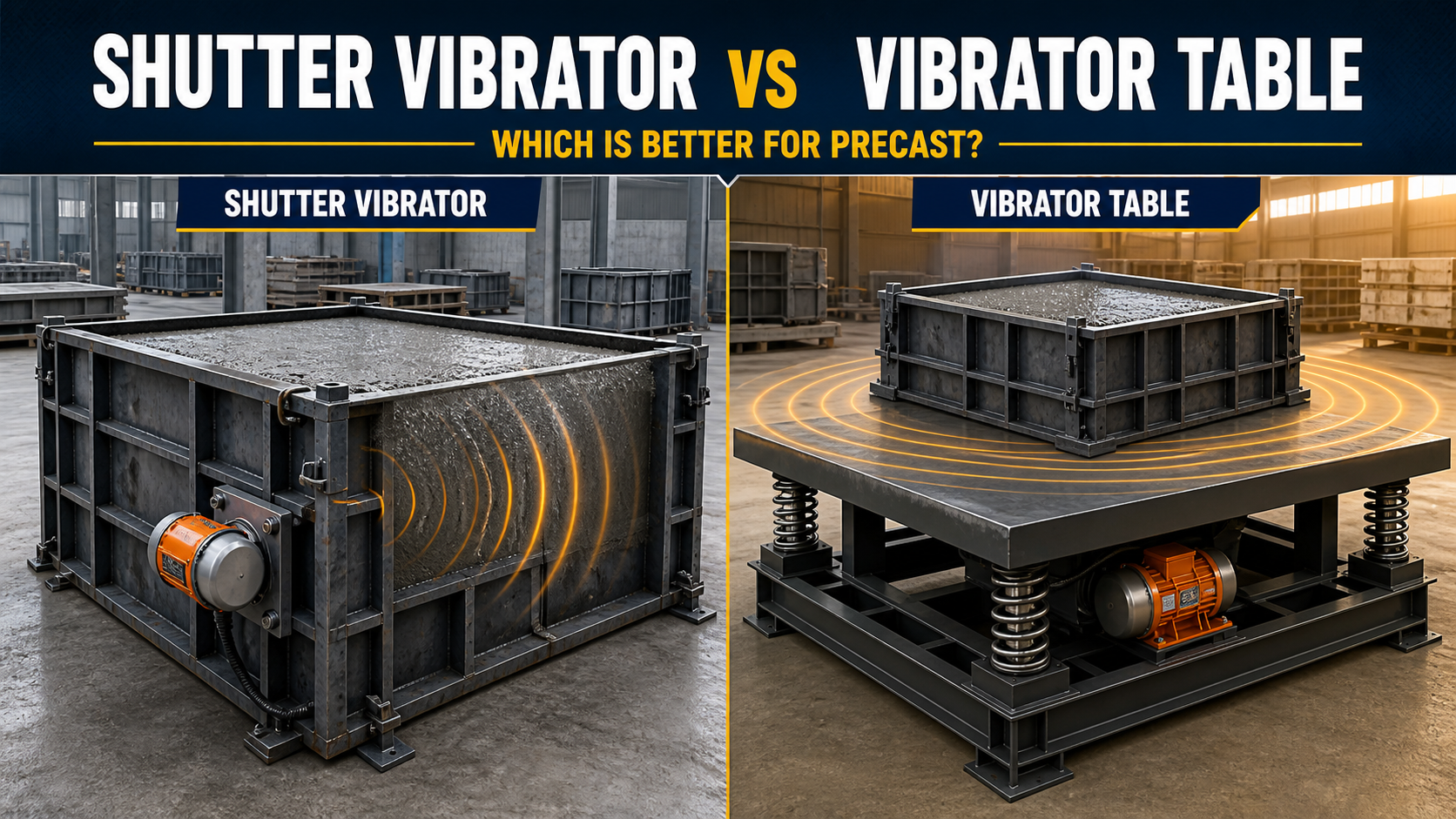
Shutter vibrators transfer vibration directly into a mould, while vibrator tables compact the complete mould from below. Compare both systems for different precast products.
By Paras Steel Industries ·
Shutter Vibrator vs Vibrator Table: Which Is Better for Precast Production?
Shutter Vibrator vs Vibrator Table: Which Is Better for Precast Production?
Proper concrete compaction is essential for producing strong, dense and visually consistent precast products.
Fresh concrete contains trapped air after mixing and placement. If this air is not removed, the finished component may develop honeycombing, surface voids, weak corners and poor reinforcement bonding.
Two commonly used factory compaction systems are shutter vibrators and vibrator tables.
A shutter vibrator is mounted directly onto the mould or its supporting frame. A vibrator table supports the complete mould on a mechanically vibrating platform.
Neither system is universally better. The correct choice depends on mould size, product geometry, concrete workability, production volume and factory layout.
This guide compares shutter vibrators and vibrator tables to help precast manufacturers select an appropriate compaction system.
What Is a Shutter Vibrator?
A shutter vibrator is a mechanical vibration unit attached directly to the external surface or supporting frame of a concrete mould.
It transfers vibration energy through the heavy-duty iron mould plate into the fresh concrete.
The equipment is also called:
External mould vibrator
Formwork vibrator
External concrete vibrator
Shuttering vibrator
Mould-mounted vibrator
The motor contains rotating eccentric weights that create vibration. These weights may be adjustable on suitable models, allowing vibration force to be changed.
How Does a Shutter Vibrator Work?
The vibrator is fixed to a reinforced mounting plate on the mould.
When the motor starts:
Eccentric weights rotate.
The motor creates vibration.
The mounting plate transfers vibration to the mould.
The heavy-duty iron mould transfers energy into the concrete.
Trapped air moves upward.
Concrete settles around reinforcement and mould details.
The vibrator must be mounted at an engineered location. Installing it on a thin or unsupported plate can damage the mould without producing effective compaction.
Advantages of Shutter Vibrators
Direct Vibration Transfer
Vibration enters the mould near the required concrete section.
Suitable for Large Fixed Moulds
The mould can remain installed on the factory floor while the vibrator operates.
Reduced Need to Shift Heavy Moulds
Large box culvert, drain, barrier and wall moulds do not need to be lifted onto a table.
Flexible Mounting
Multiple vibrators can be installed at calculated positions along a long mould.
Suitable for Vertical Moulds
Shutter vibrators can compact concrete in tall or vertically cast products.
Local Compaction Control
Selected mould sections can receive vibration where required.
Useful for Heavy Infrastructure Products
The system is practical for large moulds that exceed standard vibrator-table dimensions or capacities.
Limitations of Shutter Vibrators
Uneven Vibration Risk
Incorrect mounting can create strongly vibrated areas near the motor and weak areas farther away.
Mould Reinforcement Required
The mounting zone requires adequate iron plate thickness, channels and stiffeners.
Multiple Motors May Be Needed
A long mould may require several vibrators to achieve uniform compaction.
Higher Stress on Mould Joints
Excessive force can loosen bolts, clamps and welded connections.
More Electrical Connections
Multiple motors require suitable cables, starters and protection.
Motor Relocation May Be Required
Some production setups move the vibrator between different mounting points, increasing labour and cycle time.
Noise Transfer
A directly mounted vibrator can transmit substantial noise through the mould and factory structure.
What Is a Vibrator Table?
A vibrator table is a platform that vibrates the complete mould from below.
The table generally consists of:
Heavy top plate
Reinforced channel framework
Vibration motors
Helical springs or isolation mounts
Base frame
Mould-locking arrangements
Electrical control panel
The mould is placed on the table and secured. When the motors run, vibration is distributed through the table surface into the complete mould.
How Does a Vibrator Table Work?
A typical operating sequence includes:
Place the empty mould on the table.
Secure the mould against movement.
Install reinforcement and inserts.
Fill the mould with concrete.
Start the vibration motors.
Observe concrete settlement.
Add concrete where required.
Stop vibration after adequate compaction.
Remove or demould the product according to the production process.
The table should have a rigid under-grid to minimise dead spots and distribute vibration across the working surface.
Advantages of Vibrator Tables
Uniform Whole-Mould Vibration
A correctly designed table transfers vibration across the entire mould base.
Suitable for Multiple Small Moulds
Several small moulds can be placed on the same table during one production cycle.
Repeatable Operation
Workers can follow a standard vibration time and equipment setting.
Flexible Product Production
The same table may compact different moulds within its size and load limits.
Better Factory Organisation
A dedicated vibration station can simplify production workflow.
Reduced Mould-Mounted Equipment
Individual moulds do not require their own external motor in many applications.
Adjustable Vibration Force
Suitable unbalance motors or VFD controls can adjust vibration according to mould weight and concrete workability.
Good Surface Finish
Uniform compaction helps reduce trapped air and honeycombing when the concrete mix and mould are correct.
Limitations of Vibrator Tables
Mould Size Restriction
The mould must fit safely on the table.
Load-Capacity Restriction
The total weight of the mould, reinforcement and wet concrete must remain within the table’s rated capacity.
Material Handling Required
Moulds may need a crane, trolley or workers to position them on the table.
Not Practical for Very Large Fixed Moulds
Long wall, culvert and heavy infrastructure moulds may exceed table dimensions.
Dedicated Floor Space
The factory requires space for the table, material handling and operator access.
Foundation and Isolation Requirements
An incorrectly installed table can transfer vibration into the floor and nearby machinery.
Higher Initial Machinery Investment
A heavy-duty table requires a reinforced frame, top plate, motors, springs and control system.
Shutter Vibrator vs Vibrator Table: Quick Comparison
Vibration Transfer
Shutter vibrator:
Transfers vibration directly through the mould wall or frame.
Vibrator table:
Transfers vibration through the supporting platform and mould base.
Suitable Mould Size
Shutter vibrator:
Suitable for medium, large and fixed moulds.
Vibrator table:
Suitable for moulds that fit within the rated table dimensions.
Compaction Distribution
Shutter vibrator:
Can be concentrated near the mounting point.
Vibrator table:
Can distribute vibration across the whole base when properly designed.
Installation
Shutter vibrator:
Requires reinforced mounting points on the mould.
Vibrator table:
Requires a dedicated table foundation and isolation system.
Mould Handling
Shutter vibrator:
The mould may remain in its production position.
Vibrator table:
The mould must be placed and secured on the table.
Product Flexibility
Shutter vibrator:
Generally configured around selected moulds.
Vibrator table:
Can handle multiple compatible mould types.
Maintenance
Shutter vibrator:
Requires inspection of motors, mounting bolts and mould brackets.
Vibrator table:
Requires inspection of motors, springs, top plate, frame and clamps.
Best Use
Shutter vibrator:
Large, long, deep or vertically cast products.
Vibrator table:
Small and medium moulds or several products cast together.
Suitable Applications for Shutter Vibrators
Box Culvert Moulds
Large box culvert moulds require vibration around side walls and inner-core sections.
U-Drain Moulds
External vibrators can transfer compaction energy through long drain side shutters.
Highway Barrier Moulds
Long New Jersey or F-shape barrier moulds may require vibration at multiple positions.
Large Wall-Panel Moulds
Large fixed mould beds may use external vibration when placing the complete mould on a table is impractical.
Footing and Foundation Moulds
Deep footing sections may benefit from external vibration combined with an approved internal vibration method.
Column and Pole Moulds
Long pole moulds can use vibrators positioned along the supporting frame.
Bridge Component Moulds
Heavy fixed moulds may require multiple engineered mounting points.
Vertical Battery Moulds
Shutter vibration can compact concrete placed inside tall vertical cavities.
Suitable Applications for Vibrator Tables
Boundary Wall Panels
Small and medium wall-panel moulds can be placed on a table for uniform compaction.
Fencing Poles
Long but manageable pole moulds may operate on a suitably sized heavy-duty table.
Window and Door Frames
Frame moulds can be compacted on a flat vibration platform.
Paver and Cover Products
Multiple small moulds can be vibrated during one cycle.
Manhole Covers
Cover and frame moulds can be placed securely on the table.
Garden Products
Bench, planter and decorative concrete moulds may use table vibration.
Kerb Stones
Several kerb moulds can be compacted on a suitable platform.
Testing Laboratories
Small concrete samples and product trials can use compact vibration tables.
Vibrator Table Size and Capacity
Vibrator tables are available in different dimensions and load capacities.
Indicative configurations may include:
Standard Production Model
Table size: Approximately 3 ft × 6 ft
Motor option: Approximately 2 HP or 3 HP
Typical capacity: Approximately 500 to 1,000 kg
Industrial Model
Table size: Approximately 4 ft × 8 ft
Motor option: Approximately 3 HP or 5 HP
Typical capacity: Approximately 1,000 to 2,000 kg
Heavy Precast Yard Model
Table size: Approximately 5 ft × 10 ft
Motor option: Approximately 5 HP or 7.5 HP
Typical capacity: Approximately 2,000 to 4,000 kg
These figures are indicative configurations. The final table must be designed according to total operating weight and vibration requirements.
The operating load includes:
Empty mould weight
Reinforcement weight
Concrete weight
Inserts and accessories
Any supporting tray or fixture
Importance of Motor Selection
Vibration motor power alone does not determine compaction quality.
Motor selection should consider:
Total operating weight
Table dimensions
Concrete workability
Product thickness
Required vibration force
Motor speed
Number of motors
Eccentric weight setting
Spring design
Table-frame rigidity
An oversized motor can create excessive vibration, damage mould joints and segregate concrete. An undersized motor may fail to compact the product properly.
Motor Size vs Vibration Force
Buyers often compare vibrator equipment only by motor horsepower.
This is incomplete.
Two motors with the same horsepower may produce different vibration forces because of differences in:
Eccentric weights
Motor speed
Mounting position
Rotating direction
Table mass
Mould mass
Spring characteristics
Control settings
Request the machinery manufacturer to evaluate the complete operating system rather than selecting the highest horsepower.
Vibration Frequency and Amplitude
Vibration performance involves two major characteristics.
Frequency
Frequency describes how rapidly the equipment vibrates.
Amplitude
Amplitude describes the approximate movement or displacement during vibration.
Different concrete mixes and products may respond differently to frequency and amplitude.
A high-frequency, low-amplitude setup may suit selected fine or thin products, while heavier products may require a different force arrangement.
The correct settings should be established through controlled production trials.
Single-Motor vs Dual-Motor Vibrator Table
Single-Motor Table
A single motor may suit smaller tables and moderate loads.
Benefits include:
Lower initial cost
Simple electrical system
Reduced maintenance
Dual-Motor Table
Two motors may be used for larger tables or to improve force distribution.
Important considerations include:
Correct motor position
Matching motor specifications
Rotation direction
Electrical synchronisation
Frame rigidity
A dual-motor system must be engineered correctly. Simply installing two random motors does not guarantee uniform vibration.
Importance of Spring Isolation
Heavy-duty helical springs or suitable isolation mounts separate the vibrating top frame from the fixed base.
The isolation system helps:
Confine vibration to the table top
Reduce floor transmission
Protect the base frame
Allow controlled table movement
Support the working load
Incorrect springs can cause uneven movement, excessive bouncing or premature failure.
Springs should be selected according to total operating weight and vibration characteristics.
Mounting a Shutter Vibrator Correctly
A shutter vibrator should not be attached randomly to the mould plate.
The mounting point should include:
Reinforced iron mounting plate
Strong channel or stiffener support
Flat motor seating surface
Correct bolt grade
Locking arrangement
Cable protection
Safe maintenance access
The motor should transfer energy into the mould structure rather than only shaking a small unsupported plate.
Multiple Shutter Vibrator Placement
Long moulds may require several motors.
Their position depends on:
Mould length
Concrete depth
Product geometry
Stiffener spacing
Inner-core design
Motor vibration force
Expected dead zones
Concrete placement sequence
All motors do not necessarily need to run continuously or simultaneously. The correct sequence should be established by the equipment and mould manufacturer.
Effect of Concrete Workability
The vibration system must match the concrete mix.
Stiff Concrete
A stiff mix may require greater vibration energy or duration.
Moderately Workable Concrete
This may compact effectively with controlled table or shutter vibration.
Highly Workable Concrete
Excessive vibration can cause segregation and paste movement.
Self-Compacting Concrete
SCC may require little or no mechanical vibration when properly designed.
Workers should not increase vibration to compensate for a poorly controlled concrete mix without investigating the actual cause.
Under-Vibration Problems
Insufficient vibration can produce:
Honeycombing
Large air voids
Poor corner filling
Visible aggregate pockets
Reduced reinforcement bond
Weak edges
Rough concrete surfaces
Lower durability
Over-Vibration Problems
Excessive vibration can produce:
Concrete segregation
Coarse aggregate settlement
Paste movement
Slurry leakage
Reinforcement displacement
Uneven surface colour
Loss of entrained air
Mould fastener loosening
Longer vibration is not automatically better.
How to Determine the Correct Vibration Time
Vibration time varies according to:
Concrete workability
Product thickness
Reinforcement density
Mould design
Equipment setting
Concrete quantity
Aggregate size
No single vibration duration is suitable for every product.
Trial production should identify observable signs of adequate compaction, such as:
Major air bubbles stop rising.
Concrete reaches corners.
Surface settlement stabilises.
No excessive paste separation appears.
Vibration time and settings should then be standardised for the product.
Impact on Heavy-Duty Iron Moulds
Both systems transfer dynamic force into the mould.
The heavy-duty iron structure must have:
Adequate plate thickness
Strong stiffener channels
Secure flange joints
Reliable clamps
Correct welding
Stable base supports
Proper motor-mounting points
A weak mould can expand, crack or lose alignment under excessive vibration.
Before installing shutter vibrators on an existing mould, the manufacturer should confirm that the frame can withstand the additional dynamic load.
Production Output Comparison
A vibrator table can support high output when several compatible moulds fit on one platform.
A shutter-vibrator system can be more productive when large fixed moulds are installed in dedicated casting positions.
Daily output depends on:
Number of moulds
Concrete batching capacity
Loading and unloading time
Vibration duration
Curing period
Demoulding time
Crane availability
Worker experience
Changing the vibrator system does not automatically solve bottlenecks in mixing, curing or product handling.
Noise and Factory Vibration
Both systems can generate substantial noise.
Noise control may include:
Correct equipment maintenance
Tight mould fasteners
Spring isolation
Flexible cable supports
Acoustic enclosures where appropriate
Worker hearing protection
Separating the vibration area
Avoiding loose tools on the table
A table with correctly selected springs can reduce vibration entering the building floor, but it does not eliminate operational noise.
Electrical Requirements
The electrical system should include:
Correct voltage and phase
Suitable cable size
Motor protection
Thermal overload relay
Short-circuit protection
Emergency stop
Safe earthing
Water-resistant connections
Controlled starter
VFD where compatible and required
Only qualified electrical personnel should install and maintain the system.
Safety Requirements
Secure the mould before starting a vibrator table.
Keep workers away from moving table edges.
Do not place hands between the mould and table.
Inspect shutter-vibrator mounting bolts.
Stop and isolate power before maintenance.
Do not operate damaged electrical cables.
Keep water away from unprotected connections.
Use hearing protection where required.
Do not exceed the rated table load.
Do not adjust eccentric weights while the motor is energised.
Provide emergency-stop access.
Maintenance of Shutter Vibrators
Check mounting bolts daily.
Inspect the reinforced bracket.
Clean concrete buildup.
Inspect electrical cables.
Monitor abnormal motor noise.
Check motor temperature.
Inspect bearing condition.
Verify eccentric-weight settings.
Repair cracked mould welds.
Confirm protective covers are secure.
Maintenance of Vibrator Tables
Inspect the top plate.
Check table clamps.
Inspect spring condition.
Tighten motor bolts.
Check the channel under-grid.
Inspect base-frame anchors.
Clean concrete deposits.
Monitor motor bearings.
Inspect the control panel.
Check table movement for unevenness.
Repair corrosion and paint damage.
Price Factors
Shutter Vibrator Price Factors
Motor power
Vibration force
Motor brand and duty rating
Number of motors
Mounting brackets
Electrical control equipment
Cable and installation requirements
Vibrator Table Price Factors
Table dimensions
Rated load capacity
Top-plate thickness
Channel-frame design
Number and power of motors
Spring specifications
Control panel
VFD compatibility
Custom mould-locking arrangements
The lowest-price option may not provide the lowest production cost if it produces uneven compaction or frequent maintenance.
When Is a Shutter Vibrator Better?
A shutter vibrator may be better when:
The mould is too large for a table.
The mould remains fixed on the factory floor.
The product is long, deep or vertically cast.
Local vibration is required.
Crane handling of the filled mould is impractical.
Several motors can be positioned along the mould.
The mould contains reinforced mounting points.
When Is a Vibrator Table Better?
A vibrator table may be better when:
The mould fits safely on the platform.
Several small moulds are produced together.
Uniform base vibration is required.
The factory produces multiple product types.
Moulds can be loaded and unloaded efficiently.
A dedicated vibration station is practical.
Repeatable vibration settings are required.
Can Both Systems Be Used Together?
Some large or complex products may use a combination of:
Vibrator table
Shutter vibrator
Poker vibrator
The combination should be planned carefully. Running multiple systems without control can over-vibrate the concrete and damage the mould.
A production trial should establish:
Which equipment operates first
Operating duration
Motor settings
Vibrator positions
Signs for stopping vibration
Questions to Ask Before Buying
What is the total loaded mould weight?
What are the product dimensions?
How many moulds must operate together?
What concrete workability is used?
Is the mould fixed or movable?
Which motor power and vibration force are required?
Is single or dual-motor operation recommended?
How is the vibration adjusted?
Which electrical supply is required?
What table capacity safety margin is provided?
How will the mould be secured?
Are shutter-vibrator mounting points reinforced?
Which maintenance parts are locally available?
Final Recommendation
Choose a shutter vibrator for large, long, deep or fixed heavy-duty iron moulds that cannot be placed conveniently on a table.
Choose a vibrator table for small and medium moulds, multi-product production and factory setups requiring uniform whole-mould vibration.
Do not select equipment only by horsepower. Evaluate:
Mould size
Loaded weight
Concrete workability
Product geometry
Required output
Factory handling equipment
Vibration force
Spring and frame design
Electrical requirements
The best system is the one that compacts concrete consistently without segregation, mould damage or unnecessary production time.
Paras Steel Industries manufactures heavy-duty concrete vibrator tables in standard and customised sizes. Moulds can also be designed with reinforced mounting arrangements for suitable external shutter vibrators.
Frequently Asked Questions
What is the main difference between a shutter vibrator and vibrator table?
A shutter vibrator attaches directly to the mould, while a vibrator table vibrates the complete mould through a supporting platform.
Which system provides more uniform vibration?
A properly designed table can distribute vibration across the complete mould base. A shutter vibrator provides more localised vibration and may require multiple mounting points.
Which system is suitable for large moulds?
Shutter vibrators are generally more practical for large fixed moulds that cannot fit on a table.
Can a vibrator table be used for wall panels?
Yes, provided the mould and wet concrete remain within the table’s size and load capacity.
Can shutter vibrators damage the mould?
Incorrect mounting or excessive force can damage plates, welds and clamps. Reinforced mounting points are required.
How is vibrator-table capacity calculated?
Capacity must include the combined weight of the mould, reinforcement, wet concrete and supporting fixtures.
Is a higher-horsepower motor always better?
No. Excessive power can cause segregation and mould damage. Motor selection must match operating weight and required vibration force.
Can both vibration systems operate together?
They can be combined for selected complex products, but the sequence and duration must be established through controlled trials.
Does vibration increase concrete strength?
Correct compaction removes trapped air and improves concrete density. Excessive vibration can cause segregation and reduce quality.
Can a vibrator table be customised?
Yes. Table dimensions, capacity, top plate, channel structure, springs and motor configuration can be customised according to production requirements.