
Precast Mould Guide
Steel U Drain Mould: Key Features to Check Before Buying
A steel U drain mould should match your finished drain drawing and fit your factory’s production process. Learn which construction details, operating features and inspection requirements to review before purchasing equipment for precast concrete drainage channels.
By Paras Steel Industries ·
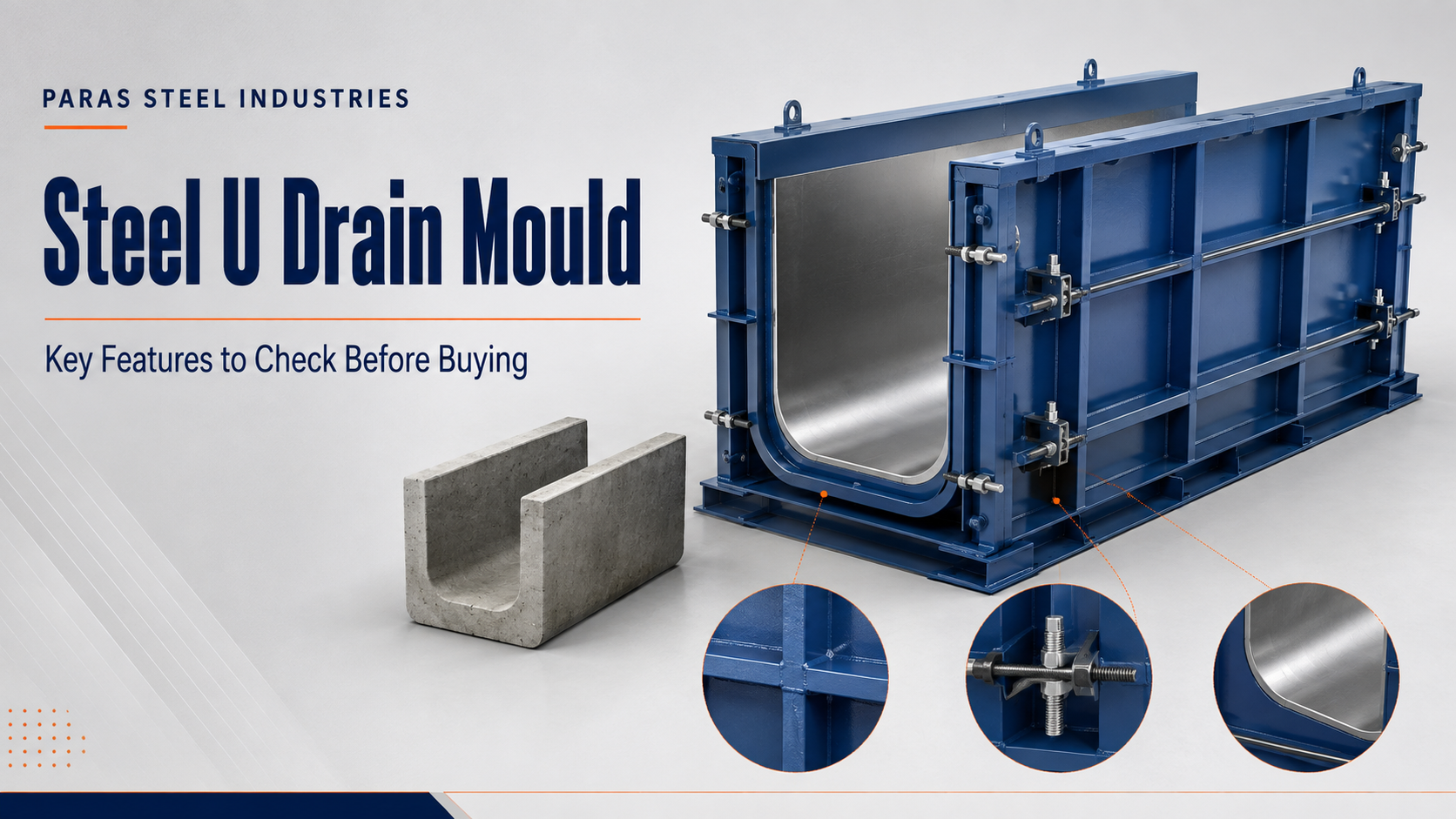
Steel U Drain Mould: Key Features to Check Before Buying
Steel U Drain Mould: Key Features to Check Before Buying Buying a steel U drain mould requires more than comparing product photographs and quotations. The equipment must form the specified concrete drain, fit your available workspace and support a practical production sequence. Before placing an order, review how the mould is constructed, assembled, opened, inspected and maintained. A clear technical specification helps you compare suppliers and identify what is included in the purchase. This guide explains the key features to check when selecting a steel mould for precast U drain production. 1. Compatibility with the Finished Drain Drawing The first requirement is a match between the proposed mould and the concrete component you intend to manufacture. Provide an approved drawing showing: - Internal channel width and depth. - External dimensions. - Finished drain length. - Wall and base thickness. - Channel profile and corner details. - End joints. - Openings or cover supports, where required. Ask the supplier to reference the drawing number and revision in the quotation. A general description such as “large U drain mould” is not enough to define the equipment. Even a nominal size can be misleading if it does not distinguish internal measurements from external dimensions. 2. A Written Material Specification If the equipment is described as an MS U drain mould or mild steel drain mould, request the actual material specification. Ask the manufacturer to identify the materials used for the forming surfaces, supporting members and other relevant components. Where material documentation is part of your purchase requirement, agree on it before ordering. Descriptions such as “premium steel” or “heavy duty” should be supported by technical information. Avoid judging the complete mould by plate thickness alone. Review the proposed construction as a whole and ask the supplier to explain its suitability for the intended operating conditions. 3. Frame Construction and Supporting Members Review the supporting frame and its relationship to the forming panels. Ask the supplier how the equipment is supported during casting and whether the proposed installation requires a particular foundation, platform or supporting arrangement. During inspection, compare the delivered construction with the approved equipment drawing. Record visible damage, missing components or differences that require clarification. The aim is to verify the agreed design rather than selecting equipment simply because it appears heavier in a photograph. 4. Concrete-Contact Surfaces Concrete-contact surfaces deserve close attention because they form the visible profile of the casting. Ask what surface condition will be provided at delivery and how those surfaces should be cleaned and maintained. Include the following in your inspection discussion: - Visible dents or damage. - Surface condition at panel connections. - Residue or contamination. - Areas that are difficult to clean. - Any specified finish requirements. The mould surface is only one factor in the appearance of the finished drain. Concrete properties, release-agent application, compaction and curing also require production control. 5. Panel Alignment and Fastening The assembly arrangement should allow your team to position and secure the mould components according to the operating instructions. Ask to see how the panels are located and fastened. Check that the proposed sequence provides access to the relevant bolts, clamps or other fitted components. Useful questions include: - How is correct assembly verified? - Which components must be checked before every casting? - Are special tools required? - How are replacement fasteners identified? - What should operators do if a component does not align correctly? Clarify the inspection and maintenance procedure for fastening components before production begins. 6. Opening and Demoulding Arrangement A steel U drain mould should have a clearly explained opening sequence. Request an operating demonstration or suitable documentation showing how the form components move and how the finished drain is released. Review the arrangement against your factory conditions. Consider the space required, equipment availability and handling responsibilities. If assisted or powered equipment is included, ask the supplier to identify: - The supplied equipment and controls. - Required power or other utilities. - Installation requirements. - Operating instructions. - Maintenance responsibilities. Do not assume that powered accessories are included unless they appear in the written supply scope. 7. Handling Information and Equipment Weight Obtain the assembled mould weight and the relevant information for moving individual components. Your receiving and production teams need to know how the equipment will be unloaded, positioned and handled during use. Ask for the supplier’s approved handling instructions. Identify any lifting accessories that must be provided separately. Also confirm the overall dimensions and operating space. The area needed to open or dismantle the mould may be greater than its assembled footprint. Reviewing these details before delivery helps the factory prepare the required space and equipment. 8. Support for Required Product Variants If you plan to manufacture several drain sizes, provide a complete variant schedule. Ask whether the proposed mould is dedicated to one product or supports specific changes through adjustment or interchangeable components. For each supported configuration, request confirmation of: - Finished drain dimensions. - Additional components required. - Changeover instructions. - Inspection checks after setup. - Any limitations or exclusions. An adjustable length does not automatically mean that width, depth or concrete thickness can also be changed. 9. Access for Cleaning and Maintenance Consider how your team will clean and inspect the equipment between casting cycles. Ask the supplier to explain access to forming surfaces, joints and moving components. Identify parts that need regular inspection or servicing. Request written guidance covering: - Approved cleaning methods. - Release-agent requirements. - Lubrication points, where applicable. - Inspection of wearing components. - Storage and preservation. - Checks before returning stored equipment to use. A maintenance plan is easier to follow when responsibilities and procedures are defined at handover. 10. Spare Parts and Supply Scope Request an itemised list of everything included with the steel drain mould. Check whether the quotation covers all components required for the agreed configuration. Identify optional parts separately. Ask how replacement components will be specified and ordered. A parts list with clear references can help avoid confusion when requesting support later. Review warranty coverage, exclusions and the procedure for reporting a problem. Keep these terms with the approved drawings and purchase documents. Inspection Checklist Before Dispatch Before approving dispatch, compare the equipment with the agreed purchase requirements. Inspection area What to verify Drawing reference Correct approved revision Dimensions Agreed measurements and acceptance criteria Construction Match with the approved equipment specification Forming surfaces Agreed condition and absence of unresolved damage Assembly Correct fit and complete fastening components Opening arrangement Demonstration or agreed operating checks Parts list All included components accounted for Documentation Operating, maintenance and handling information
If a trial casting is required, agree on its arrangements and acceptance criteria before manufacturing begins. Common Buying Mistakes to Avoid One common mistake is choosing a steel U drain mould based only on its advertised weight or plate thickness. Other mistakes include accepting an incomplete quotation, overlooking operating space or failing to define the finished drain profile. Avoid relying on verbal changes. If the specification changes, update the drawing and ask the supplier to confirm the effect on the equipment, price and delivery schedule. Include production and maintenance staff in the final review so practical requirements are considered alongside purchasing terms. Frequently Asked Questions What should I check first when buying a steel U drain mould? Start by confirming that the proposed equipment matches the approved finished drain drawing. Then review construction, operation, inspection and supply scope. Is a thicker steel plate always better? Plate thickness alone does not establish whether a mould is suitable. Review the complete design, supporting construction and intended operating conditions with the supplier. Can a steel U drain mould manufacture reinforced concrete drains? A suitable mould can accommodate reinforced concrete production when the reinforcement arrangement, concrete cover and component geometry are coordinated with the approved design. Does the mould guarantee a smooth concrete finish? No. Finished surface quality also depends on concrete properties, preparation, release-agent application, placement, compaction and curing. What documents should accompany the mould? Request the agreed drawings, supplied-parts list, inspection records and relevant operating, maintenance and handling instructions. Discuss Your Steel U Drain Mould Requirement Contact Paras Steel Industries with your approved drain drawing, required mould quantity, production details and delivery location. A clear specification provides the basis for discussing a steel U drain mould that suits your precast manufacturing requirements.